
Game review
Idle Wizard
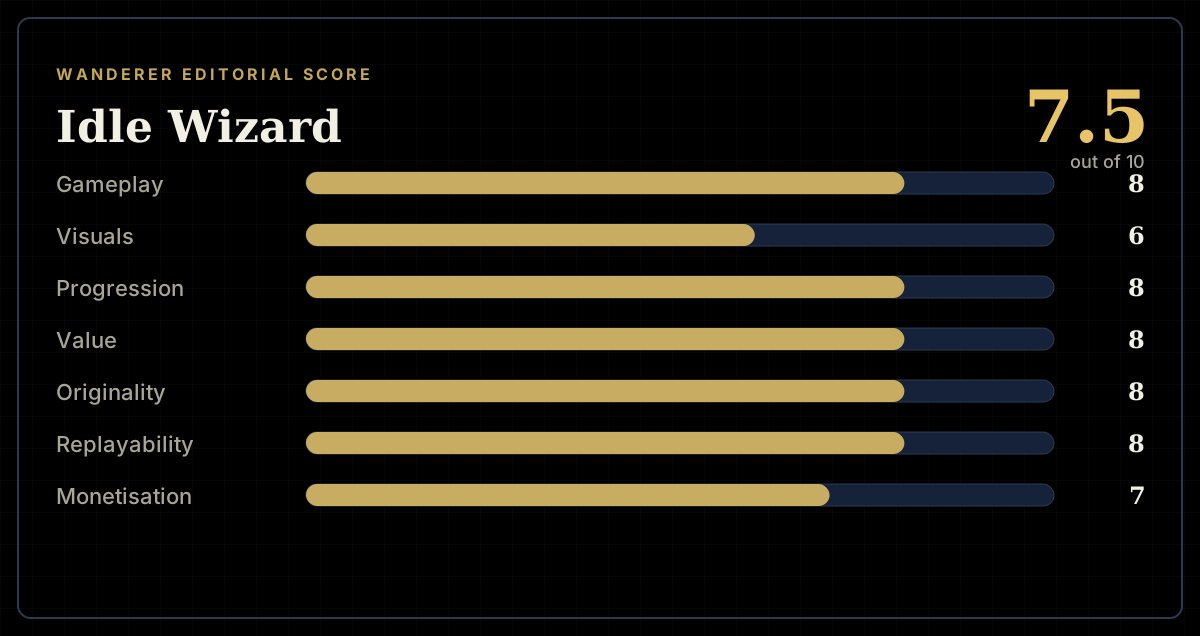
7.5 / 10
- Developer
- TwoWizards
- Publisher
- TwoWizards
- Released
- 24 January 2019
- Platforms
- Windows, macOS, Linux (Steam); browser (Kongregate)
- Genre
- Idle RPG
- Monetisation
- Free to play everywhere it's available, funded by an in-game Relics currency purchasable with real money and four optional Steam DLC packs that hand over specific progress or cosmetics rather than a currency top-up
- Players
- Single-player
The short version
Idle Wizard treats its twelve character classes as a rotation rather than a life sentence: you're expected to swap Apprentice for Druid for Voidmancer as each one's ceiling comes into view, and the six Hybrid classes that unlock later exist specifically to reward having actually learned more than one school. That structure produces real strategic variety, not just a reskinned number-go-up chain, and the spell, pet and item systems layered underneath it give each class enough of its own identity to be worth returning to.
It asks a lot of patience in return. Twelve classes, over a hundred craftable items, Challenges, Trials, Catalysts and Expeditions all stack on top of each other with limited in-game explanation, and the "later isn't automatically stronger" design that makes class-swapping meaningful also makes it genuinely hard to tell, unaided, when you should actually swap.
Biggest strengths
- Swapping classes is a genuine strategic decision because later-unlocked classes aren't automatically stronger than earlier ones
- The six Hybrid classes reward players who've actually learned multiple schools instead of just grinding one to the cap
- Pets, spells and a hundred-plus craftable items give each class enough internal variety to avoid feeling like a reskin
Biggest weaknesses
- A dozen classes plus item, spell and pet systems are introduced with little in-game guidance, pushing new players toward community wikis almost immediately
- Deliberately withholding a simple power ranking between classes makes early swap timing feel like guesswork rather than an informed choice
- The four Steam DLC packs sell direct progress (pre-owned Renown levels, a fully upgraded Gatherer) alongside cosmetics, which is a sharper shortcut than a pure currency top-up
Who it's for: Idle-RPG players who want their prestige layer to change how they play, not just which number ticks up, and who don't mind consulting a wiki to make sense of a dense, sprawling class roster.
Our recommendation: It costs nothing to find out whether the class-swapping loop clicks for you — install it on Steam or open the Kongregate browser build, ride the first class or two to their natural ceiling, and judge the Exile reset from there before deciding whether the DLC packs are worth a purchase.
7.5 / 10
Most idle RPGs let you pick a class once and spend the rest of the game making that one choice bigger. Idle Wizard makes you pick a class roughly a dozen times over, and it wants you to notice that the fifth one isn't automatically better than the second. That's an unusual bet for the genre — prestige systems are supposed to reward commitment, not indecision — and Idle Wizard is at its best when that bet pays off: a class you unlock two hours in can still be the correct answer six hours later, and the game is built specifically so you can't just chase the newest unlock and assume it's an upgrade.
A rotation, not a commitment
Idle Wizard's core loop starts the way every clicker does — tap the orb, buy a source, watch a number climb — but the game's own description is upfront about its actual structure: twelve base classes, starting from Apprentice, with six further Hybrid classes unlocked once you've put in the groundwork. Each class uses a different mechanic to generate its core resource, carries its own spells and item pool, and — critically — the developer explicitly says power "does not follow the simple logic of 'the later it is unlocked, the more powerful it is now.'" A class you meet early might out-earn one you unlock forty hours later, depending on where your run currently sits.
That single design decision is what separates Idle Wizard from a faction-locked incremental like Realm Grinder, where you commit to an alignment and mostly stay there. Here, swapping classes is a recurring decision you're expected to revisit constantly, and the Hybrid classes turn that into a long-term payoff: they exist specifically to reward players who've actually played more than one school well enough to combine them, rather than players who picked a favourite and never looked back. It's a genuinely different shape for a "which build am I" system, and it produces real strategic variety rather than a checklist of colours to tick off.
The friction is that the game gives you almost nothing to judge that decision with. There's no in-game power comparison, no obvious signpost saying "this class has more room left in your current run than that one." Community spreadsheets and wikis exist for exactly this reason, and most players end up leaning on them within the first few sessions — not because the class system is badly designed, but because a system built to defy simple hierarchies needs some way to explain itself, and Idle Wizard mostly doesn't try.
Pets, spells and the hundred-item stockpile
Underneath the class layer sits a genuinely dense set of secondary systems. Pets are treated as a real mechanic rather than a cosmetic add-on — each has a distinct role, and running more than one at a time is frequently the correct call rather than an indulgence. Spells arrive early, a scroll or two into the opening minutes, and range from straightforward profit boosts to meta-effects like compressing offline time or accelerating a pet's own experience gain; the game mixes spells common to every class with ones tied to a single school, which is part of what makes each class feel distinct rather than palette-swapped. Layered over all of that are more than a hundred craftable items, plus secondary goal systems named Challenges, Trials, Catalysts and Expeditions that give the midgame extra structure once the class-and-spell basics have been absorbed.
Judged individually, none of these systems is revolutionary — item sets, secondary challenge tracks and pet loadouts are genre furniture at this point. What's notable is how deliberately they're tuned to interact with the class-swap decision rather than sit beside it: an item set that's excellent on one class can be dead weight on the next, so a class swap isn't just a new resource curve, it's a loadout puzzle you're solving again from a different angle. That's a meaningfully different kind of replay value than most idle games manage, where switching a build usually just means restarting the same optimisation with bigger numbers.
The reset that actually resets your approach
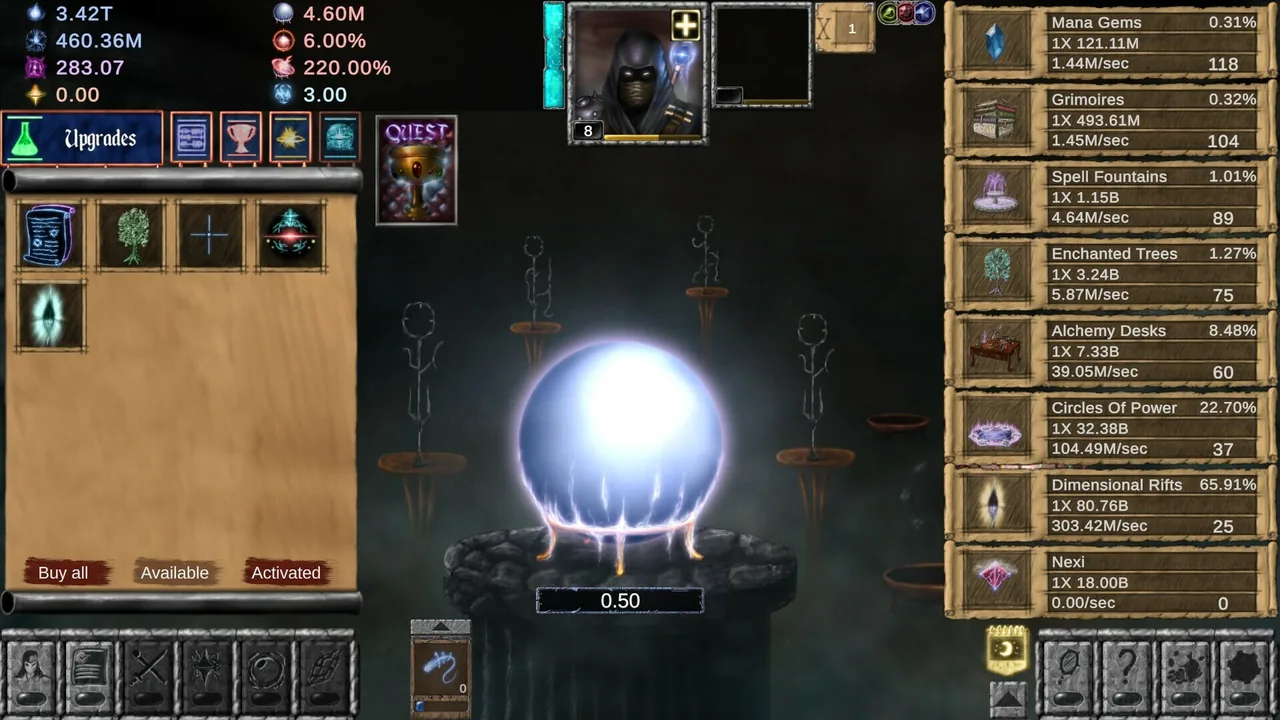
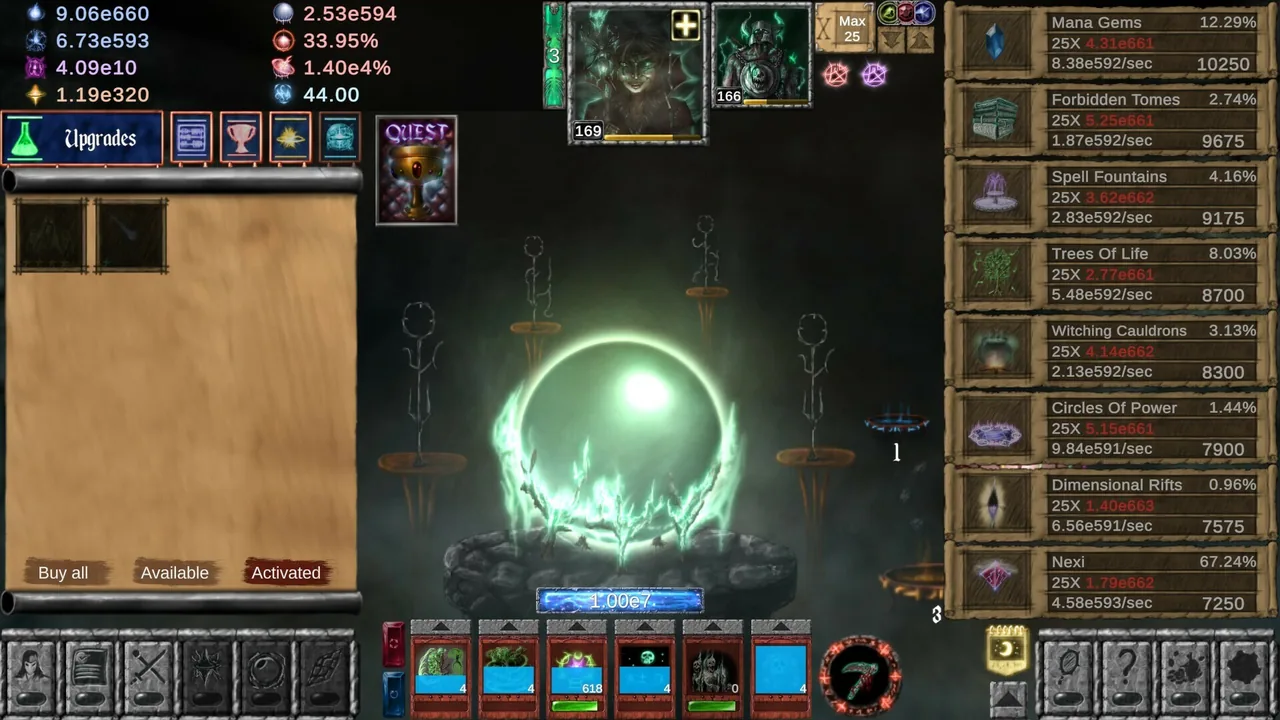
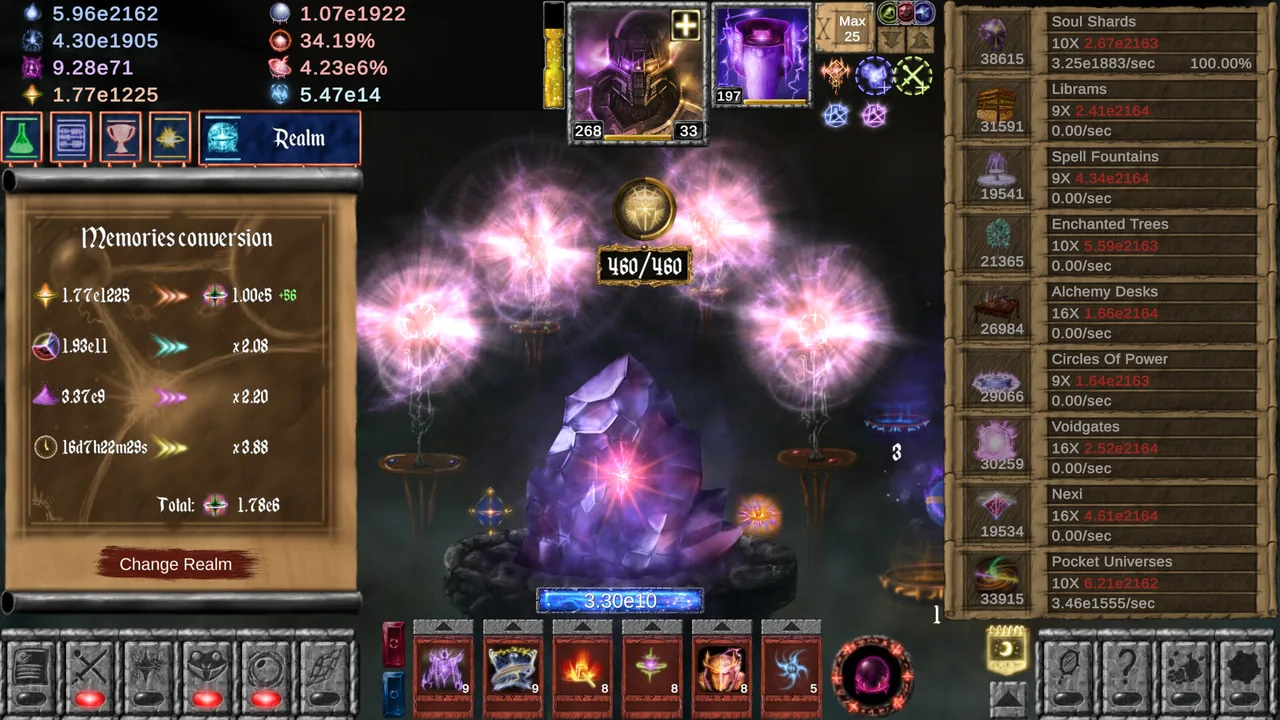
Long-term progression runs through an Exile-style reset that clears a run's accumulated power in exchange for permanent bonuses that carry forward — the standard incremental trade, but one that matters more here because a reset is also the natural point to reconsider which class and spell combination you're carrying into the next cycle. Later systems like Expeditions extend the loop further for players who've been through several resets already. None of this is presented with much ceremony; Idle Wizard's interface is number-dense and utilitarian rather than attractive, and players coming from a more polished production shouldn't expect much beyond readable panels and clear stat tables. For a game meant to sit open for hundreds of hours, that's a defensible trade, but it's still a trade, and the visual presentation won't be anyone's reason for picking this over a rival idle RPG.
What actually costs money
Idle Wizard is free wherever it's available, and its Steam page lists in-app purchases funding an in-game Relics currency alongside four separate DLC packs — Renown, Gatherer, Expedition and Bat Hunter — each priced between roughly NZ$14.75 and NZ$15.75. These aren't simple currency top-ups. The Gatherer Pack, for instance, hands over a fully upgraded Dust Gatherer outright, removing a clicking chore and adding a permanent resource bonus; the Renown Pack instantly grants Renown levels 1 through 3 and their bonuses, plus cosmetic frames and an orb skin. Anyone who's already earned those levels the slow way gets a pile of Relics instead, so the packs aren't purely pay-to-skip for veteran players, but for a newcomer they are a direct purchase of account power and time saved, not just a coat of paint.
That's worth being precise about, because it's a sharper form of monetisation than a pure currency sale. There's no other player on the other end of an Idle Wizard session to out-pace, so none of this is competitive pay-to-win in the traditional sense, and the core game — including every class and the Exile reset — is fully reachable without spending a cent. But a purchase here buys a specific, named shortcut rather than a vague boost, and that's a more direct trade than games which only sell a generic premium currency. Whether it's worth it comes down to how much a specific grind is worth saving, which is a fair question to ask of any idle game's DLC shelf, but Idle Wizard's packs make that question easier to answer than most because they tell you exactly what you're buying.
Where to actually play it
The primary release is on Steam for Windows, macOS and Linux, and the same game is playable for free directly in a browser through Kongregate, which is worth knowing if you'd rather try before installing anything. What doesn't appear to exist is an official mobile release under the developer's own name — several apps also titled "Idle Wizard" turn up on the App Store, but they belong to unrelated developers and aren't this game. Players hoping to carry Idle Wizard around on a phone are better served by the browser build in a mobile browser tab than by searching an app store for a port that isn't there.
Verdict
Idle Wizard's core idea holds up under scrutiny: making class choice a recurring decision rather than a one-time commitment, and refusing to let later unlocks automatically outclass earlier ones, genuinely changes how the game is played across a long session rather than just changing which multiplier is on screen. The spell, pet and item layers give that decision real texture instead of leaving it as an empty label, and the Hybrid classes reward the players who actually learn the system instead of picking a favourite and coasting. What holds it back from the genre's top tier is presentation and onboarding — a dense, sprawling class roster with no in-game way to compare them pushes players toward outside guides almost immediately, and the interface never gets past purely functional. The DLC packs are honest about what they sell, even if what they sell is more pointed than a typical premium-currency purchase. For an idle RPG built entirely around the question of when to change who you are, that's a fair trade, and one worth exploring for free before deciding whether any of the packs are worth the price tag.
Players who'd rather have their class choice be permanent, with the character growth happening on a single continuous road instead of through repeated resets, might also enjoy Wanderer.
Pros and cons
Pros
- Swapping classes is a genuine strategic decision because later-unlocked classes aren't automatically stronger than earlier ones
- The six Hybrid classes reward players who've actually learned multiple schools instead of just grinding one to the cap
- Pets, spells and a hundred-plus craftable items give each class enough internal variety to avoid feeling like a reskin
- Fully playable for free with no paywall blocking the core loop, on both Steam and the Kongregate browser build
- The Exile reset and later systems (Challenges, Trials, Catalysts, Expeditions) give the midgame more shape than a single flat prestige button
Cons
- A dozen classes plus item, spell and pet systems are introduced with little in-game guidance, pushing new players toward community wikis almost immediately
- Deliberately withholding a simple power ranking between classes makes early swap timing feel like guesswork rather than an informed choice
- The four Steam DLC packs sell direct progress (pre-owned Renown levels, a fully upgraded Gatherer) alongside cosmetics, which is a sharper shortcut than a pure currency top-up
- Interface and presentation are functional rather than attractive, leaning entirely on number-heavy panels
- No official mobile release exists under the developer's own name, so players expecting a phone version need the browser build instead
Screenshots
-
Idle WizardImage: TwoWizards via Steam -
Idle WizardImage: TwoWizards via Steam -
Idle WizardImage: TwoWizards via Steam -
How the review scores each part of the gameWanderer Editorial -
The short versionWanderer Editorial