Game review
Realm Grinder
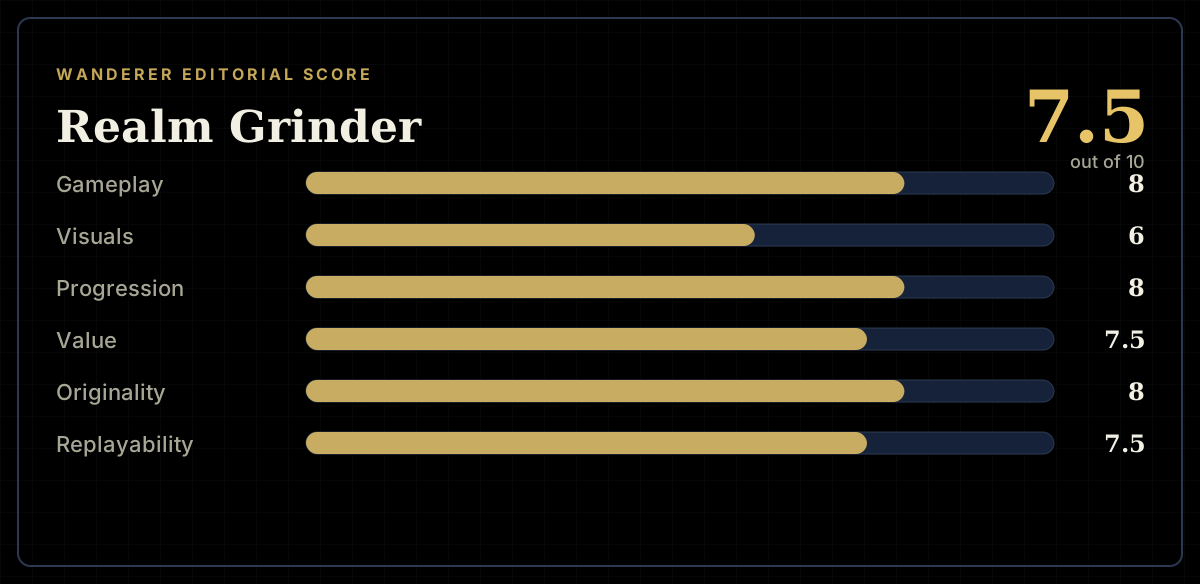
7.5 / 10
- Developer
- Divine Games
- Publisher
- Kongregate
- Released
- 19 May 2015
- Platforms
- Browser (Kongregate), Windows, macOS, Android, iOS
- Genre
- Incremental RPG
- Monetisation
- Free to play on every platform, funded by optional Ruby purchases; the mobile builds also carry advertising that the Steam and browser versions do not
- Players
- Single-player
The short version
Realm Grinder earned its decade-long following honestly: choosing Good, Evil or Neutral genuinely rewires how the game is played, from spell-slinging click cycles to buildings that quietly stack themselves, and the Mercenary faction lets veterans build something closer to a custom class than a reskinned multiplier chain.
What keeps it from the top tier is how much of that promise you only get to enjoy after leaning on a wiki. The alignment fork is real, but the optimal path through it is thoroughly mapped by the community, and the Rubies that unlock permanent power are sold for cash as readily as they're dug out of the ground.
Biggest strengths
- Alignment and faction choice genuinely changes how you play, not just which multiplier you're staring at
- The Mercenary faction lets veteran players hand-pick upgrades and a spell from every pool instead of following one faction's fixed script
- A decade of continuous updates has built an unusually deep late game around excavations, artifacts and research
Biggest weaknesses
- The alignment/faction/prestige stack is dense enough that new players reach for third-party wikis and spreadsheets almost immediately
- Rubies are sold for real money and also unlock permanent account-wide power, so paying does buy a genuine, if not mandatory, shortcut
- Mobile builds carry advertising that the desktop and browser versions don't, so the experience isn't identical across platforms
Who it's for: Idle veterans who want a genre classic with real decision-making in it, and anyone curious where the "faction determines your build" idea in modern incrementals actually started.
Our recommendation: Play it free on Kongregate or Steam before touching a wallet. The core loop and both starting alignments are fully playable without spending a cent, and you will know inside a few reincarnations whether the long game — research, excavations, Mercenary theorycrafting — is worth your time.
7.5 / 10
Most incremental games ask you to pick a theme. Realm Grinder asks you to pick a side, and then it actually makes you live with the consequences. Go Good and you're clicking treasure piles and timing spell rotations like a much more active game; go Evil and the whole point is to leave the window alone while stacked buildings do the work; go Neutral once you've earned the right to, and you get a hybrid that borrows tricks from both. That fork — real enough to change your moment-to-moment habits, not just the colour of the UI — is the reason a browser clicker from 2015 is still being actively played, patched and argued about a decade later.
Choosing a side
Everything starts with an Alignment. Buying a Proof locks you into Good, Evil or Neutral, which then opens a shortlist of Factions within that alignment — fairies, elves and angels on the Good side; demons, undead and their kin on the Evil side; a further roster of Neutral factions once you've crossed the one-billion-gem threshold that unlocks the game's Archaeology systems. Committing to a Faction via its Trade Treaty reshapes the upgrade tree you're staring at for the next several hours: Good factions lean on spellcasting and manual "treasure" clicks for burst production, Evil factions lean on flat, steady building output that keeps climbing whether or not you're watching, and Neutral factions split the difference while often out-pacing both if you've built into them correctly.
It's a genuinely different design decision from the "prestige currency buys a bigger multiplier" template most of the genre runs on, because it changes your input pattern, not just your output curve. A Good build rewards attention in a way an Evil build actively punishes — sitting there clicking treasures does nothing for an Evil kingdom, and ignoring a Good one for a day leaves real production on the table. Later, once you've reincarnated a few times, the Mercenary faction unlocks and throws that binary out the window: you hand-pick twelve upgrades and one spell from across every Good, Evil and Neutral pool and assemble something closer to a bespoke class than a stock faction. It's the strongest single idea in the game, and it only exists because the earlier factions were different enough from each other to be worth stitching together in the first place.
A mana layer that wants you back
Sitting underneath the faction system is a spell economy that gives Good-aligned play its identity. Twenty-one spells exist in total — a dozen faction-specific, a handful shared across every alignment, a few universal ones open to everyone — and mana regenerates passively at a base rate before upgrades push it higher. Casting spells by hand is how an active build actually earns its keep, and the game deliberately makes that inconvenient at first: autocasting a single spell only unlocks after you've produced 60,000 lifetime mana, and even then spells simply don't fire while you're offline unless you've bought further upgrades to let the autocast tick over at a drastically reduced rate.
That's a smart piece of friction. It means an idle-styled Evil kingdom can genuinely be left alone, while a spellcasting Good kingdom asks for real attention in exchange for real output, and the game never pretends those two experiences are the same thing wearing different sprites. The cost is that manual spell-timing is one more system a newcomer has to learn on top of buildings, upgrades, factions and alignments, all stacked in the first few hours.
Abdication, Reincarnation, and the long tail
Realm Grinder's endgame is built from layered resets rather than one big prestige button. Abdication lets you swap factions and alignment without losing everything, which is how Mercenary access and alignment experimentation happen at all. Reincarnation is the deeper reset, unlocked once you've crossed one octillion gems: gold, gems and excavation progress all clear out, but trophies, unlocked upgrades, Heritages, Rubies and Artifacts survive the trip, and each Reincarnation hands you a permanent Reincarnation Power upgrade that scales with how many times you've done it. Archaeology opens its own sub-loop at the one-billion-gem mark, spending gold on Excavations that dig up Faction Coins, Rubies and rare Artifacts at exponentially rising cost, some of which are flatly required to unlock the Neutral and Prestige factions. Research, the genuine late-game system, doesn't open until Reincarnation 16.
Stacked together, that's four or five progression systems layered on top of each other, each gating the next behind a large, specific threshold. Judged as design, it's coherent: nothing unlocks before you've built the context to understand it, and the permanent currencies (Rubies, Artifacts, Heritage) give every reset real weight instead of the hollow "number resets to zero, multiplier goes up" feeling cheaper prestige systems settle for. Judged as an onboarding experience, it's a lot — the existence of detailed third-party autocast guides and faction-build spreadsheets isn't a coincidence, it's the community filling a gap the base game leaves open. You can absolutely play Realm Grinder without ever opening a wiki. You will just be finding the good builds several reincarnations later than the players who did.
Steam, browser, and mobile — three storefronts, one game
The bones are the same everywhere: free to download, free to reach the credits-adjacent late game, funded by an optional currency called Rubies that also drops naturally from Excavations. Where the platforms diverge is presentation and pressure. The Steam build, which arrived two years after the original Kongregate release, adds fourteen Steam Achievements, Trading Cards and Family Sharing — none of which the browser version ever had — and its store page carries no mention of advertising. The mobile builds on iOS and Android are the version that actually monetises through more than one channel: alongside the same Ruby purchases, the App Store listing confirms the app "contains advertising," even though the interface itself stays free of banner clutter during normal play. Practically, that means the fairest version of the game to start on is whichever one you'd play anyway — browser for zero commitment, Steam for a cleaner ad-free session with achievements attached, mobile if you want it in your pocket and don't mind the odd ad prompt.
What Rubies actually buy
This is the part worth being precise about. Rubies are Realm Grinder's premium currency, and they are not exclusive to real money — Excavations turn them up alongside Artifacts and Faction Coins as a normal part of late-game play, and they're one of the few resources that survives a Reincarnation reset, which is why the game treats them as a long-term investment rather than pocket change. The App Store also sells them directly, in packs running from a $4.99 Small Pack up to a $49.99 Huge Pack, plus a separate set of themed "Gift" bundles between $9.99 and $19.99 that mix Rubies with other boosts. The Steam listing carries its own in-game purchases through Steam's wallet system rather than a storefront pop-up, funding the same currency.
So: yes, this is pay-for-progress, in the specific sense that money buys the same permanent resource grinding buys, and that resource unlocks real account-wide power. It is not pay-to-win in any competitive sense — there's no other player on the other end of a Realm Grinder session to beat — and nothing about the free path is artificially slowed to sell the paid one; Excavations work exactly the same whether or not you've ever opened your wallet. What a purchase actually buys is time saved on a grind that was always going to end at the same place. Whether that's a fair trade depends entirely on how much you value your own hours, which is the honest answer for most of this genre and not a dodge specific to this game.
Presentation and comfort
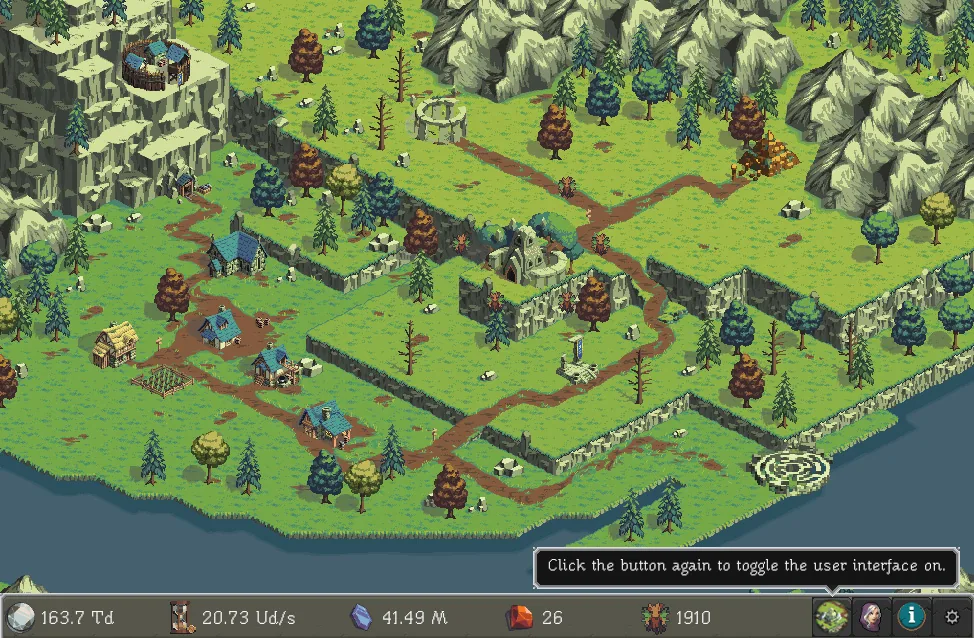
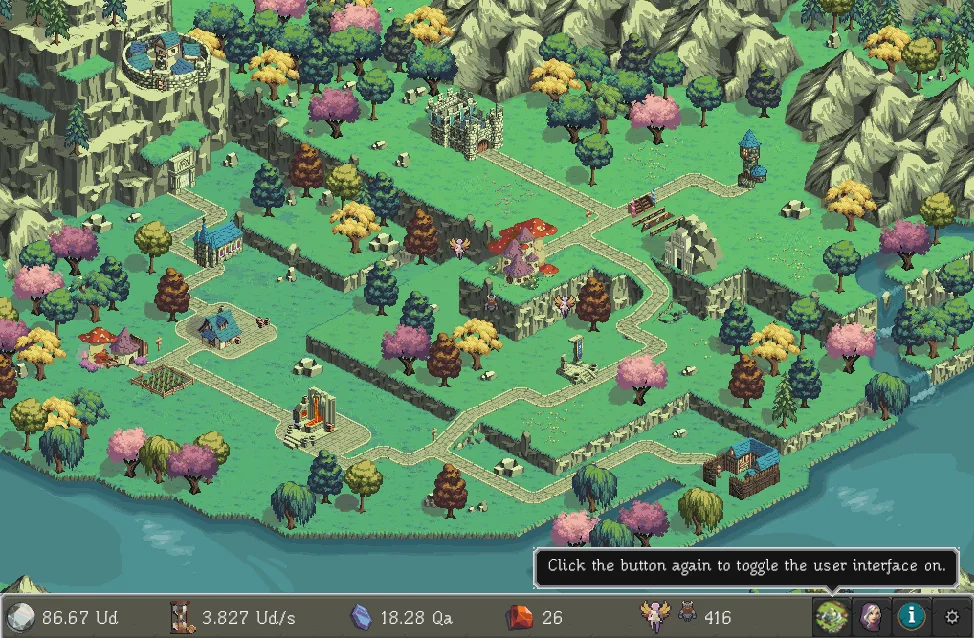
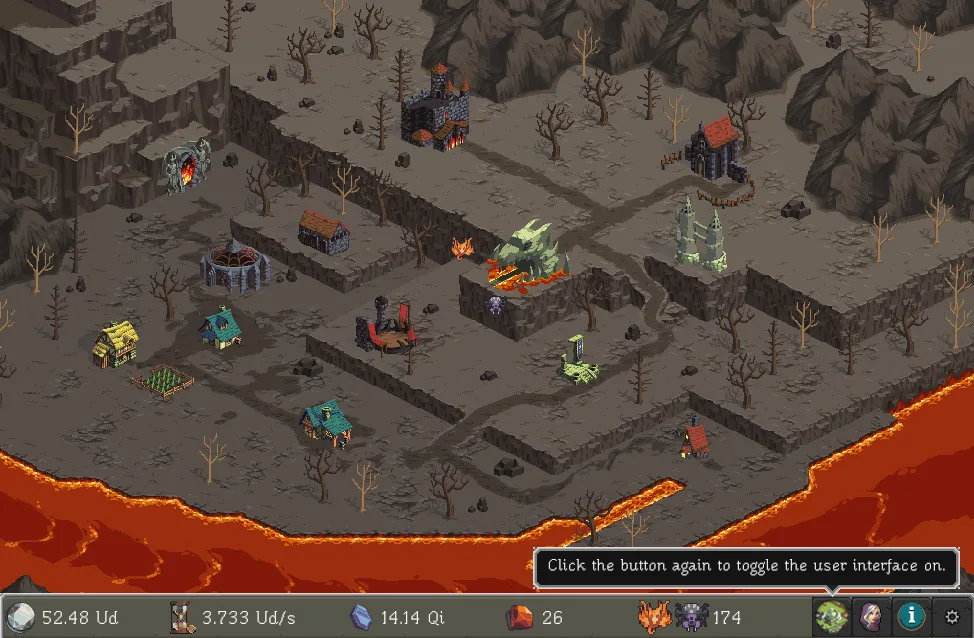
Realm Grinder doesn't try to be a looker, and a decade-old browser-game skeleton shows in the menu-heavy screens and the modest Pixel Graphics tag Steam files it under. What it does have is legibility: numbers, buttons and upgrade trees that stay readable even once the exponents get absurd, which matters far more in this genre than a fresh coat of paint would. System requirements are trivial by design — a Core i5, a gigabyte of RAM, a ten-year-old integrated GPU will run it without complaint — and that's exactly correct for a game meant to sit open in a background tab for months.
Verdict
Realm Grinder's reputation rests on one real idea, executed with genuine follow-through: the faction you choose changes the game you're playing, not just the number you're staring at. Ten years of updates have built a research-and-excavation endgame with actual weight to it, the Mercenary faction turns that early choice into full build customisation for players who stick around, and every bit of it is reachable without spending a cent on any platform. The reasons it doesn't sit higher are just as real: the systems stack fast enough that most players will end up leaning on a guide, the community-mapped optimal builds quietly narrow the choice the alignment system advertises, and the Rubies funding all of it are for sale in packs up to fifty dollars, buying the same permanent currency the grind hands out for free. None of that makes it predatory. It makes it an old-school, well-built idle RPG that expects patience from you either way — with your money or without it.
Players drawn to a world that keeps moving while they're away, without needing to pick a side first, might also enjoy Wanderer — a single continuous road rather than a fork between factions.
Pros and cons
Pros
- Alignment and faction choice genuinely changes how you play, not just which multiplier you're staring at
- The Mercenary faction lets veteran players hand-pick upgrades and a spell from every pool instead of following one faction's fixed script
- A decade of continuous updates has built an unusually deep late game around excavations, artifacts and research
- Fully playable for free on every platform, with no premium edition gatekeeping the core game
- Runs comfortably in a browser tab or on years-old hardware, and the Steam build adds achievements and trading cards the browser version never had
Cons
- The alignment/faction/prestige stack is dense enough that new players reach for third-party wikis and spreadsheets almost immediately
- Rubies are sold for real money and also unlock permanent account-wide power, so paying does buy a genuine, if not mandatory, shortcut
- Mobile builds carry advertising that the desktop and browser versions don't, so the experience isn't identical across platforms
- Visual presentation hasn't moved much past its 2015 browser-game roots
- Optimal faction and Mercenary builds are extensively documented by the community, which narrows the build diversity the alignment system promises once you're following a guide
Screenshots
-
Realm GrinderImage: Kongregate via Steam -
Realm GrinderImage: Kongregate via Steam -
Realm GrinderImage: Kongregate via Steam -
How the review scores each part of the gameWanderer Editorial -
The short versionWanderer Editorial