
Game review
Idle Champions of the Forgotten Realms
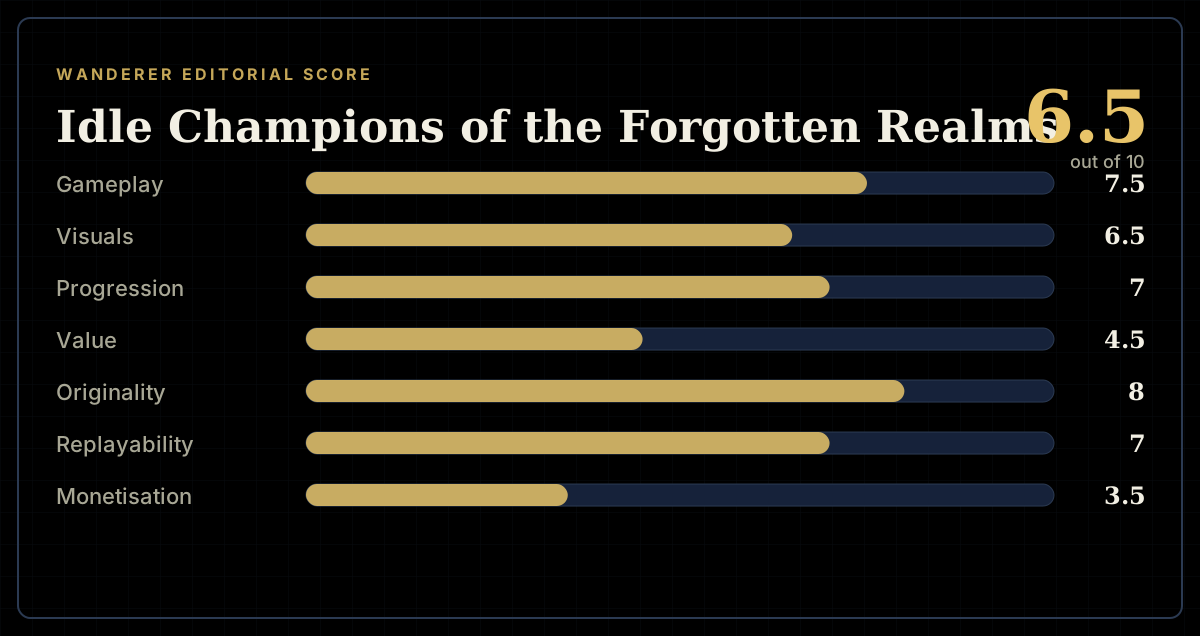
6.5 / 10
- Developer
- Codename Entertainment
- Publisher
- Codename Entertainment
- Released
- 25 March 2020
- Platforms
- Windows, macOS, iOS, Android, PlayStation, Xbox, Nintendo Switch
- Genre
- Idle Strategy RPG
- Monetisation
- Free to play with a large in-game store — champion packs, familiar packs, founder's bundles, premium currency and time-limited events
- Players
- Single-player
The short version
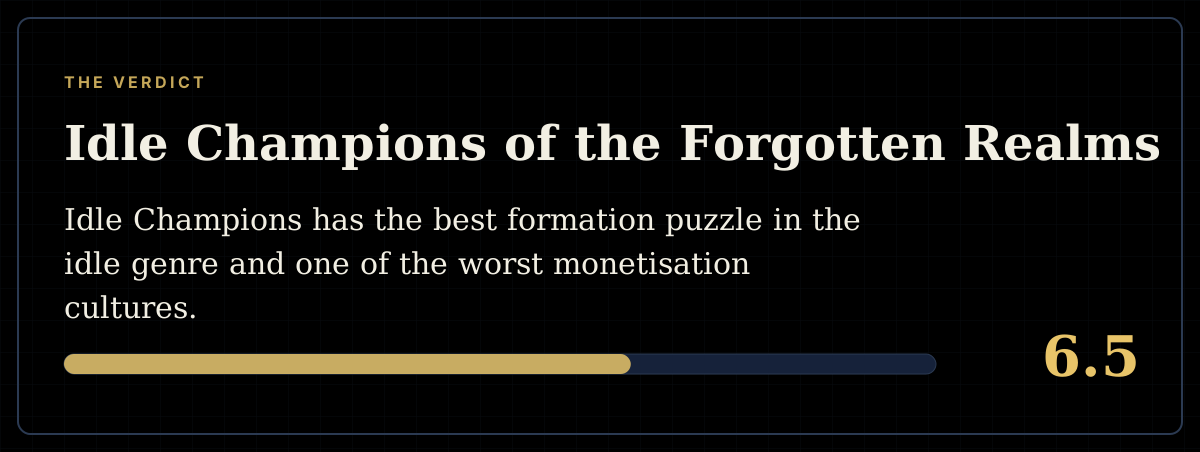
Idle Champions has the best formation puzzle in the idle genre and one of the worst monetisation cultures. Lining up champions so their auras chain down the party isn't decoration on top of the idle loop, it is the loop, and it holds up over hundreds of hours in a way most number-go-up games can't match.
Every one of those champions, though, is a separate product, and the store never really stops selling them to you. This is a genuinely clever D&D game wearing a free-to-play shell built to extract money from the people who love it most.
Biggest strengths
- Formation positioning genuinely matters — auras, taunts and buffs chain down the line in ways that reward redesigning your party rather than just upgrading it
- Over 140 champions drawn from D&D novels, actual-plays, video games and tabletop modules give the roster real personality instead of palette-swapped stat blocks
- Idle income and chest drops keep ticking over usefully between sessions without demanding constant check-ins
Biggest weaknesses
- Nearly every new champion arrives as its own paid pack before it becomes earnable for free, and the release cadence never slows down long enough to feel finished
- Familiar packs, founder's bundles and premium currency sit on top of the champion packs, so a completionist's realistic total spend runs into the thousands of dollars over the game's lifetime
- Time-limited events pressure immediate purchases with FOMO rather than letting players save toward what they want
Who it's for: D&D fans who want their idle game to feel like a party-building puzzle rather than a spreadsheet, and who can either ignore a permanent store or budget for it deliberately.
Our recommendation: Play it free and stay free for as long as it interests you — the core formation puzzle and a rotating cast of earnable champions are enough for a real game. Only start spending once you know exactly which champions you're paying for and why, because there is no natural stopping point built into the store.
6.5 / 10
Most idle games ask you to pick numbers that go up. Idle Champions asks you to solve a lineup. Every champion you own has an aura that radiates a fixed distance up and down a single-file formation — a healer three tiles back, a taunting frontliner, a rogue who only buffs the champion directly behind her — and the actual skill in the game is arranging up to a dozen-plus bodies so those auras overlap in the right order. That's a real tactical decision sitting underneath an idle economy, and it's rarer in this genre than it should be.
It's also, unmistakably, a Dungeons & Dragons game built by a studio that has held the licence for close to a decade and clearly knows the source material. And it is, just as unmistakably, one of the more aggressively monetised free-to-play games a mainstream RPG audience will run into, with a store that never stops introducing new things to buy.
The formation is the game
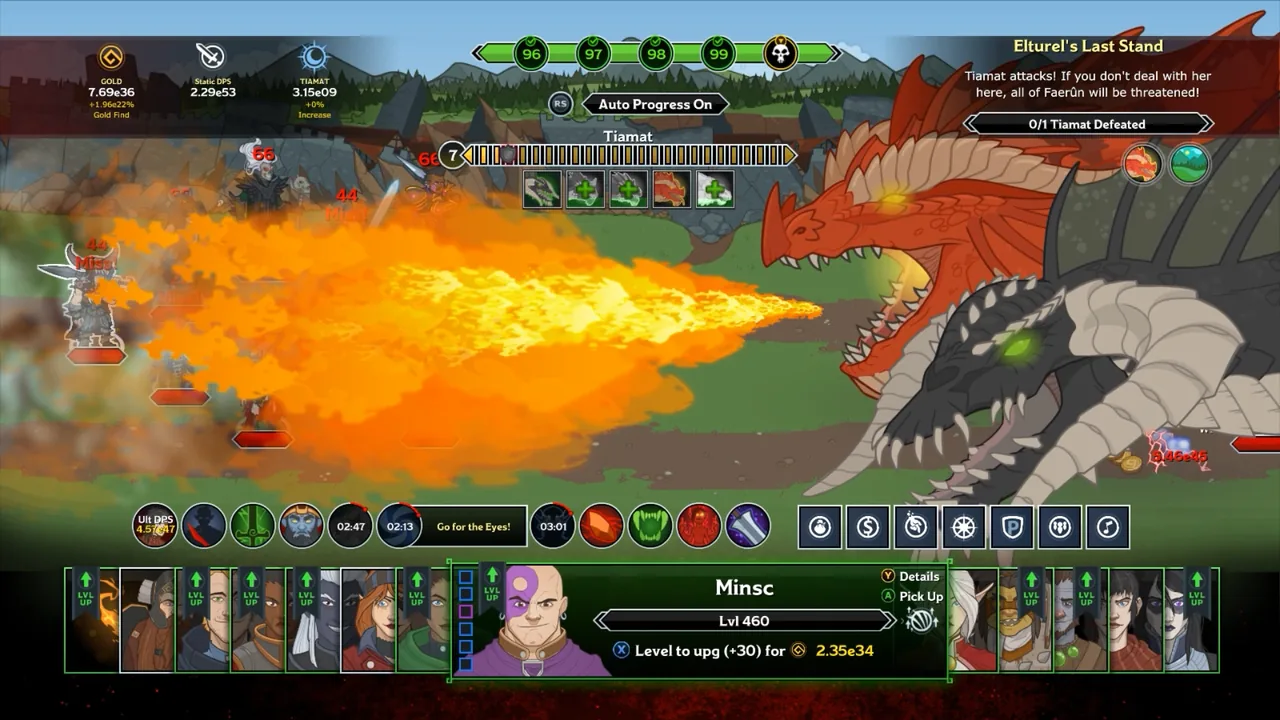
Codename Entertainment's central idea is simple to state and hard to master: champions stand in a line, and most of what they do is passive, aura-based support for whoever is standing near them. Bruenor Battlehammer buffs the melee champions behind him. Minsc taunts enemy attention away from squishier allies. Support casters extend healing or damage multipliers to a specific radius. None of this is about reflexes — there's no dodging, no timing window, nothing you can flub in the moment — but reshuffling twelve-plus champions to chain their auras correctly, and reshuffling them again every time a new champion or a harder map arrives, is a genuine optimisation puzzle. Fan-run formation calculators and spreadsheets exist for a reason: solving for the best possible lineup against a specific encounter is the kind of problem idle-game players enjoy chewing on between sessions.
Combat itself resolves passively against fixed monster lines, generating gold and loot chests whether or not the game is open, in the genre-standard idle rhythm. What elevates it above a pure number-go-up loop is that formation choices directly change the shape of the idle curve — the right positioning can turn a stalling run into one that clears a stage cleanly, and the wrong one quietly wastes hours of otherwise-productive idle time. That's the spine the brief for this genre keeps looking for: positioning as a real lever, not cosmetic flavour on a stat-comparison game.
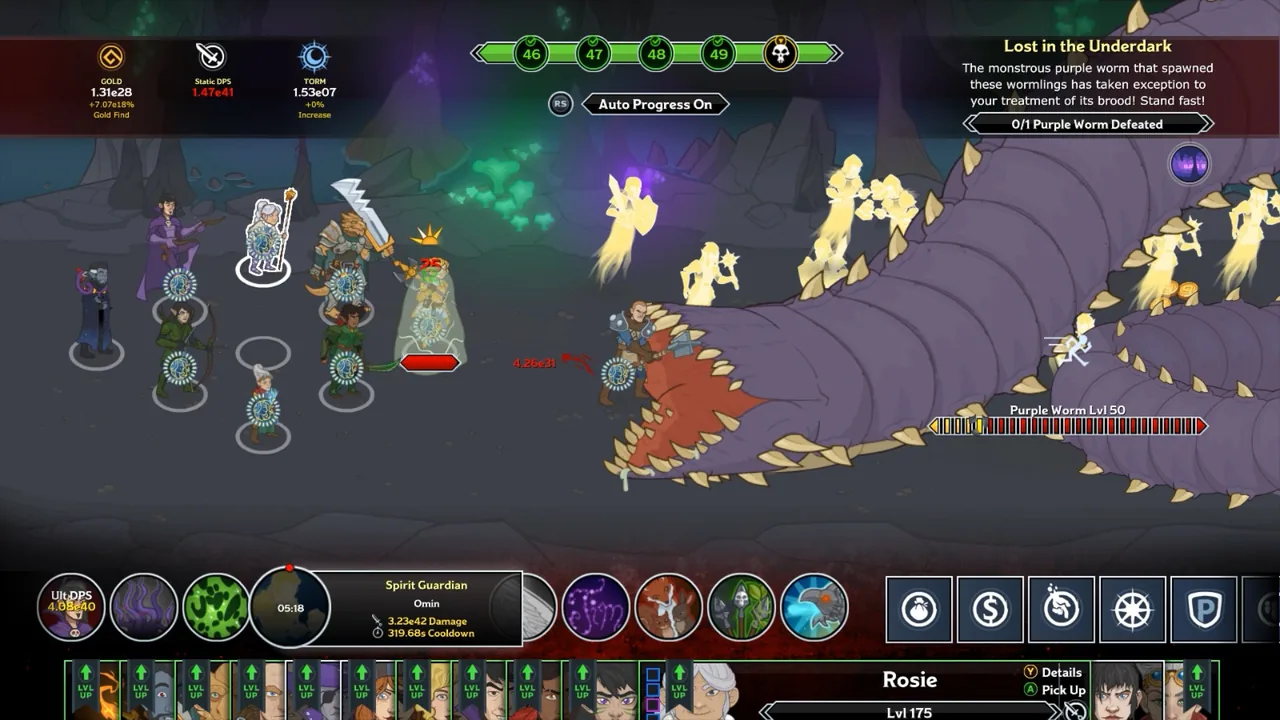
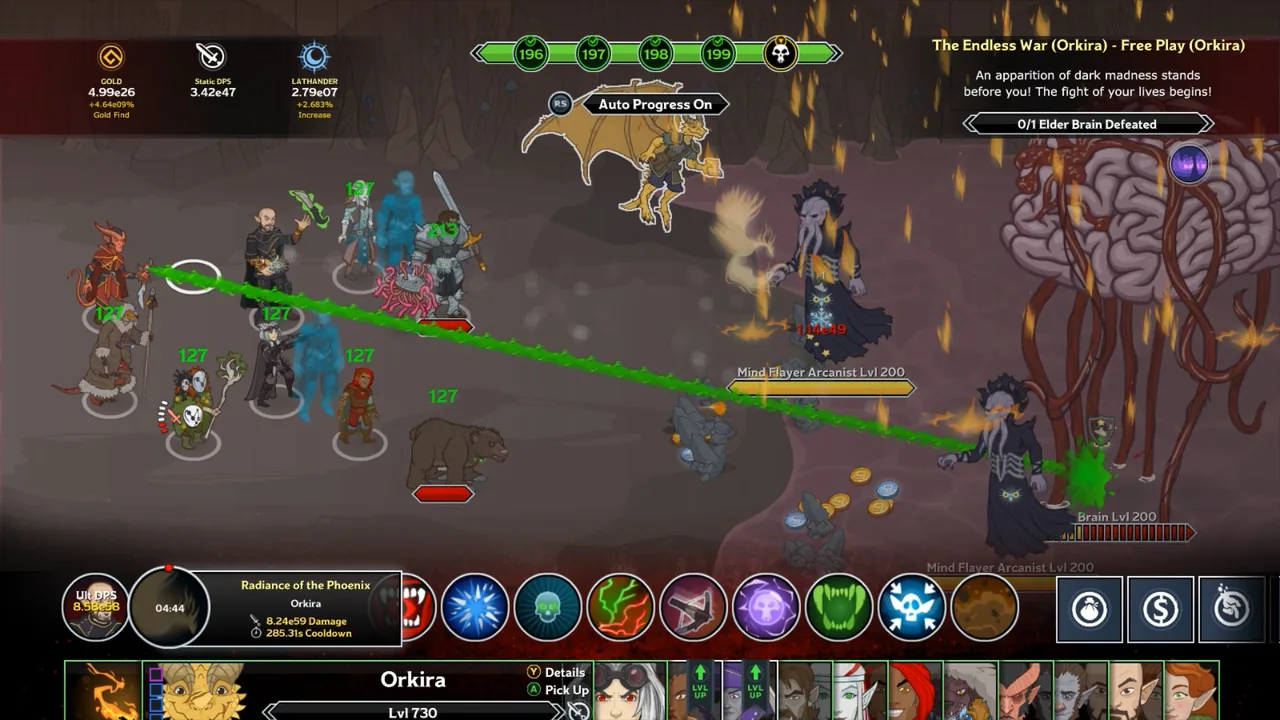
Where it gets harder to sustain enthusiasm is variety in what you're actually fighting. Maps are built from D&D modules and storylines — Icewind Dale, the Sword Coast, crossover events tied to published campaigns and shows — and the settings are recognisable to anyone who knows the setting. But mechanically, most encounters are the same wall of health bars with a different skin, and the game leans on champion variety to disguise that the underlying fights don't change much for hundreds of hours at a stretch.
Progression and the chest economy
Champions level up, gain equipment through chest drops, and eventually unlock alternate variant forms that change their abilities outright — a familiar RPG gearing loop layered on top of the idle income. Chests are the connective tissue: clearing content drops them, opening them yields equipment fragments and currency, and better gear is what lets a champion's aura reach further or hit harder, which feeds back into the formation puzzle. It's a loop that works, and the drip-feed of new champions and variant forms genuinely does keep the mid-game interesting in a way a lot of single-track incrementals can't manage.
The friction shows up in how many separate systems are stacked on top of each other to get there. Gold, premium currency, event tickets, chest keys, familiar treats — Idle Champions doesn't want for currencies, and its interface reflects that: a dense wall of icons and store tabs where working out what's actually worth your attention takes real effort, especially for anyone arriving without prior idle-game experience. It's not an unusable interface, but it never gets out of its own way either.
Monetisation: the part that decides the score
This is where the review has to spend most of its words, because it's what most separates Idle Champions from its idle-RPG peers.
The base game is free and stays playable free — there is no paywall on entering the game, and a real slice of the champion roster and content is earnable through login rewards, free events and in-game chests without spending a cent. That much is genuinely to its credit, and it's worth saying plainly: nobody is locked out of playing.
What happens after that is a store that essentially never closes. Checking Steam's own DLC listing for the game on 30 July 2026 turns up ten current entries: single-champion "Choose Your Champion" starter packs at roughly NZ$17.49 each (with 3-pack and 6-pack bundles at NZ$35.99 and NZ$71.49, working out to roughly NZ$12 per champion at bulk pricing), familiar packs at NZ$8.99–9.59, and a "Founder's Pack VIII" at NZ$43.59 — the roman numeral alone telling you how many of these bundles have already come and gone. That's a snapshot of one week's storefront in a game that has been running this model since 2020 on Steam and years earlier on browser and mobile. New champions, familiars and bundles have released on a near-continuous cadence for that entire span, and the official store description advertises "over 140 Champions" as a selling point — each one, in practice, either a grind target or a purchase.
Do the arithmetic on just the champion-pack pricing and a genuine completionist — someone who wants every champion, not just a competitive roster — is looking at a bill that runs into the thousands of dollars once familiars, founder's bundles, gear-unlocking currency and premium potions are added on top of the base champion packs. None of that is disguised as something else: there's no loot box pretending to be a mystery box, and the store tells you exactly what a pack contains before you pay for it. But the sheer surface area of things to buy, combined with recurring time-limited events that make a champion unavailable again once its release window closes, creates real and repeated pressure to spend now rather than wait and earn later. That's a different problem from deception — it's a volume and urgency problem, and it's the single biggest asterisk on an otherwise well-built game.
None of this makes Idle Champions pay-to-win in a competitive sense — there's no PvP and nobody to lose to — but it does mean the difference between a free player's roster and a paying player's roster compounds every single week the game stays live. For a completionist mindset, that gap never closes. For a player who treats it as a free game with an optional shop, it's easy enough to ignore entirely, and the base loop stands on its own without ever opening the store.
Presentation and platforms
The champion art is the visual highlight — recognisable character portraits and distinct combat animations for a roster this size is a real production achievement, and it's clearly where the studio's effort goes. Environments and monster variety don't get the same attention; most maps recycle a handful of visual templates dressed in different D&D-region palettes. It runs comfortably on modest PC hardware and is also available on iOS, Android, PlayStation, Xbox and Nintendo Switch, which is broader platform coverage than most idle games manage — useful if the appeal is picking it up on whichever screen is in front of you.
It's strictly single-player. There's no co-op, no PvP, and no shared economy — the closest thing to a social layer is comparing formations and progress with other players outside the game, on forums and community spreadsheets, rather than anything built in.
Verdict
Idle Champions of the Forgotten Realms deserves real credit for a formation-combat idea that most of the idle genre has never bothered to attempt: it makes where you put a champion matter as much as which champion you own, and that puzzle stays engaging far longer than a typical idle upgrade tree. The D&D licence is handled with evident care rather than treated as set dressing, and the free game underneath the store is a complete, playable thing on its own.
It doesn't score higher because the store built around that good idea is relentless, and it never lets up. A roster of 140-plus champions, each sold individually, with familiars, founder's bundles and premium currency stacked on top and a fresh time-limited pack arriving on a near-weekly cadence, adds up to a completionist's bill that few free-to-play games in any genre would ask a player to pay. Steam's own review base rates it Mostly Positive at 77% across 15,000-plus reviews, which tracks with a community that mostly enjoys the game it's built on top of while being consistently and loudly frustrated with what sits on top of it.
Play it free, enjoy the formation puzzle for what it is, and treat the store as optional rather than a target — because the game never signals a point at which spending is done.
Players who'd rather their progression stay on one continuous road, with no separate purchase required for each new piece of content, may find that a more comfortable fit in Wanderer.
Pricing and monetisation checked 30 July 2026.
Pros and cons
Pros
- Formation positioning genuinely matters — auras, taunts and buffs chain down the line in ways that reward redesigning your party rather than just upgrading it
- Over 140 champions drawn from D&D novels, actual-plays, video games and tabletop modules give the roster real personality instead of palette-swapped stat blocks
- Idle income and chest drops keep ticking over usefully between sessions without demanding constant check-ins
- A meaningful slice of champions and content is earnable through free events, chests and login rewards rather than locked entirely behind purchases
- The Dungeons & Dragons licence is used with care — champions reference their actual source material instead of being generic fantasy skins
Cons
- Nearly every new champion arrives as its own paid pack before it becomes earnable for free, and the release cadence never slows down long enough to feel finished
- Familiar packs, founder's bundles and premium currency sit on top of the champion packs, so a completionist's realistic total spend runs into the thousands of dollars over the game's lifetime
- Time-limited events pressure immediate purchases with FOMO rather than letting players save toward what they want
- The interface is dense with currencies, chests and store tabs, and it takes real effort to tell what's worth spending on from what's a trap
- Visual variety between champions is stronger than variety between the maps and encounters they're fighting through
Screenshots
-
Idle Champions of the Forgotten RealmsImage: Codename Entertainment Inc. via Steam -
Idle Champions of the Forgotten RealmsImage: Codename Entertainment Inc. via Steam -
Idle Champions of the Forgotten RealmsImage: Codename Entertainment Inc. via Steam -
How the review scores each part of the gameWanderer Editorial -
The short versionWanderer Editorial