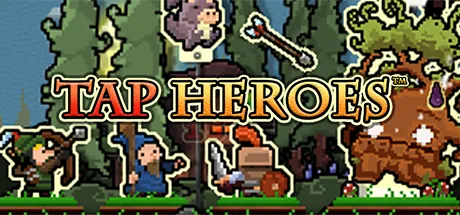
Game review
Tap Heroes
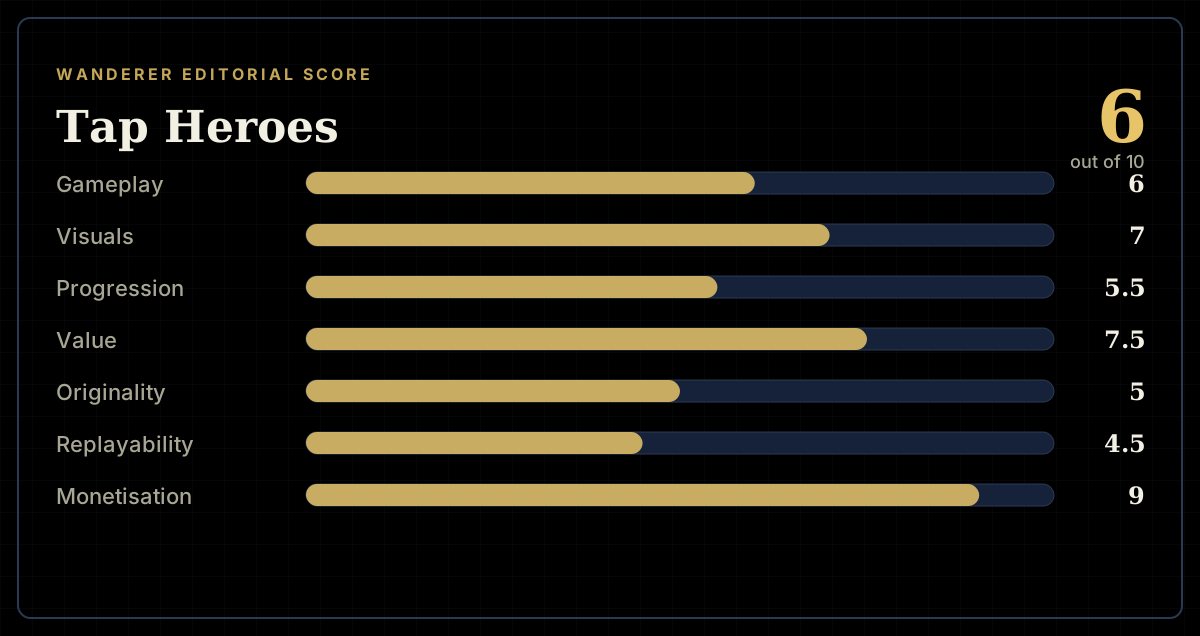
6 / 10
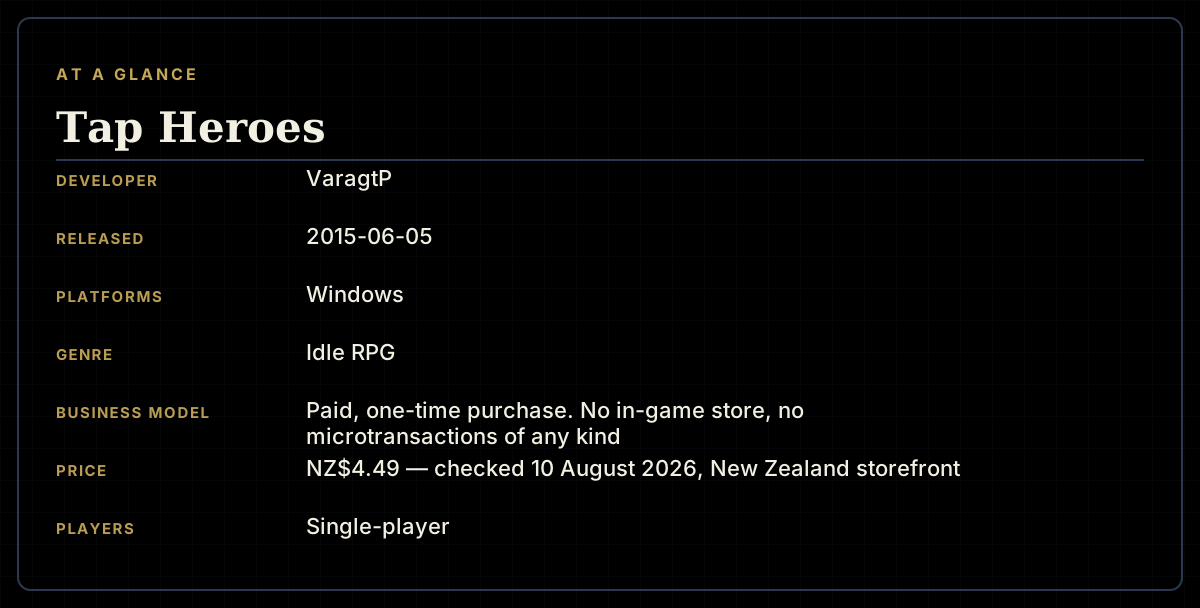
- Developer
- VaragtP
- Publisher
- VaragtP
- Released
- 5 June 2015
- Platforms
- Windows
- Genre
- Idle RPG
- Monetisation
- Paid, one-time purchase. No in-game store, no microtransactions of any kind
- Players
- Single-player
The short version
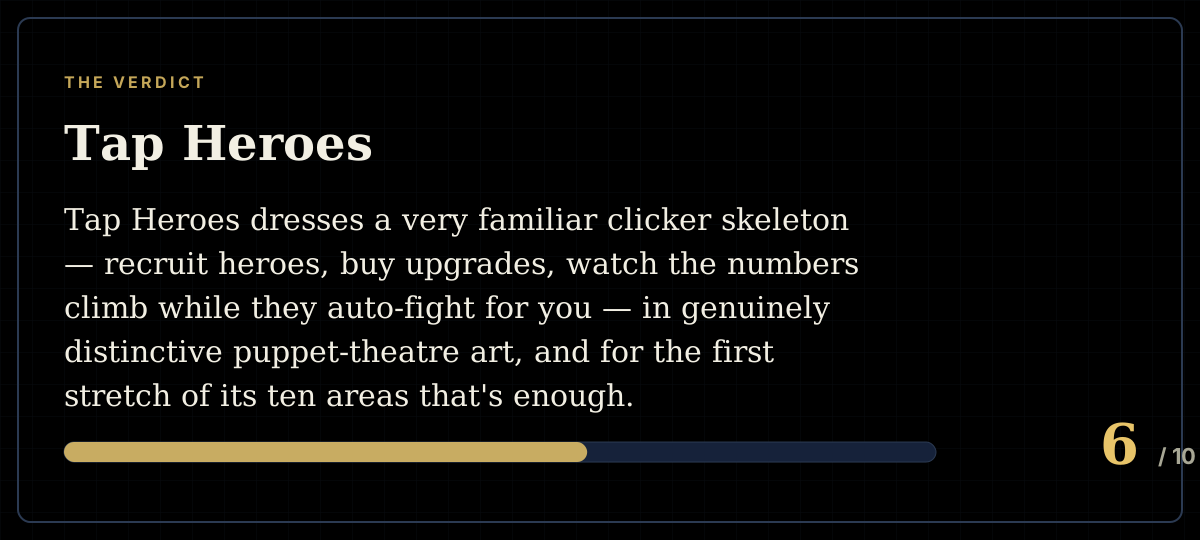
Tap Heroes dresses a very familiar clicker skeleton — recruit heroes, buy upgrades, watch the numbers climb while they auto-fight for you — in genuinely distinctive puppet-theatre art, and for the first stretch of its ten areas that's enough. The trouble is that the game arrived on Steam three weeks after Clicker Heroes and a good chunk of its own review corpus never forgave the resemblance, and its 50 Steam achievements lean hard on leaving the game idling for triple-digit hours rather than on anything you actually decide to do.
What sets it apart from most $5 clickers a decade past their launch window is that somebody is still home. The solo developer patched a long-standing achievement-unlock bug as recently as December 2025 and got the game Steam Deck verified in 2024 — rare continuity for a genre where most titles this age and this cheap have been left exactly as they shipped.
Biggest strengths
- Puppet-stage art direction and hero animations give it a visual identity none of its 2015 clicker contemporaries shared
- A single NZ$4.49 purchase with no in-game store at all — no premium currency, no ads, no battle pass, nothing to upsell
- The developer fixed a decade-old achievement-unlock bug in December 2025 and got the game Steam Deck verified the year before, evidence this is not a walked-away-from product
Biggest weaknesses
- The recruit-heroes-buy-upgrades-let-them-fight loop reads to a large share of its own negative reviews as a direct lift from Clicker Heroes, which reached Steam three weeks earlier
- Several of the 50 achievements require leaving the game running passively for 100+ hours; negative reviews that mention achievements specifically carry a 74-hour median playtime
- It launched with no offline progress at all — the developer added it within days, but the initial version drew some of the corpus's most-upvoted early complaints
Who it's for: Idle-genre completionists who don't mind a long tail of passive achievement grinding, and anyone who wants a one-time-purchase clicker with a distinctive art style and zero monetisation pressure
Our recommendation: Worth its asking price for a puppet-themed spin on the Clicker Heroes formula, but go in expecting the 100% completion goal to take hundreds of idle hours, not an afternoon
6 / 10
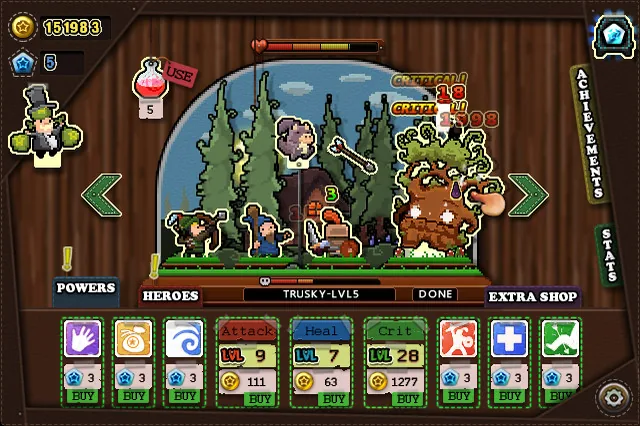
Tap Heroes calls itself "the first puppet show RPG," and for once that's not just storefront flourish. Every hero, enemy and boss is rendered as a felt-and-string marionette on a literal stage, and that framing is the single thing about the game that doesn't exist somewhere else already. Underneath the curtain sits a recruit-a-hero, buy-an-upgrade, let-them-auto-fight loop that Steam's own review corpus has been comparing to Clicker Heroes since launch week — not unfairly, since Clicker Heroes reached Steam on 13 May 2015 and Tap Heroes followed it on 5 June, just three weeks later. Solo developer VaragtP has kept patching it ever since, right up to a bug fix in December 2025, which is the part of this story a decade-old NZ$4.49 clicker rarely gets to tell.
A puppet show wearing Clicker Heroes' clothes
Strip away the marionette theming and the mechanical shape is the genre's most common one: tap or click to attack, spend the gold you earn on flat damage and gold-multiplier upgrades, unlock new heroes who keep fighting whether or not you're watching, and push through ten themed areas and more than 70 enemy and boss designs toward whatever the next gate is. "Atleast with Cookie Clicker, Adventure Capitalist, and Clicker Hero[es] the game mechanics ... were all different," reads one of the corpus's most-upvoted negative reviews, written the week of launch, arguing Tap Heroes "basically completely copies" Clicker Heroes down to individual feature choices. Sixteen of the 166 English-language negative reviews name Clicker Heroes by title, almost all of them in
- That's a real complaint and worth taking at face value rather than explaining away — but
it's also a snapshot of a specific moment, when Clicker Heroes was the newest, loudest thing in the genre and anything that resembled it looked derivative by definition. Measured against the wider clicker field rather than just that one rival, Tap Heroes' structure is closer to Cookie Clicker's buy-the-next-thing simplicity than to AdVenture Capitalist's business-ladder framing, with a hero roster and boss encounters bolted on top. The puppet-stage presentation is the one place the game actually diverges from its influences, and it's a good one — cute, a little absurd, and visually distinct from the fantasy-generic art most clickers in this price bracket ship with.
Heroes, spells and the one real decision in every fight
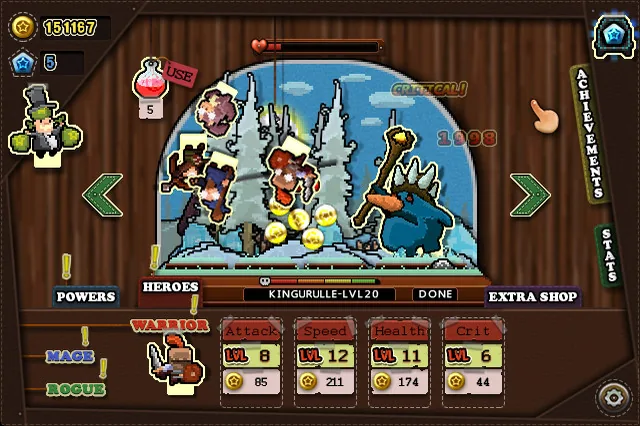
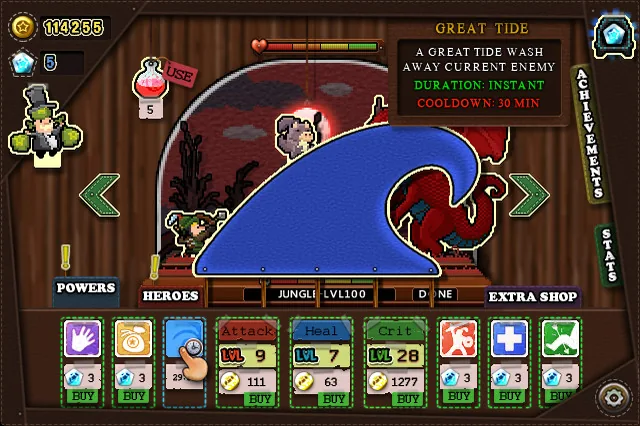
The store page names "a distinct group of heroes with different abilities" as a feature, and that's the part of the design with the most actual decision-making in it. Recruited heroes carry different jobs — one heals, one applies damage over time, one tanks and hits hardest — and managing their spell cooldowns and positioning against a boss is the closest the game gets to active play rather than passive accumulation. Several of the more considered reviews single this out as the genuine differentiator: "Unique in 3 heroes (one hero heals, one poisons, one is the meatshield + main dmg dealer)," reads one, cataloguing it as a clear pro against an otherwise familiar structure. The catch, repeated across the review corpus in almost every language, is that spells don't recharge while the game is closed — so the "sit back and enjoy the show" promise on the store page only half applies. You can leave heroes auto-fighting indefinitely, but their more interesting tools are gated to active sessions, which pulls the game toward being a clicker you sit with rather than a true offline-idle title.
The grind Steam's achievement list won't let you forget
This is where the review corpus's centre of gravity actually sits, and it isn't about combat at all. "Achievement" or "achievements" appears in 42 of the 166 English negative reviews — the single most common substantive word in the whole set, ahead of "grind" (21) and "boring" (21) — and negatives that raise it specifically carry a 74-hour median playtime, which rules out drive-by complaining. These are players who finished most of the game and then hit a wall built out of Steam achievements rather than content: "you have to actually keep it open on idle for a really really long time (~140 hours minimum)," one 2024 review reports; another, from 2025, describes "470 hours" to see it through. Global achievement data backs this up rather than just echoing it: of the tracked milestones, even the single most commonly earned one sits at only about 19% of all owners, and the least-earned at around 9%. Whatever fraction of buyers finish Tap Heroes' "possibly infinite" endgame, it's a small one, and the game's own completion goals are the mechanism making it small — a genre-wide pattern this library has flagged before, where an idle game's achievement list quietly becomes its real difficulty curve.
It launched into a rockier version of the same complaint. Tap Heroes shipped on 5 June 2015 with no offline progression at all, an odd omission for a game whose store description leads with "sit back and enjoy the show." The developer patched it in within days — one of the corpus's most-upvoted reviews tracks the fix in real time, from "no offline progression" to "offline earnings have now been added" over the course of about a week — but several of the loudest early reviews were written in that gap, and vote counts on Steam don't get un-cast once the thing being complained about is fixed. Read against a 2026 release date the complaint would be a genuine mark against the game; read against its actual history, it's launch-week noise about a bug that outlived the criticism by about five days and the good version by over a decade.
Ten years of a solo developer still showing up
What keeps Tap Heroes from reading as simply abandoned — the fate of most $5 clickers this old — is that VaragtP kept coming back to it. A December 2025 patch note, titled plainly "Long time coming," describes a specific, verifiable root cause for years of "my achievement won't unlock" reports: the unlock check only ran once, at the moment conditions were met, and if that check failed silently it never ran again even after the achievement was genuinely earned. The fix now re-checks every achievement on every launch. It's a small, honest kind of patch note — naming the actual bug rather than a vague "stability improvements" line — and it followed a 2024 update that got the game Steam Deck verified, nine years after release. None of that changes the grind itself; the December fix corrects Steam's bookkeeping, not the number of hours a completion run demands, and the achievement percentages pulled fresh for this review — after the fix has had time to take effect — still sit in the same low-teens-to-high-teens range. But it's a meaningfully different situation from a game whose developer has moved on and left the reviews to pile up, which is worth knowing before writing off a decade-old title as dead weight.
Four dollars fifty and not one microtransaction
Judged purely as a transaction, Tap Heroes is close to the cleanest structure this library reviews. NZ$4.49 buys the entire game; there is no in-client store, no premium currency, no ads, and the store page says so directly — "no microtransactions of any sort." That puts real distance between it and Tap Titans 2, whose clan tournaments and relic economy sit behind a much taller premium ladder, and it means every one of the grind complaints above is a pacing problem rather than a monetisation one — nobody is being asked to pay to skip the hundred-hour achievement wall, because there's nothing left to buy once you've bought the game. For a reader weighing whether the price is fair, the honest answer is yes: at under five dollars, with the core content playable well before the achievement grind kicks in, Tap Heroes delivers more hours per dollar than most of its full-price contemporaries, even if a sizeable share of those hours are the game idling in the background rather than anyone actively playing it.
Verdict
Tap Heroes is a competent, occasionally distinctive clicker that never fully shakes the comparison to the bigger game that launched three weeks before it, and that comparison shaped a real chunk of its review history from week one. What holds up better a decade later is the parts that comparison doesn't touch: puppet-stage art nobody else in the genre was doing in 2015, a genuinely hero-driven combat layer underneath the passive numbers, an honest one-time price with no store bolted on, and a developer who was still fixing real bugs in December 2025. What keeps it from scoring higher is that its own achievement list turns the back half of the game into a leave-it-running exercise that global completion data confirms almost nobody finishes, and the core loop underneath the puppets is still recognisably borrowed rather than reinvented. Buy it for the puppets and the price; don't buy it expecting to see the credits roll on 100% in a weekend.
Pros and cons
Pros
- Puppet-stage art direction and hero animations give it a visual identity none of its 2015 clicker contemporaries shared
- A single NZ$4.49 purchase with no in-game store at all — no premium currency, no ads, no battle pass, nothing to upsell
- The developer fixed a decade-old achievement-unlock bug in December 2025 and got the game Steam Deck verified the year before, evidence this is not a walked-away-from product
- Ten areas and more than 70 enemy and boss designs give the opening hours a real, visible sense of forward motion
Cons
- The recruit-heroes-buy-upgrades-let-them-fight loop reads to a large share of its own negative reviews as a direct lift from Clicker Heroes, which reached Steam three weeks earlier
- Several of the 50 achievements require leaving the game running passively for 100+ hours; negative reviews that mention achievements specifically carry a 74-hour median playtime
- It launched with no offline progress at all — the developer added it within days, but the initial version drew some of the corpus's most-upvoted early complaints
- Global achievement data shows even the single most-earned tracked milestone sitting at roughly 19%, suggesting most buyers never get far into the "possibly infinite" endgame the store page promises
Screenshots
-
Tap HeroesImage: VaragtP via Steam -
Tap HeroesImage: VaragtP via Steam -
Tap HeroesImage: VaragtP via Steam -
How the review scores each part of the gameWanderer Editorial -
The game at a glanceWanderer Editorial -
The short versionWanderer Editorial