Game review
Journey to Incrementalia
7.5 / 10
- Developer
- Adam Travers
- Publisher
- Adam Travers
- Released
- 23 October 2024
- Platforms
- Windows
- Genre
- Incremental, Auto Battler, RPG
- Monetisation
- One-time purchase. No DLC, no ads, no premium currency and nothing live-service on its Steam listing
- Players
- Single-player only. Steam lists Remote Play Together for shared/spectated sessions, which is not real multiplayer
The short version
Journey to Incrementalia is a one-person, NZ$7.39 incremental auto-battler about a necromancer smashing through 99 walls between them and a lost city, and its core loop — sacrificing your own minions to buff chain lightning, running two separate resource economies in souls and mana, watching wall health scale from thousands into the trillions — is exactly as inventive as its 87% Very Positive score across 911 reviews suggests. What holds it back from a higher score is a specific, repeated complaint from long-play reviewers: skills can only be reset all at once, there is no way to save a build as a loadout, and clearing a new wall tier often means manually holding the mouse button to reallocate hundreds of skill points by hand. The developer patched actively for seven months and then went quiet — nothing on Steam's news feed since May 2025 — with that exact complaint still unresolved.
Biggest strengths
- Sacrifice-driven spell and minion synergies — chain lightning that scales with skeletons fed to it, insect swarms that skip the souls economy entirely — give the game the build variety its own community tags (Incremental 169 votes, Auto Battler 119) point to as its real identity, echoed in the developer's own pull-quote from YouTuber Wanderbots calling it "a gold standard for build variety & experimentation"
- Completely clean monetisation: one NZ$7.39 purchase, no DLC, ads, IAP or premium currency, plus system requirements low enough to run on almost any Windows PC (100MB, any graphics card)
- A responsive developer during its first seven months — roughly 29 patches between October 2024 and May 2025, including a same-week rollback of an unpopular wall-HP change after player pushback
Biggest weaknesses
- Free respec is marketed as creative freedom, but reviewers with 10+ hours describe it as forced busywork instead: there's no way to save a build as a loadout, so clearing a new wall tier often means manually holding the mouse button to reallocate hundreds of skill points from scratch
- The storefront's "Idler" tag (109 community votes) oversells how passive this is — the developer's own store page calls it "Active Incremental," and multiple critics say they bought it expecting downtime-friendly idling and got a constant-attention min-maxing puzzle instead
- Nothing on Steam's news feed since 19 May 2025 — about fifteen months of silence as of this review — with the most-requested interface fixes (saved loadouts, bulk skill-point spending) still absent
Who it's for: Incremental and clicker fans who want a short, story-flavoured, actively-played build-experimentation game rather than a true idler, and who don't mind occasional full-respec busywork in exchange for a lot of build variety and a clean, honest price.
Our recommendation: Worth its NZ$7.39 for the three-to-fifteen-hour main campaign alone, and the Steam "Idler" tag is misleading — go in expecting an active, hands-on incremental, not something you can safely leave running in the background.
7.5 / 10
Ninety-nine walls, and a game that's honest about what it is
Journey to Incrementalia opens with a promise most incremental games don't bother making: it tells you, in its own short description, that this is "active incremental gameplay," not the leave-it-running kind. That's a rarer kind of honesty than it sounds. Steam's community tags for this game put Idler at 109 votes — enough that a shopper skimming tag pills could reasonably expect something passive — and a chunk of the negative reviews are exactly that expectation crashing into the reality of a game that wants your hands on the mouse more or less constantly. The store page isn't lying. The tag is just misleading, and it's worth knowing that going in.
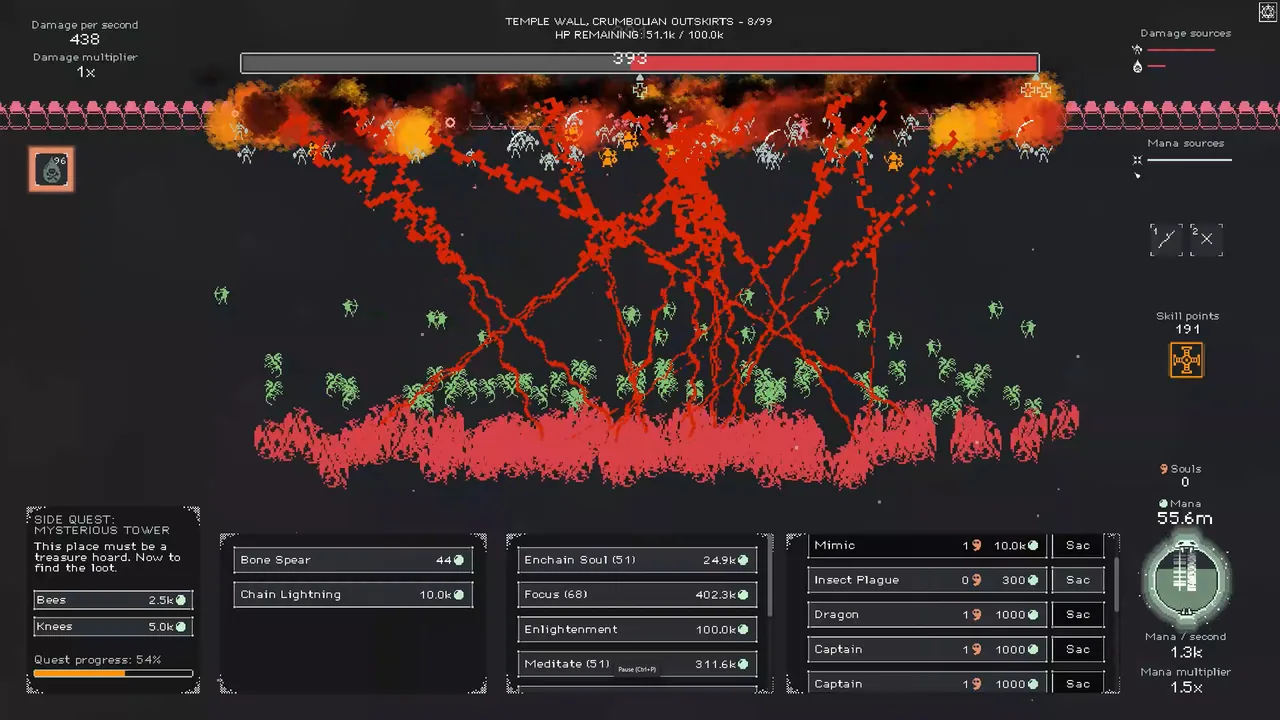
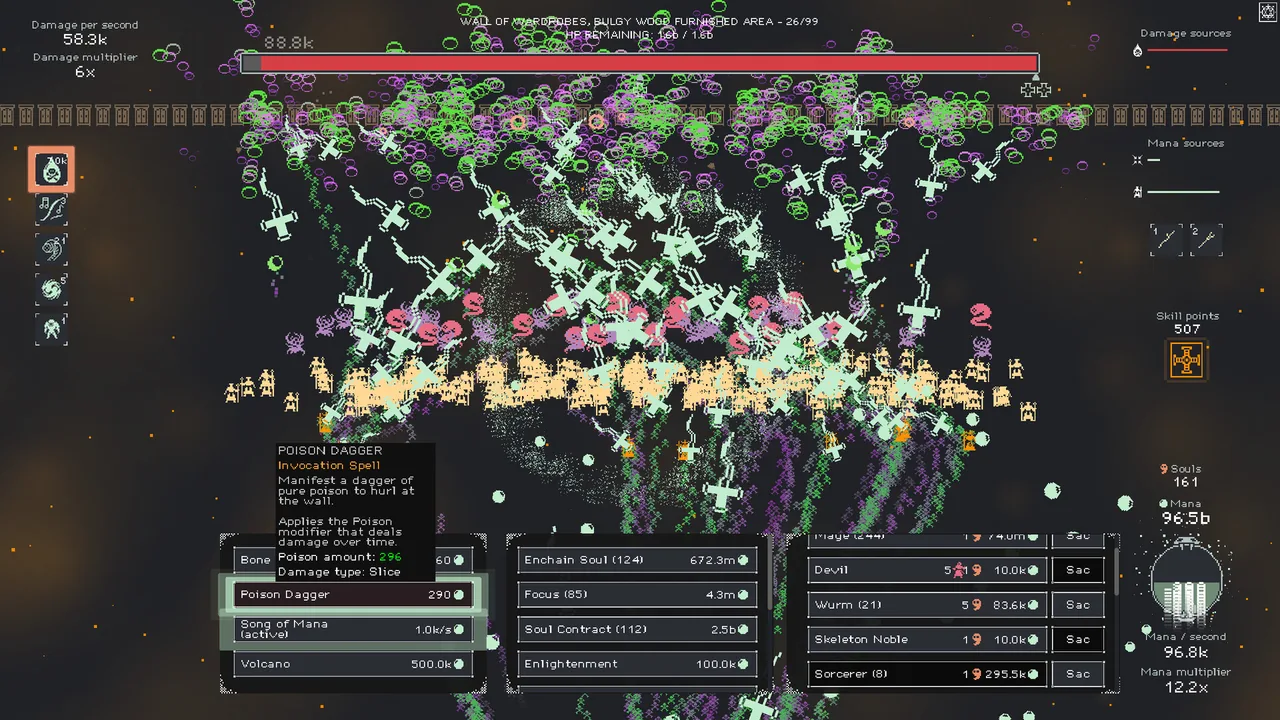
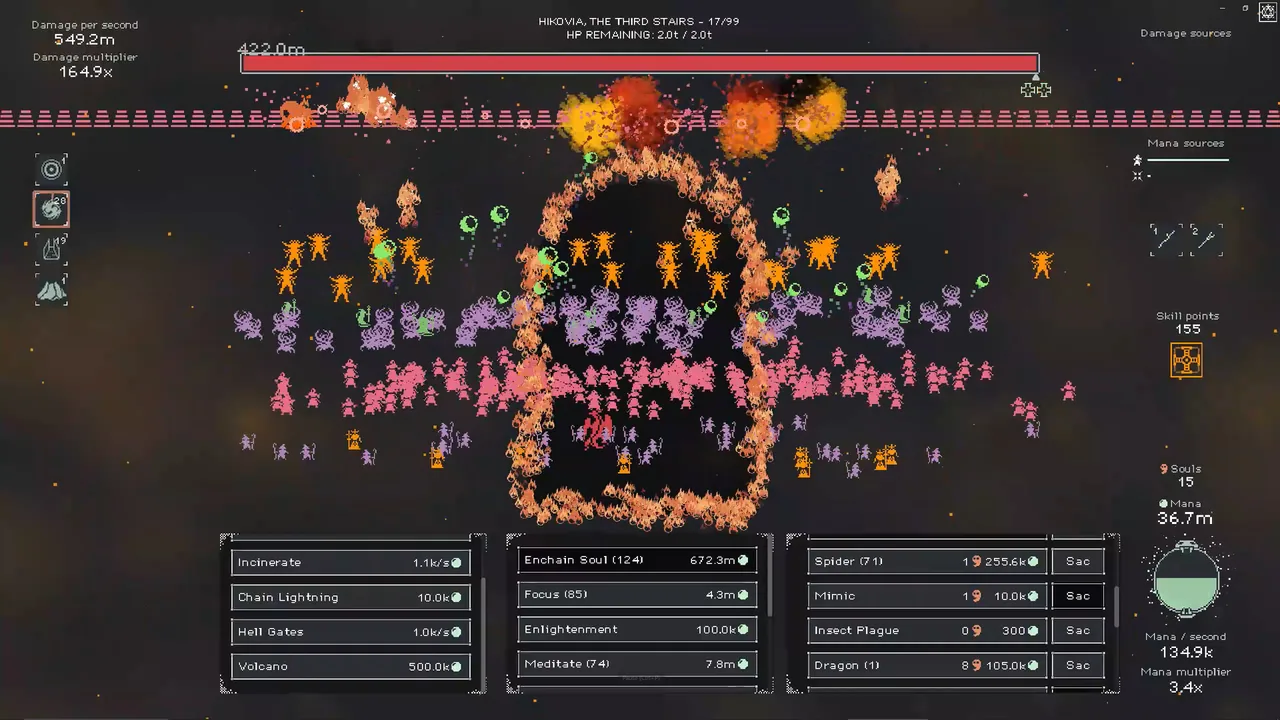
What you actually get is a necromancer grinding down 99 named walls between the surface world and the lost city of the title, one skeleton army, chain-lightning bolt and sacrificed minion at a time. Each wall carries its own name and its own health bar, and that bar escalates fast: early walls sit in the hundred-thousands, and by wall seventeen — a flaming skull structure called Hikovia, the Third Stairs, going by this review's screenshots — health is measured in trillions. Two currencies run the whole operation in parallel: mana, spent on spells and passive multiplier skills, and souls, spent on summoning minions that then march into the wall and either deal damage or get fed to a spell for a permanent buff. Chain Lightning's own tooltip states this plainly: it arcs "between your skeletons and cultists," carries a base damage figure in the hundreds of thousands, and gets stronger with every minion sacrificed into it, up to a cap. Some summons, like Insect Plague, skip the souls economy entirely and just cost mana, giving you a second lever to pull when one resource dries up. It's a genuinely clever pile of interlocking systems, and the storefront's community tags back that reading: Incremental and Auto Battler outvote every one of the official Adventure/RPG/Strategy genre labels, with Adventure trailing at a distant 68 votes against Incremental's 169.
The freedom that turns into homework
The single most consistent complaint in this game's negative reviews isn't about difficulty, balance or content — it's about the skill tree's reset button. Respeccing is free and unlimited, pitched by the store page as a feature ("skills can be reset at any time... with freedom") and echoed approvingly in one of the developer's own pull-quotes, YouTuber Wanderbots calling the game "a gold standard for build variety & experimentation." A lot of players agree with that framing. But a specific, recurring group of longer-play reviewers describe the same mechanic from the other side: "The game has predefined builds that you need to change to every time you pass certain milestones," reads the single most-upvoted negative in this review's full sample. "There's no room for creativity in the builds. Perfectly building what the [wall requires] is the only way to progress." Another, at nearly 13 hours played, is more specific about the mechanical cost: "You only have full respecs... I have to spend 200 hundred points at a time over some, IDK, 100 skills? But there is neither the option to put 10s of points at a time, so you have to hold mouse click."
That's the crux of it: there's no way to save a build as a loadout and swap between them, so finding the one skill spread that actually clears a given wall means manually reallocating every point again, by hand, from zero. One reviewer asked for exactly this in a December 2025 review — "please give us the ability to add and remove skills one by one instead of having to reset every time" — while still recommending the game overall. The developer did ship adjacent quality-of-life work during the active patch year: version 1.30 made summon limits persist between sessions, and 1.31 walked back an earlier change to wall-HP resets after players pointed out it let them get permanently stuck. Loadouts and incremental point spending never shipped. Whether that friction reads as "meaningful decision-making" or "busywork" seems to depend heavily on how many times a given player respecced — which, per several reviews, is often dozens.
Short, and the New Game+ layer doesn't fully answer for it
Most reviewers who report a finish time land somewhere between three and fifteen hours for the main 99-wall campaign, and opinion splits cleanly on whether that's a feature or a flaw. "Great shortish (4-5 hrs long) incremental that doesn't overstay its welcome," reads one positive review; "not really an incremental game, everything is linear... not worth [the price], there just isn't enough depth," reads a negative one that took roughly two days of play. The game does have a second layer on top of the main campaign — New Game+, NG2, NG3 and an NG-End mode, plus prestige abilities and legendary items added after launch — but more than one long-play reviewer describes it as the same fights again at bigger numbers rather than new content: "not going for any NG+ since it's usually just the same over and over again, just a little harder," as one puts it.
Steam's own achievement data gives this a more objective shape than either side of that argument alone. The game has only four achievements, each gating a story beat rather than a side objective, and they form a clean drop-off curve: 62.1% of owners clear a quarter of the walls, 40.8% reach the halfway point, 31.6% reach a late-game milestone, and 29.1% finish the full run. That's a real majority who get meaningfully into the game and a real minority — but not a tiny one — who see it through to the end, which is a more forgiving shape than a lot of short indie campaigns manage. It also means most of this game's negative reviews about length and depth are coming from people who did finish it, not from people who bounced off early.
A solo developer's patch trail, and where it stops
Journey to Incrementalia was made and is still solely credited to one person, Adam Travers, and for its first seven months that showed in the update cadence: roughly 29 patches on record between the October 2024 launch and 19 May 2025, ranging from balance passes to targeted performance work ("better performance with a high number of volcanoes active," reads the 7 February 2025 patch note, a very specific fix for exactly the kind of screen-filling minion swarms this game's screenshots show off) to the wall-HP rollback mentioned above, issued within days of the change that prompted it. That's a genuinely attentive solo dev cycle, and it shows in how few technical complaints show up in the negative-review sample: of 97 English negatives read for this review, only three mention bugs or crashes at all, and one specific report of losing 15 hours of unsaved progress reads as an isolated incident rather than a pattern, since nothing else in the sample corroborates it.
What's notable is where that patch trail stops. Steam's news feed has nothing recorded for this app since that 19 May 2025 bug-fix patch — about fifteen months of silence as of this review — and the interface complaints raised above, particularly the lack of saved loadouts, are still exactly as they were at launch. That's not necessarily a bad sign on its own; plenty of small, complete incremental games stop updating once the developer considers them finished, and the review sentiment hasn't measurably declined across that gap (English negatives run 28 in 2024, 58 in 2025 and 11 so far in 2026, tracking roughly the same proportion as positives across the same years). But it does mean the specific fix this review's most common complaint is asking for has had over a year to arrive and hasn't.
Clean pricing, modest presentation
There's nothing to untangle on the money side. NZ$7.39 (US$4.99) gets you the whole game — no DLC, no in-app purchases, no ads, no premium currency, nothing resembling a live-service surface at all — and system requirements are trivial (100MB, any graphics card), so there's no hidden performance tax either. Visually it's a minimalist pixel-art dark-fantasy style that reads clearly even with hundreds of sprites on screen at once, which matters more than it sounds for a game whose whole aesthetic is armies of tiny skeletons swarming a wall. The synth soundtrack is described on the store page as "inspired by DOS classics," and it's a fair match for the look, though it's a light touch rather than a centrepiece — one reviewer noted plainly that "there isn't much music," which tracks with a small, focused production rather than a lavishly scored one.
Final verdict
Journey to Incrementalia earns its Very Positive badge honestly: the sacrifice-and-scale core loop is inventive, the price is fair, the solo developer was demonstrably responsive during the game's active year, and the achievement data confirms most buyers get real mileage out of it rather than bouncing off immediately. What keeps this from scoring higher is narrow but real — a full-respec-only skill system with no saved loadouts turns the game's central selling point, build freedom, into repeated manual busywork for exactly the players who engage with it most, and that specific ask has gone unanswered through fifteen months of developer silence. If you go in expecting an actively-played build puzzle rather than the idler its own "Idler" tag implies, and you're fine occasionally rebuilding a skill spread from scratch by hand, there's a genuinely sharp three-to-fifteen-hour incremental game here for not much money.
Pros and cons
Pros
- Sacrifice-driven spell and minion synergies — chain lightning that scales with skeletons fed to it, insect swarms that skip the souls economy entirely — give the game the build variety its own community tags (Incremental 169 votes, Auto Battler 119) point to as its real identity, echoed in the developer's own pull-quote from YouTuber Wanderbots calling it "a gold standard for build variety & experimentation"
- Completely clean monetisation: one NZ$7.39 purchase, no DLC, ads, IAP or premium currency, plus system requirements low enough to run on almost any Windows PC (100MB, any graphics card)
- A responsive developer during its first seven months — roughly 29 patches between October 2024 and May 2025, including a same-week rollback of an unpopular wall-HP change after player pushback
- Achievement data backs up that most buyers make genuine progress rather than bouncing immediately: 62.1% clear the first quarter of walls, though only 29.1% finish all 99
Cons
- Free respec is marketed as creative freedom, but reviewers with 10+ hours describe it as forced busywork instead: there's no way to save a build as a loadout, so clearing a new wall tier often means manually holding the mouse button to reallocate hundreds of skill points from scratch
- The storefront's "Idler" tag (109 community votes) oversells how passive this is — the developer's own store page calls it "Active Incremental," and multiple critics say they bought it expecting downtime-friendly idling and got a constant-attention min-maxing puzzle instead
- Nothing on Steam's news feed since 19 May 2025 — about fifteen months of silence as of this review — with the most-requested interface fixes (saved loadouts, bulk skill-point spending) still absent
- A short campaign, three to fifteen hours by most finishers' accounts, whose New Game+ tiers several reviewers describe as the same fights again at bigger numbers rather than meaningfully new content
Screenshots
-
Journey to IncrementaliaImage: Adam Travers via Steam -
Journey to IncrementaliaImage: Adam Travers via Steam -
Journey to IncrementaliaImage: Adam Travers via Steam -
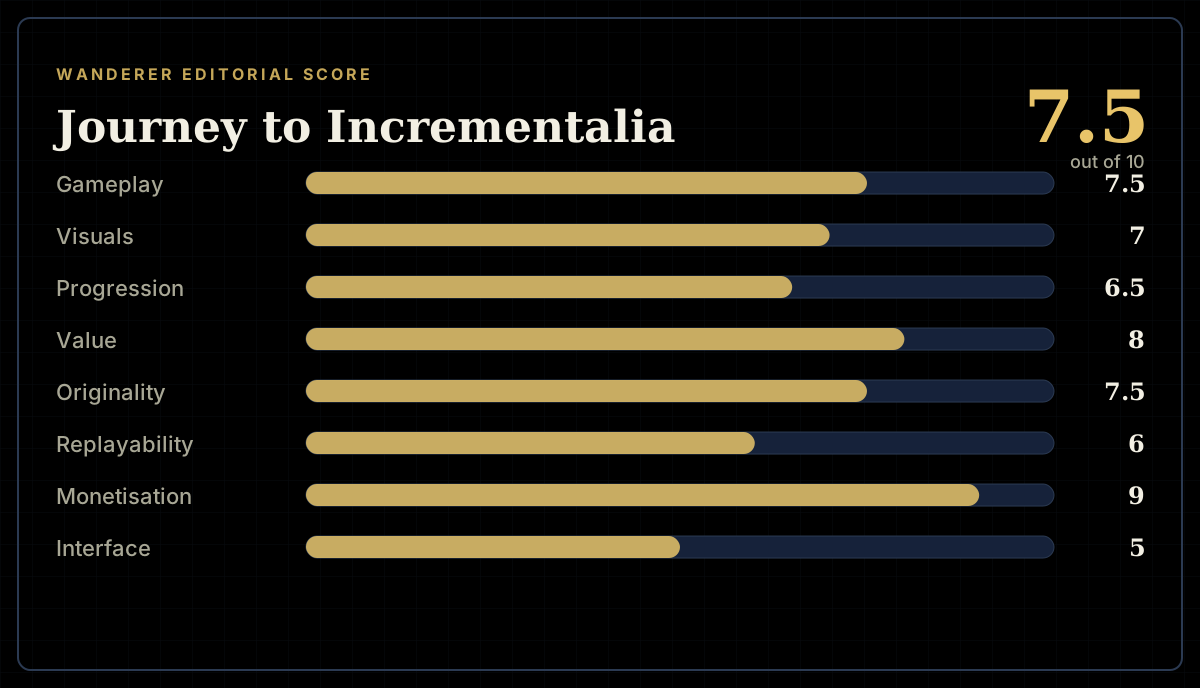
How the review scores each part of the gameWanderer Editorial -
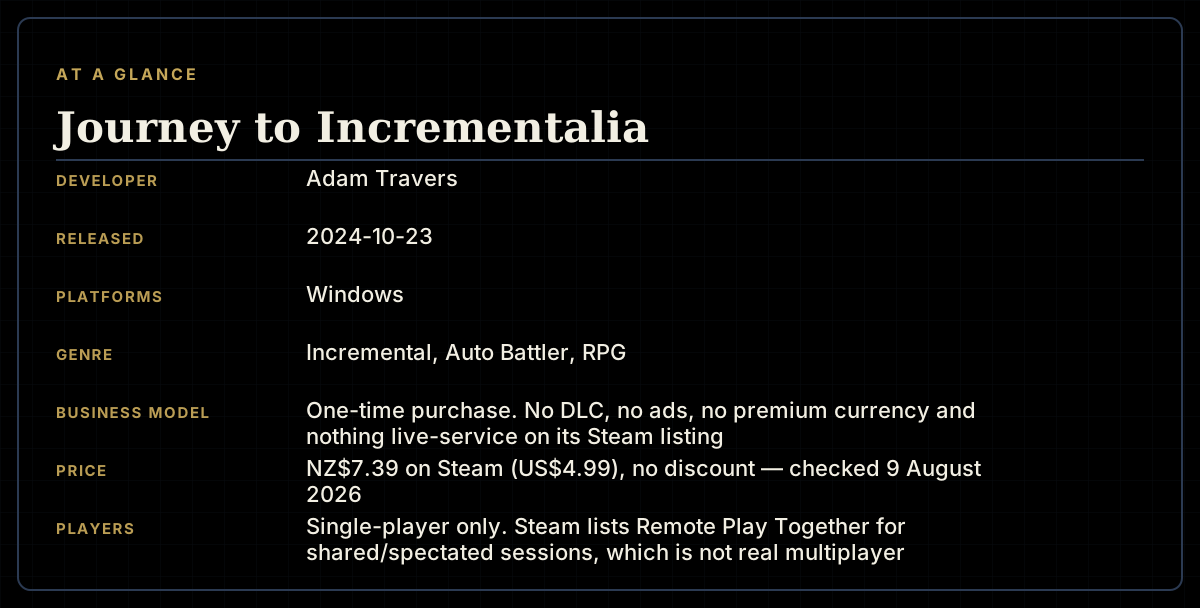
The game at a glanceWanderer Editorial -
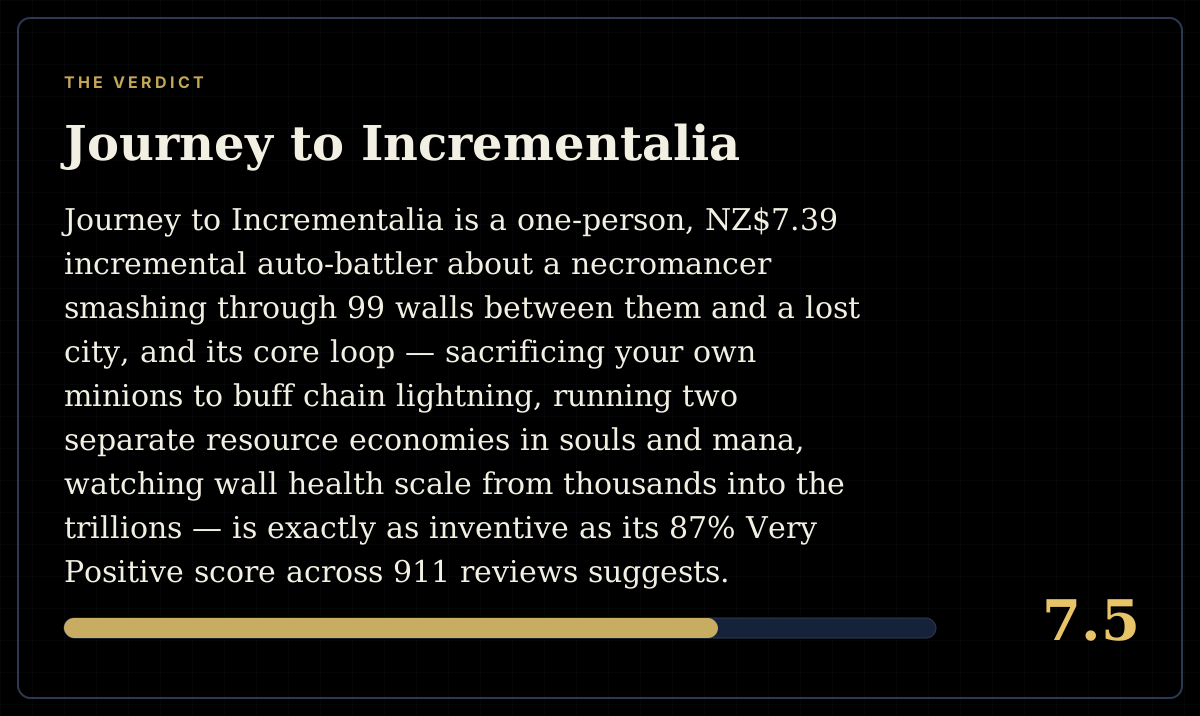
The short versionWanderer Editorial