Game review
Cookie Clicker
8 / 10
- Developer
- Orteil (Julien Thiennot); Steam version developed by Orteil and DashNet
- Publisher
- DashNet (browser); Playsaurus (Steam)
- Released
- 8 August 2013
- Platforms
- Browser, Windows, macOS, PlayStation, Xbox, Nintendo Switch
- Genre
- Incremental
- Monetisation
- Free browser game (no ads, no in-app purchases); Steam version is a one-off paid purchase with an optional soundtrack DLC
- Players
- Single-player
The short version
Cookie Clicker is the reason the words "ascension," "heavenly upgrades" and "prestige loop" mean anything to an entire genre. It was built in a day as a joke about idle games and ended up writing the rulebook for them instead, and the systems it introduced — reset for a permanent bonus, building-specific minigames, jokes as world-building — still hold up.
What doesn't fully hold up is everything around them. The interface is a relic, long stretches of the midgame reduce to buying whatever's cheapest, and the genre it fathered has since built sharper, better-explained versions of several of its own ideas. It's still worth playing. It's no longer automatically the best example of what it invented.
Biggest strengths
- The Legacy ascension system pioneered the reset-for-permanent-bonus loop nearly every idle game since has copied in some form
- Building-specific minigames — Garden, Pantheon, Grimoire, the Stock Market — give the midgame actual decisions instead of just bigger numbers
- The opt-in Grandmapocalypse turns a cute clicker genuinely unsettling without forcing the tone on players who'd rather not
Biggest weaknesses
- The interface hasn't meaningfully modernised since the early 2010s and gets genuinely cramped once dozens of buffs are stacking
- Long midgame stretches reduce to buying whatever building is cheapest per cookie-per-second, with little else to decide
- Later idle games it inspired now out-build it on specific fronts — deeper skill trees, clearer builds, better tutorialisation
Who it's for: Idle-game players curious about where the genre's core mechanics came from, and anyone who wants a five-dollar incremental with real long-term depth and no monetisation pressure whatsoever.
Our recommendation: Play the free browser version first — it's the same game, no worse for being free. Buy the Steam release only once you know you're staying for the long haul; the five dollars buys convenience, achievements and a genuinely good soundtrack, not new content.
8 / 10
Orteil built Cookie Clicker in an evening, posted it to 4chan, and watched fifty thousand people show up within the hour to click a picture of a cookie. That was August 2013. Thirteen years later, nearly every idle and incremental game on Steam is still arguing with decisions he made in the weeks that followed — whether to let players reset their progress for a permanent bonus, whether a building should unlock its own minigame, whether the joke is the game. That's the reason to look at Cookie Clicker now, in 2026, and not as nostalgia: it's still the rulebook the entire genre is quoting from, and it's worth checking how much of that rulebook still reads well.
What it actually invented
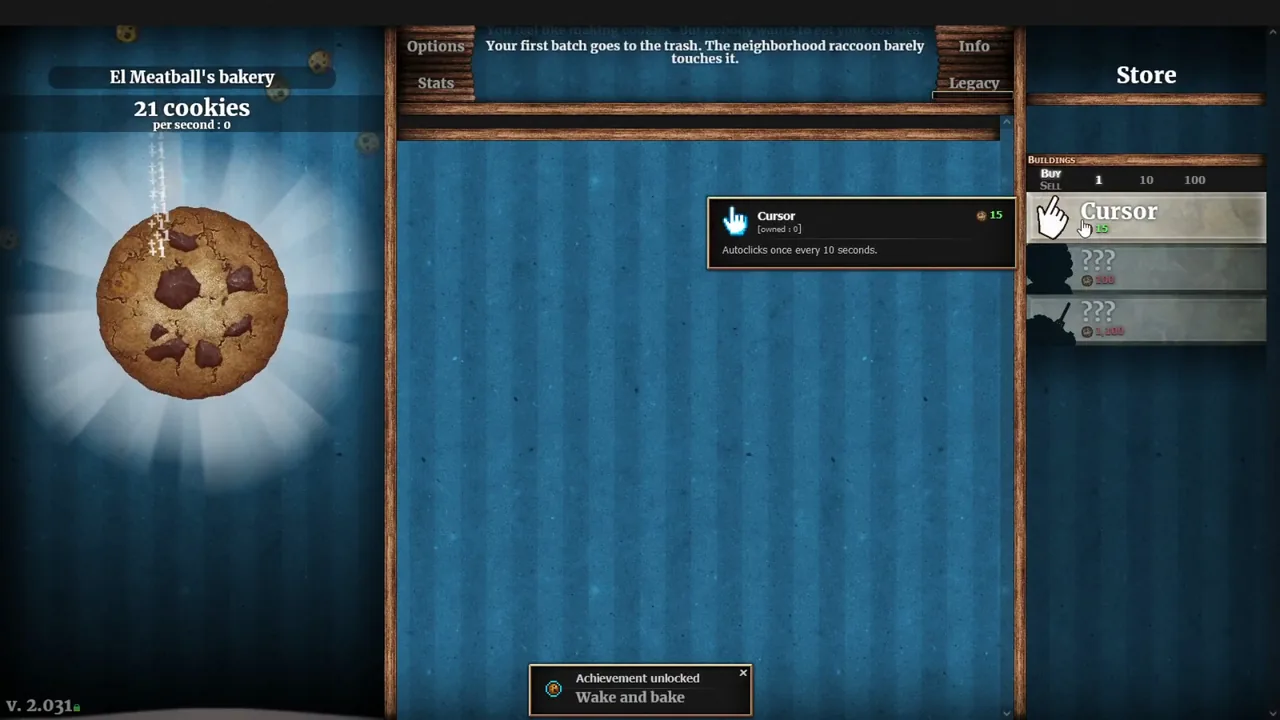
The obvious thing Cookie Clicker did first is the click itself — a cookie you tap, a number that goes up, buildings that automate the tapping. That part is old news even by 2013's standards; clicker games existed before it. What Cookie Clicker actually contributed came a few weeks into its life, with the Legacy button: press it, lose every building and upgrade you own, and walk away with Heavenly Chips and Prestige Levels that make every future run faster forever. That is the ascension loop, and it is now so standard across the genre that players rarely stop to notice it had to be invented by somebody. Cookie Clicker is where.
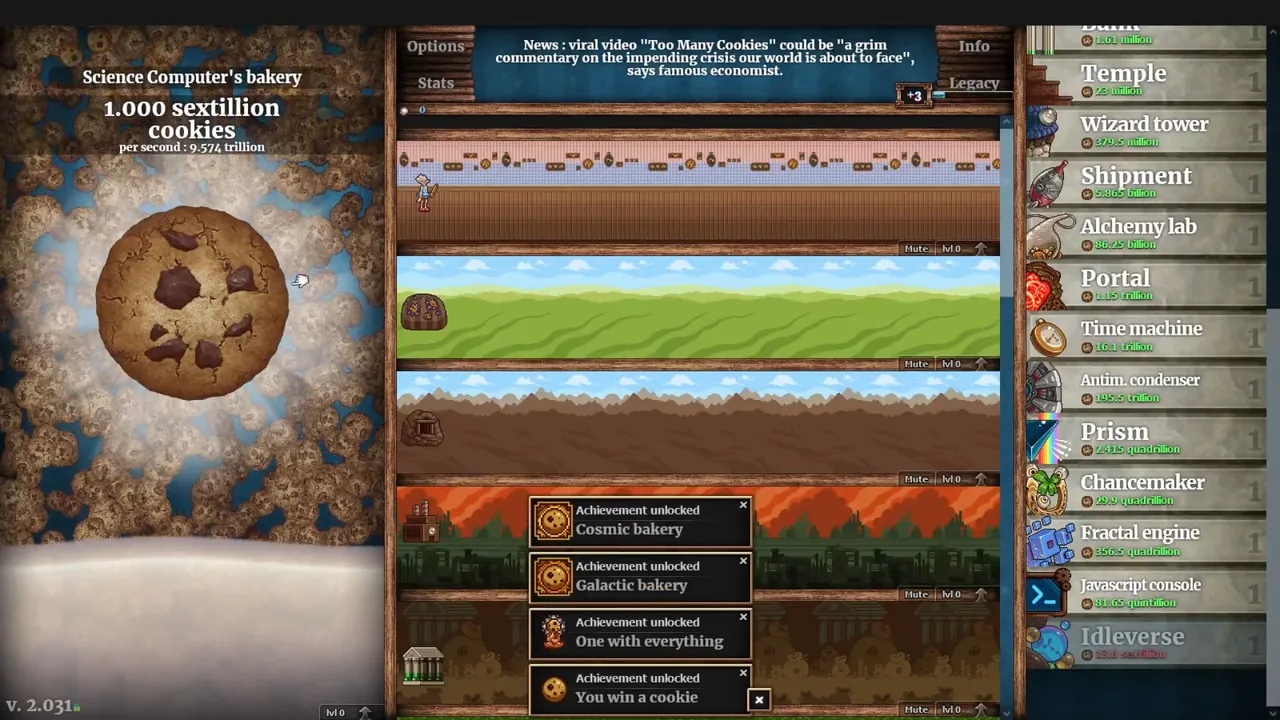
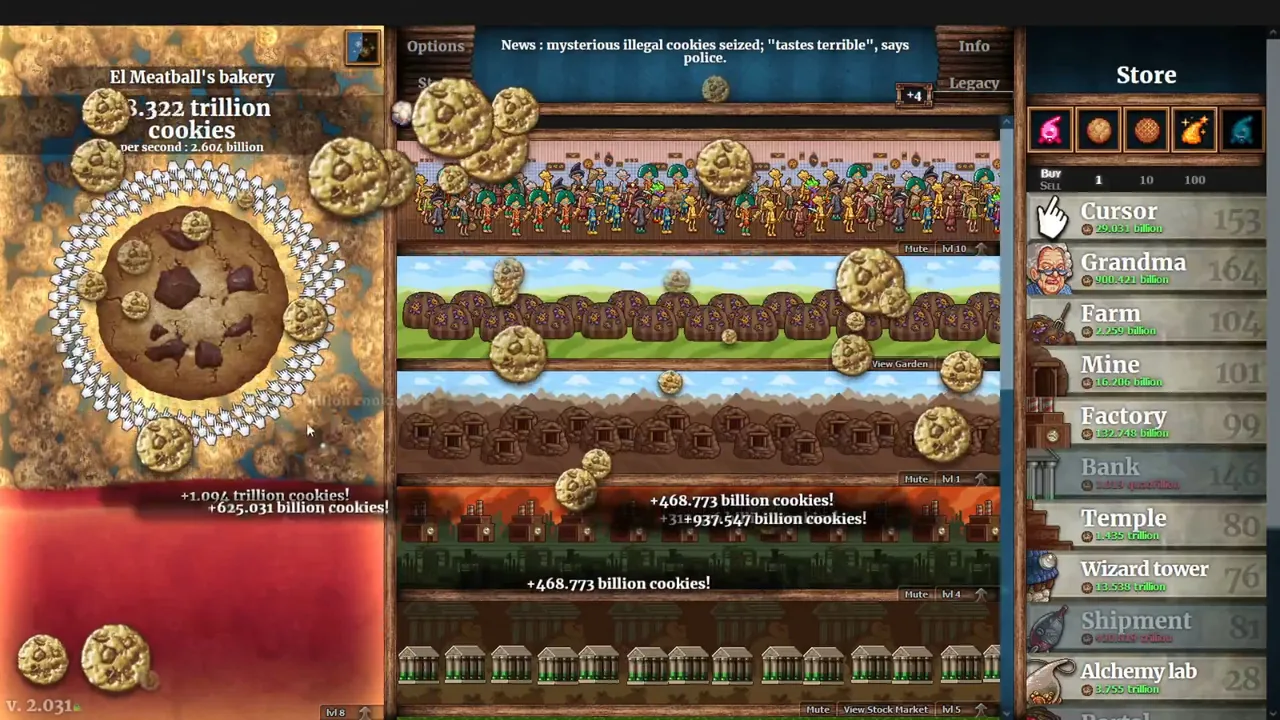
The second contribution is subtler and, honestly, better design: buildings don't just produce cookies, several of them unlock their own self-contained systems. The Farm opens the Garden, a plant-breeding minigame with cross-pollination rules worth learning on its own terms. The Temple opens the Pantheon, where you slot spirits into Jade, Ruby and Diamond sockets for passive effects and pay a resource cost every time you swap them. The Wizard Tower opens the Grimoire, a risk-reward spellcasting system where the strongest spell can also wreck your run if you cast it wrong. The Bank opens an actual stock market simulation. None of these are padding — they're the game's answer to the oldest problem in the genre, which is that a number going up stops being interesting on its own. Cookie Clicker's answer was to keep inventing new small games for you to be good at, tucked inside the big one.
The third invention is tonal, and it's the one imitators struggle to copy: the writing. Cookie Clicker takes itself seriously exactly as much as necessary and not one degree further, and it uses that space for genuinely funny achievement names, self-aware flavor text and a slow-burn narrative escalation that turns "buy grandmas to bake cookies for you" into cosmic horror without ever breaking stride. The joke isn't decoration on top of the systems — in Cookie Clicker, the joke largely is the systems, and thirteen years of imitators writing straight-faced number generators have made that harder to appreciate than it should be.
The two games wearing one name
It matters, here, that "Cookie Clicker" is two separate products with different owners on the credits page. The original is Orteil's free browser game, hosted at orteil.dashnet.org, developed by Orteil under the DashNet banner, funded by nothing more elaborate than the site itself — no ads forced on the player, no in-app purchases, no account requirement. It has been continuously updated since 2013 and, as of mid-2026, is still receiving substantive patches rather than sitting frozen at whatever state it reached years ago.
The Steam release, which arrived on 1 September 2021, is a separate SKU built by Orteil and DashNet in partnership with Playsaurus, who publish it. It costs US$4.99 (NZ$7.39, checked 30 July
- and adds things the browser version doesn't have: a full original soundtrack by C418 —
yes, the composer best known for Minecraft — cloud saves, a proper achievement and stat-tracking layer through Steam's own systems, and Steam Workshop support for community mods. None of that is new gameplay. The buildings, the ascension math, the minigames and the writing are the same game either way, and Orteil has said as much publicly: buying it is a way to support development and get some nice extras, not a way to access more content. A console version followed in May 2025 on PlayStation, Xbox and Switch, built around the same Steam-era feature set for a controller. Whichever version you land on, the underlying game is one thing wearing three storefronts.
Where thirteen years show
The honest retrospective case against Cookie Clicker is that being first doesn't automatically mean being best, and on a few fronts the genre has since lapped its own founder. The interface is the clearest example — a dense, brown-and-cream panel of numbers that was perfectly serviceable in 2013 and now looks exactly like what it is: a page built before the idle genre had agreed on any conventions for presenting dozens of stacked buffs at once. Newer idle and incremental games, several of them built explicitly to improve on Cookie Clicker's formula, spend real design effort on making their numbers legible. Cookie Clicker mostly still expects you to squint.
The midgame is the other honest weakness. Once the opening decisions are made and a build is running, long stretches reduce to "buy whichever building currently gives the most cookies per second," which is a real decision exactly once and busywork every time after. Later systems — Grandmapocalypse, the minigames, heavenly upgrade trees — exist specifically to fight that flatness, and they do fight it, but they arrive gradually enough that new players can sit through hours of pure number-watching before the game shows its hand. The onboarding doesn't help: Cookie Clicker explains almost nothing about its deeper systems inside the game itself, and the practical reality for most players is a wiki tab open in a second window within the first hour. That's a defensible design choice for a game this old and this widely documented, but it's still a real cost for anyone coming in fresh in 2026 rather than in 2013 alongside everyone else figuring it out together.
Grandmapocalypse and the long game
Where Cookie Clicker still earns its reputation is in how it paces the long haul. Buy four wrath upgrades from your grandmas and the Grandmapocalypse begins: wrath cookies start replacing golden ones, wrinklers — red, slug-like things — start crawling onto your big cookie and eating your cookies-per-second, and the tone shifts from "cute idle clicker" to something considerably stranger without a single line of forced exposition. Crucially, it's opt-in. Players who want a clean, horror-free idle run can simply not buy those four upgrades; players chasing wrinkler farming and the deeper Grimoire spells get an entirely different back half of the game. Layer ascension on top — Heavenly Chips converting into permanent upgrades, Prestige Levels adding a flat percentage to every future run — and the loop that actually justifies a "you'll play this for weeks" claim comes into focus: each ascension resets the clock but not the knowledge, and the decision of when to ascend becomes a genuine strategic call rather than a chore.
That structure is why Cookie Clicker still holds up as a long-term game rather than a novelty that burns out in an afternoon. The seasonal events — Valentine's, Easter, Halloween, Christmas — layer cosmetic variety and extra achievements on top without disrupting the core loop, and the game's willingness to keep adding minigames rather than just bigger numbers is the reason it hasn't calcified the way a lot of 2013-era browser games have.
Is the Steam version worth buying
Set against a free, actively maintained original, the Steam release has to make its case on convenience rather than content, and mostly it does. C418's soundtrack is a genuine upgrade over the browser version's simpler audio, cloud saves matter for anyone who plays across more than one device, and the achievement layer gives completionists a cleaner target than the browser's own tracking. Workshop mod support is a real plus for players who want to reskin or extend the experience. None of that changes what the game is — five dollars doesn't unlock a building, an upgrade or a minigame that the free version lacks — and Orteil has never pretended otherwise. The honest read is that the Steam version exists for players who've already decided they're staying, and want to throw a small amount of money at the person who made the thing they've been playing for weeks. As a purchase decision that's an easy one to postpone indefinitely, which is itself a kind of compliment: this is about as low-pressure as monetisation gets in a genre not exactly known for restraint.
Verdict
Eight out of ten, and the score is really doing two jobs at once. As a historical artifact, Cookie Clicker is close to unimpeachable — it invented or popularised the reset-for-bonus loop, the building-unlocks-a-minigame structure and the idea that an idle game's writing can carry as much weight as its math, and it's still being patched in 2026 rather than left to fossilise. As a game judged purely on 2026 terms against everything it inspired, it shows its age: a dated interface, a midgame that leans on the player's patience more than its design, and several specific systems that newer idle games have since built better, sharper versions of. Both of those things are true at once, and neither cancels the other out.
Play the free browser version first — there's no reason not to, and it's the same game the Steam release is built on. If you're still ascending weeks later, the five-dollar Steam version is a fair way to say thanks and pick up a soundtrack worth having. Either way, you'll be playing the game the rest of the genre has spent thirteen years responding to.
Price and store details checked 30 July 2026.
Pros and cons
Pros
- The Legacy ascension system pioneered the reset-for-permanent-bonus loop nearly every idle game since has copied in some form
- Building-specific minigames — Garden, Pantheon, Grimoire, the Stock Market — give the midgame actual decisions instead of just bigger numbers
- The opt-in Grandmapocalypse turns a cute clicker genuinely unsettling without forcing the tone on players who'd rather not
- Achievement and flavor-text writing is still some of the funniest in the genre after 500-plus achievements
- The $4.99 Steam version adds a properly good original soundtrack, cloud saves and Workshop mods on top of a game that's free anyway
- Still shipping substantive updates in 2026 rather than being left to run on autopilot
Cons
- The interface hasn't meaningfully modernised since the early 2010s and gets genuinely cramped once dozens of buffs are stacking
- Long midgame stretches reduce to buying whatever building is cheapest per cookie-per-second, with little else to decide
- Later idle games it inspired now out-build it on specific fronts — deeper skill trees, clearer builds, better tutorialisation
- The game explains almost none of its deeper systems in-game, pushing new players to the wiki within the first hour
- Paying for Steam buys convenience and a soundtrack, not extra content, which is an easy purchase to talk yourself out of
Screenshots
-
Cookie ClickerImage: Playsaurus via Steam -
Cookie ClickerImage: Playsaurus via Steam -
Cookie ClickerImage: Playsaurus via Steam -
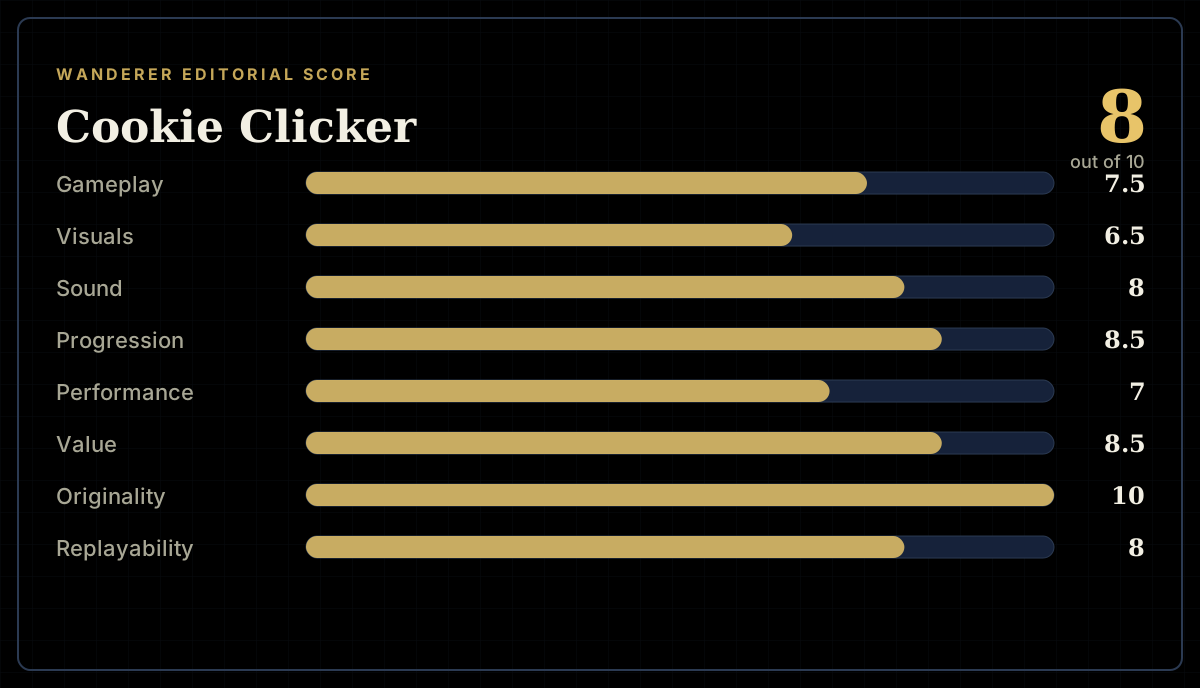
How the review scores each part of the gameWanderer Editorial -
The short versionWanderer Editorial