
Game review
Bills Must Be Paid
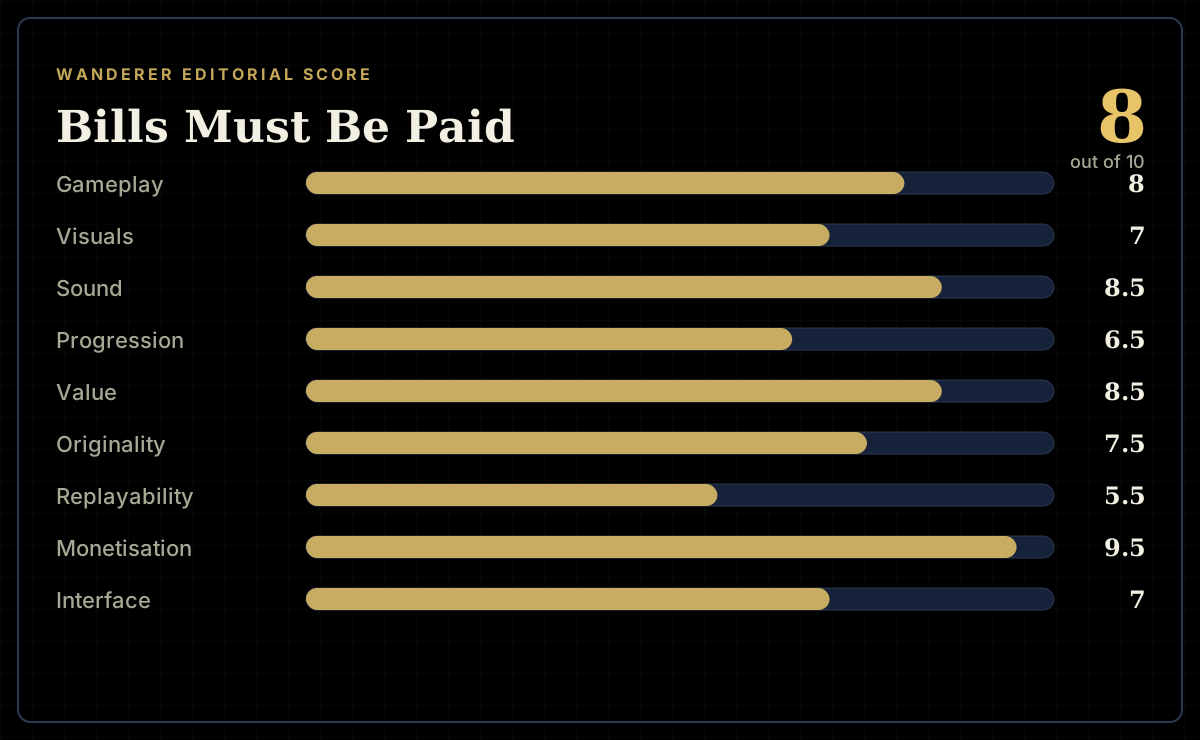
8 / 10
- Developer
- Rike Games
- Publisher
- Rike Games
- Released
- 29 July 2026
- Platforms
- Windows, macOS
- Genre
- Incremental
- Monetisation
- One-time purchase, no in-app purchases, no ads, no subscription
- Players
- Single-player only
The short version
Bills Must Be Paid takes a joke that could have stayed a one-liner — you're broke, so smash piggy banks with a hammer until the bills are paid — and builds a genuinely well-paced incremental around it. A stamina bar stops the loop from turning into mindless clicking, the skill tree gives every upgrade a punchline as well as a percentage, and the whole thing is over in an afternoon at a price that matches the runtime exactly. It doesn't have much left to say once you've seen the skill tree once, and the prestige reset that's supposed to bring you back feels like a step down to a meaningful slice of its own audience.
Biggest strengths
- The stamina bar meaningfully paces each run instead of rewarding pure click speed, forcing real decisions about when to swap hammers or push for one more piggy bank
- The skill tree gives its upgrades actual personality — caffeine addiction, gym sessions, electrified hammers — rather than reading as a flat list of plus-percent modifiers
- Sound design is the single most consistently praised element in player feedback, turning every swing and every bill payment into a small, distinct payoff
Biggest weaknesses
- The skill tree and hammer upgrades flatten out well before the game ends, and several of its flashier abilities are gated behind reported trigger chances as low as roughly 3%, which makes them feel more like decoration than a real system
- The legacy/prestige reset meant to extend the loop reads to a real slice of players as a step backwards rather than forward momentum, since the bonuses it grants don't offset what a fresh run loses
- Piggy bank variety doesn't extend far into presentation — the targets you're smashing look and behave similarly across most of a run, and a few reviewers single out the lack of visual escalation as the destruction stops feeling special
Who it's for: Players who want a short, funny, mechanically honest incremental they can finish in one or two sittings, and anyone who likes a clicker that actually asks for timing decisions instead of just faster clicking.
Our recommendation: An easy recommendation at its asking price if you go in wanting a tight few hours rather than a long-term idle habit. Players chasing deep prestige loops or dozens of hours of build variety should temper expectations, or try the free browser demo first.
8 / 10
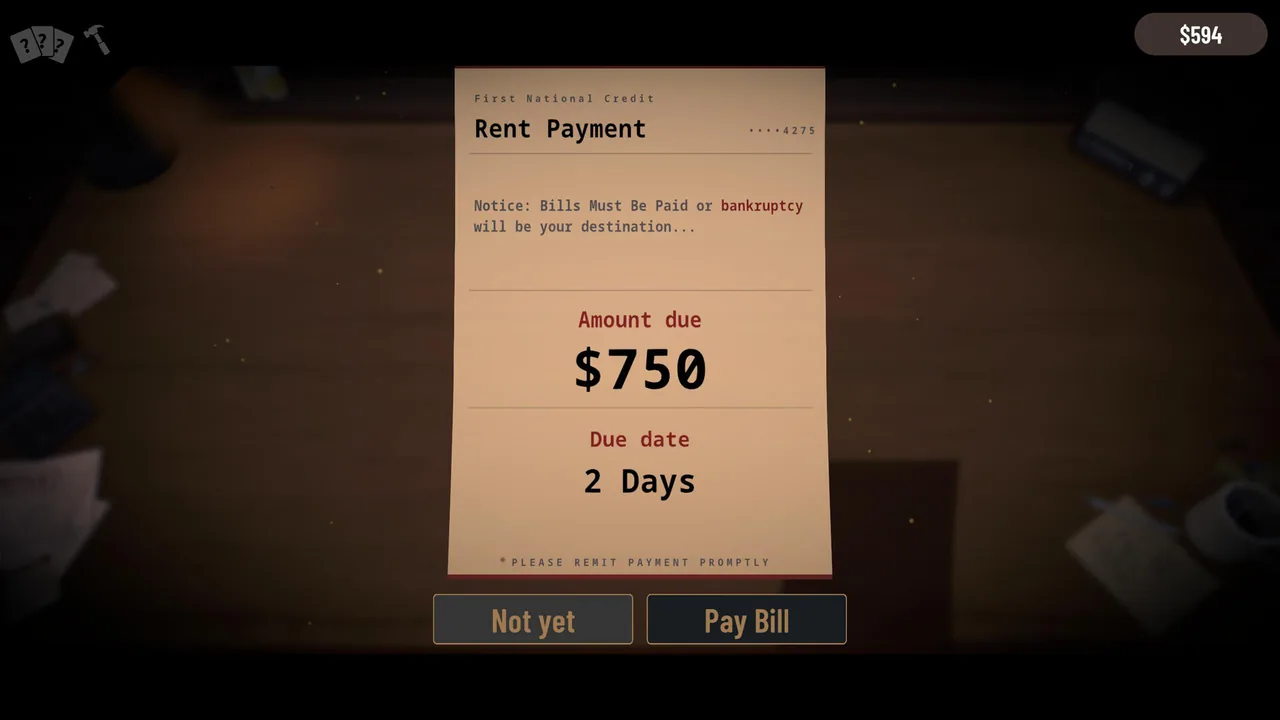
Most incrementals ask for your attention indefinitely — leave the tab open, let the numbers climb, come back tomorrow for more of the same. Bills Must Be Paid asks for an afternoon. You're broke. There's a piggy bank in front of you and a hammer in your hand. Every swing costs stamina, every coin goes toward a stack of overdue bills, and a debt collector is waiting to take a cut of whatever you haven't paid off by the time the next one comes due. It's a joke about financial precarity told through the most literal mechanic imaginable, and the game commits to that joke completely rather than treating it as set dressing for a generic clicker underneath.
That commitment is a big part of why it's landed as well as it has. Close to 1,650 Steam reviews sit at 97% positive, and at a launch price under twelve New Zealand dollars — cut further by a 30% opening discount — the game is being judged against a runtime it's honest about rather than one it pretends to have. That honesty is rarer in this genre than it should be.
A hammer, a stamina bar, and a reason to stop
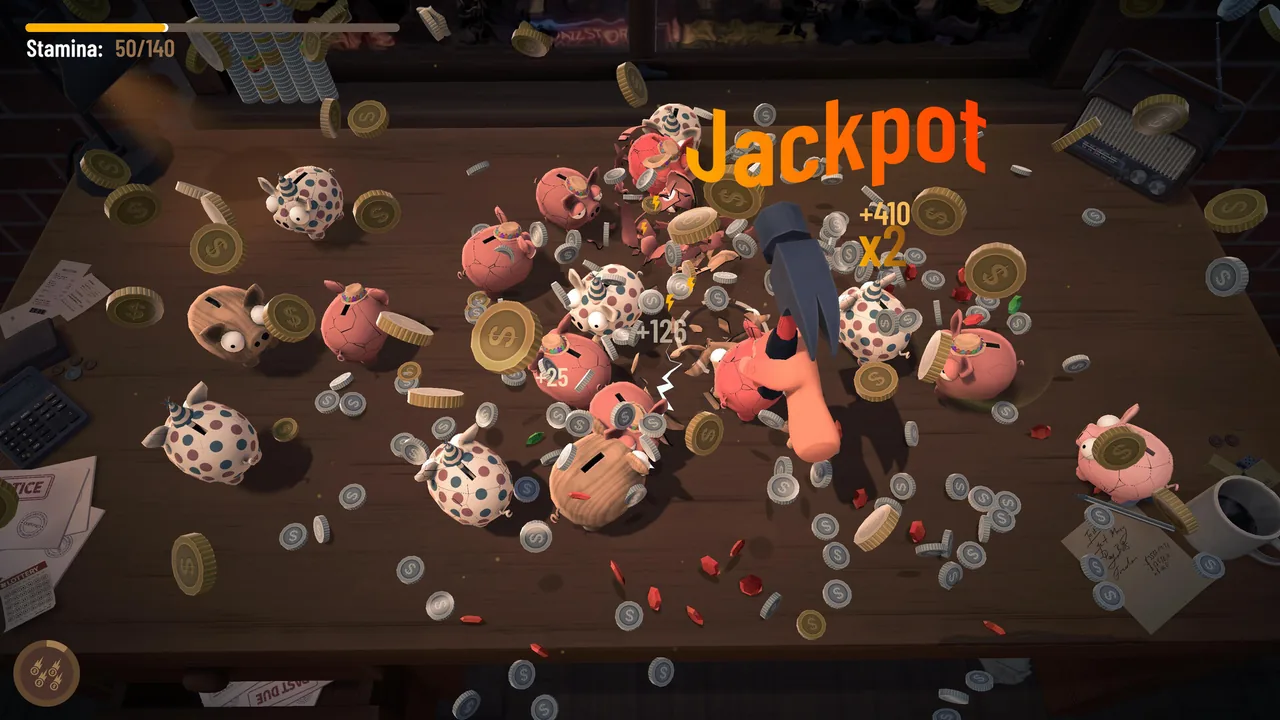
The core loop is deliberately simple: smash piggy banks, collect the coins and loot they drop, and funnel the money into bills before the collector arrives to take a cut. What keeps it from collapsing into mindless clicking is the stamina system. Every swing costs something, and once your hand tires out, the run ends and whatever you've earned gets banked. That single constraint does a lot of design work — it turns "keep clicking" into "decide when this run is worth ending," and it means the choice of hammer actually matters, since different hammers trade crit chance, swing radius, speed and raw damage against each other rather than just scaling one number upward.
Piggy banks aren't uniform targets either. Some flee once you get close, some sit still and take the hit, and the higher-value ones are worth chasing down even at a stamina cost that makes you think twice. It's a small piece of variety, but it's enough to keep the moment-to-moment loop from feeling like the same swing repeated at different speeds.
The skill tree carries the joke
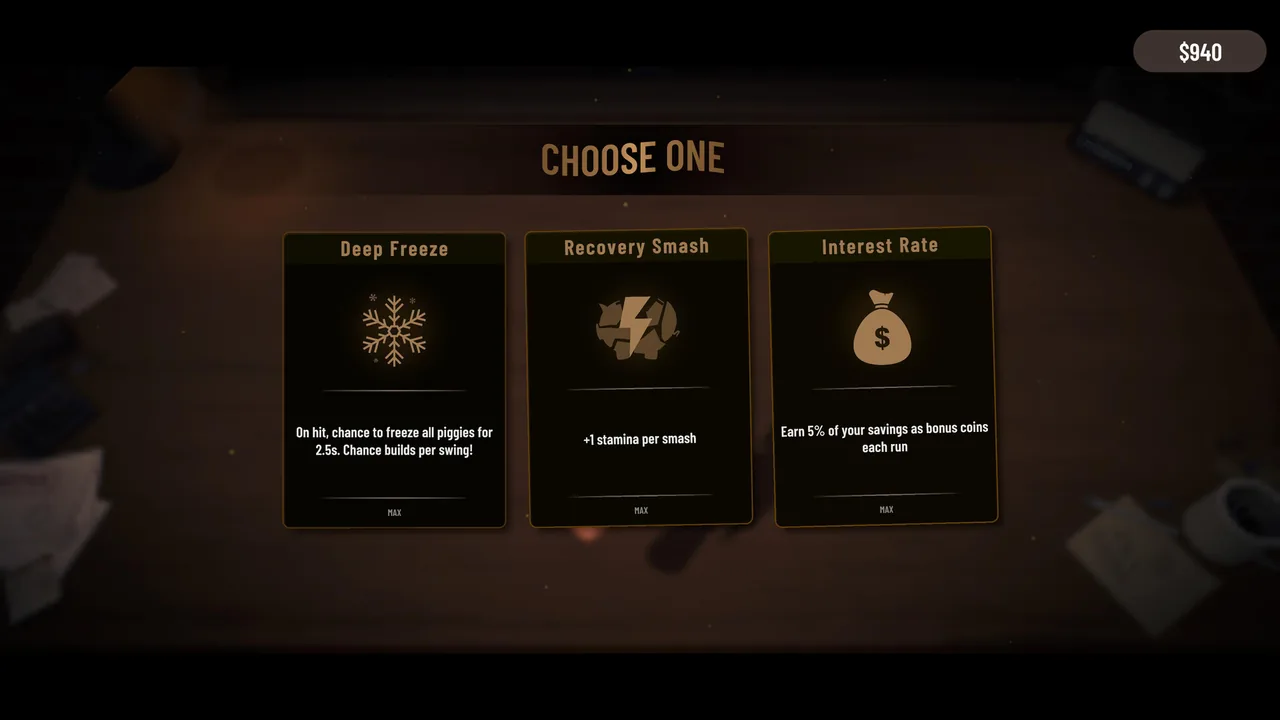
Where a lot of incrementals let their upgrade trees become a wall of percentages, Bills Must Be Paid keeps its skill tree in on the premise. Grip strength, a caffeine habit, gym sessions to build up your swing — the upgrades read like the coping mechanisms of someone actually trying to work their way out of debt, not just abstract multiplier nodes. Special abilities like rock rain or an electrified hammer head give the tree a ceiling worth building toward, and paying off bills on time unlocks its own track of perks, which ties the game's central tension directly to its meta-progression instead of treating debt as flavour text bolted onto a separate system.
The trouble is that tree runs out of ideas faster than the runtime does. By the time a session is winding down, most of what's left to unlock is more of what you've already seen, and a few of the more dramatic abilities are tied to reported trigger rates as low as roughly 3% — rare enough that players describe them as barely proccing even deep into a run. An ability that's supposed to be a highlight doesn't do much for the pacing if you rarely see it fire.
Sound over spectacle
Visually, Bills Must Be Paid is functional rather than ambitious — readable piggy banks, clear destruction feedback, a UI that doesn't get in the way. It's not the game's strongest category, and a recurring note in both player and press feedback is that the targets themselves don't escalate much in appearance as runs progress, which costs the smashing some of its late-run impact.
What consistently gets singled out instead is the audio. Across player reviews, the sound design is the single most repeated compliment the game receives — the crunch of a piggy bank breaking, the chime of a bill getting paid off, small hits that land with more weight than the simple visuals would suggest on their own. For a game built around one repeated physical action, having that action feel good in the ears as much as on screen is doing more of the retention work than any system underneath it.
Why the short runtime is the right call, and where it still bites
Most players report finishing Bills Must Be Paid, achievements included, somewhere in the three- to five-hour range, and the majority treat that as a feature rather than a shortfall — a tightly-paced game that ends before its ideas thin out, at a price that was never pretending to buy more than that. That alignment between scope and price is the clearest reason the Steam response has been this positive: nobody's disappointed by a length the store page never hid.
Where the cracks show is in the systems meant to extend that runtime for players who want more. The prestige structure resets your run in exchange for permanent legacy bonuses, but a consistent thread in negative reviews describes that trade as a net loss rather than a step forward — the bonuses don't feel like they offset what starting over costs, so the loop that's supposed to invite another few hours instead reads as punishment for engaging with it. Upgrade impact flattening out in the late game compounds the same problem: several players describe pushing through a second or third prestige only to find the numbers barely move.
None of this undoes the opening hours, which are close to a best-case example of how to pace a short incremental. It does mean the ceiling on "just one more run" is lower than the strength of the first few hours implies.
Price and monetisation
There's very little to criticise here. Bills Must Be Paid is a flat purchase — NZ$11.25 at full price, discounted to NZ$7.87 during its launch week — with no ads, no in-app purchases and nothing resembling a stamina-refill store bolted onto a system that's explicitly about stamina limits. The irony of a game about debt anxiety refusing to nickel-and-dime its own players is not lost on the people reviewing it, and it's a real part of why the Steam response has stayed this positive: the premise and the business model are pointed in the same direction instead of working against each other.
The one wrinkle worth flagging is that a free browser version of the same core loop is available through itch.io and other portals, alongside a free Steam demo. That doesn't make the paid release a bad deal — it's a fuller build with achievements, cloud saves and the complete skill tree — but it does mean the honest comparison for a curious player is "is the full version worth roughly seven to eleven dollars over the free one," not "is this worth full price against nothing." Most players who've made that comparison have landed on yes.
Final verdict
Bills Must Be Paid succeeds by refusing to overreach. It picks one mechanic, ties it tightly to a premise that's actually funny rather than just novel, gates it with a stamina system that turns clicking into decision-making, and gets out in an afternoon rather than padding itself toward a number that would justify a higher price tag it never asked for. The sound design and the personality baked into the skill tree do more work than the visuals or the late-game systems, and that's the right place for a short, cheap incremental to spend its effort.
It falls short of the top tier because the parts meant to extend its appeal — the prestige reset, the rarest skill-tree abilities, the visual variety of the piggy banks themselves — don't hold up to the same scrutiny as the opening loop. If you want a tight few hours with a joke that actually lands, this is an easy recommendation at its price. If you're hoping the prestige system turns it into a long-term habit, it's worth trying the free version first to see whether that loop grabs you before paying for more of it.
Players who like the idea of a resource that limits how long any one session can run, but want that tension driving a persistent world rather than a single afternoon, might also want to look at Wanderer.
Pros and cons
Pros
- The stamina bar meaningfully paces each run instead of rewarding pure click speed, forcing real decisions about when to swap hammers or push for one more piggy bank
- The skill tree gives its upgrades actual personality — caffeine addiction, gym sessions, electrified hammers — rather than reading as a flat list of plus-percent modifiers
- Sound design is the single most consistently praised element in player feedback, turning every swing and every bill payment into a small, distinct payoff
- A flat one-time Steam price with no ads and no in-app purchases undercuts the exact financial anxiety the premise is satirising
- Runtime matches the price: most players finish and fully achievement-hunt it in under five hours, and the game doesn't pad that out with filler stages
Cons
- The skill tree and hammer upgrades flatten out well before the game ends, and several of its flashier abilities are gated behind reported trigger chances as low as roughly 3%, which makes them feel more like decoration than a real system
- The legacy/prestige reset meant to extend the loop reads to a real slice of players as a step backwards rather than forward momentum, since the bonuses it grants don't offset what a fresh run loses
- Piggy bank variety doesn't extend far into presentation — the targets you're smashing look and behave similarly across most of a run, and a few reviewers single out the lack of visual escalation as the destruction stops feeling special
- A free browser version of the same core loop exists on itch.io and other portals, which puts a specific, comparable price tag on the convenience of the paid Steam release for anyone who finds it after already trying the free version
Screenshots
-
Bills Must Be PaidImage: Rike Games via Steam -
Bills Must Be PaidImage: Rike Games via Steam -
Bills Must Be PaidImage: Rike Games via Steam -
How the review scores each part of the gameWanderer Editorial -
The short versionWanderer Editorial