
Game review
Agrivore: Incremental Farming
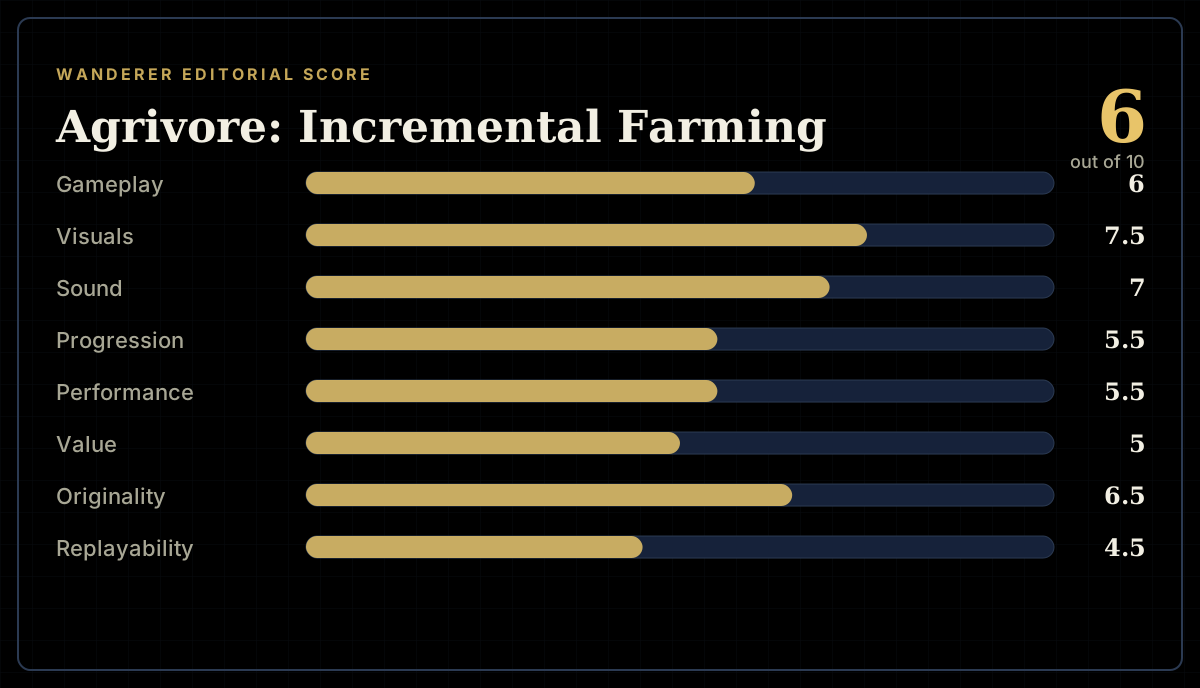
6 / 10
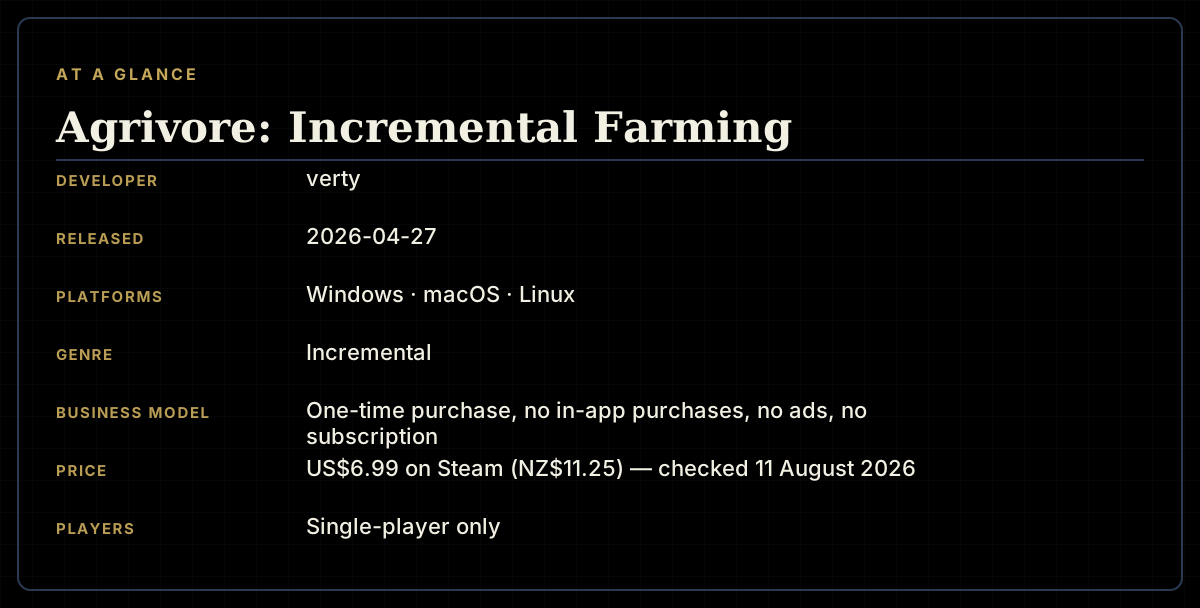
- Developer
- verty
- Publisher
- Rogue Duck Interactive, Gamersky Games
- Released
- 27 April 2026
- Platforms
- Windows, macOS, Linux
- Genre
- Incremental
- Monetisation
- One-time purchase, no in-app purchases, no ads, no subscription
- Players
- Single-player only
The short version
Agrivore takes the auto-attacking "point a weapon at a swarm and watch numbers climb" loop that Vampire Survivors popularised and re-skins it as farming: you sweep a magic tool across a field, crops die instead of monsters, and the harvest buys equipment and skill-tree nodes for the next run. It's a clean, well-observed hybrid, and the pixel art and music land well with almost every reviewer, negative or positive. What it doesn't survive is repetition. A large share of both the positive and negative Steam reviews describe finding one dominant crop-and-weapon combo in the first half hour and then repeating that exact build to the credits, because the game's own balance rewards it and its own systems punish trying anything else.
This isn't a minority complaint dressed up as a review-bombing pile-on — the game's public achievement data shows almost the whole audience reaching the credits, which is exactly what you'd expect if a large share of players found the one build that trivialises everything and rode it to the end. A US$6.99 price for what most reviewers clocked at two to six hours isn't unreasonable on its own, but it's a harder sell when a big piece of that runtime is optional 100%-completion grinding through a skill tree that stops offering real choices early.
Biggest strengths
- The auto-attack-farming hybrid is a genuinely fresh spin on the bullet-heaven formula, and almost every reviewer — positive or negative — singles out the pixel art, music and general feel as a highlight
- Cheap to get into and quick to finish, which several reviewers count as a feature rather than a flaw for an afternoon session
- A skill tree with real branching choices on paper, plus a King's Mood system aimed specifically at discouraging players from replaying the exact same optimal build
Biggest weaknesses
- The single most repeated complaint across the negative reviews, independently and in almost identical language, is that one starting crop (a fast-spawning mushroom) is so far ahead of its alternatives that there's rarely a reason to pick anything else, and the King's Mood system meant to discourage repetition doesn't fix the underlying imbalance
- Multiple reviewers describe outright bugs — weapon effects that don't fire correctly, upgrade tooltips that don't match what the upgrade does, a gameplay screen occasionally rendering on top of the results screen — on a game with achievements and leaderboards, where reliability matters more than usual
- The game's own achievement curve barely tapers from first login to final boss, which lines up with reviewer complaints that a dominant build lets you clear the whole skill tree and the end boss without engaging most of what's on offer
Who it's for: Incremental and bullet-heaven fans who want something that can be finished in an afternoon rather than fed for weeks, and who don't mind that the "best" way to play tends to reveal itself fast.
Our recommendation: Worth it on a sale for a short, good-looking couple of sessions; think twice at full price if repeatable build variety and a long tail of progression matter to you.
6 / 10
Somewhere in the last few years, "point an auto-firing weapon at an endless swarm and watch the numbers climb" stopped being a Vampire Survivors impression and became its own load-bearing genre convention, one incremental games have been quietly borrowing from ever since. Agrivore: Incremental Farming takes that borrowing further than most and makes it literal: instead of a survivor mowing down bats and skeletons, you're a farmhand sweeping a magical tool across a field, and the thing dying in waves is the crop. Harvest enough of it and you feed a "gluttonous King," unlock new farming gear, and spend the proceeds on a skill tree that carries into the next run. It's a sharp, specific idea for a genre that mostly reskins the same chassis, and on Steam it currently sits at a Mixed 61% positive across 107 reviews — a small enough sample, particularly on the negative side, that this review is built on every single one of the 42 negative reviews on record at time of writing, not a skimmed selection of the loudest ones.
A genuinely clever hybrid, on paper
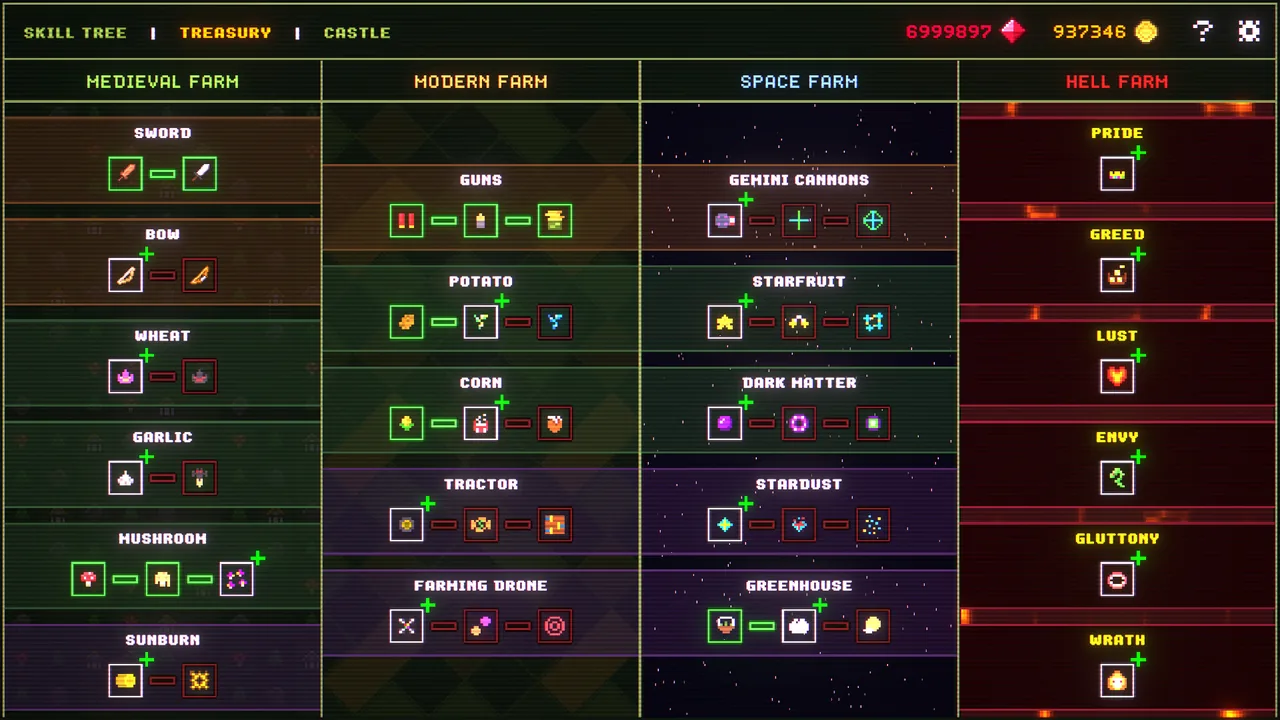
The pitch is easy to picture even without playing it: crops spawn across a field in waves, your equipped weapon (options extend to bows, guns, lasers and more as you unlock them) auto-targets and clears them, and each crop type carries its own passive effect layered on top of raw harvest value. The store page's own trailer shows the intended shape of a late run — screens fully chaotic with harvest effects chaining off each other — and that same "hyper combo" framing shows up constantly in the positive reviews, several of which describe becoming "addicted" within minutes of picking it up. The skill tree sits underneath as the meta-progression layer familiar from any incremental: spend the Crowns you've banked to permanently unlock and strengthen equipment, then take that stronger loadout into the next farm.
Presentation is the one area with almost no dissent in the review sample. Reviewers on both sides of the recommend/don't-recommend line single out the pixel art, the music and the general feel of the harvest loop as a highlight — "extremely satisfying," "such a fun game," "the visuals captivated me" all appear in different reviews written months apart. One negative reviewer who still couldn't recommend the game called it "a cute and very interesting incremental that lacks the polish to be worth finishing." That's a genuinely rare thing for a Mixed-rated release: agreement on what the game gets right, and disagreement almost entirely confined to what happens after the first thirty minutes.
The mushroom problem
Read enough of the negative reviews back to back and one specific complaint recurs with a consistency that stops looking like taste and starts looking like a measurable balance flaw: the mushroom, one of the game's starting crops, spawns fast enough and stacks strongly enough with early weapon choices that it dominates every other option for most of a typical run. "Mushrooms are massively overpowered. There's basically no reason to use anything else for most of the game," one reviewer wrote, and versions of that sentence show up independently across reviews with wildly different playtimes — 94 minutes, 293 minutes, 707 minutes. One Japanese-language reviewer with nearly 12 hours logged noted that garlic, a different crop, behaved almost identically to mushroom in its overpowered stacking before a patch addressed it, but that mushroom itself was strong enough that the imbalance felt tolerable either way.
The developer's response, several reviewers note, was a system called King's Mood: reusing the same crop across consecutive runs incurs a growing penalty meant to push players toward variety. On paper that's a reasonable fix for exactly this complaint. In practice, multiple reviewers describe it as papering over the underlying problem rather than solving it — one wrote that the mood system "doesn't really solve this either — it just forces you off [mushroom] for a run or two" before drifting back to the same build, and another described a bug where stacking spawn-rate upgrades on top of the mood penalty could paradoxically make mushroom's spawn rate collapse toward zero. When a patch-era system is being independently reported as either cosmetic or buggy by reviewers who don't appear to know about each other's reports, that's a stronger signal than any single complaint on its own.
What the achievement data actually shows
Agrivore ships with nine Steam achievements, and Steam's global completion percentages for them lay out the shape of the whole playerbase's experience more honestly than the review text alone:
| Achievement | Global completion |
|---|---|
| Farm Architect (early progress) | 98.0% |
| First Blood | 90.8% |
| Ascended | 84.9% |
| Modernize | 84.0% |
| Leave The Atmosphere | 68.2% |
| Devil's Field | 56.5% |
| Land Baron | 56.4% |
| Polyplot Theorist | 51.5% |
| Kill The God (hidden, final boss) | 49.1% |
For comparison, incremental and roguelite achievement curves typically fall off a cliff somewhere in the back half — the games that don't are usually either extremely short or extremely easy to break wide open. Agrivore's curve does neither dramatically: it drifts down gently from 98% to 49% across nine achievements, meaning very nearly half of everyone who ever launched the game also beat its final boss. That's an unusually flat curve for a genre where the whole design intent is usually a long, thinning tail of dedicated players pushing further than the rest. It corroborates, almost exactly, what the negative reviews describe in prose: find the mushroom-and-weapon build early, ride it through the skill tree, and the "boss" falls "super easy without even completing 1/3 of the skill tree," as one reviewer put it. A completion rate this high isn't proof the game is bad, but it is hard evidence for the specific shape of the complaint — that the game's ceiling is reachable by roughly half its audience without engaging most of what it built.
Bugs, and a price built for more hours than most players used
Beyond balance, a recurring second thread in the negative reviews is reliability: weapon visual effects that don't fire correctly on some upgrades, upgrade tooltips describing effects the upgrade doesn't actually produce, and at least two independent reports of the results screen and gameplay screen rendering on top of each other. None of these read as game-breaking on their own, but they stack badly with a game that also asks players to grind a prestige loop for its achievements and leaderboards, where correctness matters more than in a purely cosmetic idle game. Several reviewers note the developer has kept patching since launch — one long-playtime review specifically credits a recent update with fixing a laser weapon that had been silently failing to trigger harvest effects — which is the right instinct, even if the mushroom-level balance question looks unresolved as of this review.
Price is the other recurring friction point. At US$6.99 full price, Agrivore isn't expensive by any objective measure, but multiple reviewers who paid it directly compare that price to a Steam marketing post advertising 6+ hours of content, and then report 100%-completing the game in two to five hours — one in as little as two hours flat after a discount purchase. "The price still felt pretty steep for what it provided," one wrote, adding they never felt progression "pay off" the way a longer incremental would. None of this is a demand for the game to be free; it's a specific, repeated mismatch between the runtime pitched and the runtime most reviewers actually needed to see everything the game has.
Where it sits next to its neighbours
Within its own micro-genre, Agrivore is closer to a bullet-heaven roguelite wearing an incremental's meta-progression than a traditional idle game, which makes Soulstone Survivors and Vampire Survivors itself the more useful comparisons than a typical clicker. Both of those games solve the "one build dominates" problem Agrivore struggles with by shipping enough viable weapon and character combinations that finding the single best one takes real playtime, not thirty minutes — the exact gap the negative reviews are describing. Readers who want the farming half of the pitch without the balance complaints might also look at Farmer Against Potatoes Idle, a free idle RPG built around a similarly silly farming-combat premise that reviewed well specifically for pacing its progression out further than a single sitting.
Final verdict
Agrivore: Incremental Farming has a genuinely good idea at its core — auto-attack bullet-heaven combat wearing a farming skin, built with real craft in its pixel art and music — and it's easy to see why a solid majority of Steam reviewers still recommend it. But the negative reviews aren't a scattered pile of unrelated complaints; they converge, independently and repeatedly, on one specific balance failure that the game's own achievement data corroborates: a dominant early crop that lets roughly half the entire playerbase reach the credits without needing to explore most of what the skill tree offers. Add a handful of persistent visual and tooltip bugs and a runtime that several paying reviewers found shorter than advertised, and what's left is a good-looking, promising incremental that needed one more balance pass before launch. Worth a look on a sale for an afternoon; a harder recommendation at full price until the mushroom problem gets solved rather than worked around.
Anyone drawn to the numbers-go-up satisfaction of watching a build compound over a run, without a single dominant strategy trivialising the rest of the game, might also enjoy Wanderer, where gear and skill progression is deliberately spread across enough overlapping systems that no one early choice quietly ends the decision-making for everyone else.
Pros and cons
Pros
- The auto-attack-farming hybrid is a genuinely fresh spin on the bullet-heaven formula, and almost every reviewer — positive or negative — singles out the pixel art, music and general feel as a highlight
- Cheap to get into and quick to finish, which several reviewers count as a feature rather than a flaw for an afternoon session
- A skill tree with real branching choices on paper, plus a King's Mood system aimed specifically at discouraging players from replaying the exact same optimal build
- Steam Achievements, Cloud saves and Leaderboards are all wired in for a budget release, and a free demo exists for anyone who wants to try the loop before paying
- The developer has visibly kept patching post-launch — several reviews reference recent fixes to broken visual effects and drop-rate bugs
Cons
- The single most repeated complaint across the negative reviews, independently and in almost identical language, is that one starting crop (a fast-spawning mushroom) is so far ahead of its alternatives that there's rarely a reason to pick anything else, and the King's Mood system meant to discourage repetition doesn't fix the underlying imbalance
- Multiple reviewers describe outright bugs — weapon effects that don't fire correctly, upgrade tooltips that don't match what the upgrade does, a gameplay screen occasionally rendering on top of the results screen — on a game with achievements and leaderboards, where reliability matters more than usual
- The game's own achievement curve barely tapers from first login to final boss, which lines up with reviewer complaints that a dominant build lets you clear the whole skill tree and the end boss without engaging most of what's on offer
- Several reviewers who paid full price at launch felt the six-hours-of-content pitch didn't hold up, finishing and 100%-completing the game in two to three hours
- Prestige, the game's core replay loop, resets the entire skill tree for what multiple reviewers describe as small, decimal-point gains, and more than one called the required repeat clicking through the tree "carpal tunnel inducing"
Screenshots
-

Agrivore: Incremental FarmingImage: Rogue Duck Interactive via Steam -

Agrivore: Incremental FarmingImage: Rogue Duck Interactive via Steam -
Agrivore: Incremental FarmingImage: Rogue Duck Interactive via Steam -
How the review scores each part of the gameWanderer Editorial -
The essentials at a glanceWanderer Editorial -
The short versionWanderer Editorial