Game review
Dwarf Eats Mountain
8.5 / 10
- Developer
- Green Wizard
- Publisher
- Green Wizard
- Released
- 18 May 2026
- Platforms
- Windows, Linux, Browser
- Genre
- Incremental
- Monetisation
- Premium, one-off purchase — no in-game purchases; a free browser build is on itch.io
- Players
- Single-player
The short version
The best-argued incremental of the year so far. Most games in this genre give you a number and ask you to make it bigger; this one gives you a mountain, a payroll and a logistics problem, and the number goes up as a consequence of solving it.
Runs are short enough to hold their shape, the artifact pool is deep enough that builds diverge properly, and at around fifteen dollars with no purchases inside it, the value case is embarrassing for most of the genre. Its weakness is the usual incremental one — the middle of a run can settle into watching.
Biggest strengths
- Every run is a real puzzle — extraction rate against how much of the mountain you can safely bring home
- 120-plus artifacts change how a run is played, not just how fast the numbers climb
- Nearly 100 prestige upgrades give the meta-layer somewhere to go for weeks
Biggest weaknesses
- Mid-run stretches turn passive once a build is locked in, which is the genre's oldest problem
- The browser build slows noticeably in the late game when physics objects pile up
- No offline progression to speak of — this is an idler you watch, not one you leave for a day
Who it's for: Incremental players who want decisions rather than a ticking counter, and anyone who likes roguelite meta-progression attached to a fantasy economy.
Our recommendation: Try the free browser build first — it is the same game with worse late-run performance. If you're still there an hour later, the paid version is the version to own.
8.5 / 10
The pitch is stupid in the best way. There is a mountain. You have dwarves. The dwarves have ballistas, flamers, dynamite and, later, laser cannons, and the mountain has gold in it. Point the one at the other until there is no mountain left.
What makes Dwarf Eats Mountain the most interesting incremental released this year is that the demolition is the easy half. Getting the gold home is the game.
The loop has an actual problem in it
Break rock and the treasure has to be hauled back by runners while the mountain, now thoroughly annoyed, drops things on them. So every decision has two sides: more extraction means more gold on the ground, and gold on the ground is worth nothing until someone survives the trip with it.
That single tension is why this doesn't play like a spreadsheet. You are constantly trading throughput against safety — do I add another dynamite thrower, or the housing and the runners to keep up with the one I already have? Most incrementals ask which upgrade is mathematically best. This one asks what your operation can actually absorb, and the answer changes as the mountain degrades.
The unit list backs it up. Spelunkers, brewmasters, bulldozers, gyrocopters, ballistas, flamers — they do different jobs rather than the same job at different rates, so a build reads as a composition. Rituals give you an active lever to pull when a run is going sideways. Mithril and mountain souls are the scarce currencies that force you to actually choose.
Runs and the layer above them
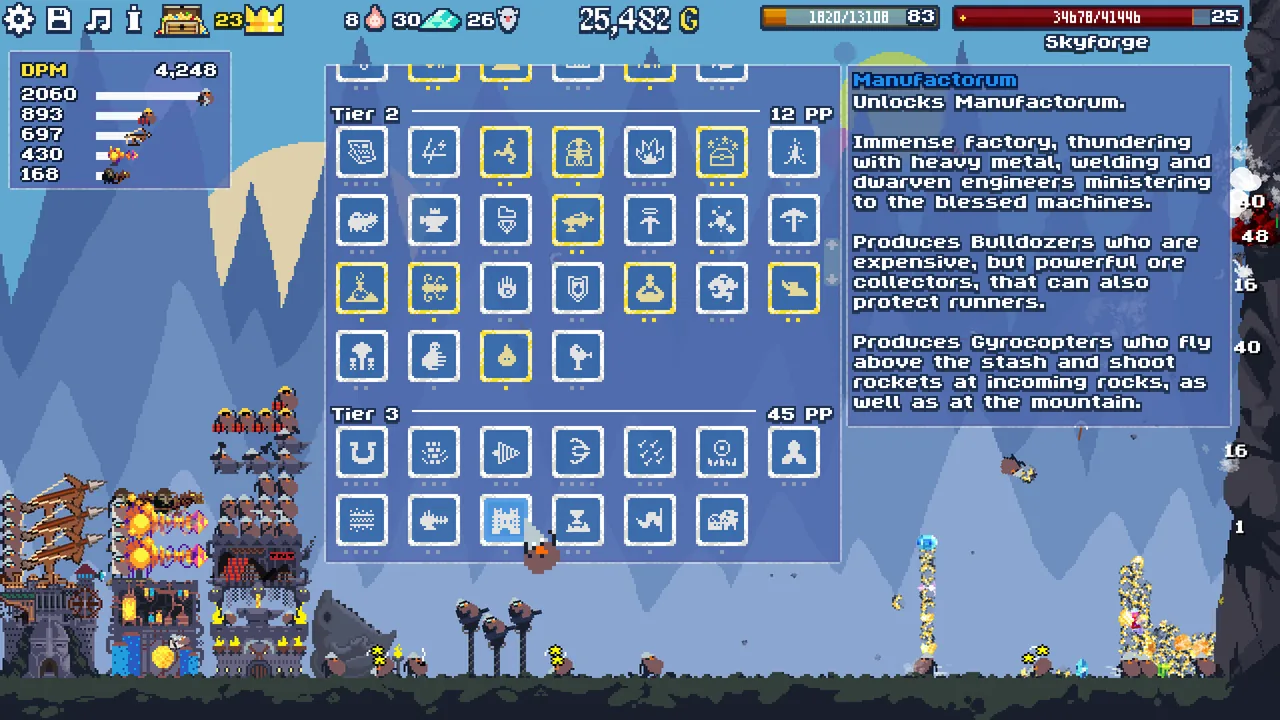
It's a roguelite in structure: a run, a reset, a permanent upgrade, a better run. The meta-layer is where the hours accumulate — around 96 prestige upgrades and more than 120 artifacts, which is a lot of pool for a game at this price. Artifacts are the part that matters. They shape how a run is played rather than multiplying its output, and the good ones combine into the kind of nonsense synergy that makes you start a run specifically to see whether it works.
The pacing is well judged. Runs are short enough that a failed one costs you an evening's mood rather than an evening, and the prestige ladder always seems to have the next rung in view. That's the hardest thing to tune in this genre and Green Wizard has tuned it well.
Where it's ordinary
Two honest limits.
First, the middle of a run gets passive. Once your composition is set and the mountain is coming apart on schedule, there's a stretch where you're a spectator with a ritual button. That's endemic to incrementals and this game is better at fighting it than most — the mountain's calamities keep interrupting — but it doesn't escape it.
Second, this is an idler in the watching sense, not the away sense. There's no meaningful offline progression: close it and it stops. If your idea of an idle game is one that funds your morning while you're at work, this is a different animal, and the tag will mislead you.
The browser build, which the developer keeps free on itch.io, comes with its own caveat that Green Wizard states plainly: it slows down late in a run when the physics objects stack up, and it can't carry a save to Steam. Treat it as a demo of the design rather than the way to own the game.
Presentation and price
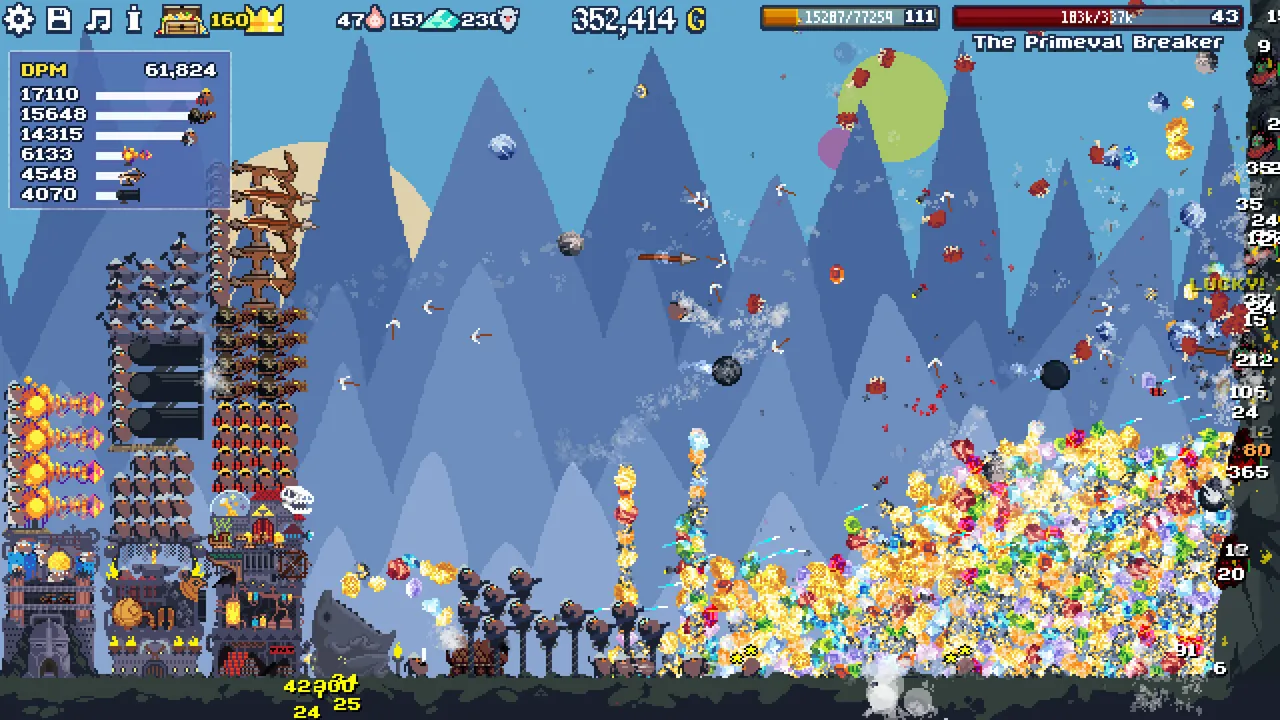
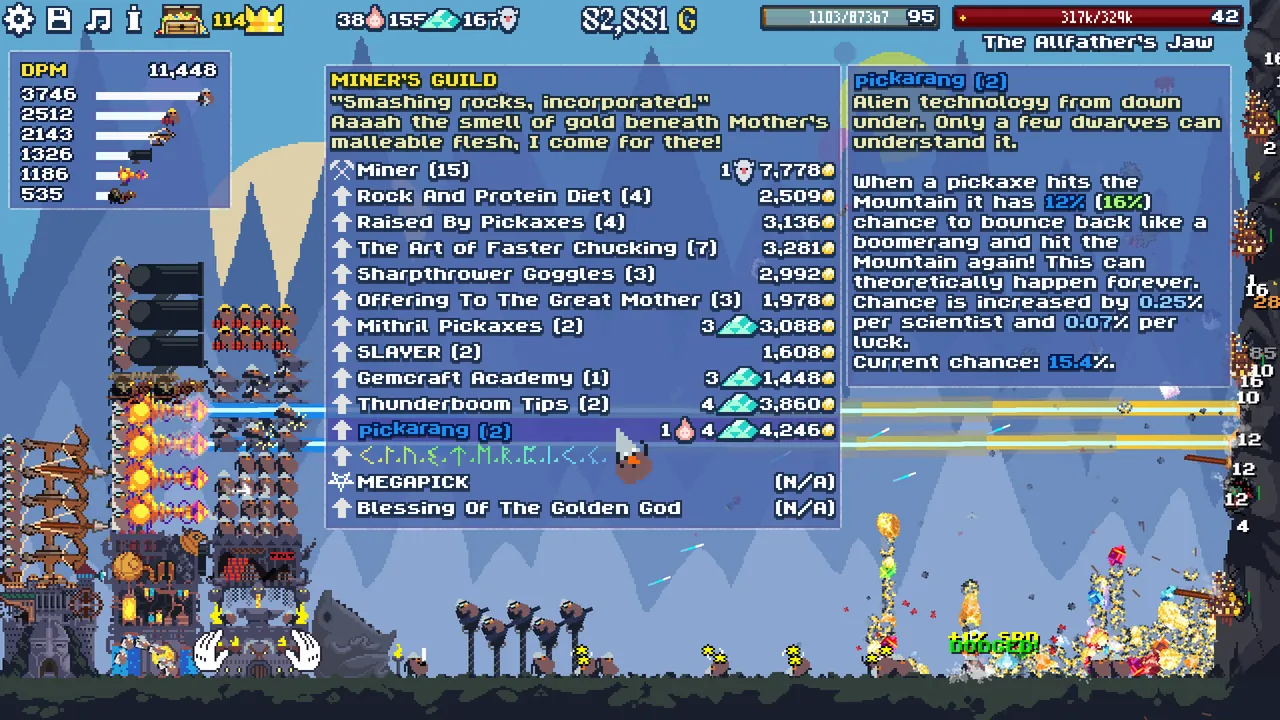
Cheerful pixel art, clean silhouettes on the units, and a mountain that visibly deteriorates as you eat it — the art is doing real informational work, not just decorating. The interface is dense and gets denser, and it explains itself less well than it might; expect to learn some of it by experiment. It runs on essentially anything, which is a genuine feature and not a joke about the listed requirements.
Around fifteen New Zealand dollars, bought once, with no in-game purchases at all. In a genre where "free" usually means an advert every four minutes and a shop full of time-skips, that deserves saying out loud.
Verdict
Eight and a half, and the half point it's missing is passivity rather than anything broken. Dwarf Eats Mountain understands that the pleasure of an incremental is not the number climbing, it's the moment you realise why the number can climb faster — and it keeps giving you new reasons for weeks. The artifact pool has range, the prestige ladder has depth, and the run structure keeps both in front of you.
If you want an idle game to run while you're away, look elsewhere — this one wants your attention, in bursts, and rewards it. If you want the best few hours of incremental design released this year for the price of a sandwich, start here.
Price and store details checked 29 July 2026.
Pros and cons
Pros
- Every run is a real puzzle — extraction rate against how much of the mountain you can safely bring home
- 120-plus artifacts change how a run is played, not just how fast the numbers climb
- Nearly 100 prestige upgrades give the meta-layer somewhere to go for weeks
- Units have distinct jobs, so a build is a composition rather than a shopping list
- Runs on a potato — a couple of hundred megabytes and no graphics card worth naming
- One purchase, no currencies, no timers, no adverts
Cons
- Mid-run stretches turn passive once a build is locked in, which is the genre's oldest problem
- The browser build slows noticeably in the late game when physics objects pile up
- No offline progression to speak of — this is an idler you watch, not one you leave for a day
- Interface density grows faster than its explanations do
- Single-player and self-contained, with nothing social attached
Screenshots
-
Dwarf Eats MountainImage: Green Wizard via Steam -
Dwarf Eats MountainImage: Green Wizard via Steam -
Dwarf Eats MountainImage: Green Wizard via Steam -
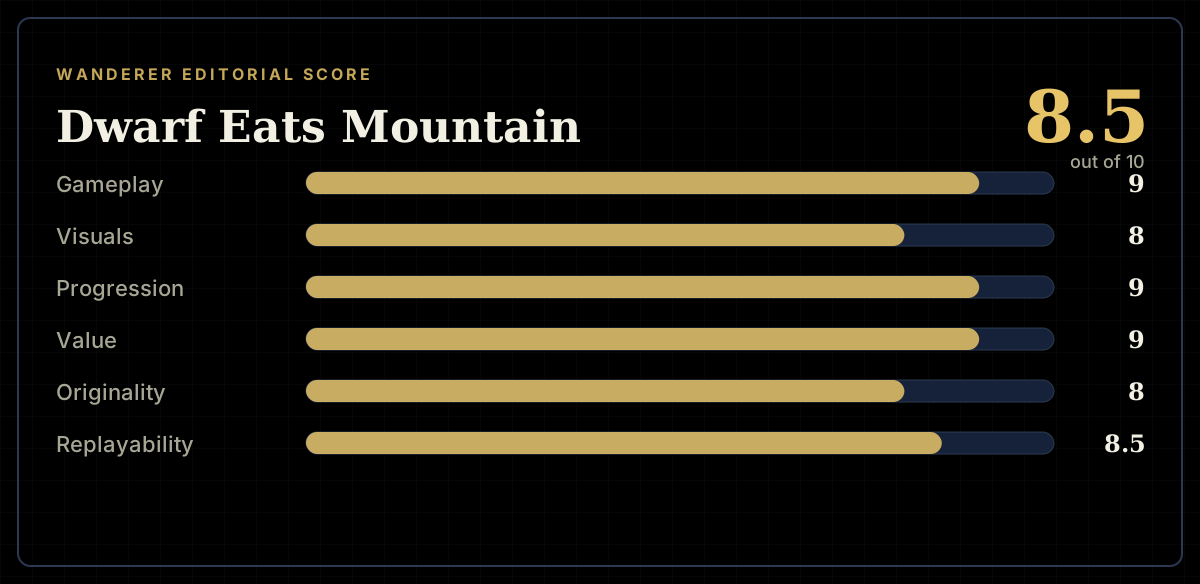
How the review scores each part of the gameWanderer Editorial -
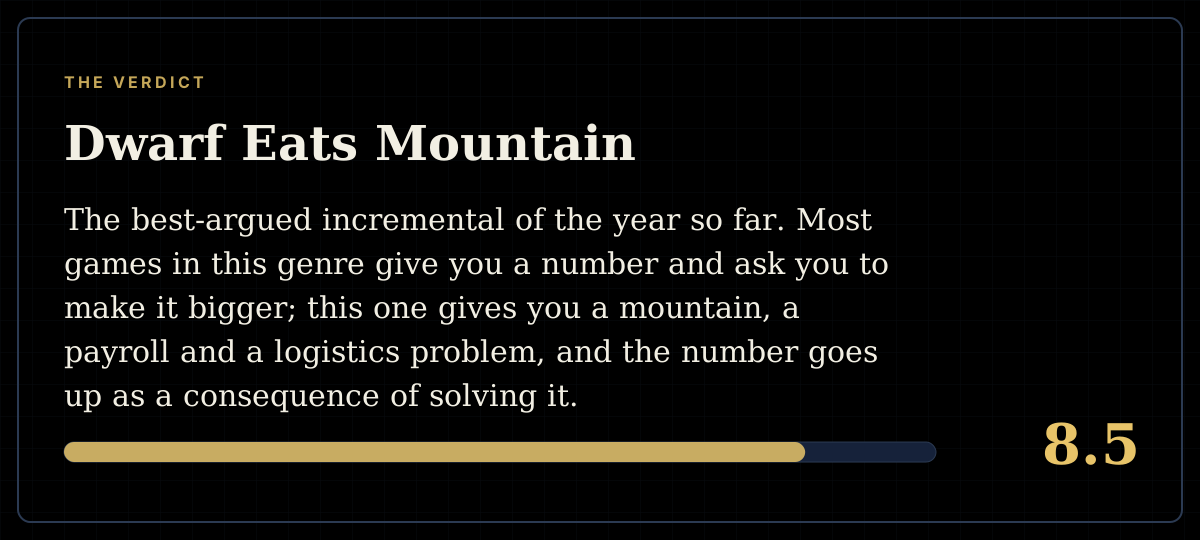
The short versionWanderer Editorial