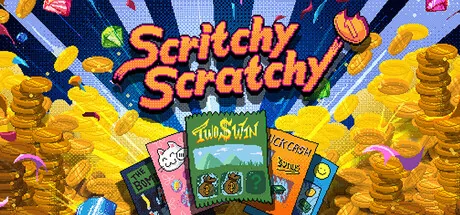
Game review
Scritchy Scratchy
7 / 10
- Developer
- Lunch Money Games
- Publisher
- Funday Games
- Released
- 18 March 2026
- Platforms
- Windows, macOS
- Genre
- Incremental
- Monetisation
- One-off premium purchase. Two optional add-ons exist — a Supporter Pack and an original soundtrack — and neither touches gameplay; both are pure pay-what-it's-worth extras for people who liked the base game enough to throw a few more dollars at the developer
- Players
- None. Single-player only, with no leaderboard or shared-progress feature
The short version
Scritchy Scratchy takes the single most tactile idea in casual gaming — dragging a coin across a scratch card and watching the foil peel away — and builds a genuinely well-judged incremental economy around it, complete with a prestige loop that hands out permanent upgrades for resetting your bankroll. The scratching itself never stops feeling good, even once you've automated it away. What it doesn't have is enough game behind that feeling: the difficulty curve loosens its grip too early, several late-game systems arrive after most players have already stopped needing them, and more than one reviewer has hit a wall around the two-to-three hour mark where the number still goes up but nothing about watching it do so has changed.
Biggest strengths
- Dragging the cursor across a card to reveal its symbols is a genuinely satisfying physical gesture that most clicker games never bother reaching for
- The prestige layer's Jack Points buy permanent upgrades that actually reshape strategy — slow-and-steady odds-boosting versus high-variance jackpot-chasing — rather than a single flat multiplier
- Fully premium with no in-app purchases, energy timers or premium currency anywhere in the base game; both add-ons are optional and change nothing about play
Biggest weaknesses
- Several of the higher-tier prestige upgrades unlock only after a player has already accumulated everything they were meant to help with, so the reward arrives after the problem it solves is gone
- One upgrade branch is still labelled "Coming Soon" in the shipped 1.0 build, which reads as unfinished even though the game isn't marketed as Early Access
- The core loop of buy, scratch, automate, prestige repeats with limited new context after the first couple of hours, and a meaningful slice of the negative review sample specifically describes losing interest once the automation phase takes over
Who it's for: Incremental fans who want a short, cheap, extremely tactile session rather than a months-long commitment, and anyone who enjoys the sensory pull of a real scratch ticket without the part where it costs money to lose.
Our recommendation: Worth the asking price for a focused few hours, but go in expecting a tight arcade-style loop rather than a long-tail incremental you'll still be running in a month — and if that shorter shape sounds like a downside rather than a feature, wait for a sale.
7 / 10
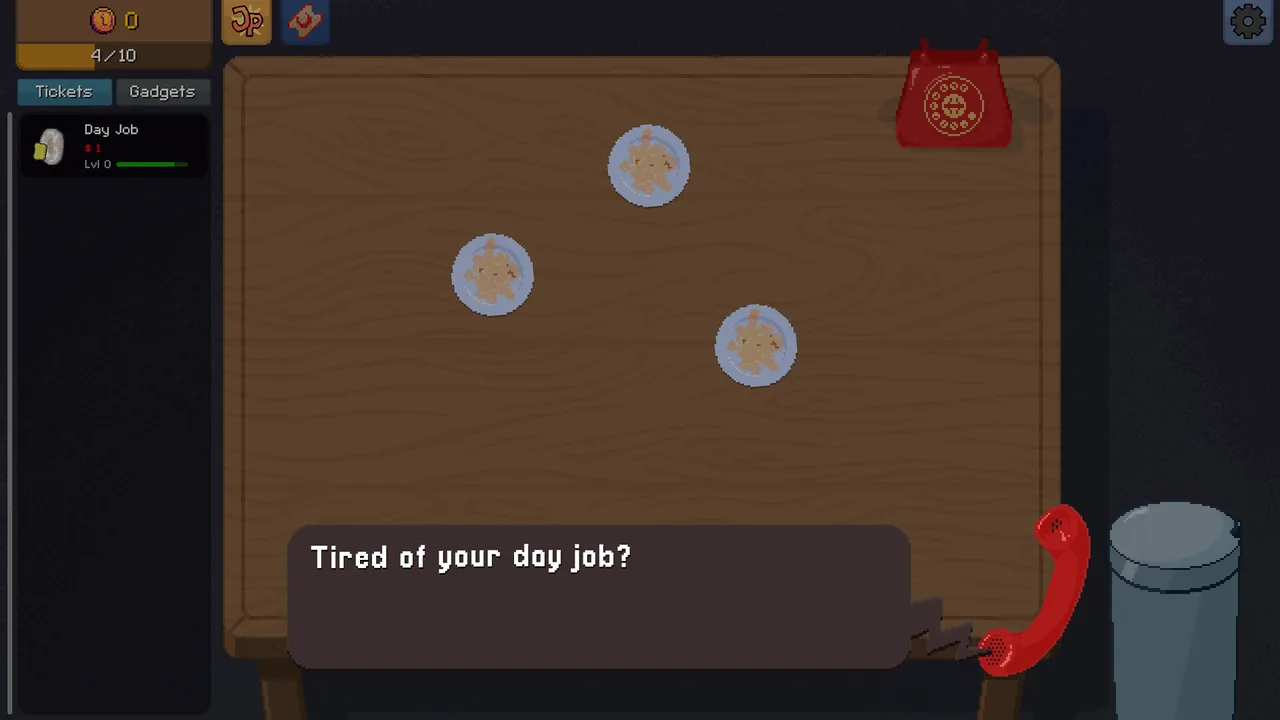
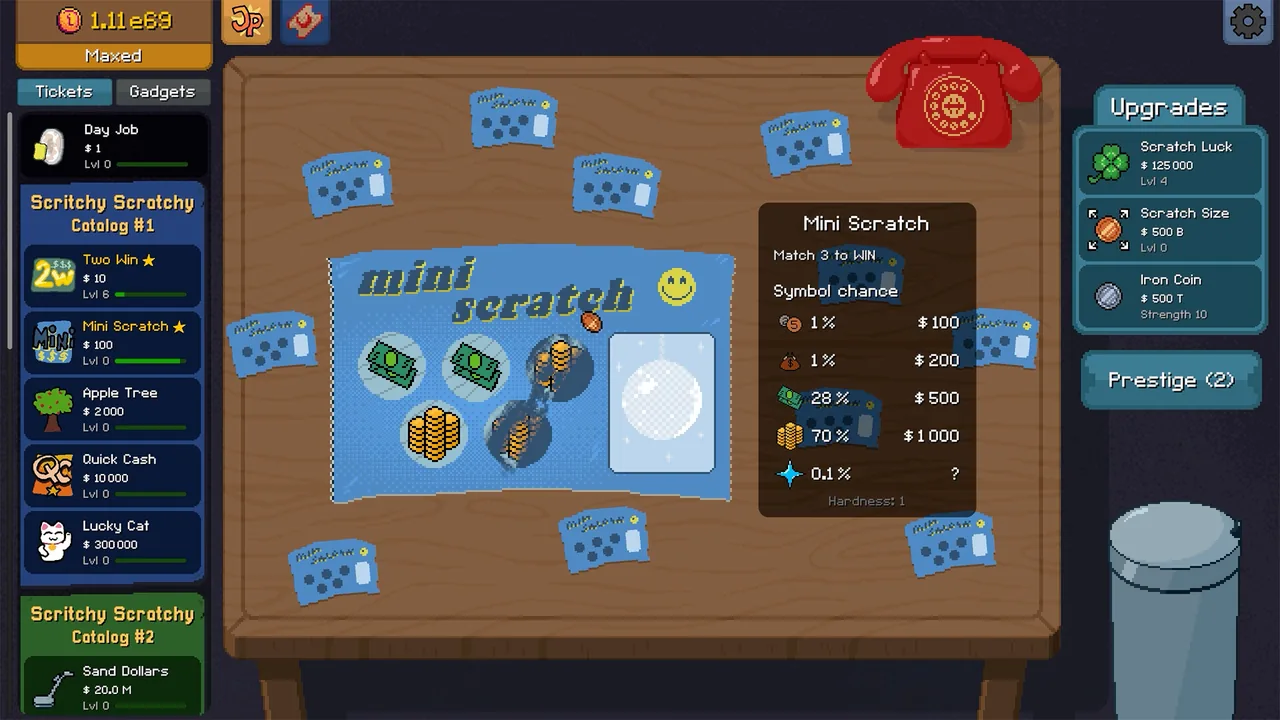
Most incremental games ask you to click a button. Scritchy Scratchy asks you to drag a coin across a piece of foil and watch it curl away in little flakes, and that one change in verb — click versus scratch — turns out to matter more than it has any right to. The game's entire opening hour is built on that gesture: buy a stack of tickets, scratch them one at a time, watch symbols line up into wins, and reinvest the payout into bigger stacks and better odds. It's a scratch-card simulator that happens to also be a very competent incremental, rather than the other way around, and for as long as the scratching stays the point, it's one of the most purely enjoyable things in the genre this year.
The core loop
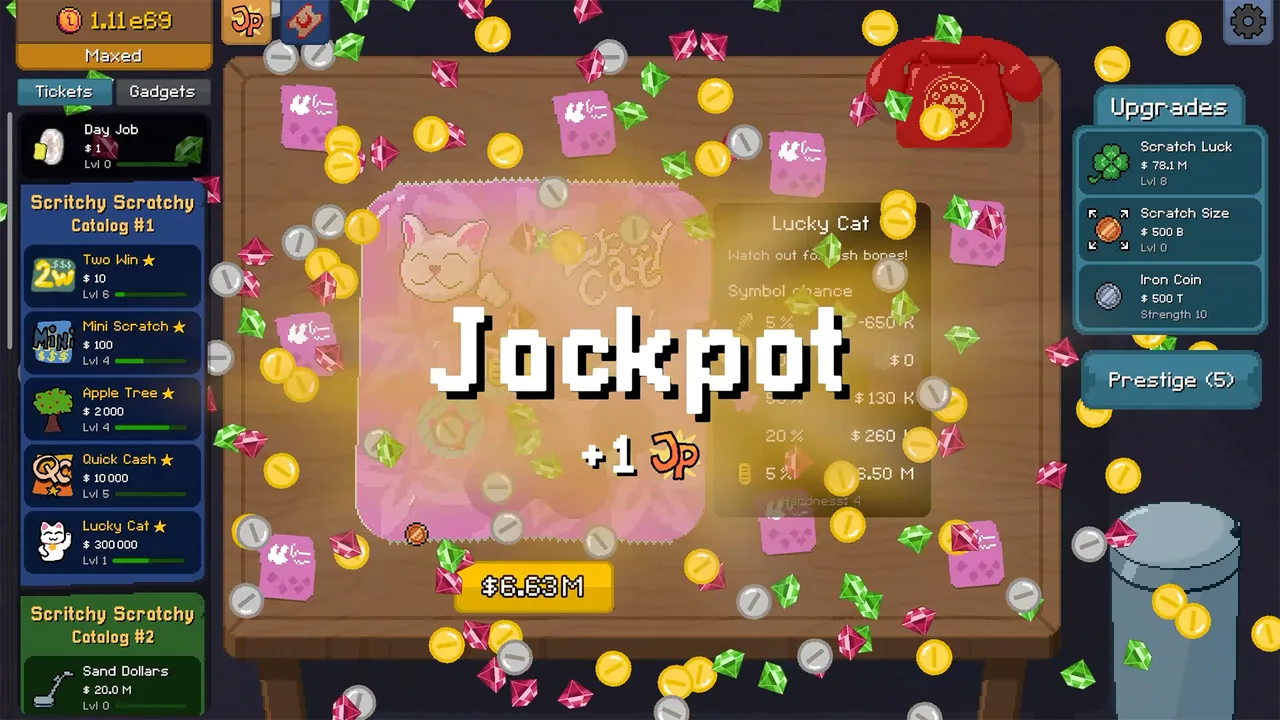
The shape will be instantly familiar to anyone who's played a modern clicker: manual play gives way to automation, automation gives way to a prestige reset, and the prestige reset hands out a new currency — Jack Points — that buys permanent upgrades for the next run. What keeps it from feeling like a reskin is how much weight the game puts on the physical act underneath all of that. Different scratch card variants introduce their own rules as the run progresses — some trade steady, modest payouts for total safety, others dangle a monstrous jackpot behind a real chance of losing your stake outright — and choosing which cards to run is a genuine strategic decision, not just a bigger number replacing a smaller one. The Scratch Bot, the game's automation unlock, is deliberately framed as a labour-saving device rather than the point of the game: it takes over the physical scratching, but it doesn't take over the choice of which cards are worth scratching in the first place.
The Jack Points prestige system is the other genuine strength. Rather than a single "ascend for a permanent multiplier" screen, it splits into upgrade paths that meaningfully change how a run plays: a cautious build that boosts baseline odds and softens penalty cards, versus an aggressive one that leans into high-variance tickets for the chance at an early runaway economy. Both are viable, and switching between them across resets is one of the better reasons to keep playing once the first prestige cycle is behind you.
Where the pacing comes apart
The trouble starts once that first big loop closes. A significant share of Scritchy Scratchy's negative reviews converge on the same complaint from different angles: the game is extremely fun for two or three hours and noticeably thinner after that. Several of the deeper prestige upgrades unlock only once a player has already stockpiled the resources they were designed to help manage, which means the reward shows up after the problem is solved rather than as a solution to it — a structural pacing error rather than a difficulty one. One upgrade branch is still flagged "Coming Soon" inside the shipped 1.0 build, which is a strange thing to find in a game that isn't marketed as Early Access and has been out since March.
It's worth being precise about what this isn't: Steam's global achievement data shows a smooth, gradual decline rather than a cliff — the easiest achievement sits at 95.7% completion and the hardest at 12%, with a fairly even staircase between them rather than a sudden drop-off partway through. That's a healthier curve than plenty of incrementals manage, and it argues against the game running dry in any literal sense. What the review sample is actually describing is closer to a game whose mechanical surface stops changing well before players stop being able to progress — the number keeps climbing, but the climbing stops teaching you anything new. For a genre that lives or dies on the feeling of discovering the next system, that's a real problem even when the underlying math still works.
One recurring bug report deserves a direct mention: several players describe a specific challenge mode — a "zero waste" restriction — corrupting or resetting their save entirely. Public patch notes since launch (a content update in April, a balance pass in May) don't obviously address it, and it's the kind of failure that turns an otherwise low-stakes session game into a genuinely bad afternoon for whoever hits it.
Feel, price and who this is for
None of the above erases what the game gets right at a moment-to-moment level. The scratching itself stays satisfying for as long as you're doing it manually, the presentation has a clean, slightly mischievous cartoon energy that suits a game about gambling without being a real casino, and the whole thing runs lightly enough that even a heavily automated late-run session — a dozen-plus ticket types firing at once — doesn't strain a modest PC.
At NZ$11.49 with two purely optional, gameplay-neutral add-ons, the monetisation is about as clean as incremental games get: no premium currency, no timers gating progress behind real money, nothing you'd need a guide to avoid accidentally paying for. That honesty extends to the DLC — a Supporter Pack and a soundtrack release, neither of which does anything a purchase receipt wouldn't already do. Whether the price is worth it comes down entirely to how much value you put on a short, extremely well-executed few hours versus a long-tail commitment. Players coming from incrementals built to run for weeks may feel short-changed once the mechanical surface stops moving. Players who just want the best possible version of "scratch lottery tickets, but as a video game" will get exactly that, and won't mind that it ends sooner than expected.
Also worth noting for the repetitive-strain-prone: the early manual-scratching phase asks for a lot of literal mouse dragging before automation opens up, and the game's accessibility options — mouse-only and touch-only modes are both supported — don't fully remove that physical demand during the opening stretch. It's a small thing, but a few reviewers specifically call it out, and it's fair warning for anyone sensitive to it.
Wanderer players who like the idea of a resource loop that keeps rewarding attention in small, frequent bursts will recognise the appeal here, even if Scritchy Scratchy's own bursts run out sooner than a persistent world's do.
Pros and cons
Pros
- Dragging the cursor across a card to reveal its symbols is a genuinely satisfying physical gesture that most clicker games never bother reaching for
- The prestige layer's Jack Points buy permanent upgrades that actually reshape strategy — slow-and-steady odds-boosting versus high-variance jackpot-chasing — rather than a single flat multiplier
- Fully premium with no in-app purchases, energy timers or premium currency anywhere in the base game; both add-ons are optional and change nothing about play
- Steam Achievements shipped with the 1.0 launch rather than being bolted on later, and the completion curve falls off gradually rather than cratering at any single point — the game keeps giving players a reason to open it well past the opening hour
- Runs light enough that the scratching stays smooth even once dozens of auto-scratchers are firing across several ticket types at once
Cons
- Several of the higher-tier prestige upgrades unlock only after a player has already accumulated everything they were meant to help with, so the reward arrives after the problem it solves is gone
- One upgrade branch is still labelled "Coming Soon" in the shipped 1.0 build, which reads as unfinished even though the game isn't marketed as Early Access
- The core loop of buy, scratch, automate, prestige repeats with limited new context after the first couple of hours, and a meaningful slice of the negative review sample specifically describes losing interest once the automation phase takes over
- A save-corrupting bug tied to one of the challenge modes has been reported by multiple players and, as far as the public patch notes show, has not been directly addressed
- Manual scratching for extended stretches produces genuine repetitive-strain complaints in the review sample, and the game's own accessibility options don't fully solve it before automation unlocks
Screenshots
-
Scritchy ScratchyImage: Funday Games via Steam -
Scritchy ScratchyImage: Funday Games via Steam -
Scritchy ScratchyImage: Funday Games via Steam -
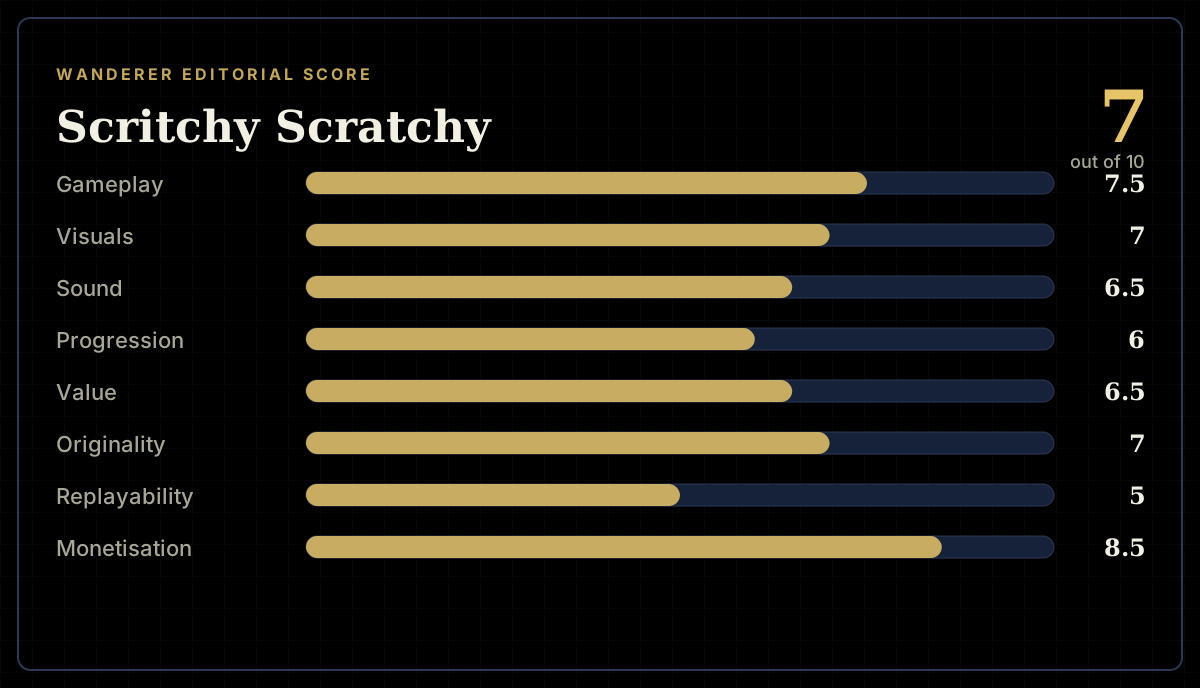
How the review scores each part of the gameWanderer Editorial -
The short versionWanderer Editorial