Game review
Incremancer
6.5 / 10
- Developer
- James Gittins (credited as JamesG466 on Kongregate)
- Publisher
- Self-published
- Released
- 30 October 2019
- Platforms
- Browser
- Genre
- Incremental
- Monetisation
- Completely free, with no in-app purchases, no premium currency and no advertising built into the game itself. Playing through Kongregate surrounds the embed with that platform's own site-wide ads, which is a Kongregate characteristic rather than anything the developer added
- Players
- Single-player
The short version
Incremancer hands you a necromancer and a graveyard and asks you to swallow one small town after another, zombie by zombie, and the systems it builds around that premise — golems, a skeleton champion, four talent mastery trees, rune enchanting — go further than most free browser incrementals bother to go. The catch is that James Gittins stopped meaningfully updating it in 2021, the Android release was quietly pulled from Google Play in 2024, and the long climb past the opening levels is exactly the kind of grind wall an active developer would still be tuning.
Judged purely as a thing to spend free time on, it holds up well. Judged as a live game with someone still home, it doesn't, and that gap is most of what a reader in 2026 needs to know before starting a save.
Biggest strengths
- Entirely free with no in-app purchases, no premium currency and no ads built into the game itself
- Golem types, a skeleton champion, four talent mastery trees and rune enchanting give the build layer real shape beyond a simple upgrade list
- The necromancer-versus-town premise commits to its own identity rather than reskinning a generic production chain
Biggest weaknesses
- Meaningful development ended around 2021, with the last GitHub commit dated 25 July of that year and no balance passes or new content since
- Player reports describe a severe grind wall once the automated late game takes over, with progress said to slow from a matter of days to a matter of months
- Long-standing bugs including an unclickable prestige button, invisible zombie and skeleton sprites, and the game halting when a monitor sleeps remain unpatched
Who it's for: Idle and incremental fans who want something with real system depth for zero cost, and who are prepared to treat the late game as a grind to manage rather than a curve that's still being balanced for them
Our recommendation: Play it. There's nothing to lose by trying a genuinely free game, but treat the hours past the early levels as optional rather than a promise the pacing will reward.
6.5 / 10
Most incremental games ask you to build something up — a factory, a kingdom, a stack of production chains feeding the tier above it. Incremancer asks you to tear a town down, one infected resident at a time, and it does that with more structural ambition than the premise strictly needs. You're a necromancer commanding a horde of zombies through small towns, and underneath the simple hook sits a surprisingly layered set of systems: golem crafting, a skeleton champion with his own talent tree, rune enchanting, and a prestige loop that banks permanent trophies alongside its numeric resets. James Gittins built all of it, gave it away for free, and then largely stopped touching it. Both of those facts matter to how this game reads today.
A horde that spreads itself
The opening hours are close to a real-time strategy game shrunk down to a single mouse button. Energy regenerates on its own and gets spent clicking zombies into a town, where each one attacks a human, converts them, and generates Blood — the base currency — automatically as the fight plays out. Killing or converting a human also drops a Brain, a scarcer currency that funds the upgrades that actually matter: movement speed, energy caps, storage caps for Blood and Brains, and eventually the buildings that turn the whole loop hands-off. Once the Cursed Graveyard goes up, zombies begin auto-spawning every time energy caps out, and from that point the moment-to-moment clicking that defined the first few towns fades into the background the way it should in anything calling itself an idle game.
That transition — from an active RTS-lite opening to a genuinely idle mid-game — is the strongest design idea Incremancer has, and it's handled with more patience than a lot of the genre shows. Nothing forces the shift; a player who enjoys manually herding zombies through a town can keep doing it, while a player who just wants the numbers to climb can build toward automation and step back. It's the same trick Swarm Simulator's production-chain design leans on in its own way: give the player a reason to stay engaged early, then let the systems they built take over.
Golems, skeletons and a talent tree with actual shape
Where Incremancer earns real credit is in how far its build layer goes past the basic zombie-spawning loop. A Creature Factory unlocks golem crafting — Earth, Air and Fire variants among them, each with distinct combat behaviour, the Fire Golem setting targets alight rather than just hitting harder. A Skeleton Champion sits above the rank-and-file horde as a persistent, upgradeable unit of his own. A Runesmith building lets you enchant units with runes that can be infused with spare resources for extra power. And prestige resets don't just hand back a lump sum: they convert into Prestige Points that buy percentage-based boosts to storage and generation rates, while separately unlocking Talent Points spent across four mastery lists — Golem, Skeleton, Spell and Zombie — that can be reassigned once per prestige if a build isn't working.
That's a genuinely deep skill-tree structure for a free browser game with no monetisation pressuring it to gate content behind purchases. It plays in the same space as Zombidle's worker-and-skill-tree loop, another villain-side idle game asking you to wreck a fantasy setting instead of saving it, and the comparison is a useful one: where Zombidle leans on writing and tone to make a conventional structure feel fresh, Incremancer leans on the width of its systems instead. Neither approach is wrong, and it's worth noting Incremancer got there without ever needing a premium currency to fund the extra complexity.
The wall past the early levels
The trouble starts once the automated mid-game runs out of things to automate. Long-time players describe progress slowing dramatically past the game's opening stretch of levels, with the climb through later milestones measured in months rather than days once numbers stop scaling with the pace the early game trained you to expect. That's a familiar shape for the incremental genre — most of them eventually ask for either patience or premium currency once the easy gains run out — but Incremancer only has the first option, and without active balance passes to soften it, the wall just sits there. Requests for more late-game content, new enemy types past the early rotation, and basic quality-of-life features like auto-upgrading have been sitting in player feedback for years with nothing arriving to answer them. A game this generous about giving away its systems for free deserved a developer sticking around long enough to keep the far end of the curve interesting, and that didn't happen.
Bugs nobody is left to fix
The performance picture is the other place abandonment shows up directly. Recurring reports describe a prestige confirmation button that stops responding, zombie and skeleton sprites rendering invisibly, and the game simply halting when a player's monitor goes to sleep — the kind of bug that would normally get triaged and patched within a release or two on a live game. None of it has been addressed since the GitHub repository's last commit in July 2021. For a game built entirely around leaving it running in a background tab, a bug that silently stops the clock while you're away undercuts the entire pitch more than almost any other kind of flaw could.
Completely free, and it shows in the right way
Whatever else has gone wrong here, the monetisation model hasn't. Incremancer has never charged for anything, has no in-app purchases, no premium currency, and nothing resembling an energy timer designed to be paid away. The only ads a player sees are Kongregate's own site-wide ones around the embed, which have nothing to do with the game itself and don't appear at all on the developer's own hosted version. That's a genuinely rare thing to say about a free browser incremental with this much system depth, and it's a sharp contrast with a paid, finite incremental like Nodebuster on the opposite end of the genre's value spectrum — one game asks nothing and never stops, the other asks a small one-time price and knows exactly when to end.
A dev who moved on, a wiki that didn't
What's most striking about Incremancer in 2026 is the gap between how thoroughly its systems are documented by other people and how quiet its own development has gone. A community-run Fandom wiki still catalogues every talent, golem type and prestige mechanic in detail, and the game's GitHub repository has picked up dozens of stars and well over a hundred forks from other developers curious enough to poke at the code — real signs of lasting interest in a project its own creator effectively set down years ago. None of that community activity has translated into an update. The Android release quietly disappeared from Google Play in April 2024 without a comparable browser-side announcement, and the core loop, bugs and grind wall are all exactly as they were when the last commit landed in the summer of 2021.
Verdict
Incremancer is a better-built free incremental than it has any obligation to be, with a golem roster, a skeleton champion, a real talent tree and a rune system layered generously on top of a simple zombie-spawning hook, and none of it behind a paywall. It's also a game whose developer has been gone for roughly five years, whose late-game grind has nowhere near enough support to soften it, and whose lingering bugs — including one that can stop time from passing while it's meant to be running idle — have had no one left to fix them. Start it expecting a few genuinely good early hours and a system-rich mid-game, not a live project. Players who want that same horde-versus-humanity structure with more narrative bite should look at Zombidle instead; players who'd rather a much longer-running world keep advancing in the background, actively maintained, might eventually find their way to Wanderer.
Pros and cons
Pros
- Entirely free with no in-app purchases, no premium currency and no ads built into the game itself
- Golem types, a skeleton champion, four talent mastery trees and rune enchanting give the build layer real shape beyond a simple upgrade list
- The necromancer-versus-town premise commits to its own identity rather than reskinning a generic production chain
- Prestige banks permanent trophies alongside its percentage-based resets, so repeat runs feel like they're building on something
- Still fully playable today, years after active development stopped, on both the developer's own site and Kongregate
Cons
- Meaningful development ended around 2021, with the last GitHub commit dated 25 July of that year and no balance passes or new content since
- Player reports describe a severe grind wall once the automated late game takes over, with progress said to slow from a matter of days to a matter of months
- Long-standing bugs including an unclickable prestige button, invisible zombie and skeleton sprites, and the game halting when a monitor sleeps remain unpatched
- The Android release was pulled from Google Play in April 2024, leaving the browser version as the only option
- Presentation is plain even by browser-incremental standards, with little beyond simple pixel sprites and menu screens to look at
Screenshots
-
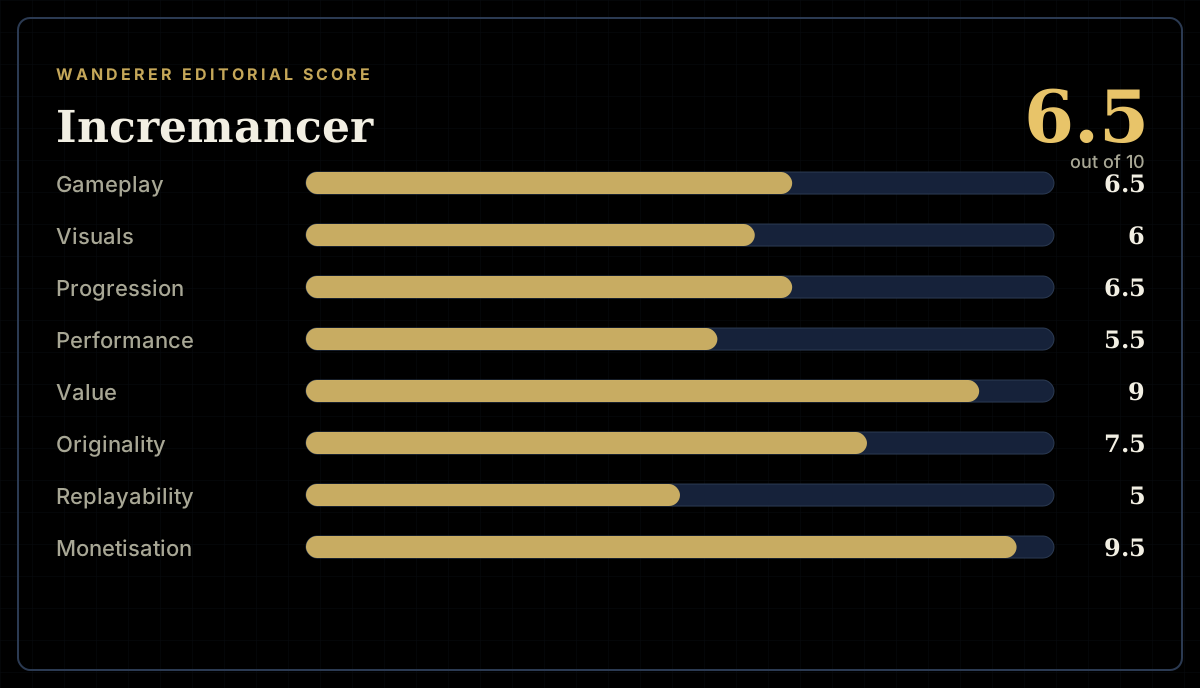
How the review scores each part of the gameWanderer Editorial -
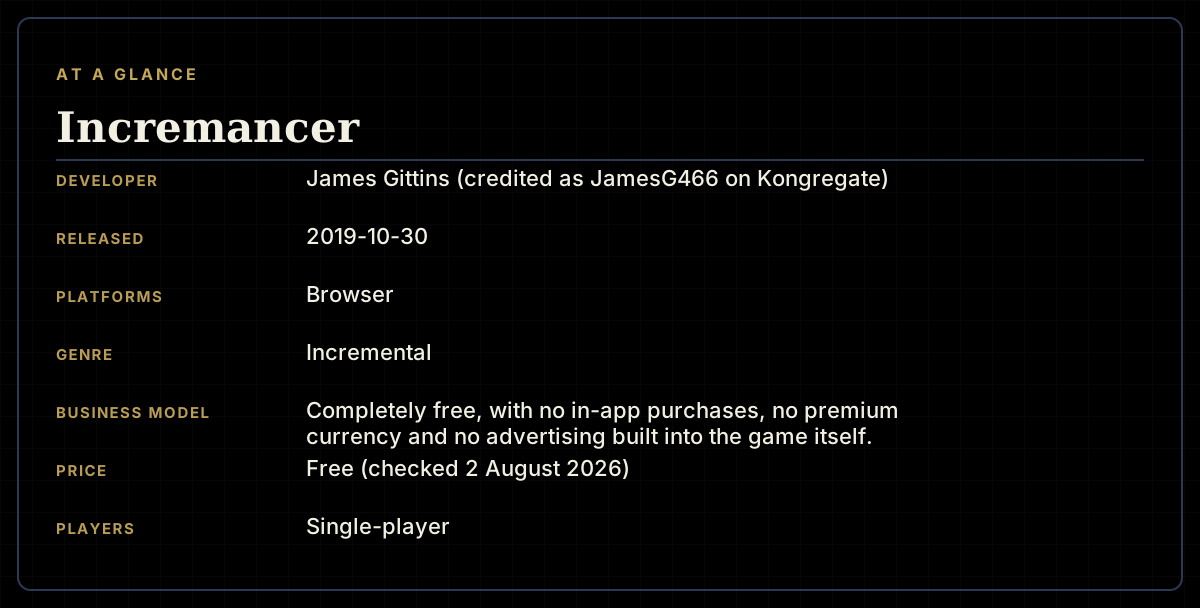
The game at a glanceWanderer Editorial -
The short versionWanderer Editorial