
Game review
Trimps
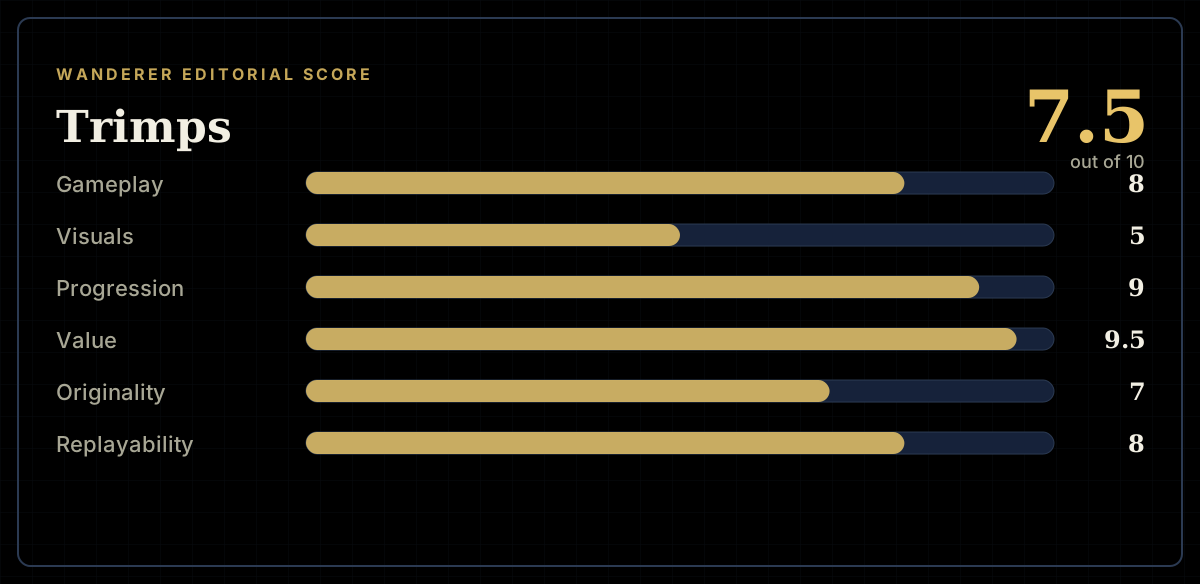
7.5 / 10
- Developer
- Greensatellite
- Publisher
- Greensatellite
- Released
- 12 July 2015
- Platforms
- Browser, Windows (Steam)
- Genre
- Incremental
- Monetisation
- Free-to-play. An optional "Bones" premium currency buys convenience upgrades; the developer states normal play earns enough Bones to buy everything on offer well before content runs out.
- Players
- Single-player
The short version
Trimps has been running since 2015 and it plays like it — not in a bad way, but the way an old city plays: every layer of the progression system was built on top of the one before it, and eleven years later the result is one of the deepest reset loops incremental gaming has ever produced. The map system alone, letting you spend a currency to custom-build the fight you want rather than just clicking the next zone, is smarter than most of what has shipped in the genre since.
What it isn't is welcoming. The interface hasn't been substantially redrawn since Kongregate was a going concern, the game explains almost none of its own math, and by the point you're running Void Maps and Daily Challenges for Helium you're configuring automation settings more than you're making decisions. It is also completely free, with nothing behind a paywall worth mentioning, which buys it a lot of patience.
Biggest strengths
- The map system turns zone-pushing into a genuine resource-crafting decision instead of a bigger number
- The Portal/Helium/Perk loop gives eleven years of accumulated systems somewhere real to go
- Built-in AutoFight, AutoUpgrade and AutoStructure let you scale from clicking to hands-off without a mod
Biggest weaknesses
- The interface is functional 2015-era HTML5 and looks it next to newer incrementals in the genre
- Fluffiness, map traits, Spire scoring and Void Map math are barely explained in-game, so the Fandom wiki is close to mandatory
- Past the midgame, progress increasingly means tuning automation and checking back rather than actively deciding anything
Who it's for: Incremental veterans who want a system with real years of depth in it, and anyone happy to keep a wiki tab open while they learn a game rather than have it explain itself.
Our recommendation: Play the free browser version first — it's the same game the Steam release packages, at no cost, so there's no reason to decide on Steam before you know whether the loop grabs you.
7.5 / 10
Most incrementals show you their whole hand in the first ten minutes: here is the number, here is the button, watch the number get bigger. Trimps takes longer than almost anything else in the genre to show its hand, because it has eleven years of hand to show. Greensatellite launched it on Kongregate in July 2015 as a straightforward creature-trapping idler, and it has been patched more or less continuously since — a Steam release in May 2022 packaged the same free game for desktop, changing nothing about the economics. There is still no purchase required to see everything in it.
That longevity is the story. Trimps isn't one system, it's roughly six systems stacked on each other in the order they were designed, and the game rarely goes back to smooth the seams. Judged purely on depth, that's a strength very few incrementals can claim. Judged on whether a new player can figure out what's happening without external help, it's the opposite.
The loop underneath the loop
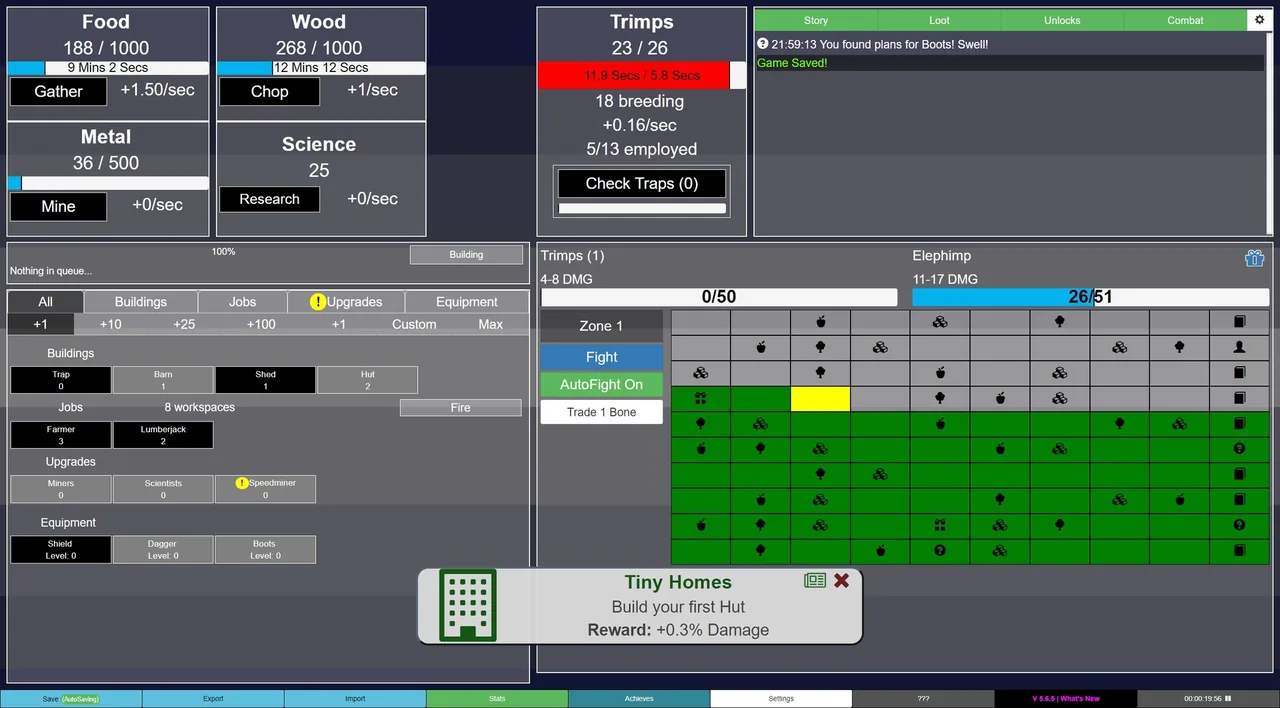
The opening hours are simple enough to explain in a sentence: build traps to catch Trimps, put them to work gathering food and resources, arm the strongest ones, and send them to fight their way through zones of 100 cells each. Enemies scale roughly linearly within a zone and exponentially between zones, so the early game reads like most of the genre — bigger numbers, incremental unlocks, a slow drip of new buildings like housing, storage, Gyms and Nurseries.
What separates Trimps from the pack shows up around zone 6, when the map system unlocks. Instead of only pushing the next zone in the queue, you can spend a resource called Fragments to build a custom map — deciding how many cells it has, how rich its loot is, how dangerous its enemies are, and whether it favours a specific resource. That's a real trade-off, not a slider dressed up as one: a map built for safety and resources costs more Fragments per return than one built to be fast and lean, and reading the trade-off correctly is most of what separates an efficient run from a slow one. Unique Maps drop with fixed, powerful rewards; Void Maps arrive tougher and less predictable. It's the single best idea in the game, because it takes the genre's most passive verb — waiting for the next zone — and makes it a decision you actively construct.
Portal, Helium, and the layers built on top of that
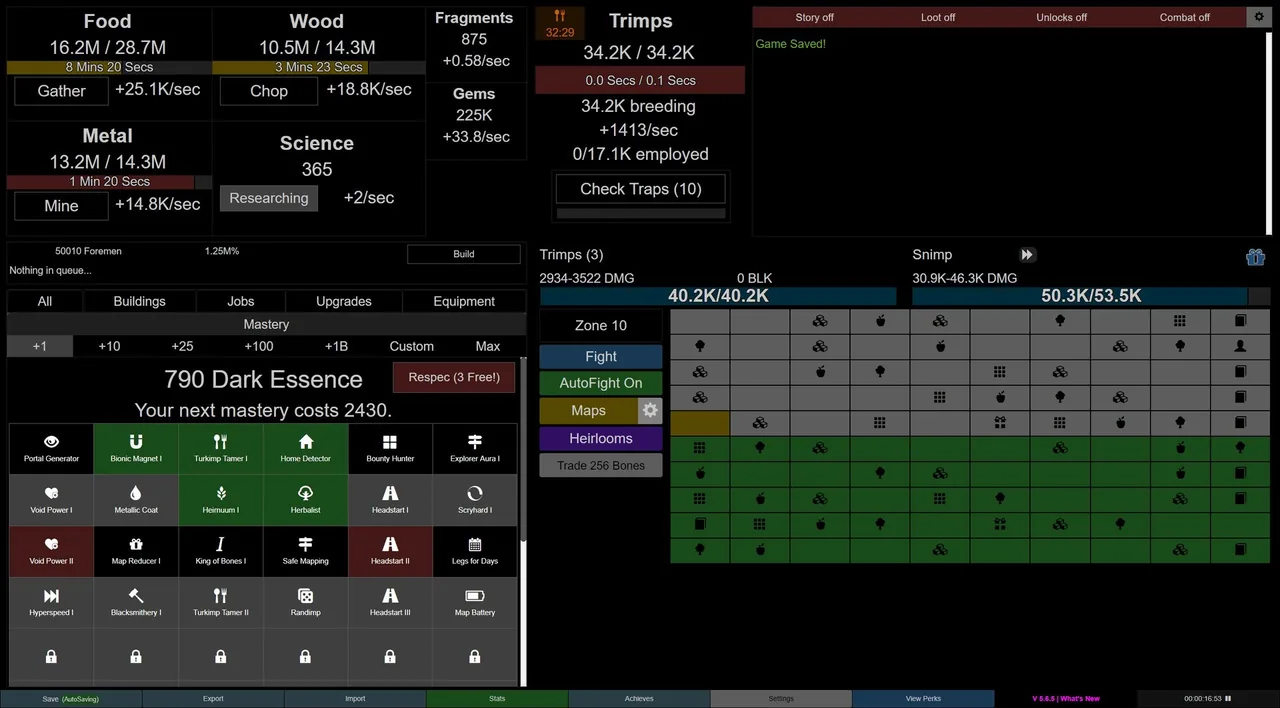
Zone 20 and a special map called the Dimension of Anger unlock Portal, the soft reset that defines Trimps' mid-and-late game. Portalling wipes your zone progress and most of your resources but converts the run into Helium, a permanent currency spent on Perks — passive bonuses that carry across every future run. This is standard prestige-loop architecture, the same shape as dozens of incrementals before and since, but Trimps commits to it harder than most: Perks aren't a short list of multipliers, they're a sprawling tree that reshapes how efficiently you can push zones on the next attempt, which changes how you build the run after that.
Beyond Portal sits a second tier most players don't see for a long time: Daily Challenges, which apply a rotating modifier and reward disproportionate Helium for clearing Void Maps under it, and the Spire, a multi-tier structure that hands out Bones — the same currency the optional purchases use — for first-time clears. None of this is explained with any real clarity inside the game itself. The tooltips tell you what a button does; they very rarely tell you why you'd want to press it in this order rather than that one. The Fandom wiki's guide pages, the "TriVialized" advanced guide and a genuinely active Reddit and Discord community exist because the game leans on them by design, not accident. That's a defensible choice for a text-heavy incremental built by essentially one person over a decade — but it should be said plainly rather than discovered the hard way: budget for wiki time if you want to understand what you're doing past the first Portal.
Where the game starts running itself
Trimps hands out automation as a reward structure, and it's honest about doing so. AutoFight unlocks early, off a cheap upgrade on zone 1. AutoUpgrade and AutoStructure follow much later, around zone 155, letting the game buy safe upgrades and build housing on its own. Heirloom gear can be set to re-equip itself on every Portal. Stack enough of these toggles and a late-game session increasingly means opening the tab, checking what died, adjusting a Perk allocation, and closing it again — administration rather than play, in the literal sense that you're managing settings more than making moment-to-moment choices.
It's worth being clear that this isn't a flaw unique to Trimps; every long-running incremental eventually automates its own early game so the player's attention can move to the current frontier. What's notable here is how far the community has taken the same instinct: AutoTrimps, a third-party open-source userscript with an active GitHub presence, will play essentially the entire game optimally on your behalf, and a meaningful slice of the long-term playerbase runs it. That a volunteer tool can substitute for the developer's own late-game automation says something honest about where Trimps' design settles once the map-building puzzle of the early hours gives way to pure systems management.
Presentation, and what free actually buys you
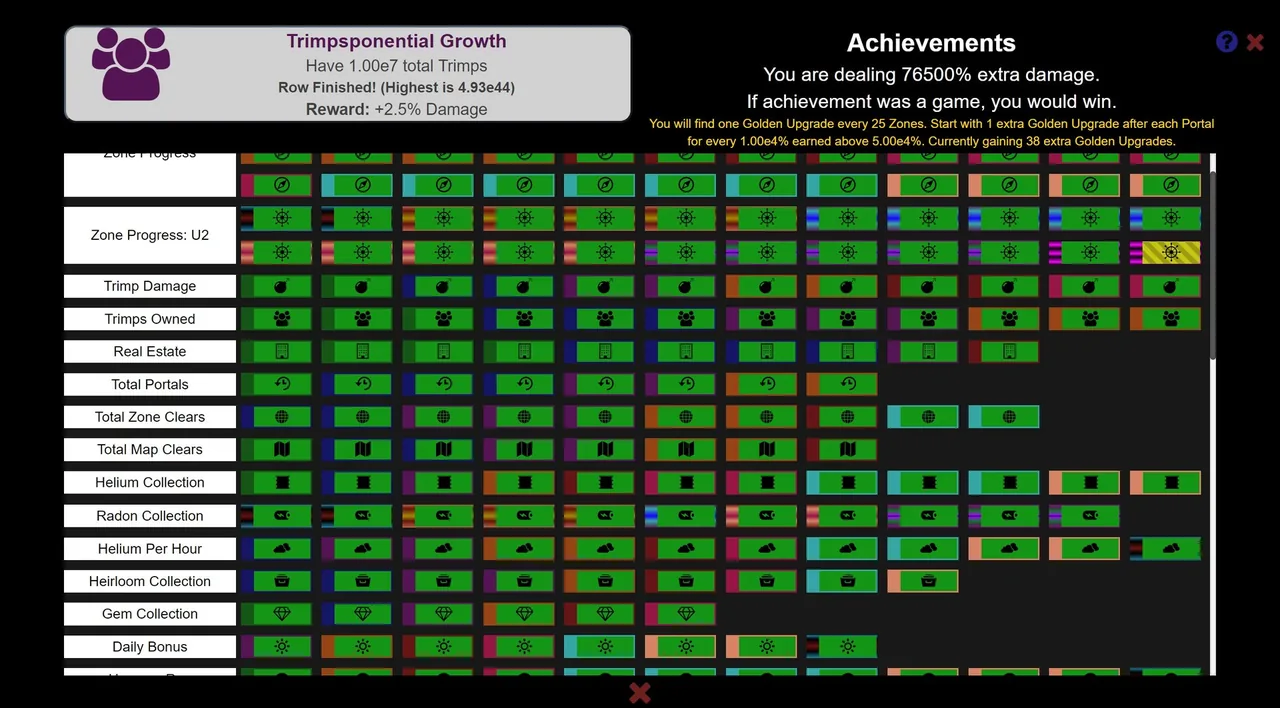
Visually, Trimps has not moved much since 2015. Sprites are simple, colours are flat, and the whole interface is built from menus, numbers and progress bars rather than any attempt at scene-setting. Kongregate's own tags list it as mouse-only, and nothing about the layout has been adapted for a phone screen beyond the fact that a browser can technically load it there. Judged as a piece of software design against anything released in the last few years, it looks its age.
None of that changes the value case, because there effectively isn't a cost to weigh it against. Trimps is free on Kongregate, free on its own GitHub-hosted site, and free on Steam, where it holds a Very Positive rating from 1,472 reviews as of this writing. The Bones currency buys convenience — faster building, extra slots — and Greensatellite's own description of it is refreshingly modest: you'll earn enough through ordinary play to buy everything before you run out of content to spend it on. There's no energy system, no timer, no advertisement, and nothing resembling pressure to pay. For a genre where "free" too often means a shop screen with a countdown on it, that's a meaningful thing to get right, and Trimps has kept it that way for over a decade.
Verdict
Seven and a half. The map system is genuinely excellent design, the Portal-and-Helium loop gives that design somewhere to keep going for a very long time, and the price of admission is nothing at all. Against that sits an interface that hasn't aged gracefully, a game that explains almost none of its own systems and expects the wiki to fill the gap, and a late game that trades active decisions for automation settings faster than most players will want it to. That's not a fatal combination — it's the honest cost of a design that's been growing sideways since 2015 rather than being rebuilt clean — but it keeps Trimps out of the top tier of the genre it helped shape.
Players who want an incremental with real systemic depth, who don't mind learning it from outside sources, and who have no interest in paying for any of it will find a loop here that genuinely lasts. Anyone hoping for a modern interface or a game that teaches itself should look elsewhere in the genre first.
Pros and cons
Pros
- The map system turns zone-pushing into a genuine resource-crafting decision instead of a bigger number
- The Portal/Helium/Perk loop gives eleven years of accumulated systems somewhere real to go
- Built-in AutoFight, AutoUpgrade and AutoStructure let you scale from clicking to hands-off without a mod
- Completely free with no pay-to-win angle — Bones buy convenience the game says you'll earn anyway
- Open-source and still receiving regular patches nearly eleven years after its first release
Cons
- The interface is functional 2015-era HTML5 and looks it next to newer incrementals in the genre
- Fluffiness, map traits, Spire scoring and Void Map math are barely explained in-game, so the Fandom wiki is close to mandatory
- Past the midgame, progress increasingly means tuning automation and checking back rather than actively deciding anything
- Kongregate's own tags call it mouse-only, and nothing about the layout has been redesigned for a touchscreen
- No leaderboard, seed-sharing or any way to compare a run against another player, despite an active Reddit and Discord community
Screenshots
-
TrimpsImage: Greensatellite via Steam -
TrimpsImage: Greensatellite via Steam -
TrimpsImage: Greensatellite via Steam -
How the review scores each part of the gameWanderer Editorial -
The short versionWanderer Editorial