Game review
Progress Knight
7 / 10
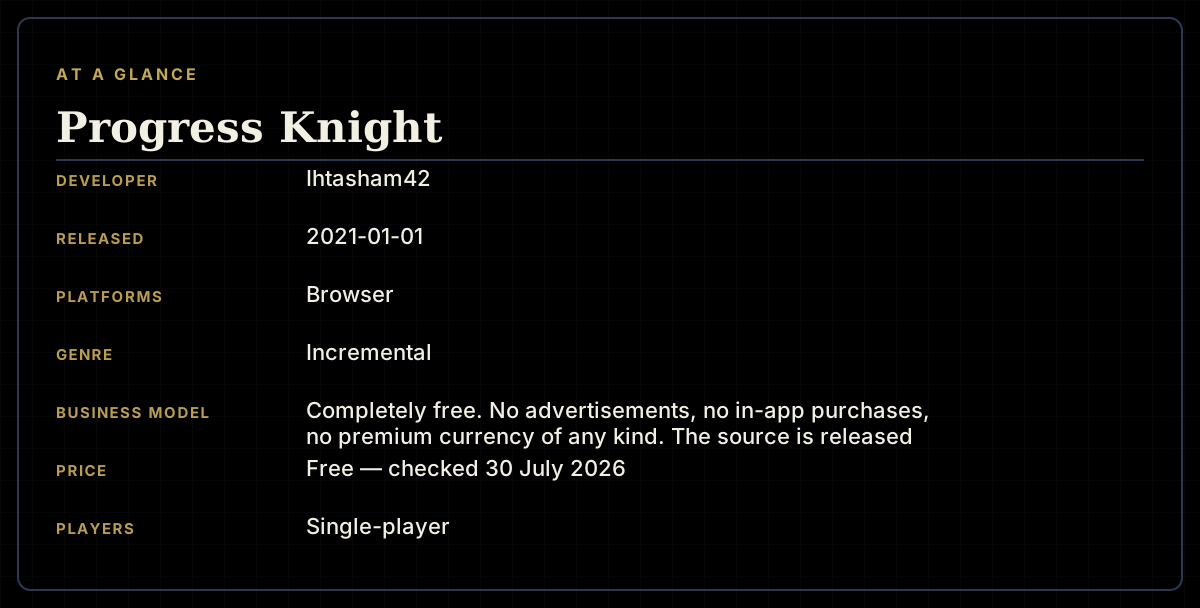
- Developer
- Ihtasham42
- Publisher
- Ihtasham42
- Released
- 1 January 2021
- Platforms
- Browser
- Genre
- Incremental
- Monetisation
- Completely free. No advertisements, no in-app purchases, no premium currency of any kind. The source is released under the Unlicense (public domain).
- Players
- Single-player
The short version
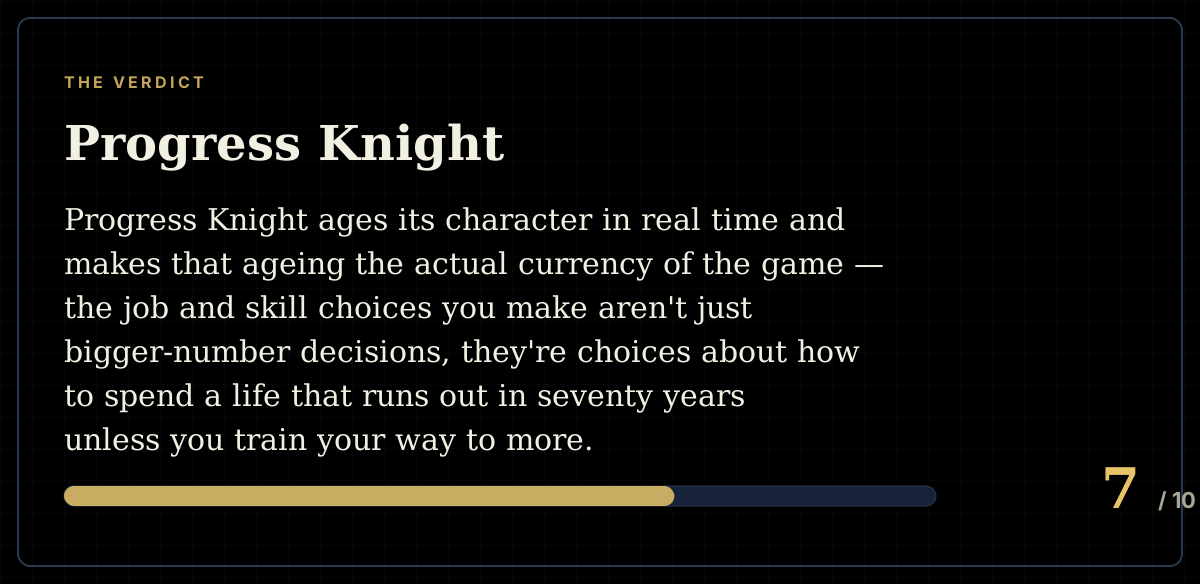
Progress Knight ages its character in real time and makes that ageing the actual currency of the game — the job and skill choices you make aren't just bigger-number decisions, they're choices about how to spend a life that runs out in seventy years unless you train your way to more. That framing does real work: a rebirth here reads less like an abstract prestige reset and more like a second chance at living better. The trouble is how little game sits underneath the idea. There's a beggar-to-chairman ladder, a squire-to-legendary-knight ladder, a student-to- master-wizard ladder, and an optional evil turn once you've lived two centuries, and that's close to the whole tree. The developer hasn't materially touched the code since August 2023, so what's live now is what's staying live, and the free time you'd sink into optimising it measures in single-digit hours next to a Trimps or a Melvor.
Biggest strengths
- The lifespan-as-resource framing gives every job and skill choice a genuine opportunity cost instead of just a bigger number
- The three job ladders (commoner, military, magic) and their linked skill trees are legible within minutes without a wiki
- Completely free with the source released into the public domain — nothing is held back behind a purchase
Biggest weaknesses
- Development has been dormant since August 2023, so open bugs and a long-requested mobile-friendly layout have gone unaddressed
- The full content tree - three job ladders, roughly two dozen skills and one evil branch - is exhausted in a handful of rebirths, nowhere near genre marathons like Trimps or Melvor Idle
- Visual presentation is a single desktop-oriented panel of text and numbers with no art beyond a light and dark theme
Who it's for: Idle-genre newcomers who want a complete, free, single-sitting-friendly loop, and incremental veterans curious about the lifespan-as-currency idea before they go looking at one of its many forks.
Our recommendation: Play the developer's own build at ihtasham42.github.io first — it's the canonical version and it's free, so there's no reason to start with a fan mirror or reskin.
7 / 10
Most incrementals ask you to optimise an abstraction: currency, prestige points, some invented unit that only means something inside the spreadsheet. Progress Knight asks you to optimise a human lifespan, and that one substitution changes how every other number in the game reads. You start at fourteen, broke and unskilled. You have seventy years, counted down in real time as the game runs, unless you train the skills that buy you more of it. Every job you take and every skill you level is, functionally, a decision about how to spend a life that is actively running out underneath you.
A life with a clock built into it
The loop itself is familiar incremental machinery: pick a job for income, pick skills to raise alongside it, spend the income on housing and gear that push your stats further, repeat. What sells it is that the game never lets you forget the clock is real. A stat called Happiness taxes every experience gain you earn; a running balance of income against living expenses can put you in the red if you overspend on gear before your job pays enough to support it; and the "life expectancy" figure at the top of the screen is not flavour text, it is the hard stop on the run. Reach it, and an amulet you find partway through the game offers a rebirth: you lose your levels and your coins, but you keep an experience multiplier built from how far you got, and the next life levels faster because of it.
That's a standard soft-reset shape - Cookie Clicker's ascension, Trimps' Portal, a dozen others - but Progress Knight earns something extra from tying it to a literal death and literal rebirth rather than an abstract currency flip. The skill tree makes the metaphor explicit rather than incidental: Immortality and Super Immortality are real skills that extend baseLifespan beyond its default seventy years, and Time Warping is a skill that speeds up the simulation itself. The game is telling you outright, in its own systems, that time is the resource under everything else - not gold, not experience, time. Few incrementals commit to their central metaphor mechanically rather than just narratively, and it's the best thing Progress Knight does.
Three ladders, not many more
Where the game is honest with itself is scope. There are three job ladders - Beggar through Farmer, Fisherman, Miner, Blacksmith and Merchant on the common track; Squire through Footman, Veteran Footman, Knight, Veteran Knight, Elite Knight, Holy Knight and Legendary Knight in the military; Student through Apprentice Mage, Mage, Wizard and Master Wizard in magic, capping out at Chairman - and a matching set of skills that boost specific parts of that income (Concentration for skill XP, Productivity for job XP, Strength for military pay, Mana Control for magic XP, and so on). None of it takes long to read and understand, which is a real strength for anyone who finds incrementals like Trimps or Melvor Idle intimidating on day one. You can see the entire shape of the game inside your first sitting.
The cost of that legibility shows up fast, though. Once you've cycled a few rebirths and picked a lane, there isn't a fourth ladder waiting, or a fifth skill category, or a new resource type to learn. At year 200 of a sufficiently extended life, an "evil embrace" option opens a genuinely separate skill line - Dark Influence, Evil Control, Intimidation, Demon Training, Blood Meditation and Demon's Wealth, tracked on their own Evil currency - and it's the closest the game comes to a real late-game twist. But mechanically it's the same promote-and-wait loop wearing a different skin, not a new kind of decision. Compared with something like Trimps, which is still adding systems on top of systems more than a decade after launch, Progress Knight's entire tree is something you can exhaust in an evening or two of engaged play. That's not a flaw exactly - not every incremental needs to be a ten-year project - but it should be stated plainly rather than discovered after the fact: this is a short, complete idea, not an ongoing one.
A project the developer has stepped away from
The GitHub repository behind Progress Knight hasn't received a substantive commit since August 2023, even though issues have kept arriving since - reports about the "evil" happiness multiplier, about a skill staying active after a rebirth when it shouldn't, about auto-pause not pausing during the game's catch-up simulation. None of that is disqualifying for a free single-developer project; plenty of good incrementals stop receiving updates once their creator considers them finished. But it does mean the handful of known rough edges are permanent features of the current build, and a 2021 community request for a mobile-friendly layout was never acted on - the page loads fine in a phone browser thanks to a responsive framework, but the UI is a dense grid of small buttons and tables clearly laid out with a mouse and a full-width monitor in mind.
The upside of that stillness is unusual: because the source is released under the Unlicense - full public domain, no attribution required - anyone can take it and keep going. A lot of people have. The GitHub repository has been forked well over a hundred times, and while most of those forks are personal, inactive copies, at least one, a sci-fi reskin called Progress Station, is still being actively developed years after the original went quiet. That's a genuinely interesting afterlife for a small game, and it says something good about how reusable the underlying systems are. It also means the Progress Knight you find through a casual search isn't guaranteed to be the original - a "Progress Knight: Multiplayer" listing on Steam, for instance, is an unrelated PvP project from a different developer entirely, built around a premium store rather than the free, single-player game this review covers. Worth knowing before you go looking for it on a storefront the actual developer never used.
Presentation and the price tag
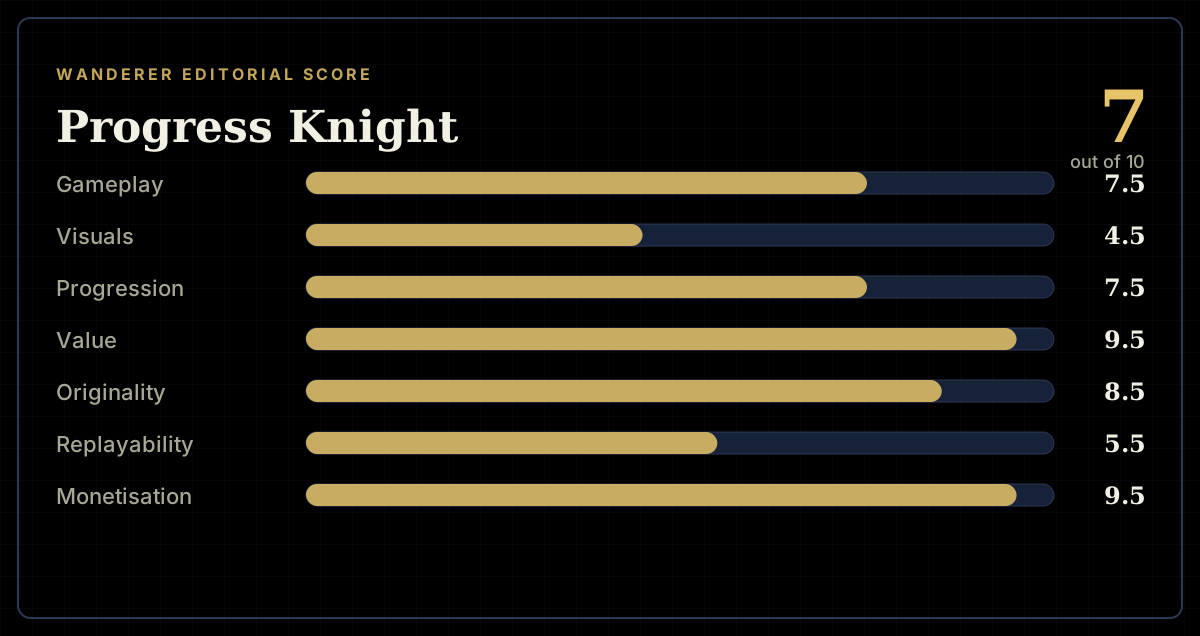
There is essentially no art to speak of. Progress Knight is number panels, progress bars and a light or dark theme toggle, built on a basic CSS framework rather than any custom visual design. That's a defensible choice for a solo-developed text incremental and it keeps the game fast and light in any browser, but it also means there's nothing here to look at beyond the numbers moving. Sound doesn't factor in at all.
None of that weighs much against the price, because there isn't one. Progress Knight costs nothing on every official host - the developer's own GitHub Pages build, Armor Games and CrazyGames - carries no advertising, and asks for nothing in return beyond the time you put into it. There's no energy system, no timer gating your next click, no premium currency waiting behind a paywall. For a genre that increasingly monetises even its free entries, that's worth crediting outright, and it's part of why the short content tree stings less than it otherwise would: you haven't paid for more than you got.
Verdict
Seven out of ten. The idea at the centre of Progress Knight - that your character's finite lifespan is the thing you're actually managing, not an abstract currency standing in for it - is smarter than the game's plain presentation suggests, and the three job ladders it hangs that idea on are approachable in a way a lot of the genre isn't. What keeps it out of the upper tier is simply how much game there is: a handful of rebirths will show you everything Progress Knight has, the project has sat untouched since 2023, and the interface hasn't been built with a phone in mind. It's a strong afternoon, not a long-term hobby, and its real legacy may end up being the forks it spawned rather than the original build itself.
Players who want a complete, free, quickly-understood incremental with a genuinely clever central idea should play it and expect to be finished, in the sense that matters, within a handful of rebirths. Anyone chasing the kind of decade-deep system that games like Trimps or Melvor Idle offer should treat Progress Knight as a starting point for the genre rather than a destination. Players who like the idea of a run that keeps giving them something new to plan around, session after session, may find Wanderer's own persistent progression a natural next stop.
Pros and cons
Pros
- The lifespan-as-resource framing gives every job and skill choice a genuine opportunity cost instead of just a bigger number
- The three job ladders (commoner, military, magic) and their linked skill trees are legible within minutes without a wiki
- Completely free with the source released into the public domain — nothing is held back behind a purchase
- Rebirth XP multipliers scale off your own previous best, so a first death never feels like wasted time
- Auto-promote and auto-learn toggles let a run tick over unattended once you understand its rhythm
Cons
- Development has been dormant since August 2023, so open bugs and a long-requested mobile-friendly layout have gone unaddressed
- The full content tree - three job ladders, roughly two dozen skills and one evil branch - is exhausted in a handful of rebirths, nowhere near genre marathons like Trimps or Melvor Idle
- Visual presentation is a single desktop-oriented panel of text and numbers with no art beyond a light and dark theme
- The evil-embrace second layer at year 200 reuses the same promote-and-wait loop rather than introducing a genuinely new mechanic
- The public-domain licence has scattered the game across well over a hundred forks and reskins, so search results and store listings routinely surface someone else's build instead of the original
Screenshots
-
How the review scores each part of the gameWanderer Editorial -
The game at a glanceWanderer Editorial -
The short versionWanderer Editorial