
Game review
Idle Dice
6.5 / 10
- Developer
- Lutsgames (Lutz Schoenfelder)
- Publisher
- Lutsgames (Lutz Schoenfelder)
- Released
- 8 April 2020
- Platforms
- Browser, Android, iOS
- Genre
- Incremental
- Monetisation
- Free-to-play with optional rewarded-video ads and in-app purchases on Android and iOS; the developer states across the studio's catalogue that ad-watching is entirely optional and the game is balanced to be finished without spending
- Players
- None — single-player, no leaderboards or social features documented
The short version
Idle Dice has one genuinely interesting idea — swap the clicker genre's deterministic tick for a rolling die — and then spends its own upgrade tree undermining it. Stack enough dice and let them auto-roll, and the variance that made the early game feel alive statistically disappears into the same smooth exponential curve every other clicker produces. What's left is a competent, honestly-monetised, still-updated idle game with a decent card-and-roulette layer sitting on top of a hook that only really works before you've invested in it.
Biggest strengths
- The card-and-roulette meta layer gives the prestige reset real choices instead of just a bigger permanent multiplier
- The developer shipped an iOS update as recently as 20 May 2026, six years after the original 2020 launch, rather than walking away from it
- Completely playable without spending anything, on browser, Android or iOS
Biggest weaknesses
- Once dozens of dice are auto-rolling per second, the law of large numbers smooths individual randomness into a flat rate, so the game's defining idea is most visible exactly when the player has invested in it least
- No Steam release exists for the original — desktop players are stuck with a browser tab while the numbered sequel got the PC storefront treatment instead
- The iOS audience is tiny and unhappy by comparison (3.5 stars from just 6 New Zealand ratings) next to Android's much larger and warmer reception (4.75 from 11,885), suggesting iOS is the neglected platform
Who it's for: Idle-game regulars looking for a free, no-pressure browser or mobile session with a light strategic layer, and anyone curious what happens when a clicker's core resource is a distribution instead of a number. Not for players who want the randomness to still matter once the numbers get big, or who want a PC storefront release — that's the sequel's job, not this game's.
6.5 / 10
A number that isn't a number
Almost every clicker or incremental game is built around a resource that behaves like a spreadsheet cell: press the button, the number goes up by exactly the amount the current upgrades say it should. Idle Dice swaps that cell for a die. Each roll returns a value from a range, not a guarantee, and the entire early game runs on watching that range play out — a lucky string of high rolls genuinely outpaces the "expected" rate for a few seconds, and a cold run visibly lags behind it. That's a real point of difference in a genre that has otherwise settled on determinism as its default language, and it's the reason this particular clicker is worth a serious look rather than a shrug.
It's also a promise the game can't fully keep, and the most useful thing this review can do is explain exactly where that promise breaks down, because the answer says something about incremental design generally, not just about this one title.
Where the randomness actually lives
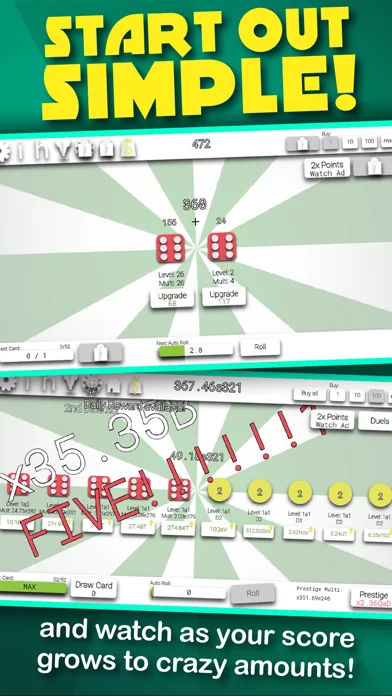
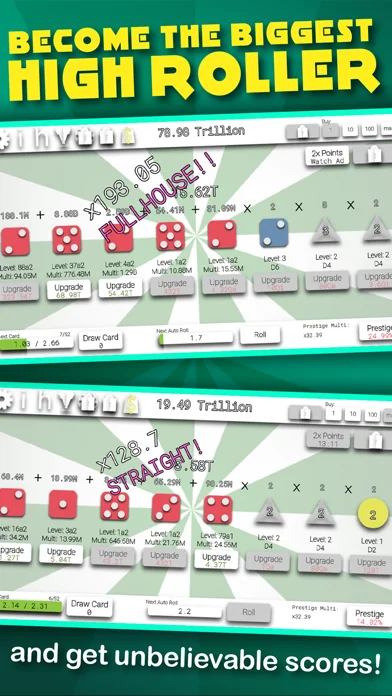
Idle Dice's own description of itself is straightforward: upgrade the value of your dice to raise your income, unlock more dice to roll in parallel, and let the game roll automatically while you're not looking. That third piece is where the trouble starts. A single die rolling once a second is a genuinely swingy source of income — the difference between a run of sixes and a run of ones is enormous relative to the average. But the moment the game encourages you to own a dozen dice rolling several times a second each, which is exactly what the upgrade tree pushes you toward, the law of large numbers takes over. Sum enough independent dice rolls and the total output per second converges tightly around its expected value; the relative size of the swings shrinks roughly with the square root of how many rolls you're summing. In practice that means the visible, felt randomness of the opening minutes — the thing the game is actually selling — is precisely the part of the game you're incentivised to upgrade your way out of. By the time a run is producing serious numbers, the dice-roll animation is closer to a cosmetic tick than a live outcome; the aggregate curve looks exactly like the exponential growth line every other clicker in this library draws, just with a rolling-cube sprite layered over it.
That's not a fatal flaw, but it is a real one, and it's worth being specific about why it matters more here than in a game that never claimed randomness as its hook in the first place. Cookie Clicker and AdVenture Capitalist never pretend the number generator has any variance — they're honest about being deterministic, and the design energy goes elsewhere. Idle Dice puts variance on the marquee and then quietly designs it out of relevance as the primary reward for playing well. The game that ships is good; the pitch that sells it oversells what's actually happening once you're twenty minutes in.
Where the real decisions are
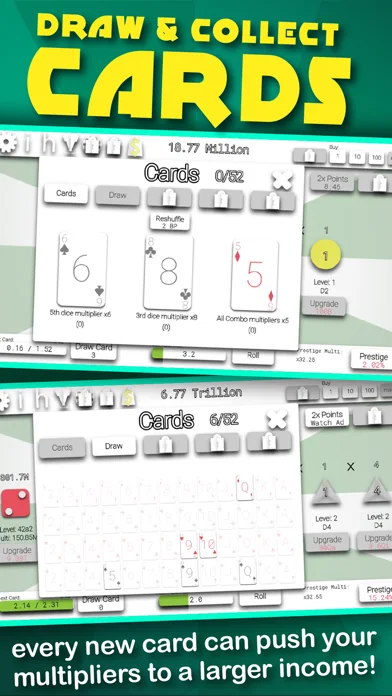
The upgrade tree that raises per-die value and unlocks new dice is the least interesting part of Idle Dice, precisely because it's the part any clicker has. The more interesting layer is the card system sitting alongside it: rather than being a passive multiplier, cards are drawn — including through a dedicated roulette spin — and selected into a small active set that shapes how a run scales. That's a genuine decision point rather than a straight-line purchase queue, and it's also where the game's randomness relocates once the dice themselves stop mattering statistically. A roulette spin or a card draw is a single, discrete, infrequent random event with a real decision attached to it — keep this card or don't, build around this combination or wait for a better one — which is a much smarter place to put unpredictability than a resource you're rolling dozens of times a second. If the whole game had been built around that layer instead of the dice animation, the "randomness as resource" pitch would have landed a lot harder.
Prestige works the way this genre's resets usually work: cash in a run for a permanent bonus, start over with new card options, and get through the early game faster next time. It's functional and it does its job of giving long-term structure to what would otherwise be a single flat curve, but it doesn't add much beyond what Cookie Clicker's Heavenly Chips or Idle Slayer's Ascension already established as the genre standard. Nothing here reinvents the reset loop; it just applies it competently to a slightly different base resource.
Idle behaviour and what money actually buys
The game's own pitch leans hard on offline income — dice keep rolling, and presumably at close to the online rate, while the app is closed, which is the baseline this site's readers expect from anything calling itself idle. What isn't documented anywhere reliable is a specific offline cap or an exact multiplier for the optional ad-boosts, so treat any claim of an unlimited or uncapped away-timer with appropriate suspicion until you've checked it yourself. What is verifiable is the monetisation shape: Google Play lists both ads and in-app purchases as present, and the developer has stated, across the studio's catalogue rather than in a game-specific promise, that ad-watching is optional and every game is balanced to be completed without spending. That's a meaningfully more honest starting position than the energy-timer and forced-interstitial designs this genre is often built around, and there's no evidence of a pay-to-skip wall blocking core progression. It's fair monetisation for what it is; it just isn't remarkable enough to be a selling point on its own.
The platform story nobody expects
Here's the detail that actually matters for anyone deciding where to play: the original Idle Dice never got a Steam release. It exists on browser, through Kongregate, CrazyGames and the developer's own site, and on Android and iOS. The PC storefront treatment went to Idle Dice 2 instead, which launched on Steam in mid-2023 as a free, ad-optional expansion of the same idea — more dice, a bigger card alphabet, deck-building, and the dark mode players had apparently been asking for since the first game shipped. That sounds like a straightforward "play the sequel" recommendation, except the install-base numbers point the other way: the original still carries close to twelve thousand Google Play ratings at a strong 4.75, while the sequel's Play Store presence sits closer to three thousand, and its Steam page shows no meaningful review volume at all. The more polished, more feature-complete version of this game is also the one almost nobody is playing yet. New players shouldn't feel obligated to start with Idle Dice 2 just because it's numbered higher and technically improves the format — the original is still the bigger, still-supported product, and a fine place to start on its own terms.
Final verdict
Idle Dice earns real credit for trying something the rest of the genre doesn't bother with, and for being upfront about its monetisation while it does it. The problem is structural rather than cosmetic: the exact mechanic that makes this game distinctive is the one its own progression system is designed to erase, and the smarter randomness sitting in the card and roulette layer never gets promoted to the game's real centrepiece. What's left is a fair, free, still-updated dice-themed clicker that's worth an idle session on a phone or in a browser tab, but not one that fully delivers on its own premise once you've played it long enough to see the curve flatten. Players who want a genre entry that's honest about being deterministic and builds real structure on top of that honesty might get more long-term mileage out of Cookie Clicker or Idle Slayer; players who just want the free, low-pressure hour Idle Dice actually delivers will get exactly that.
Pros and cons
Pros
- The card-and-roulette meta layer gives the prestige reset real choices instead of just a bigger permanent multiplier
- The developer shipped an iOS update as recently as 20 May 2026, six years after the original 2020 launch, rather than walking away from it
- Completely playable without spending anything, on browser, Android or iOS
- Ads and purchases are opt-in by the studio's own stated design philosophy, not gated behind energy timers or forced interstitials
Cons
- Once dozens of dice are auto-rolling per second, the law of large numbers smooths individual randomness into a flat rate, so the game's defining idea is most visible exactly when the player has invested in it least
- No Steam release exists for the original — desktop players are stuck with a browser tab while the numbered sequel got the PC storefront treatment instead
- The iOS audience is tiny and unhappy by comparison (3.5 stars from just 6 New Zealand ratings) next to Android's much larger and warmer reception (4.75 from 11,885), suggesting iOS is the neglected platform
- Idle Dice 2 objectively improves the format with a bigger deck and dark mode, yet draws a fraction of the original's install base, so the better-built version is also the quieter one
Screenshots
-
Idle Dice: Incremental GameImage: Lutz Schoenfelder via the App Store -
Idle Dice: Incremental GameImage: Lutz Schoenfelder via the App Store -
Idle Dice: Incremental GameImage: Lutz Schoenfelder via the App Store -
How the review scores each part of the gameWanderer Editorial -
The short versionWanderer Editorial