
Game review
AdVenture Capitalist
6 / 10
- Developer
- Hyper Hippo Games
- Publisher
- Hyper Hippo Games
- Released
- 30 May 2014
- Platforms
- Browser, Windows, macOS, Linux, iOS, Android, PlayStation 4
- Genre
- Incremental / Idle Tycoon
- Monetisation
- Free-to-play everywhere it ships, built on a purchasable gold currency, a monthly gold subscription, a separate mobile ad-removal pass and near-weekly timed events; no world, manager or Angel Investor bonus is locked behind payment
- Players
- Single-player
The short version
AdVenture Capitalist strips the idle genre down to its studs: buy a business, watch it print money, hire someone to run it without you, reset for a permanent multiplier, repeat on a bigger world. There's nothing hiding under that loop, and for the first few hours that honesty is the appeal — it is a cleaner, faster, funnier version of the "number goes up" idea than almost anything that copied it.
What sits underneath the loop is a mobile monetisation system built with real intent: a gold currency, a monthly subscription, a separate paid ad-removal pass and a rotating calendar of timed events, all aimed at converting patience into revenue. None of it blocks progress outright, and none of it is subtle either. This is a review where that second half is the main event.
Biggest strengths
- The Angel Investor reset compresses a fully-idle empire back to a lemonade stand in exchange for a permanent multiplier, and chasing that multiplier stays satisfying across all three worlds
- Every investment, manager and world unlock is reachable without spending real money — gold buys speed, not access
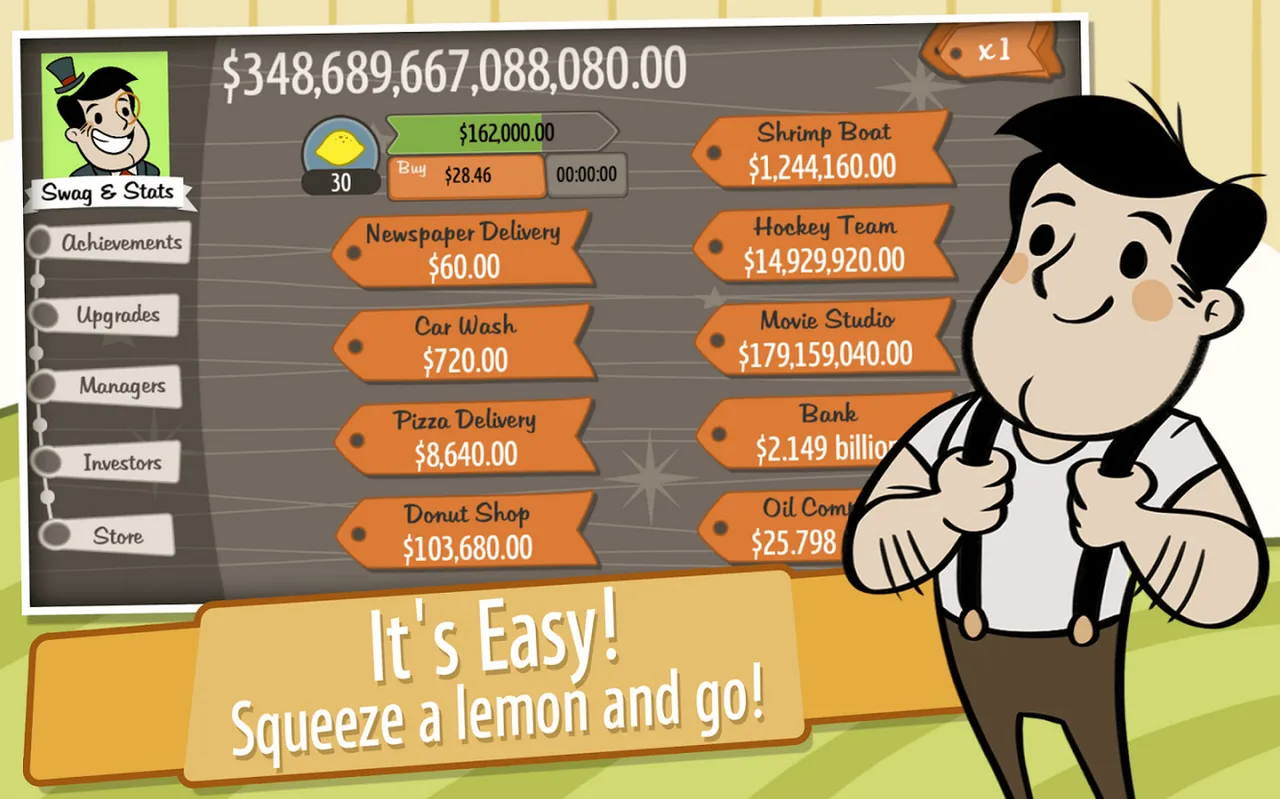
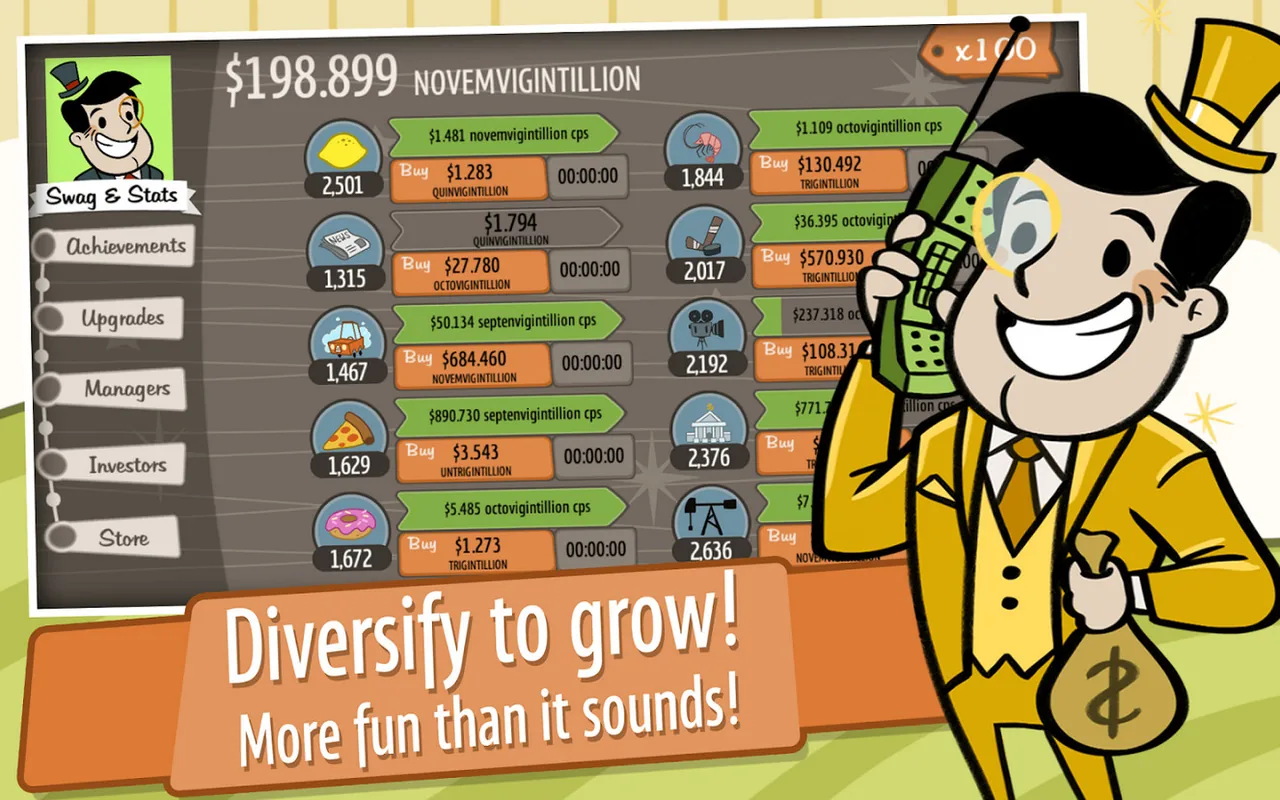
- The bulk-buy interface stays readable even with dozens of investments running simultaneously, which busier idle games often fail to manage
Biggest weaknesses
- A separate Gold Subscription and a $14.99 ad-removal pass mean a genuinely friction-free experience is sold as an ongoing cost rather than a single purchase
- First Time Buyer and Insider Deal bundle pricing lean on new-player urgency tactics rather than a stable, predictable shop
- Once managers take over the early investments there is no equivalent of a boss timer or forced decision point, and the mid-game can reduce to watching a number climb
Who it's for: Idle-game newcomers who want the clearest, least-decorated version of the buy-automate-reset loop, and anyone studying how a free mobile idle game actually makes money once the tutorial ends.
Our recommendation: Play it free — the core loop through Earth, the Moon and Mars costs nothing to see. Ignore the Gold Subscription and the ad-removal pass until you know you're staying for the long haul, and treat the "First Time Buyer" pop-up exactly like the anchor-priced sales pitch it is.
6 / 10
Cookie Clicker made idling feel like a joke worth being in on. Clicker Heroes wrapped that joke in an RPG skin. AdVenture Capitalist did something plainer than either: it took the loop apart, kept only the parts that made money, and shipped them with a straight face. Buy a lemonade stand. Buy a hundred. Hire someone to run them. Buy a newspaper route, then a car wash, then a bank, then a movie studio, then something called a "space company," each one costing exponentially more than the last and paying proportionally more once it's running. When the whole ladder stalls, reset it for an Angel Investor bonus and climb faster the second time. There is no combat, no story, no skill tree with branching choices — just the cleanest possible expression of "number goes up," and a gold shop sitting directly on top of it. That combination is exactly why it's worth reviewing on its own terms rather than as Cookie Clicker's quieter cousin: few idle games make the buy-automate-reset formula this legible, and few are this upfront about turning every stage of it into a purchase opportunity.
Buy, hire, reset, repeat
The opening hour is close to perfect idle-game pacing. A lemonade stand costs almost nothing and pays for itself in seconds; the second doubles the payoff and the price climbs with it, and within a few minutes the game is teaching its central lesson without a tutorial box in sight — spread cash across cheap, fast-cycling businesses early, then let the expensive, slow ones take over once there's enough capital sitting idle to fund them. A hired manager removes the need to keep clicking any one investment, and stacking managers is the whole mid-game: work shifts from "click the lemonade stand" to "decide which business deserves the next dollar," which is a much better use of a player's actual attention than raw clicking ever was.
The structural hook is the Angel Investor system. Push far enough and growth flattens against the cost curve; resetting every investment back to zero converts accumulated progress into a permanent revenue multiplier that applies from the very next lemonade stand onward. It's the same shape Clicker Heroes' Hero Souls and Ancients popularised around the same period — reset on purpose, spend what the reset earned on something permanent, come back faster — but AdVenture Capitalist runs it with one moving part instead of a tree of interacting Ancients, which makes it far easier to read and far less interesting to optimise. Clear Earth's businesses past 100 trillion dollars and a second world, the Moon, opens with its own ladder of investments; clear that and Mars follows. Three worlds, three complete versions of the same climb, each one bigger and slower than the last. It's a small structure doing a lot of work, and it's honestly the best idea in the game — a genuine long-term destination for a loop that could otherwise just repeat forever with no finish line in sight.
Where the automation stops being interesting
The trouble is what happens once every early investment has a manager attached. Where Clicker Heroes throws up a boss with a visible countdown every few zones — one active decision forced into an otherwise passive stretch — AdVenture Capitalist has nothing equivalent. Past the opening world, meaningful play mostly consists of checking back periodically to buy the next tier of investment or spend an Angel Investor reset, with long stretches in between where the game plays itself and there is genuinely nothing to decide. Pocket Gamer's contemporary review called it "a pointless waste of time" over exactly this complaint, and while that undersells what the loop gets right in its opening hour, it's not an unfair read of hour six or hour twenty, when the businesses running themselves have become the entire game rather than a convenience layered on top of one.
That's a defensible design choice for an idle game built to sit in a background tab or a phone dock — the whole pitch is that it works without your attention. But it does mean the mid-game has very little to offer anyone who wants an idle game with occasional active texture, the way Clicker Heroes' boss timers or Melvor Idle's combat encounters provide. AdVenture Capitalist's near-weekly timed events are the closest thing it has to that texture, and they matter more for retention than for design: each one runs for several days around a real-world holiday or occasion, hands out a separate limited-time currency, and disappears on a countdown, which is a proven way to bring lapsed players back but not really a new decision to make within the core loop itself.
The gold economy, in detail
This is where AdVenture Capitalist earns its place as a case study rather than just another idle game. Nothing in its core loop is paywalled — every investment, every manager, every world, and the Angel Investor bonus that ties them together are all reachable through play alone. What's for sale is speed, and the shop selling it is built with real sophistication. Gold Bars come in four tiers on mobile, from twenty bars for US$1.99 up to two hundred and forty for US$19.99, and gold buys instant investment purchases, instant manager hires and permanent income boosts that would otherwise take hours of accumulated play to reach the same way. Sitting alongside the straight currency packs are a First Time Buyer Bundle and an Insider Deal Package, both classic anchor-priced offers aimed specifically at players still early enough in a session to be impulsive about a "limited" discount — a new-player conversion tactic lifted straight from mobile free-to-play's most well-worn playbook, not something AdVenture Capitalist invented but something it leans on unapologetically.
Above the one-off packs sits a Gold Subscription priced at US$9.99, and separately from that, a US$14.99 pass that removes ads for thirty days — two different recurring costs for two different kinds of friction relief, on top of the currency packs, rather than one purchase that clears both. That structure matters: a player who wants an ad-free, friction-free version of the game isn't buying something once, they're renting it monthly, and the two passes don't appear to be bundled into a single tier. Apple's own storefront disclosure separately flags the app for randomized loot-box-style rewards and third-party advertising, on top of everything already listed for real money. None of this makes AdVenture Capitalist pay-to-win in any competitive sense — there's no other player to lose to, and MegaBucks earned through ad-watching, events and milestones can buy the same Golden Ticket multipliers that gold indirectly funds via faster progress toward them. But it is comprehensively built to convert idle patience into recurring spend, more aggressively and on more fronts than the restrained free-to-play model Clicker Heroes settled into after nearly a decade with its rubies. If Clicker Heroes shows what a fair idle monetisation model looks like, AdVenture Capitalist shows what the more typical, more insistent version looks like right next to it.
Still maintained, rarely reinvented
AdVenture Capitalist isn't a dead game. It launched on Kongregate's browser platform in May 2014, reached Android in December that year and iOS in February 2015, arrived on Steam for Windows and Mac that March and Linux that July, and made it to PlayStation 4 in August 2016 — a genuinely wide platform spread for a single-developer-studio idle game, and Hyper Hippo has kept the mobile build alive well past most of its contemporaries. The current iOS build, now listed as "AdVenture Capitalist Tycoon," shipped an update in early July 2026, describing the change as internal stability work rather than new content — a maintenance patch, not a creative one, which is a fair summary of the game's last several years overall. The core three-world structure has not meaningfully expanded since Mars was added, and the studio's creative attention has clearly shifted toward its spin-offs, AdVenture Communist and the more recent AdVenture Ages, rather than back into the original. That's a reasonable business decision for a ten-year-old mobile earner, but it does mean returning players shouldn't expect the loop itself to have grown much, even as the game keeps quietly running.
Verdict
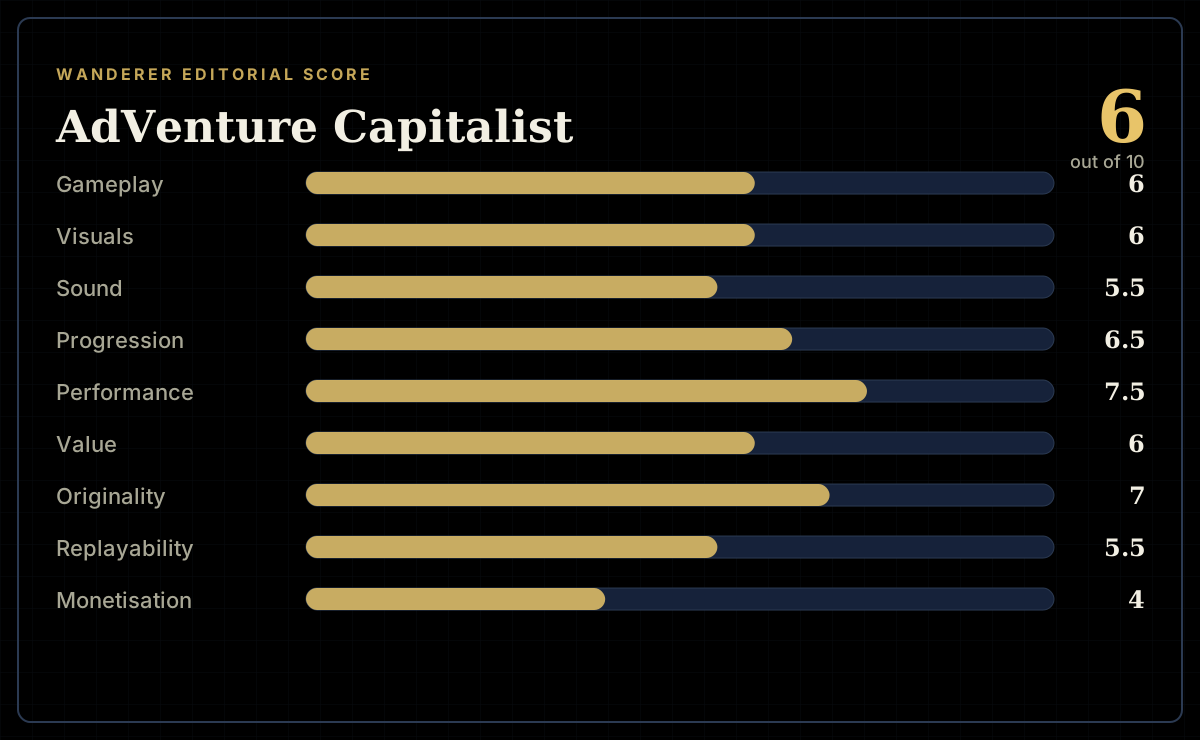
Six out of ten. As a piece of idle-game design, AdVenture Capitalist's opening hour is genuinely excellent — the cleanest, funniest version of the buy-automate-reset loop in the genre, and the Angel Investor system gives that loop an actual destination across three worlds instead of letting it spiral forever. It loses ground once the managers take over and the mid-game stops asking for decisions, and it loses more on the business model wrapped around all of it: a gold shop, a monthly subscription, a separate ad-removal pass and anchor-priced new-player bundles stacked on top of each other, all aimed at converting patience into payment far more insistently than its genre peers. Nothing is locked behind that system, which keeps this from being a pay-to-win problem — but it is, without question, the more typically aggressive version of idle monetisation, not the exception to it. Play it free to see where a huge slice of the genre's mobile audience actually lives. Just go in with a clear idea of what every pop-up is asking for before you tap it.
Pricing, platform availability and Steam review data checked 30 July 2026.
Pros and cons
Pros
- The Angel Investor reset compresses a fully-idle empire back to a lemonade stand in exchange for a permanent multiplier, and chasing that multiplier stays satisfying across all three worlds
- Every investment, manager and world unlock is reachable without spending real money — gold buys speed, not access
- The bulk-buy interface stays readable even with dozens of investments running simultaneously, which busier idle games often fail to manage
- Nearly eleven years after its 2014 browser debut, the mobile build was still receiving update patches as of July 2026
- Offline earnings apply the same manager-driven income the game runs while open, so stepping away never quietly resets progress
Cons
- A separate Gold Subscription and a $14.99 ad-removal pass mean a genuinely friction-free experience is sold as an ongoing cost rather than a single purchase
- First Time Buyer and Insider Deal bundle pricing lean on new-player urgency tactics rather than a stable, predictable shop
- Once managers take over the early investments there is no equivalent of a boss timer or forced decision point, and the mid-game can reduce to watching a number climb
- Visual and audio presentation has barely evolved since 2014 — charming in its lemonade-stand cartoon style, but functional rather than distinctive
- Near-weekly timed events keep pulling attention back with a fresh currency and countdown, which reads as retention design at least as much as content
Screenshots
-
AdVenture CapitalistImage: Hyper Hippo Games via Steam -

AdVenture CapitalistImage: Hyper Hippo Games via Steam -
AdVenture CapitalistImage: Hyper Hippo Games via Steam -
How the review scores each part of the gameWanderer Editorial -
The short versionWanderer Editorial