
Game review
Idle Apocalypse
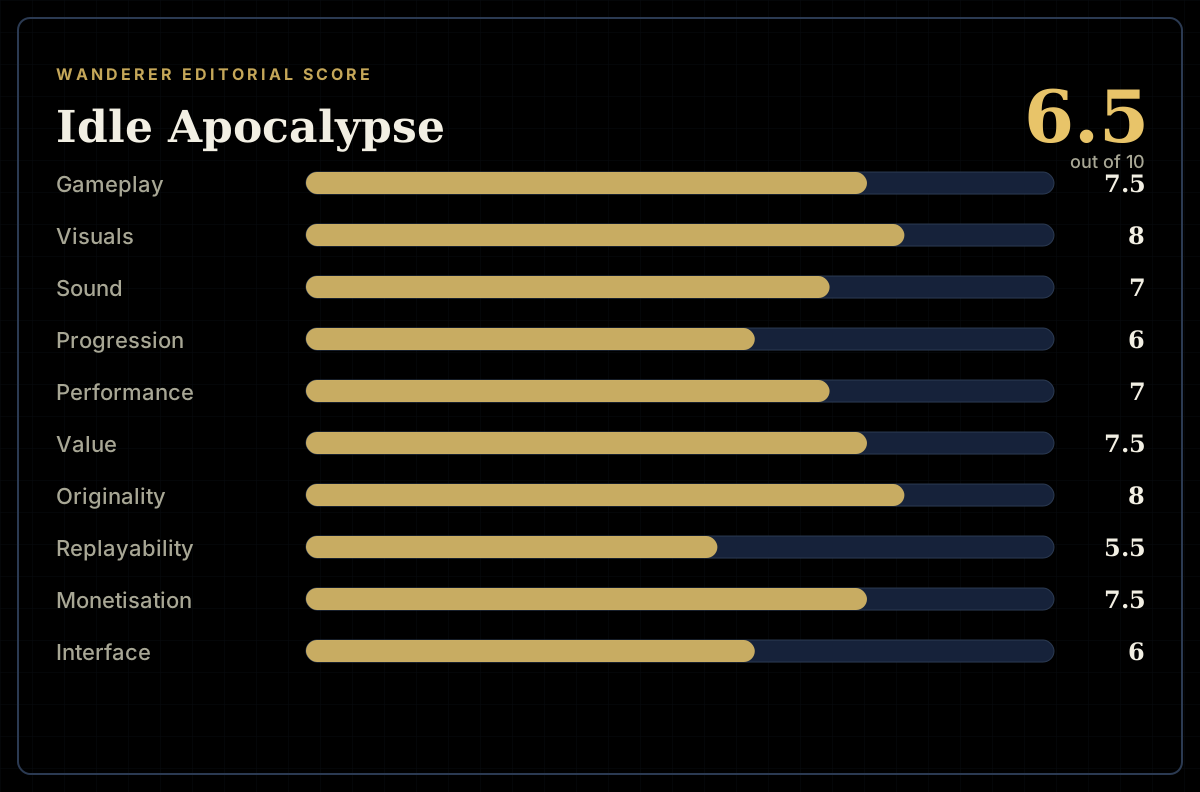
6.5 / 10
- Developer
- Grumpy Rhino Games
- Publisher
- Grumpy Rhino Games
- Released
- 31 July 2018
- Platforms
- iOS, Android
- Genre
- Idle Tycoon
- Monetisation
- Free-to-play with rewarded video ads for temporary production and combat boosts, plus a gem premium currency sold in bundles, event and seasonal bundles, and a one-off Remove Ads purchase
- Players
- Single-player; no guilds, trading, chat or PvP
The short version
Idle Apocalypse still does something few mobile idlers bother with: it turns the tower itself into the puzzle, feeding each floor's output into the next instead of hiding everything behind an upgrade list. The monster-breeding layer and the Idol-summon prestige loop give that puzzle real teeth for a long opening stretch. What holds it back in 2026 is time — the studio has clearly moved to maintenance mode, the mid-tower grind was always the game's weak point, and a returning player will find almost exactly what they left behind.
Biggest strengths
- The tower's floor-to-floor resource chain makes room placement a real planning decision, not just a bigger-number button
- Twenty-plus craftable monsters with distinct jobs give the worker layer more depth than most clicker-tier competitors
- The cult-leader art direction and writing have a specific, dry sense of humour that never leans on stock fantasy tropes
Biggest weaknesses
- Recent updates are bug-fix patches only, and the store description still reads like 2018 launch copy with no sign of new content on the way
- Mid-tower floors slow to a crawl once the early rooms stop mattering, well before the next Idol makes the wait worthwhile
- Switching a floor's resource output halts the previous one completely, a mechanic the game never explains and new players routinely trip over
Who it's for: Idle-tycoon fans who want a genuine spatial system to plan around rather than another scrolling upgrade list, and who don't mind a game whose active development has effectively stopped
6.5 / 10
Running a cult should feel like this more often
Idle Apocalypse opens with a pitch most idle games would bury under three menus of flavour text: you're not a farmer, a miner or a fantasy hero. You're a cult leader building a tower into the sky and the earth, breeding monsters to staff it, and working toward summoning a demon god who will personally end the world. It's a funnier premise than the genre usually bothers with, and Grumpy Rhino Games — a small UK studio that has been making idle games since 2015 — built an unusually literal system to support it. The tower isn't a list of upgrades dressed up as a building. It's a stack of floors that actually feed each other, and getting that right is the best thing Idle Apocalypse has going for it, seven years after release.
The tower is a production chain, not a menu
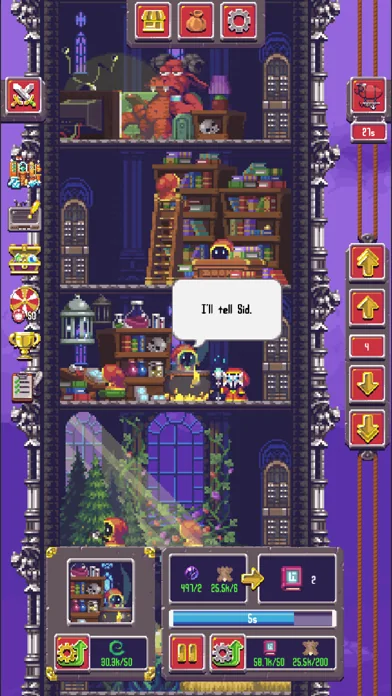
Most idle tycoons fake verticality. You "build" a mine and a smelter and a shop, but mechanically they're three rows in the same spreadsheet, connected by nothing but a shared currency. Idle Apocalypse actually wires its floors together. Each room on the tower produces exactly one resource at a time, and switching what it produces halts the old output stone dead — there's no running two resources off one floor. That constraint sounds like a nuisance, and early on it is one, but it's what makes the tower legible as a machine: dark energy from one floor powers the research on another, a mined resource above feeds a factory below, and the layout you choose determines which chains are even possible. Planning a floor means asking what it unlocks two and three rooms away, not just what it produces this minute.
That's a genuinely different decision space from the tech trees most idle games dress up as something spatial. Cell to Singularity, reviewed here, sells the entire history of life as a sprawling web of nodes, but strip away the art and it's a linear unlock order with extra steps. Idle Apocalypse's tower is smaller in scope but the dependency is real: a badly placed floor genuinely costs you throughput, and rearranging it later costs materials and time. The spatial presentation isn't just nicer to look at — it's load-bearing for the decisions the game asks you to make.
Monster breeding is where the actual optimisation lives
Rooms don't run themselves. Idle Apocalypse hands you over twenty craftable monster types — goblins, beasts, demons — each suited to different jobs, and getting the right creature onto the right floor is the layer where the tower stops being a static diagram and starts being a build to tune. Monsters can be evolved and upgraded, and because different creatures interact differently with a floor's output, staffing decisions ripple through the resource chain the same way room placement does. It's not a deep crafting system by the standards of a dedicated monster-collector, but it's a meaningfully deeper worker-assignment layer than the tap-and-wait competition, and it's the part of the loop that keeps paying off well after the tower's basic shape has been decided.
Where it runs thin is late. There's a ceiling to how many meaningfully different roles twenty-odd monster types can fill once you've seen the obvious pairings, and without new creatures or new floor types landing regularly, the optimisation space stops growing. That's a problem shared with Soda Dungeon, whose ascension loop is charming for the first several resets and repetitive by the tenth — except Soda Dungeon is free with almost nothing to buy, which makes the diminishing returns easier to shrug off than they are here.
Idols, prestige, and a curve that isn't quite endless
Idle Apocalypse doesn't run on one uninterrupted number-go-up curve. Progress is organised around summoning a sequence of Idols — legendary demon gods — each summon resetting the tower's height while banking permanent "chants" that carry forward and reshape how the next run plays out. It's closer to a soft chapter break than a single endless climb: each Idol run unlocks mechanics the previous one didn't have, so returning to floor one doesn't feel like starting over so much as starting the next stage. That's a smarter shape than a lot of idle tycoons manage, and it's the part of the design that earns the "endless idle game" line in its own store listing rather than just repeating a bigger multiplier back at you.
The catch is that this structure depends on new Idols, new chants and new floor types continuing to show up, and the evidence that they still are is thin. Idle Apocalypse's own iOS release notes show nothing beyond "Bug fixes" for well over a year, and its store description hasn't been rewritten since launch. Compare that to Idle Planet Miner, which is roughly the same age and still shipping new systems seven years in — the difference in how each studio has kept its game alive is the single biggest factor separating "an idle tycoon worth starting today" from "a good idle tycoon whose story stopped a while ago."
Offline progress does the job without pretending to replace you
The monster crews keep working the tower while the app is closed, which is table stakes for the genre at this point, but Idle Apocalypse doesn't lean on offline gains as hard as some of its competitors do. Away time restocks resources at a pace that rewards checking in every few hours rather than every few days, and the ad-boosted multipliers that appear on login are framed as a top-up, not the only way to make offline time worthwhile. It respects the player's time without making the decision to actually open the app feel pointless — the harder trick most idle games fumble one way or the other.
Monetisation that mostly behaves
The premium currency is gems, sold in bundles from a $4.99 starter pack up to a $30.99 top tier, alongside a $9.99 Remove Ads purchase and rotating event and skin bundles. None of it buys a competitive edge, because there's no competitive mode to have an edge in — gems mainly speed up waits that would otherwise resolve on their own. Rewarded ads cover the same ground: watch one for a temporary production or combat boost, or don't, and the tower still climbs. It's a considerably gentler stack than Legend of Mushroom, whose gacha layer turns the screws hard once the opening weeks end, or the honest-but-visible ad economy of Almost a Hero. Idle Apocalypse never asked players to choose between paying and losing, which is a big part of why its 4.6-star App Store rating and roughly 4.7-star, six-figure Google Play rating count have held up as well as they have.
Where it actually falls short
The mid-tower stretch is Idle Apocalypse's weakest hour, well before any of that. Early floors produce fast enough to feel generous, but there's a long middle section where the next meaningful unlock is several sessions away and the existing rooms have already stopped teaching you anything new. The floor-switching mechanic that halts a room's old output the instant you pick a new one is never explained on screen, and it's the single most common way new players accidentally set themselves back. None of that would matter much if content kept arriving to paper over it — but for a returning player in 2026, the tower they left is essentially the tower they'll find again.
Verdict
Idle Apocalypse earned its reputation honestly: a floor-by-floor tower that behaves like an actual machine, a monster layer with real staffing decisions, and a prestige loop that resets height without resetting your sense of progress. All of that still works. What's changed is the studio's attention — updates have narrowed to bug fixes, and the game reads today as a well-made idler that finished growing rather than one still being built. It's an easy recommend for anyone who wants a tight, funny, fair-monetised tower to plan around for a few weeks. It's a harder sell as a long-term home, because the ceiling that was always there is now the whole story.
Pros and cons
Pros
- The tower's floor-to-floor resource chain makes room placement a real planning decision, not just a bigger-number button
- Twenty-plus craftable monsters with distinct jobs give the worker layer more depth than most clicker-tier competitors
- The cult-leader art direction and writing have a specific, dry sense of humour that never leans on stock fantasy tropes
- Summoning an Idol resets the tower but keeps permanent chants, giving prestige runs a genuine new-game-plus feel rather than a bigger multiplier
- Ads are opt-in and normal play hands out enough gems that free players are never obviously behind paying ones
Cons
- Recent updates are bug-fix patches only, and the store description still reads like 2018 launch copy with no sign of new content on the way
- Mid-tower floors slow to a crawl once the early rooms stop mattering, well before the next Idol makes the wait worthwhile
- Switching a floor's resource output halts the previous one completely, a mechanic the game never explains and new players routinely trip over
- Room icons and floor-selector buttons are small enough to misfire on compact phone screens
- A player returning after a long break finds the same endgame ceiling that existed years ago, with nothing new to work toward
Screenshots
-
Idle ApocalypseImage: Grumpy Rhino Games LTD via the App Store -

Idle ApocalypseImage: Grumpy Rhino Games LTD via the App Store -

Idle ApocalypseImage: Grumpy Rhino Games LTD via the App Store -
How the review scores each part of the gameWanderer Editorial -
The short versionWanderer Editorial