
Game review
Idle Bank Tycoon
5.5 / 10
- Developer
- Kolibri Games GmbH
- Publisher
- Kolibri Games GmbH, majority-owned by Ubisoft since February 2020
- Released
- 30 December 2022
- Platforms
- iOS, Android
- Genre
- Idle Business Simulation
- Monetisation
- Free-to-play, built on rewarded video ads, loot-box "briefcases" bought with a hard currency, ingot and season-pass bundles from $0.99 to $9.99, and two time-limited ad-removal passes rather than one permanent purchase
- Players
- Single-player; no trading, guilds or direct player interaction, though Google Play Achievements track a separate XP ladder
The short version
Idle Bank Tycoon takes the studio's own miner-elevator-warehouse formula, swaps a bank's Marketing, Service Windows, Vault and Main Hall departments in for shafts and conveyor belts, and proves the underlying structure travels well: reading which department is bottlenecking the other three is still an honest, learnable skill rather than filler between taps. What it doesn't inherit is the older game's relative restraint. Loot-box "briefcases," rewarded-ad loops built to be watched repeatedly, and an ad-removal purchase that lapses after a week or a month rather than once and for all push the monetisation further than Kolibri's back catalogue usually goes, and the meta-game running alongside the core loop is thinner than it needs to be to carry a player past the first month.
Biggest strengths
- The Marketing/Service Windows/Vault/Main Hall department chain recreates the studio's classic bottleneck-reading puzzle convincingly in a completely different theme
- Managers and reputation levels give upgrade spending a real branching structure rather than one flat power number to keep pushing
- Idle income keeps accruing while the app is closed, so a returning player isn't staring at an empty vault
Biggest weaknesses
- Loot-box "briefcases" sit behind hard currency and rewarded ads, a mechanic Kolibri's older, better-regarded games don't lean on nearly as hard
- Neither ad-removal purchase is permanent — $7.99 buys seven days, $14.99 buys thirty, and the ads come back on a timer either way
- Third-party analysis of the game's own launch metrics found engagement dropping sharply after roughly a week to a month, with player retention consistently pointing at a shallow meta-game rather than a hard content wall
Who it's for: Players who already like Kolibri's mining and factory idles and want the same shape with a different coat of paint, and mobile idle fans specifically curious how far a studio will push loot boxes and rewarded ads once a formula is already proven to convert.
Our recommendation: Worth a free install for a handful of sessions to see the department-juggling loop click into place. Don't expect the shop to stay out of the way once it does, and don't buy the weekly or monthly ad-removal pass without checking the calendar — neither one is permanent.
5.5 / 10
The studio's mould, poured into a new shape
Kolibri Games has spent a decade proving that one structural idea — automate a resource chain across three or four connected stations, let the player feel exactly which one is the current bottleneck, and keep the "just upgrade one more thing" pull alive with steep multipliers between tiers — survives almost any reskin. Idle Miner Tycoon did it with mineshafts, elevators and warehouses. Idle Factory Tycoon did it with factory floors. Idle Bank Tycoon, which launched on iOS and Android on 30 December 2022 with a broader marketing push in the following weeks, does it with a bank: Marketing, Service Windows, the Vault and the Main Hall stand in for dig, lift and sell, each generating soft currency that the others depend on to keep flowing.
It's worth being plain about how well that launch actually went, because it complicates any easy "just another skin" dismissal. Industry analysis of Kolibri's own launch data credited Idle Bank Tycoon with the fastest revenue growth of any title in the studio's ten-game portfolio at the time, out-earning the studio's own Idle Firefighter Tycoon in its first stretch and pulling in more monthly downloads than Idle Miner Tycoon was managing by that point in its much longer life. Whatever else is true about the game, Kolibri didn't stumble into a weaker version of its own formula — they built a version that converted faster than the games that came before it. That's a commercial story more than a design one, but it's the reason this particular reskin earns a review of its own rather than a footnote in the Idle Miner Tycoon piece.
Four departments, one honest puzzle
The core loop holds up. Marketing drives customers toward the bank, Service Windows process them into deposits, the Vault stores the resulting cash, and the Main Hall turns reputation and foot traffic into the multipliers that make everything else worth upgrading faster. Push Marketing too hard and Service Windows can't process the queue it creates. Max out the Vault without upgrading the Main Hall and the reputation gains that unlock managers and new activities stall out. It's the same three-or-four-variable balancing act that made the studio's mining games genuinely satisfying to read, transplanted convincingly enough that a player who's never touched Idle Miner Tycoon would have no reason to suspect the department names used to be mineshafts.
Managers unlock at reputation level six and behave exactly the way Kolibri veterans would expect: assign one to a department and it runs itself, freeing the loop to actually go idle instead of demanding constant taps. Reputation itself climbs through a three-tier milestone structure — quests, a progress bar, and a completion menu — that gives early sessions a clear sense of "what am I working toward right now" rather than a single ambiguous number going up. None of this is new by 2026, and it doesn't try to be. It's a well-worn structure executed competently, which is a perfectly reasonable thing for a nine-year-old formula's newest coat of paint to be.
Audit Madness and the meta-game's thin edges
Where Idle Bank Tycoon does try something its own portfolio siblings don't: a match-3 mode called Audit Madness unlocks within the first couple of days and folds the game's managers into a battler layer, matching tiles to fight through "audits" using the same characters a player has been upgrading in the idle loop. It's a reasonable idea for keeping active-session attention somewhere other than a menu of upgrade buttons, and integrating recruited managers into it rather than bolting on generic match-3 characters at least ties the two loops together instead of running them in parallel.
The trouble is how quickly that meta-layer runs out of things to say. A Business Mode unlocks at reputation level seven, letting players spend soft currency on manager-upgrade materials and more Audit Madness boss fights — but beyond that, there isn't a second or third system waiting in the wings the way the mining games eventually add continents, research branches and Super Managers to keep the mid-game feeling like it's still expanding. Third-party analysis of the game's own engagement data found day-one retention sitting respectably around 48%, edging out Kolibri's own Idle Office Tycoon on the same metric, but with a much steeper drop in the days that follow — a pattern the analysis attributes directly to a shallow meta-game rather than any single content wall. A player who sticks around past the opening week is doing so on the strength of the core department loop alone, because there isn't much else being added to hold their attention.
Finding your own bank
One recurring complaint in that same third-party analysis is worth repeating because it's the kind of small friction that's easy to underrate until you're the one experiencing it: the department zones on the bank floor are reportedly difficult to read at a glance, leaving new players unsure which area they're actually tapping. Idle Office Tycoon, by the same studio, uses clearer wall-enclosed zoning for its equivalent departments — a detail that sounds trivial until you remember that in a game whose entire appeal rests on reading which of four stations is bottlenecking the others, not being able to tell the stations apart at a glance undercuts the one thing the genre is supposed to do well.
What the shop is actually selling
This is where Idle Bank Tycoon pulls furthest away from the rest of Kolibri's catalogue, and where the review's score takes its biggest hit. The in-app purchase menu runs from a $0.99 seasonal offer up through ingot and briefcase bundles at $1.99, $4.99 and $9.99, a $9.99 season pass, and a pair of "Ad Tickets" purchases at $2.99 and $4.99. Two of those briefcase-style purchases are explicitly loot boxes — Apple's own storefront flags the app as containing both ads and loot boxes, and industry write-ups of the design specifically single out "Specialist" and "Executive" briefcases as popular purchases, which is another way of saying the randomised reward mechanic is doing real monetisation work rather than sitting unused in a menu nobody opens.
Rewarded video ads are built to be watched more than once per session: the game offers instant soft or hard currency, two-hour 2x income boosts, welcome-back bonuses, doubled upgrade materials and access to lootbox-adjacent "green cases" that refresh every two hours specifically so there's always a fresh ad to watch for one more reward. None of that is unusual for the genre — AdVenture Capitalist and Idle Miner Tycoon both run comparable rewarded-ad economies — but the ad-removal option is where Idle Bank Tycoon is genuinely worse than its own stablemate. Idle Miner Tycoon sells a one-time, permanent ad removal for around $15. Idle Bank Tycoon sells the same idea as a subscription in everything but name: $7.99 buys seven days without ads, $14.99 buys thirty, and once the clock runs out the ads come back whether or not the player remembers to renew. There is no permanent option at any price. For a reader weighing whether to spend anything at all on this game, that's the single most important fact in this review: paying to make the ads stop is a recurring cost here, not a one-time one.
None of this is a hard progress gate — every department, manager and Audit Madness stage is reachable without spending a cent, and the core loop functions identically whether or not a player ever opens the shop. But "reachable for free" and "not built to extract money from regular players" are different claims, and the loot-box framing plus the subscription-shaped ad removal put Idle Bank Tycoon meaningfully further along that spectrum than the mining and factory games the same studio built its reputation on.
Reception, four years on
The app's US App Store page currently sits at 4.8 out of 5 across roughly 104,000 ratings, a strong headline number that's worth reading with the usual caveat about self-selected mobile review pools skewing positive. More telling is that Kolibri has kept the game updated in parallel with its older titles rather than letting it fade — build 1.95.0 landed in July 2026, nearly four years after launch, with a revamped bank progression map among the recent changes. Whatever the meta-game's thinness costs it in long-term engagement, this isn't an abandoned launch-and-forget mobile game; it's still an actively maintained part of a profitable portfolio.
Verdict
Idle Bank Tycoon is proof that Kolibri Games' core structural idea — a multi-station resource chain where reading the bottleneck is the actual skill — survives a theme change intact, and the Marketing/Service Windows/Vault/Main Hall loop earns its keep on that basis alone. What keeps this from sitting anywhere near Idle Miner Tycoon's score is everything built around that loop: a meta-game that thins out within a month by the studio's own engagement data, department zoning that's reportedly hard to parse at a glance, and a monetisation menu that adds loot boxes and swaps a permanent ad-removal purchase for a pair of purchases that quietly expire. It's a free, playable, occasionally clever idle game for a handful of sessions. Just don't mistake either ad-removal tier for buying your way out of the ads for good — neither one does that, at any price.
Readers who'd rather their idle progression run inside a persistent shared world with no shop menu, loot boxes or expiring purchases to track at all may also want a look at Wanderer.
Pricing, ratings and version information checked 2 August 2026 against the US App Store (id 1645281275, Kolibri Games GmbH) and cross-referenced against the Android release (com.luckyskeletonstudios.idlebanktycoon on Google Play, build 1.95.0). No Steam listing exists for Idle Bank Tycoon as of this check.
Pros and cons
Pros
- The Marketing/Service Windows/Vault/Main Hall department chain recreates the studio's classic bottleneck-reading puzzle convincingly in a completely different theme
- Managers and reputation levels give upgrade spending a real branching structure rather than one flat power number to keep pushing
- Idle income keeps accruing while the app is closed, so a returning player isn't staring at an empty vault
- Still receiving regular content builds four years after launch (1.95.0 as of July 2026), from a studio with a decade of live-service idle games behind it
- The core loop is legible in a single glance, which matters more for a phone-idle interface than raw visual polish does
Cons
- Loot-box "briefcases" sit behind hard currency and rewarded ads, a mechanic Kolibri's older, better-regarded games don't lean on nearly as hard
- Neither ad-removal purchase is permanent — $7.99 buys seven days, $14.99 buys thirty, and the ads come back on a timer either way
- Third-party analysis of the game's own launch metrics found engagement dropping sharply after roughly a week to a month, with player retention consistently pointing at a shallow meta-game rather than a hard content wall
- Department boundaries on the bank floor are reportedly easy to misread, leaving players unsure which zone they're tapping until they've played for a while
- A banking reskin of a nine-year-old template doesn't do much to justify itself as its own game rather than another skin in the same studio's back catalogue
Screenshots
-
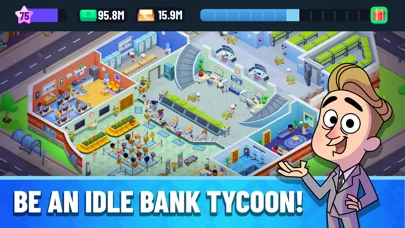
Idle Bank Tycoon: Money GameImage: Kolibri Games GmbH via the App Store -

Idle Bank Tycoon: Money GameImage: Kolibri Games GmbH via the App Store -

Idle Bank Tycoon: Money GameImage: Kolibri Games GmbH via the App Store -
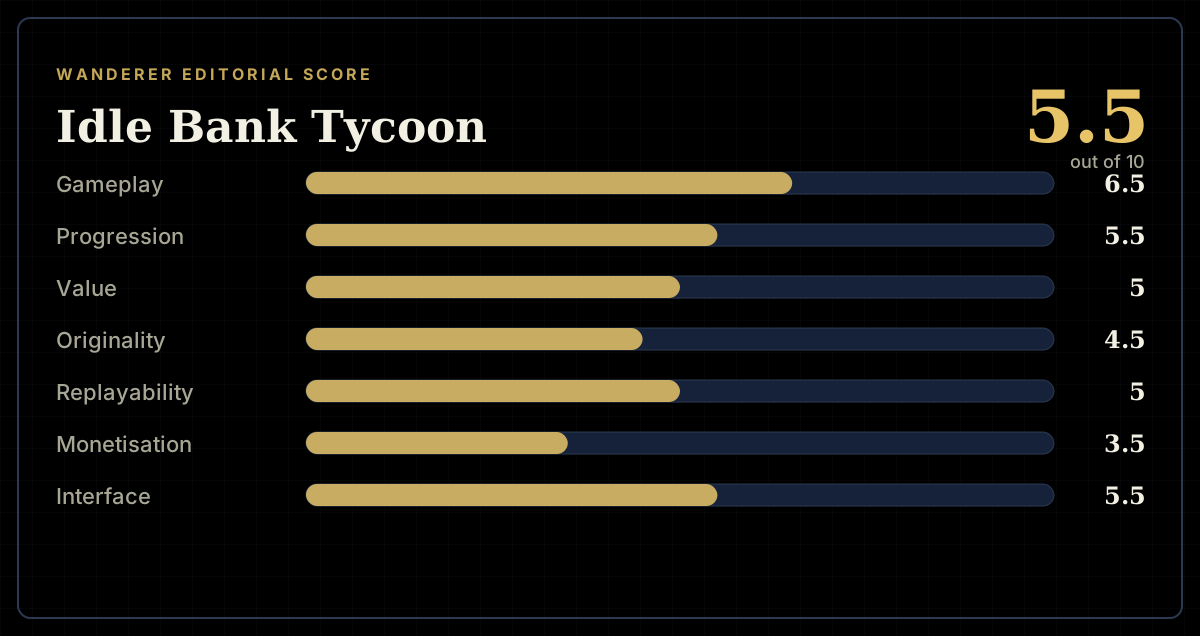
How the review scores each part of the gameWanderer Editorial -
The short versionWanderer Editorial