Game review
Market Chain 98
6 / 10
- Developer
- MGR Studio
- Publisher
- MGR Studio
- Released
- 29 July 2026
- Platforms
- Windows
- Genre
- Incremental / Management Sim
- Monetisation
- One-time purchase, no in-app purchases, no ads, no currency packs. Listed at NZ$11.25 with a 15% launch discount bringing it to NZ$9.56 (roughly US$6) — checked 3 August 2026.
- Players
- Single-player only
The short version
There's a good small game in here and it knows what it's doing for about four hours. The 90s-desktop shell is more than decoration — windows open as your business grows, so the interface itself is the progress bar — and the loan, tax and IPO systems give the numbers real friction instead of the usual frictionless doubling. Then the factory layer arrives, feels bolted on, and the content runs out. At six US dollars that's a fair trade for a couple of evenings. Anyone expecting the hundred-hour incremental this genre trained them to expect should read the achievement percentages first.
Biggest strengths
- The 90s desktop framing is executed properly — new windows opening as the company grows makes the interface itself the progression, which is a genuinely smart bit of design
- Loans, interest, debt ceilings and tax bills give the economy real downside; an idle game where ignoring your email has consequences is a rare thing
- The IPO prestige loop is clean — go public, earn share points, spend them in a Portfolio of permanent upgrades, run it back faster
Biggest weaknesses
- It's short — one player unlocked every achievement in about eight hours, and multiple reviews put the real content nearer four
- The early game demands sustained manual clicking; one reviewer flatly recommends an autoclicker and says two runs without one hurt their hand
- The factory and logistics systems sit awkwardly beside the market systems rather than feeding them, a complaint that recurs across languages
Who it's for: Incremental players who like management sims with actual downside risk — debt, interest, tax bills — and anyone who finds a fake Windows 98 desktop inherently pleasing. Not for players who want a long idle game to leave running for weeks, and not for anyone who resents clicking.
Our recommendation: Buy it on the launch discount if a four-to-eight hour incremental with good atmosphere sounds like a fair evening's entertainment, and go in expecting to finish it rather than to settle in with it. If your incremental library is measured in hundreds of hours per game, wait for a deeper sale or for the developer's promised updates to add the business sectors the Chinese-language reviews are asking for.
6 / 10
The best idea in Market Chain 98 is that your desktop is the progress bar.
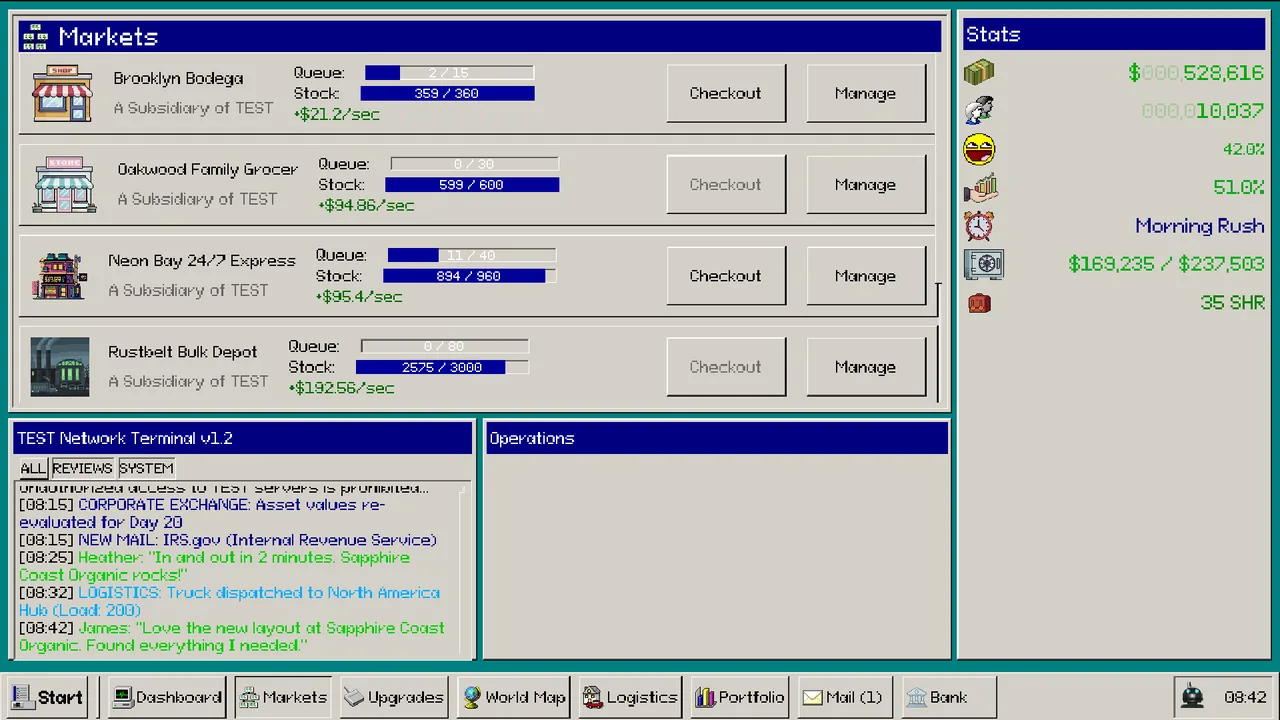
You start with one window: a bodega in Brooklyn, a cash register to upgrade, a queue of customers to clear. Play well and a second window opens. Then a third. By the late game the fake Windows 98 desktop you've been staring at is cluttered with overlapping panels — markets, logistics, factories, a stock ticker — and the visual chaos is the game telling you how far you've come without a single number needing to be read. Incremental games have been chasing "make growth feel like growth" for fifteen years. This one solved it with window management.
Everything else is more ordinary, and about four hours long.
Money that can go backwards
What separates this from the endless run of number-goes-up releases is that the numbers can go the wrong way.
You take bank loans to expand, and they come with interest rates and debt ceilings. Aggressive borrowing eats the margins it was supposed to buy. Taxes arrive on revenue. There are sponsorships and political donations to fund. One Japanese review describes the effect perfectly: it's supposed to be an idle game, but look away for a minute and the demands for tax and repayment turn up in your inbox. That's a real design decision, and it's the right one — friction is what most incrementals are missing, and here it produces the genre's rarest sensation, which is a decision you might get wrong.
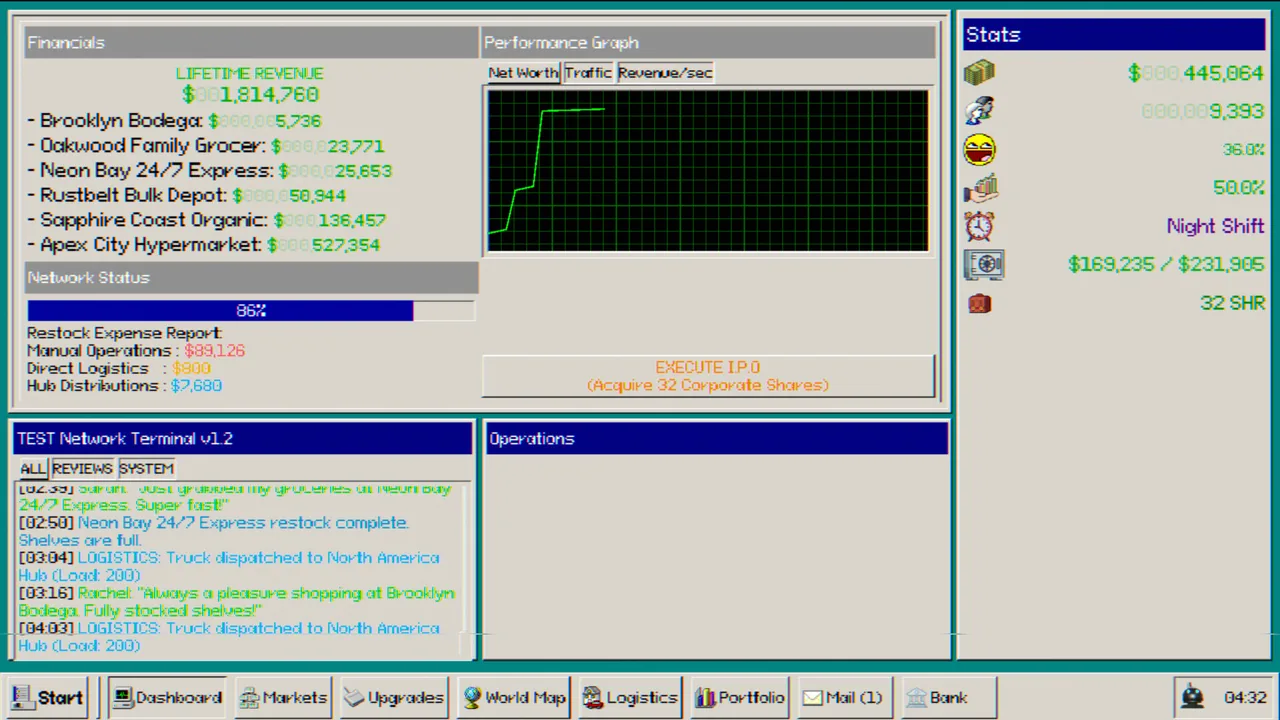
The prestige layer is standard but well-shaped. Take the company public, convert a run into share points, spend them in a Portfolio of permanent upgrades, start again with more efficiency. Nothing novel, but the IPO framing fits the fiction better than the usual reincarnation metaphor, and going public actually feels like an ending rather than a reset.
Bizsweeper, an in-fiction Minesweeper clone you can pull up while the money accrues, deserves a mention for being exactly the right size of joke — a period-appropriate diversion that doesn't try to be a second game.
Where players actually stop
The game shipped on 29 July with seventeen Steam achievements, and because they were there from launch rather than added later, the global completion rates are honest evidence rather than an artifact. Five days in, here's the shape:
Ninety-eight percent of players clear the opening two. Seventy percent reach the first IPO. Sixty percent hit the mid-run markers, forty-six percent the next, and by the time you reach the heavy-industry and monopoly achievements it's down to around a third — 32% for the factory tier, 29% for the monopoly.
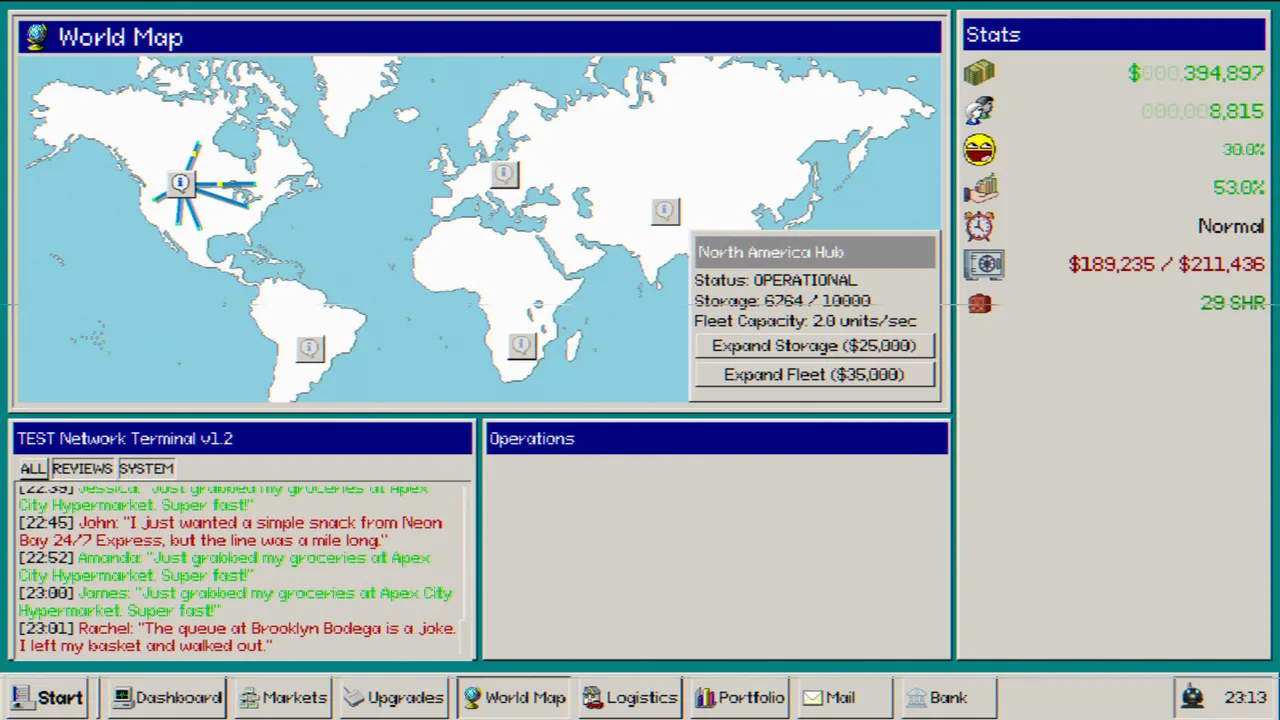
That's a steep drop for a game less than a week old, and it lines up precisely with what the written reviews say. The complaint isn't that the late game is hard. It's that the late game is where the design stops being coherent: the factory and logistics systems arrive as separate machinery sitting next to the market you've been running, rather than plugging into it. A Korean reviewer works through this in detail — the headquarters upgrades for storage and truck hubs never justify themselves, and the factory system runs on a track entirely separate from the market system. Roughly two thirds of players never got far enough to find out.
The clicking problem
For a game in the idle aisle, Market Chain 98 asks for a startling amount of manual input early on. The most direct verdict on this comes from a Chinese-language review that repeats itself three times for emphasis: you are under no obligation to play without an autoclicker. Two runs done honestly, they say, nearly wrecked their hand.
This is a solvable pacing problem rather than a fundamental one — the automation does arrive, and by the mid-game the thing genuinely idles the way the store page promises. But the opening hour is where a player decides whether they're in, and asking them to spend it hammering a mouse button is a strange choice for a game whose entire pitch is a business running itself. Melvor Idle and Bills Must Be Paid both understood that the first ten minutes have to sell the automation, not defer it.
Short, cheap, and a bit half-built
The honest summary of the negative reviews is not that the game is bad, it's that it's small. One player finished every achievement in around eight hours. A negative review puts the real content closer to four and calls the price disappointing on that basis. Two of the Chinese reviews say they're enjoying it but want more business sectors, which is the same complaint phrased kindly.
There's also a rougher edge worth naming. The Korean localisation appears to be misaligned — a tax prompt whose two options should read "pay" and "ignore" reportedly renders as "ignore" and "mayor", which means the script is offset against its labels. That's the kind of bug that turns a decision into a coin flip for anyone playing in that language, and it's a fair thing to hold against a full release rather than an Early Access build.
And then there's the accusation that the game is derivative — the single most-upvoted review on the page calls it a literal copy of another game with no creativity in it. That review doesn't name the game, and I'm not going to guess at one, but the surrounding context is checkable: MGR Studio has released four titles since November 2025, roughly one every two to three months. A cadence like that doesn't prove anything about originality on its own. It does explain why a section of the audience arrived already suspicious, and why "good bones, feels like Early Access" is the most common shape of the positive reviews.
Verdict
Market Chain 98 is a six-dollar game that is worth six dollars, which is a less backhanded compliment than it sounds. The desktop conceit is genuinely clever, the debt-and-tax economy gives the incremental loop teeth that most of its shelf-mates lack, and the first few hours have real momentum. It also finishes before it gets deep, hands its late systems to a third of its players in a state they describe as unfinished, and expects an autoclicker to cover for its pacing.
If you liked Defrag Incremental's take on turning an operating system into a game, this is a warmer, sillier, more commercial cousin — smaller and more polished on the surface, thinner underneath. Buy it for an evening or two on the launch discount, enjoy the tax-evasion achievement, and don't expect it to still be open in a fortnight.
Players who want the opposite trade — a world that keeps growing over weeks rather than a business you finish in an evening — may also enjoy Wanderer.
Pros and cons
Pros
- The 90s desktop framing is executed properly — new windows opening as the company grows makes the interface itself the progression, which is a genuinely smart bit of design
- Loans, interest, debt ceilings and tax bills give the economy real downside; an idle game where ignoring your email has consequences is a rare thing
- The IPO prestige loop is clean — go public, earn share points, spend them in a Portfolio of permanent upgrades, run it back faster
- Bizsweeper, the in-fiction Minesweeper pastiche, is a well-judged diversion rather than filler
- The developer is visibly responsive in the launch reviews, and the game runs on anything
Cons
- It's short — one player unlocked every achievement in about eight hours, and multiple reviews put the real content nearer four
- The early game demands sustained manual clicking; one reviewer flatly recommends an autoclicker and says two runs without one hurt their hand
- The factory and logistics systems sit awkwardly beside the market systems rather than feeding them, a complaint that recurs across languages
- The Korean localisation is broken in a way that affects play — a review reports the script offset so a tax prompt's options render as the wrong labels entirely
- A visible chunk of the audience calls it derivative, and the developer's release cadence — four games since November 2025 — invites the comparison
Screenshots
-
Market Chain 98Image: MGR Studio via Steam -
Market Chain 98Image: MGR Studio via Steam -
Market Chain 98Image: MGR Studio via Steam -
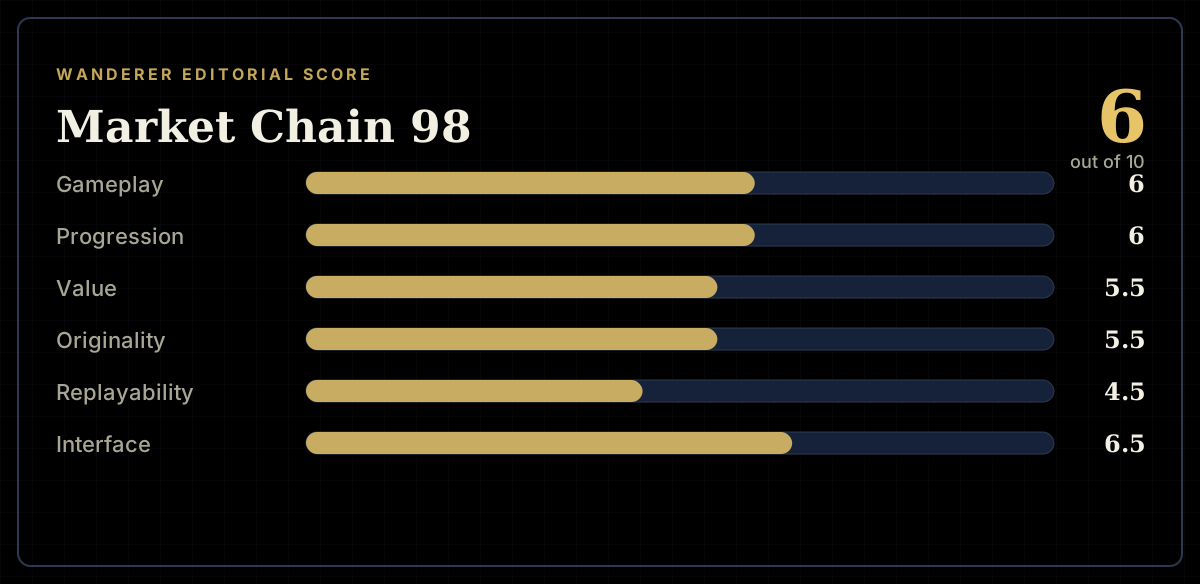
How the review scores each part of the gameWanderer Editorial -
The short versionWanderer Editorial