Game review
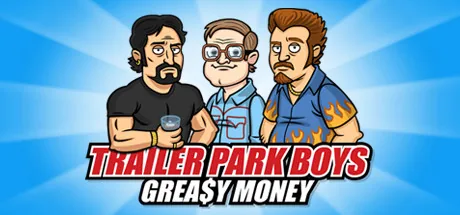
Trailer Park Boys: Greasy Money
6.5 / 10
- Developer
- East Side Games (Vancouver, BC, Canada)
- Publisher
- East Side Games
- Released
- 20 April 2017
- Platforms
- iOS, Android
- Genre
- Idle Business Tycoon Sim
- Monetisation
- Free-to-play with a Hashcoin premium currency sold across four bundle tiers plus a recurring Hashcoin subscription, and a second currency, Liquor, earned mainly through a card-gacha system that also happens to be the only way to raise the character levels required to automate each business.
- Players
- None. Entirely single-player against AI-controlled boss fights against the park's authority figures; no trading, co-op or head-to-head play of any kind.
The short version
Trailer Park Boys: Greasy Money takes a licensed idle tycoon template that could easily have been a lazy cash-in and builds one genuinely clever piece of design into it: getting caught by the park's authority figures doesn't just end a run, it sends the player to jail and resets the business empire, mirroring the show's own running joke about its characters never quite getting away with anything. That reset carries forward character and business levels the way any idle-game prestige system would, but wrapping it in the source material's own premise instead of a generic "ascend for a multiplier" screen is the kind of licensed-game decision that actually respects the property it's built on.
Nine years of continuous mobile support and a 4.8-star average from roughly 106,000 App Store ratings say the core loop works. What keeps the score from climbing further is a structural decision on the monetisation side: certain character levels are required before a business can be automated at all, and the fastest way to raise those levels runs through a gacha system built around the Liquor currency. That's a real design choice with real friction attached, not just a cosmetic shop sitting beside the game, and it's worth understanding before installing.
Biggest strengths
- The jail/reset mechanic reframes a standard idle-game prestige system as the show's own joke about its characters always ending up back in trouble, rather than a generic ascension screen
- Character writing and episodic "season" structure track the show's actual cast and tone closely enough that longtime viewers can recognise specific running gags rather than a surface-level reskin
- Nine years of continuous mobile updates is rare for a 2017 licensed mobile game and points to a developer still actively supporting the title rather than one that shipped a launch build and walked away
Biggest weaknesses
- Automating a business requires levelling the two characters assigned to it, and the fastest route to those levels runs through gacha-based card pulls funded by the Liquor currency — a structural gate on convenience, not just a cosmetic shop bolted to the side
- Four separate Hashcoin bundle tiers plus a recurring subscription is a heavier premium-currency menu than the genre needs, and working out which tier is actually worth buying is its own puzzle
- The abandoned Steam PC version — no updates since July 2020 and delisted from the store entirely — leaves mobile as the only way to play a game that once had a legitimate desktop release
Who it's for: Fans of the show who want an authentically written, on-brand idle game rather than a reskinned template, and idle-tycoon players who don't mind a gacha layer sitting between them and full automation. Less suited to players who want a monetisation-light idle experience or who find character-gated automation a dealbreaker on principle.
Our recommendation: Worth installing for the licence alone if you know the show — the writing, character voices and episodic "season" structure are handled with real care, and the core business-upgrade loop holds up fine on its own terms. Go in expecting the Hashcoin and Liquor economies to apply real pressure once free automation options run out, and don't expect the now-delisted Steam version to be an alternative.
6.5 / 10
Most licensed mobile games treat their source material as a skin: swap the icons, rename the currencies, ship the same tycoon template every other studio is running that quarter. Trailer Park Boys: Greasy Money does that too, on the surface — it's a business-upgrade idle game with cards, currencies and timers like a hundred others. What sets it apart is a single structural decision: when a boss fight against the park's authority figures goes badly, the player doesn't just lose a run, they get thrown in jail, and the business empire they'd built collapses. Character and business levels carry over into the next attempt the way any idle game's prestige system works, but the wrapper around that reset is the show's own long-running joke about its characters never quite getting away with anything. It's a small piece of design thinking, and it's the reason this review is more interested in Greasy Money than its genre placement would otherwise suggest.
Sunnyvale as a spreadsheet, with actual jokes attached
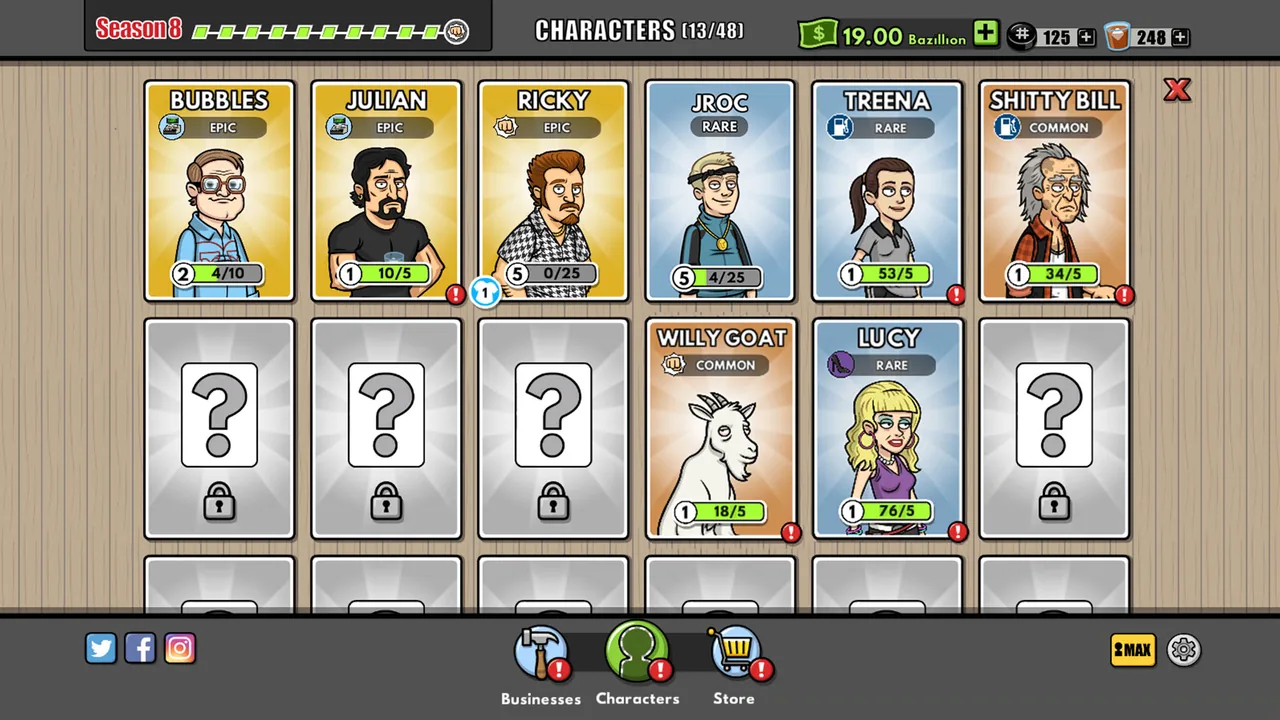
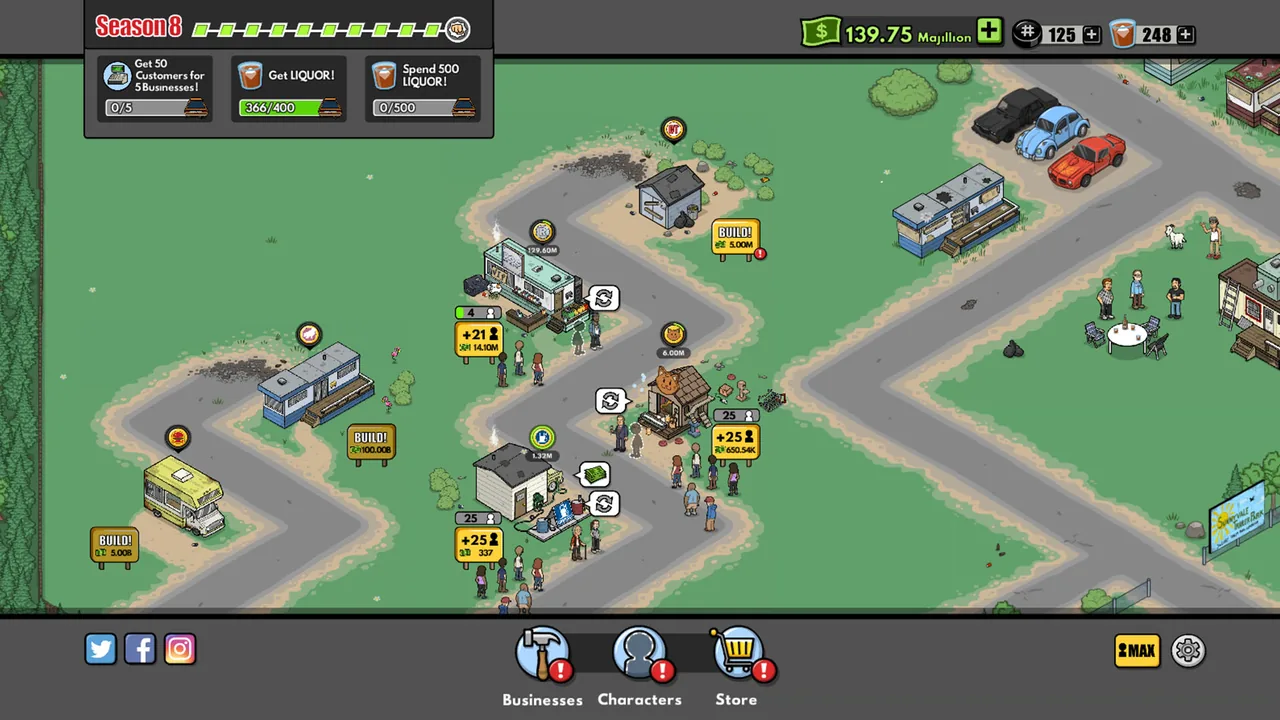
The core loop will be instantly familiar to anyone who has played an idle tycoon game before. Players build up businesses around Sunnyvale Trailer Park — Ricky's Used Gas, the Convenient Store, Roc Vodka and several others recur across seasons — each generating passive income that scales with two things: the business's own upgrade level, and the levels of the two named characters assigned to run it. Money accrues as the soft currency, while a card-collection system built around East Side Games' gacha mechanics is how those characters actually level up. Layered episodic content the developers call "seasons" ties progression to specific story beats lifted from the show, and the game currently spans eight of them, each introducing its own businesses, characters and boss encounters.
What keeps that structure from reading as pure spreadsheet management is how directly the writing leans on the source material. East Side Games worked with the show's creators — Mike Smith, John Paul Tremblay and Robb Wells, through their production company TPB Productions — and it shows in places a reskinned template wouldn't bother getting right: character dialogue, the specific rhythm of the show's running gags, and mobile-exclusive seasonal stories that expand on the TV canon rather than just re-staging old episodes. The game earned an 18+ age rating for exactly the reasons you'd expect from the property — the currencies are literally named Liquor and Hash, and the writing doesn't sand down the show's language or drug-culture setting to make the game more broadly marketable. That's a defensible choice for a licensed product: fans of the show are the audience, and a version of Sunnyvale that pretended to be family-friendly would be a worse fit for the license than an accurate one with an age gate attached.
The jail mechanic is the one genuinely clever idea here
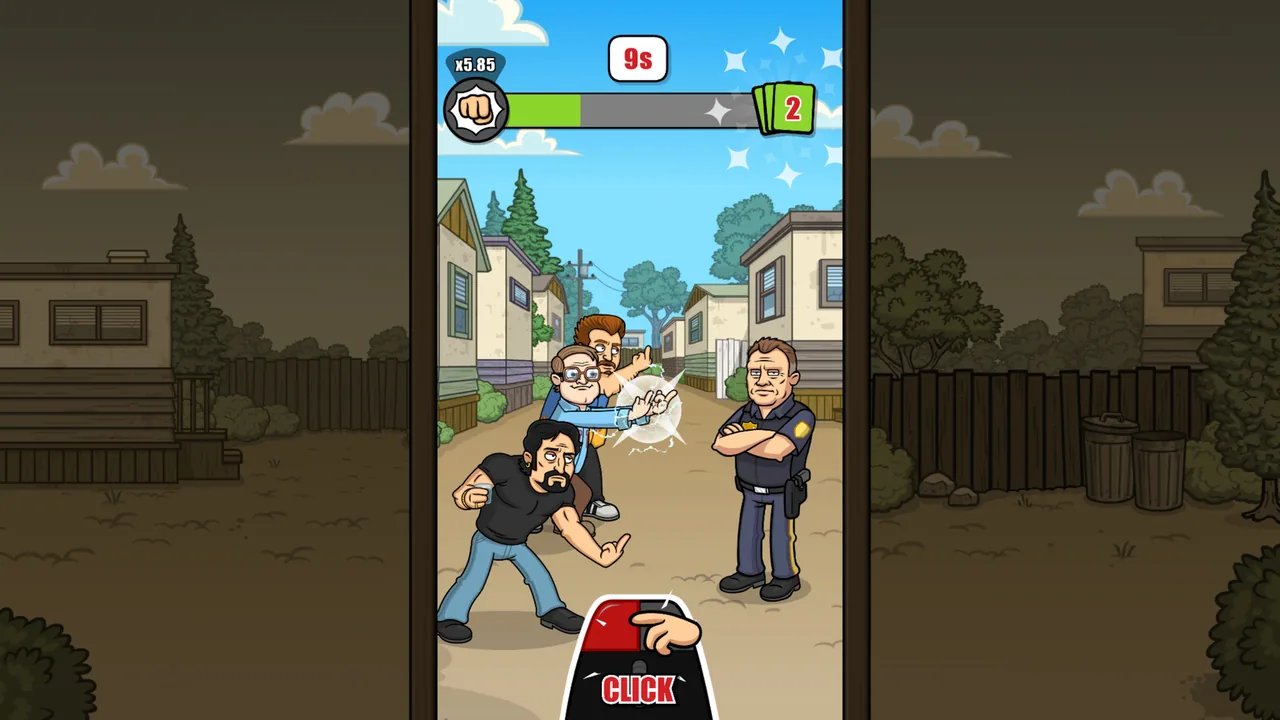
Idle and incremental games live or die on their prestige loop — the moment where progress resets in exchange for a permanent multiplier, dressed up as ascension, rebirth, or some other in-fiction justification for starting over with an advantage. Greasy Money's version of that loop is tied directly to boss fights against the police and other park authority figures. Losing sends the player to jail; the business empire they built collapses, but the character and business levels they earned carry forward into the next attempt, making each subsequent run faster than the last.
It's a genuinely well-chosen piece of licensed-game design, because it doesn't require inventing a new fictional justification for a mechanic every idle game needs anyway — the show already supplies one. Ricky, Julian and the rest of the cast getting arrested and starting some new scheme from scratch is the entire premise of Trailer Park Boys, run after run, season after season. Using that same beat as the actual prestige trigger means the mechanical loop and the licensed story are doing the same job at the same time, instead of sitting next to each other unconnected. It's the strongest evidence in the whole game that someone treated the licence as a design constraint worth building around, rather than a marketing layer to bolt on afterward.
Where the free-to-play economy tightens
The friction point worth understanding before installing sits in how business automation is unlocked. Each business is staffed by two named characters, and East Side Games built the system so that certain character levels are required before that business can run itself while the player is away — a deliberate decision, according to the game's own designer commentary, to stop players from simply deciding when to prestige on their own terms and instead gate that choice behind clear goal completion. The fastest way to raise those character levels is through card pulls funded by Liquor, which in turn is earned slowly through play or bought more directly with real money via the Hashcoin premium currency.
That's a meaningfully different pressure from a game that just sells convenience or cosmetics on the side. It ties a genuinely useful quality-of-life feature — offline automation, the entire point of an idle game — to a gacha system, which means the free-to-play economy isn't simply "pay if you want to go faster," it's "pay or grind specifically to unlock the thing that makes the game idle-friendly in the first place." Player accounts describe clearing all eight seasons without spending, so the free path is real, but it asks for patience through stretches where a paying player would simply be automating already. The Apple App Store listing shows four Hashcoin bundle tiers between $1.99 and $19.99 plus a recurring subscription pack — a heavier premium-currency menu than this genre strictly needs, and one more thing for a new player to have to learn to ignore before the game settles into something more casual.
Nine years on mobile, zero years left on Steam
Greasy Money's history is unusually split between two very different outcomes for the same game. The mobile version launched worldwide on 20 April 2017 and has been continuously supported since, with new seasonal content still arriving as of 2026 — a genuine rarity for a licensed mobile free-to-play title from that era, most of which quietly stop receiving updates within a year or two of launch. A Steam PC port followed on 18 April 2018 and initially performed well, settling at roughly 1,170 positive reviews against 322 negative out of 1,492 total lifetime ratings before development stopped. East Side Games posted a direct message to the Steam community on 31 July 2020 confirming they had ceased active development on that version — automated in-game events would keep generating on their own, but no further bug fixes or content were planned. The listing has since gone further than that: the Steam store page for Greasy Money now displays explicitly as no longer available for purchase, meaning a game with a genuinely positive review history on that platform is simply gone from it. Anyone considering this review specifically for a PC option should know upfront that mobile is the only route left.
Verdict
Trailer Park Boys: Greasy Money earns its 6.5 by doing one thing that matters more than its genre placement suggests it should: treating the source material as a design constraint rather than a skin. The jail-and-reset prestige loop is a smarter piece of licensed-game thinking than this genre usually gets, the writing holds up for anyone who actually watches the show, and nine years of continuous mobile support — backed by a 4.8-star average across roughly 106,000 ratings — is proof the audience it's built for has stuck around. That's a genuinely strong result for a 2017 licensed mobile idle game.
It doesn't climb higher because the free-to-play economy asks something specific and slightly uncomfortable of players: automation, the exact feature that makes an idle game idle, sits behind character levels that are fastest to reach through a gacha system funded by real money. That's a different, sharper kind of pressure than a cosmetic shop sitting off to the side, and it's worth weighing against how much the licence itself is worth to any individual player before installing. Fans of the show who can tolerate that structure will find a genuinely well-written mobile game underneath it. Players hunting for a lighter-touch idle economy have plenty of other options that don't ask the same thing of their patience.
Players who'd rather have their away-from-keyboard progress build toward gear and skills instead of premium-currency card pulls might also want to look at Wanderer.
Pros and cons
Pros
- The jail/reset mechanic reframes a standard idle-game prestige system as the show's own joke about its characters always ending up back in trouble, rather than a generic ascension screen
- Character writing and episodic "season" structure track the show's actual cast and tone closely enough that longtime viewers can recognise specific running gags rather than a surface-level reskin
- Nine years of continuous mobile updates is rare for a 2017 licensed mobile game and points to a developer still actively supporting the title rather than one that shipped a launch build and walked away
- A 4.8-star average across roughly 106,000 App Store ratings is an unusually strong long-run result for a free-to-play licensed idle game this old
- Playable and completable across all eight released seasons without spending, according to player accounts, for anyone willing to grind through the slower stretches
Cons
- Automating a business requires levelling the two characters assigned to it, and the fastest route to those levels runs through gacha-based card pulls funded by the Liquor currency — a structural gate on convenience, not just a cosmetic shop bolted to the side
- Four separate Hashcoin bundle tiers plus a recurring subscription is a heavier premium-currency menu than the genre needs, and working out which tier is actually worth buying is its own puzzle
- The abandoned Steam PC version — no updates since July 2020 and delisted from the store entirely — leaves mobile as the only way to play a game that once had a legitimate desktop release
- At least one recent player report flags interface elements for in-app purchases as disproportionately large on screen relative to core gameplay buttons
- The underlying loop of upgrade-a-business, level-a-character, wait for the timer is standard mobile-idle furniture once the licensed writing is set aside, and it doesn't try to innovate much past that structure
Screenshots
-
Trailer Park Boys: Greasy MoneyImage: East Side Games via Steam -
Trailer Park Boys: Greasy MoneyImage: East Side Games via Steam -
Trailer Park Boys: Greasy MoneyImage: East Side Games via Steam -
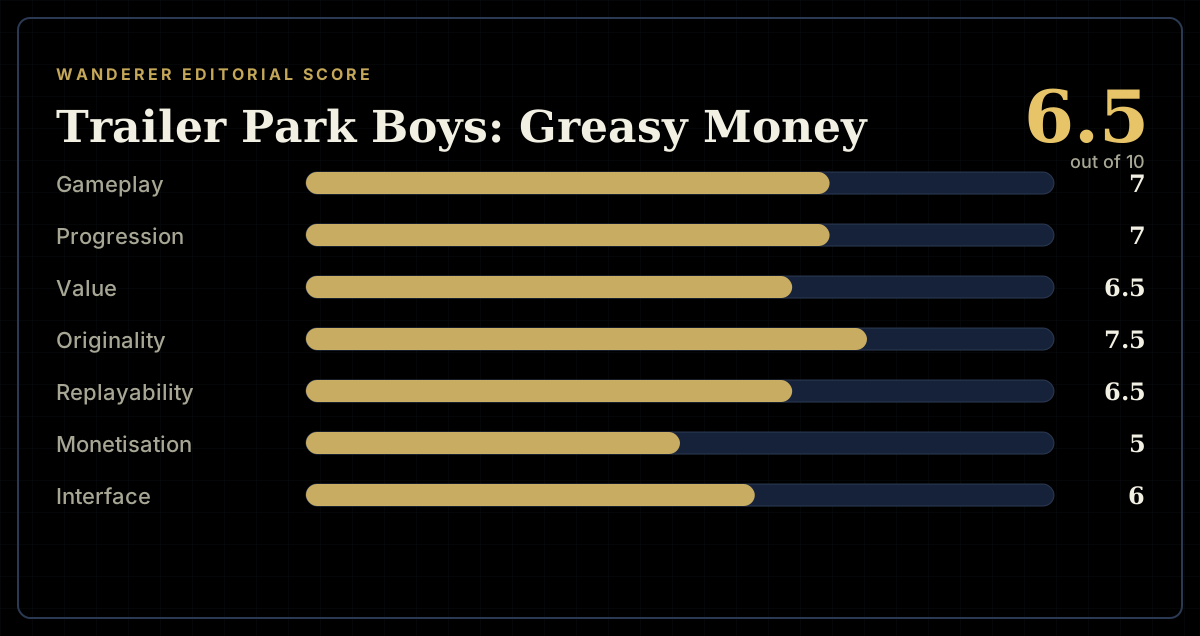
How the review scores each part of the gameWanderer Editorial -
The short versionWanderer Editorial