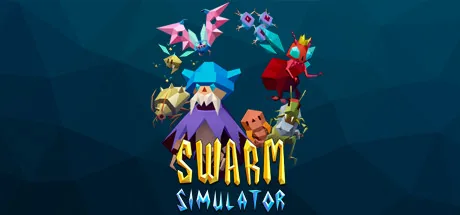
Game review
Swarm Simulator
6.5 / 10
- Developer
- Evan Rosson (original browser game); Scary Bee LLC (Swarm Simulator: Evolution)
- Publisher
- Evan Rosson (original browser game); Scary Bee LLC on Steam, Iron Horse Games LLC on Google Play (Swarm Simulator: Evolution)
- Released
- 14 August 2014
- Platforms
- Browser (original); Windows, macOS, Android (Evolution)
- Genre
- Incremental
- Monetisation
- The original browser game has never charged for anything. Swarm Simulator: Evolution is free-to-play with in-app purchases (an elixir buff currency and Golden Bugs for persistent bonuses) and, on its Android release, advertising.
- Players
- Single-player
The short version
Swarm Simulator is one of the earliest incrementals to build its whole game out of a production chain rather than a single number: larvae become drones, drones and meat become queens, queens build nests, and every tier of bug exists to feed the one above it. That structure, which now reads as standard genre furniture, was still a genuinely useful idea in 2014, and the free browser version still plays it straight, with no shop screen anywhere in sight.
What hasn't held up is everything around the loop. The interface is a wall of buttons and numbers with no scene-setting beyond it, the mid-and-late game is almost entirely about letting hatch timers and auto-buy tick over, and the 2019 mobile/Steam rebuild, Swarm Simulator: Evolution, answers the presentation problem with generic 3D bug models and then adds the ads and premium currency the original never had. Neither version asks much of your attention once the opening hours are over.
Biggest strengths
- The larvae-to-drone-to-queen-to-nest chain gives every resource a clear reason to exist instead of a single click-to-earn number
- The browser original remains completely free with no shop, no ads and no account requirement
- Offline production genuinely continues at the same rate the game runs at while you're watching it
Biggest weaknesses
- The interface is a spreadsheet of buttons and counters with no art direction to speak of, in either version
- Once auto-buyers and hatch timers are unlocked, long stretches of play consist of watching numbers tick rather than making decisions
- Evolution's 3D bug models and static camera add polygons without adding any visual identity the browser version lacked
Who it's for: Genre historians curious what an early "everything is a resource chain" incremental looked like, and anyone who wants a completely free, no-nonsense idler with zero pressure to spend. Less suited to players who want an actively engaging late game or a game that looks like effort went into its screen.
Our recommendation: Play the free browser original at swarmsim.github.io first. Evolution adds a camera and some 3D models over the same bones, but it also adds ads and a shop, so there's little reason to start there unless you specifically want it on a phone or a Steam library entry.
6.5 / 10
What it is, and which version this covers
Swarm Simulator started as a free browser game built by a solo developer, Evan Rosson, whose GitHub repository for the project has existed since 14 August 2014 and whose earliest Internet Archive snapshot dates to October of that year. It is still live and still free at swarmsim.github.io, open-sourced under the GPL, and explicitly built around the idea of playing a swarm of monstrous insects the way StarCraft's Zerg play a swarm — hatch something small, feed it, and let it become something enormous. Rosson also wired the browser version into Kongregate's save system, which is where a lot of the genre's early audience found it.
Five years later, a studio called Scary Bee LLC released Swarm Simulator: Evolution, a 3D remake of the same production chain for Steam (25 February 2019, appid 914320) and mobile. Curiously, the two storefronts don't agree on who's behind the mobile release: Steam still lists Scary Bee LLC as developer and publisher, while the Android listing on Google Play (package com.ironhorse.swarmsimulator, over one million installs and a 4.3-star average across roughly 11,200 ratings as of this check) credits Iron Horse Games LLC instead. Whatever the exact corporate arrangement, both storefront listings are unambiguously the same game built on the same systems as the free browser original.
This review treats those as two distinct products worth judging separately: the free browser game, which is the historically important one, and Evolution, which is the commercial rebuild that decided what to add and what to charge for. Where a point applies to only one of them, it says so.
The production chain is the whole design
Open the browser original today and the pitch is unchanged from a decade ago. You start with a handful of larvae and a pile of meat. Larvae, fed enough meat, become drones. Drones gather more meat and also unlock the next tier up — queens, who convert accumulated resources into nests, who in turn support more of everything below them. Every unit in the chain exists because a unit above it needs it, and every unit above needs the ones below to keep producing. That's the entire game: not a single number going up, but an ever-lengthening supply chain where the newest unlock reshapes what's actually worth building underneath it.
It sounds unremarkable now because dozens of incrementals since have used exactly this shape — convert a low-tier resource into a mid-tier one, spend the mid-tier one on a high-tier multiplier, repeat with a new tier bolted on top. In 2014, when the genre's dominant template was still closer to Cookie Clicker's single currency and a flat shop list, building the entire game out of nested conversion tiers was a real structural choice, and it's one a lot of later, more polished incrementals never really improved on so much as they dressed it up. Judged purely as a piece of systems design, Swarm Simulator's central idea has aged better than almost anything else about it.
The looping problem is that the game never really goes anywhere past demonstrating the idea. There's no map to explore, no combat to speak of beyond abstract "attack" and "defence" stats feeding an occasional threat, and no narrative framing beyond the opening premise. Once the chain is built out to its later tiers, the moment-to-moment decision is almost always "which tier is currently the bottleneck," which is a fine question to answer once and a repetitive one to keep answering for hours.
Idle by design, not as an afterthought
Where the game does hold up is its offline model, which the interface states plainly: your swarm keeps producing while the tab is closed, at the same rate it produces while you're watching it. That's not automatically true of every incremental from this era — plenty of contemporaries either capped offline gains or didn't offer them at all — and it's a big part of why Swarm Simulator reads as a genuine ancestor of the modern idle-RPG template rather than just an early clicker. Auto-buyers for lower-tier units unlock as you progress, which is the mechanism that turns the early, hands-on opening hours into the later, largely hands-off midgame. That transition is honest about what it is: the game tells you when a purchase becomes automatic, rather than hiding the shift.
What it doesn't do is give you much reason to check back other than watching bigger numbers arrive. There's no daily-reward hook, no event calendar, no social or competitive layer of any kind. The Kongregate integration gave the original a leaderboard-adjacent audience at launch, but the standalone browser version today is a private save with no comparison against anyone else's swarm.
Evolution: the same bones, a storefront wrapped around them
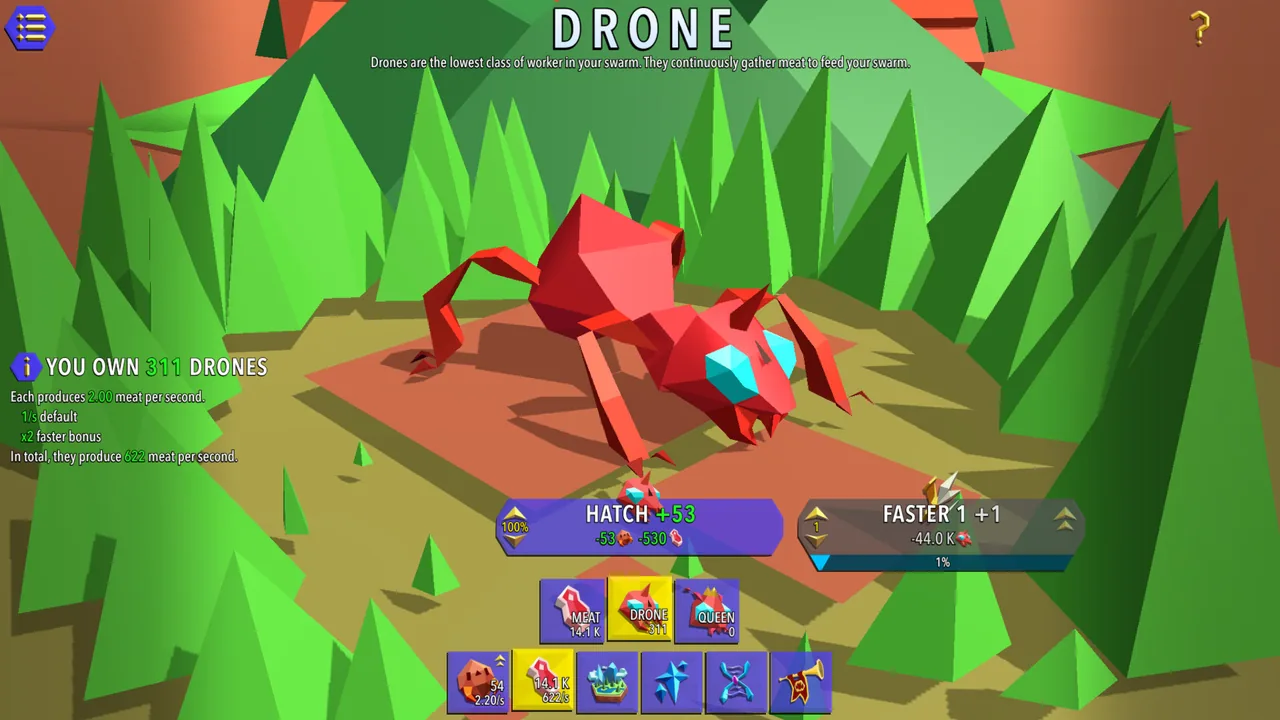
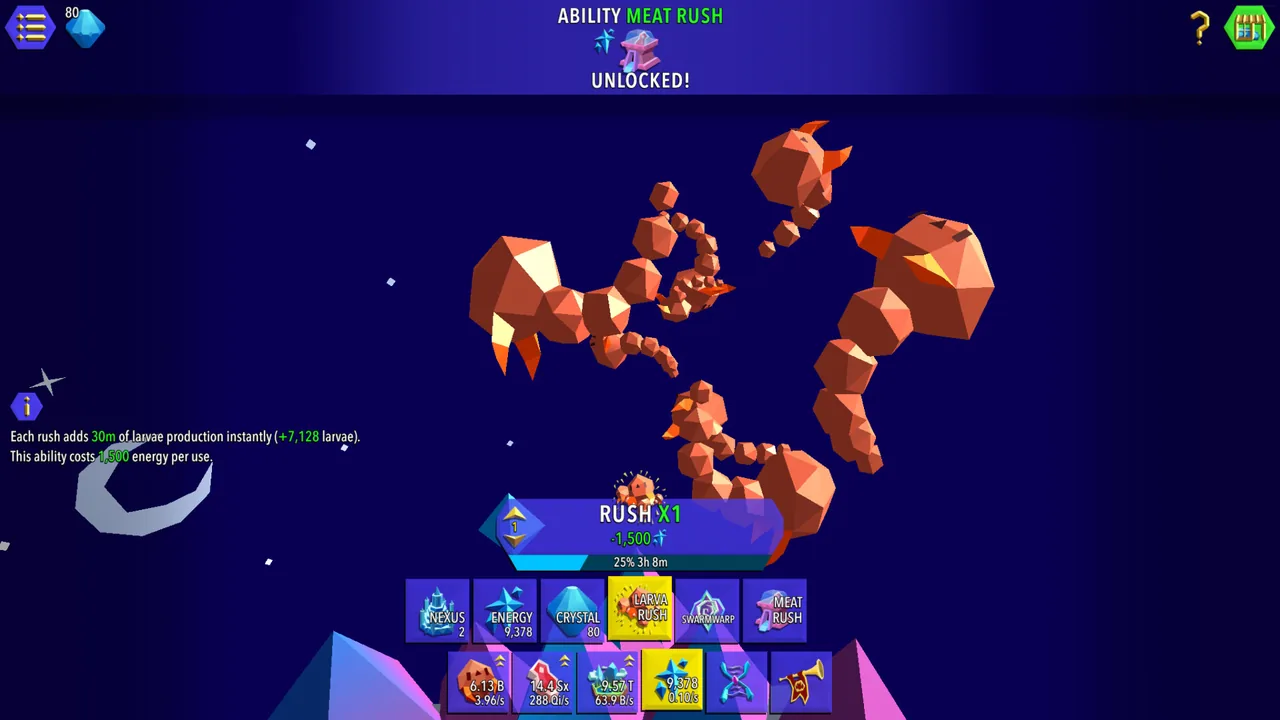
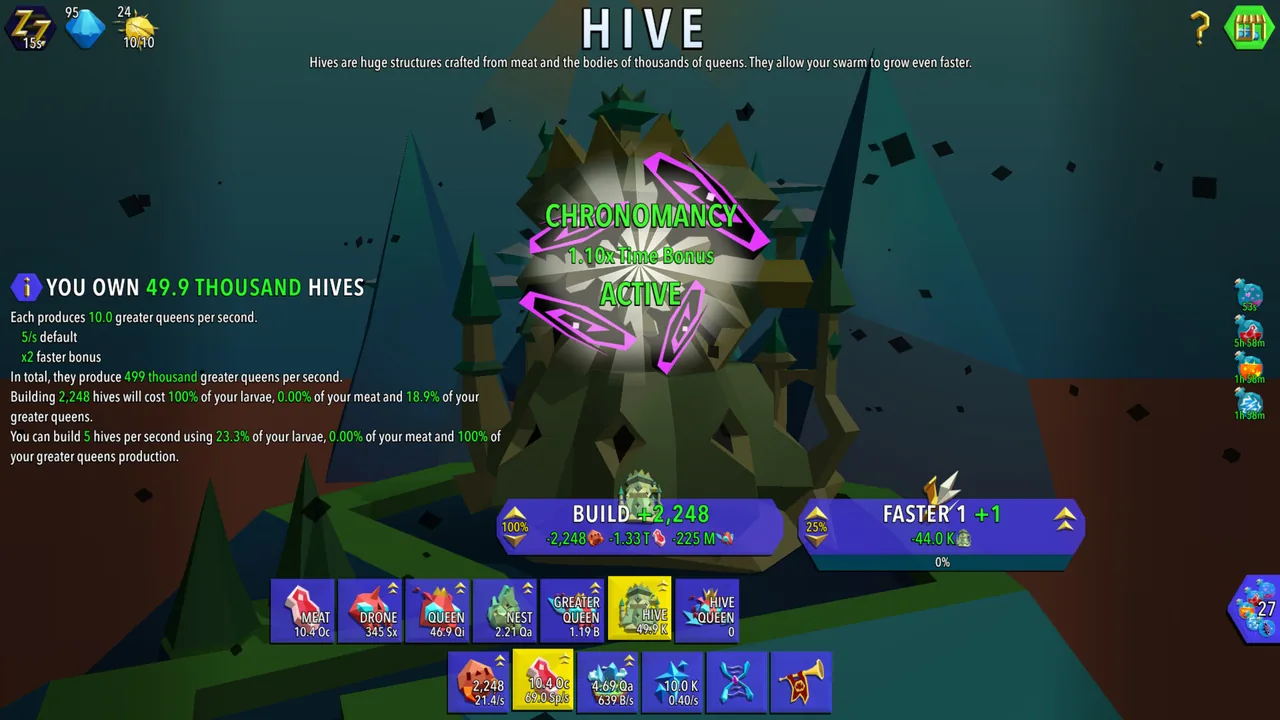
Swarm Simulator: Evolution keeps the larvae-drone-queen-nest structure intact and adds a real camera and 3D bug models to look at while it runs, plus an ascension system with mutations that resets a run for permanent bonuses — a straightforward prestige loop bolted onto the original's flat production chain, and a legitimate improvement in that it gives a completed run somewhere to go instead of just plateauing. Steam's own listing describes "Golden Bugs" for persistent bonuses, temporary elixir buffs, and periodic "Swarm Lord Invasion" events, none of which existed in the 2014 original.
The 3D models themselves are the presentation upgrade the browser version never got, and they're also its clearest limitation: generic insect meshes on a static camera angle don't do much to sell "trillions of giant alien bugs" beyond what the original's icons already implied. It's a game that looks like a mobile 3D template rather than one built around its own subject matter, and Steam's storefront categories confirm how thin the wrapping is — no Steam Achievements, no Trading Cards, nothing beyond "Single-player" and "In-App Purchases" listed against it.
That last category is the real difference from the original. Elixirs and Golden Bugs are premium currency by another name, purchasable with real money for a faster run through the same chain the browser version hands you for nothing, and the Android release layers advertising on top of that. None of it reads as aggressively predatory — there's no energy system stopping you from playing, and the free browser game the whole design is built on still exists as a genuinely complete alternative — but it's a clear step away from the original's total absence of a shop screen, and it's worth knowing before installing the mobile version expecting the same free deal the browser page offers.
Verdict
Six and a half. As a historical artefact, Swarm Simulator earns real credit: it took the single-currency clicker template that defined the genre's early years and rebuilt it as a genuine production chain, where every unit exists to feed the tier above it, years before that became standard incremental grammar. The free browser version still plays that idea straight, with honest offline production and not a single dollar asked of you anywhere.
What keeps the score from climbing higher is that neither version gives the idea anywhere interesting to live. The interface has never been more than numbers and buttons, the midgame settles into watching auto-buyers work rather than making choices, and Evolution's answer to all of that — a 3D coat of paint, a prestige layer, and a shop — solves the presentation problem only partway while creating a monetisation one the original never had. Play it for what it established, not for what it currently offers to hold your attention.
Players who like their idle progression stripped down to the mechanism, with nothing standing between them and the numbers, will find a genuinely early example of the modern shape here — and those who'd rather have that same structure wrapped in a more considered interface and a longer endgame might find Wanderer a more satisfying place to spend the hours Swarm Simulator can only fill.
Pros and cons
Pros
- The larvae-to-drone-to-queen-to-nest chain gives every resource a clear reason to exist instead of a single click-to-earn number
- The browser original remains completely free with no shop, no ads and no account requirement
- Offline production genuinely continues at the same rate the game runs at while you're watching it
- The source code has been open on GitHub since 2014 and is still being pushed to, which is rare longevity for a browser incremental
- Evolution's ascension-and-mutation layer gives the same production chain a reason to restart once a run flattens out
Cons
- The interface is a spreadsheet of buttons and counters with no art direction to speak of, in either version
- Once auto-buyers and hatch timers are unlocked, long stretches of play consist of watching numbers tick rather than making decisions
- Evolution's 3D bug models and static camera add polygons without adding any visual identity the browser version lacked
- Evolution introduces an elixir premium currency and Golden Bugs the free original never asked for, plus advertising on its Android release
- The game explains almost none of its own mutation, ascension or elixir math, so working out what's actually worth buying means guesswork or outside guides
Screenshots
-
Swarm Simulator: EvolutionImage: Scary Bee LLC via Steam -
Swarm Simulator: EvolutionImage: Scary Bee LLC via Steam -
Swarm Simulator: EvolutionImage: Scary Bee LLC via Steam -
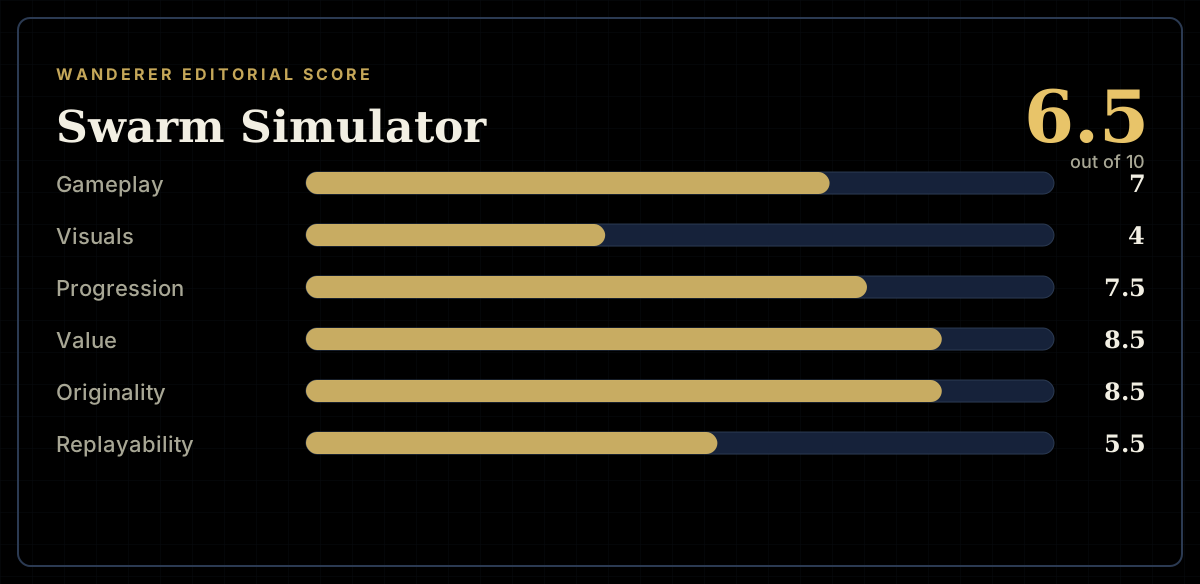
How the review scores each part of the gameWanderer Editorial -
The short versionWanderer Editorial