Game review
Dodecadragons
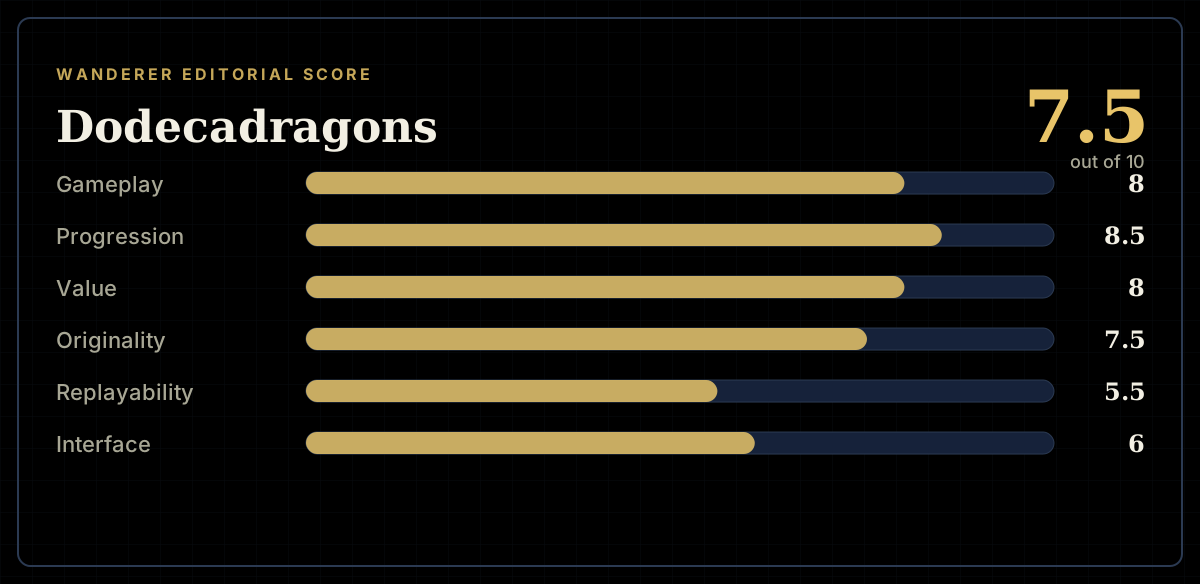
7.5 / 10
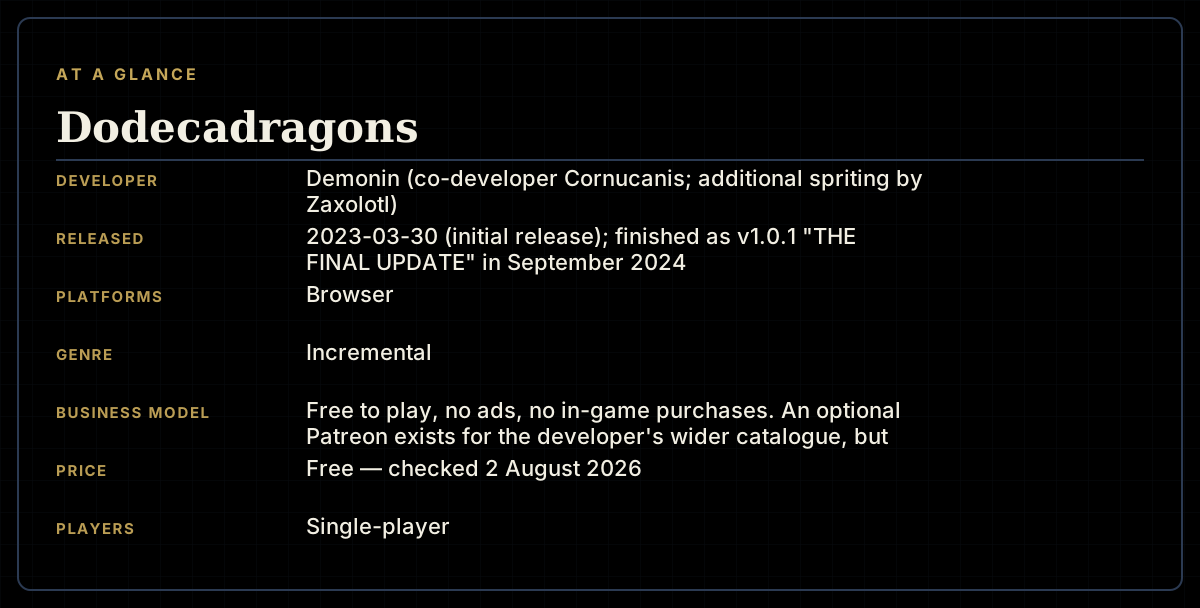
- Developer
- Demonin (co-developer Cornucanis; additional spriting by Zaxolotl)
- Released
- 2023-03-30 (initial release); finished as v1.0.1 "THE FINAL UPDATE" in September 2024
- Platforms
- Browser
- Genre
- Incremental
- Monetisation
- Free to play, no ads, no in-game purchases. An optional Patreon exists for the developer's wider catalogue, but nothing behind it affects Dodecadragons itself.
- Players
- Single-player
The short version
Dodecadragons takes the single most common promise in the incremental genre — "prestige feels bad, we fixed it" — and actually delivers on it more consistently than almost anything else built by one person. Every layer, from the first gold-to-platinum reset through to the endgame's holy polyhedra, is tuned so the next unlock always feels one purchase away, and the escalating currency names (fire, uranium, plutonium, oganesson, sigils, essence) never stop finding a new joke to make about how far the numbers have travelled from a dragon mining gold.
It also stops. Version 1.0.1 is billed as the final update, and it shows: a handful of late-game bugs, including a reported soft-lock around the sixth oganesson upgrade, sit open and unaddressed. For a free game with a genuine ending, that is a defensible trade rather than abandonment — but it does mean the last stretch of the climb is rougher than the rest of it.
Biggest strengths
- The reset cadence is tuned so a new unlock is almost always one or two purchases away, which is harder to pull off than it sounds
- Currency names escalate from gold to fire to platinum to uranium to plutonium to oganesson to sigils to essence, and the joke of that escalation never goes stale
- The game has a genuine, authored ending rather than trailing off into an infinite number-go-up loop
Biggest weaknesses
- A reported soft-lock around the sixth oganesson upgrade, where most resource generation freezes until a polygon reset, remains open and unfixed
- The "max" purchase button for the cyan-to-pink sigil upgrades reportedly splits available power evenly across categories instead of buying sequentially, undercutting a convenience feature players rely on late
- Blue fire's purchase buttons are reported to flicker rapidly between enabled and disabled states once the late-game plague mechanic kicks in
Who it's for: Incremental veterans who want a tightly paced, finite reset ladder they can actually finish, rather than an open-ended service game that keeps adding layers forever.
Our recommendation: Play it. It costs nothing, it has an actual ending, and the pacing holds up better than most incrementals twice its size — just expect the last hour or two to be the roughest part of the climb.
7.5 / 10
Most incrementals eventually break one promise or another. Either the reset ladder runs out of ideas and starts multiplying the same buttons under new names, or the game itself never actually ends, chasing whatever the next Patreon-funded update can bolt on. Dodecadragons, a free browser game built by the solo developer Demonin with help from Cornucanis and Zaxolotl, does neither. It opens on a single dragon mining gold by hand, closes on a completion screen declaring that the dragon has "become the omniverse itself," and in between it manages something rarer than either achievement alone: a prestige ladder that stays tense almost the entire way through, built by someone who then stopped adding to it on purpose.
A dragon that outgrows its own numbers
The opening hour reads like a fairly standard incremental: hire miners, buy upgrades, watch gold accumulate. The game's real hook shows up the moment the first reset arrives. Alchemy, the initial prestige layer, asks you to sacrifice your entire gold stockpile for platinum and a set of fire upgrades that feed back into gold production. From there the currency names start escalating with a straight face — platinum gives way to uranium, uranium converts into plutonium, plutonium feeds oganesson, and eventually the game introduces sigils (cyan through pink, each with its own four-stage upgrade track) and a family of "essence" resources — light, dark, holy — that exist almost entirely to be sacrificed for the next tier up. By the endgame you're assembling holy polyhedra into planets, with a soft cap of roughly e200 dodecahedra and e505 octahedra per world and no stated cap on tetrahedra at all. None of this is subtle about what it's doing: a dragon that starts by picking up gold coins finishes by manufacturing planets, and Dodecadragons is clearly in on its own joke about how far that escalation has travelled.
The pacing is the actual pitch
What separates this from a hundred other reset-stacking incrementals is not the currency count — plenty of games in the genre pile on more layers than this one does. It's how consistently each layer is tuned. The standard failure mode for prestige design is a long dead stretch where the player has nothing meaningful to decide and no unlock close enough to chase, so they park the tab and check back in an hour. Dodecadragons is built to avoid that specific failure almost everywhere: upgrades are costed so the next purchase is reliably close, not free, and each reset answers a "just one more layer" itch rather than opening a long wait. That's a genuinely difficult thing to get right by feel rather than by spreadsheet, and it's the reason the game's small following talks about it in terms of "well-paced" first and "deep" second — depth is common in this genre, pacing that holds for the whole runtime is not.
The cost of that tight tuning shows up in the numbers themselves. Reading large exponents at a glance is already the genre's classic UI problem, and Dodecadragons doesn't solve it any better than its peers — a number that looks affordable at a skim can turn out to be an order of magnitude short once you actually parse the scientific notation. It's a minor complaint against pacing this disciplined, but it's the kind of friction that costs new players real purchases before they learn to read the display properly.
An ending, which is rarer than it should be
The genre's dirty secret is that most incrementals don't actually end — they get abandoned, or they grow a content-update habit that never resolves into a final state. Dodecadragons avoids both. Version 1.0.1 is labelled, plainly, "THE FINAL UPDATE," and reaching the top of the polyhedron system delivers an actual completion screen with a running playtime total rather than another half-finished tier waiting for a future patch. For a solo project with no obligation to finish anything, that's worth crediting on its own. It also means the handful of late-game bugs sitting in the project's public issue tracker aren't getting fixed. A reported soft-lock triggered by purchasing the sixth oganesson upgrade — where gold, fire, magic, platinum, uranium and sigil generation all stop updating until you force a polygon reset or buy a planet — is the most serious of them, and it sits in exactly the part of the game where a player has invested the most time to reach. Two smaller reports (a "max" sigil-upgrade button that splits power across categories instead of spending it in order, and a late-game blue fire button that flickers between enabled and disabled) round out a short but real list of rough edges the developer has chosen not to return to. None of that changes what the game is for the ten or so hours before the endgame, but it does mean the last stretch of the climb is the least polished part of an otherwise carefully paced project.
A spreadsheet with personality
Visually, Dodecadragons doesn't try to be more than it is: numbers, buttons and small dragon and sigil icons arranged across tabs that multiply as new systems unlock. That's standard for the genre and entirely defensible for a free browser game with no funding behind it, but it does mean the interface asks more of a screen the deeper you get — by the point essence, sigils and polyhedra are all running at once alongside the original gold and fire counters, a single browser tab is doing a lot of simultaneous bookkeeping, and there's no responsive layout built for a phone screen. What keeps the presentation from feeling like a bare spreadsheet is the writing woven through it: escalating currency names, a completion screen that commits fully to the bit, and a wider "Dodeca" universe of spin-off games from the same developer — a 3D kart racer, a dragon collection sim, even a dragon-themed fighting game experiment — that gives this one small setting more personality than most solo incrementals bother building.
Verdict
Seven and a half. Dodecadragons does the one thing incremental players say they want most and almost never get: a reset ladder tuned tightly enough that "just one more upgrade" stays true for nearly the whole game, attached to an ending that actually arrives instead of trailing off into another currency. That's a real achievement for a free, solo-adjacent project, and it's the reason a small corner of the incremental community rates it well above its size. Set against that: the large-number display has the genre's usual readability problem, a handful of late-game bugs — most seriously a reported soft-lock around the sixth oganesson upgrade — are sitting unfixed in a project that has explicitly stopped receiving updates, and the interface doesn't scale down for smaller screens. Worth the several hours it takes for anyone who likes this genre; just don't go in expecting the last stretch to be as smooth as the first.
Readers who like a prestige system with teeth should also look at Antimatter Dimensions, which built the standard this genre measures itself against, or The Prestige Tree, which turns the reset ladder itself into a literal, explorable tree. Anyone who wants that same "always one upgrade away" tension wired into a world with a horizon to walk toward, rather than a column of currencies, may also want to look at Wanderer.
Pros and cons
Pros
- The reset cadence is tuned so a new unlock is almost always one or two purchases away, which is harder to pull off than it sounds
- Currency names escalate from gold to fire to platinum to uranium to plutonium to oganesson to sigils to essence, and the joke of that escalation never goes stale
- The game has a genuine, authored ending rather than trailing off into an infinite number-go-up loop
- Completely free with no ads and nothing gated behind a purchase
- A small connected universe of spin-off titles (DodecaKart, Dodeca Park, DodecaBrawlin') gives the setting more personality than a typical solo incremental bothers with
Cons
- A reported soft-lock around the sixth oganesson upgrade, where most resource generation freezes until a polygon reset, remains open and unfixed
- The "max" purchase button for the cyan-to-pink sigil upgrades reportedly splits available power evenly across categories instead of buying sequentially, undercutting a convenience feature players rely on late
- Blue fire's purchase buttons are reported to flicker rapidly between enabled and disabled states once the late-game plague mechanic kicks in
- Version 1.0.1 is explicitly the final update, so none of the above will be patched
- The interface is dense number-and-button spreadsheet styling with no scaling for small screens, and once sigils, essence and polyhedra stack up alongside gold and fire it asks a lot of a single browser tab
Screenshots
-
How the review scores each part of the gameWanderer Editorial -
The game at a glanceWanderer Editorial -
The short versionWanderer Editorial