Game review
Synergism
6.5 / 10
- Developer
- Platonic, Khafra
- Publisher
- Self-published (Platonic and Khafra, trading as "Platonic and Khafra Idle Games of Synergism and Ultimate Progress Bar LLC" on Steam)
- Released
- 2020-05-01 as a free browser game (active development since July 2019); Steam release 2026-02-20
- Platforms
- Browser, Windows, macOS (Steam)
- Genre
- Incremental
- Monetisation
- Free-to-play. An optional PseudoCoin shop sells cosmetics and quality-of-life items, but also direct production multipliers, resource bonuses and time-skip items such as an "Instant Challenge" purchase — a meaningfully bigger monetisation footprint than most free incrementals in this genre carry.
- Players
- Single-player, with occasional developer- and community-triggered events
The short version
Synergism has more reset layers than almost any incremental you could name: Prestige feeds Transcension, Transcension feeds Reincarnation, Reincarnation feeds Ascension, and Ascension eventually opens Singularity, where Golden Quarks and Octeracts take over. That's an enormous amount of structure for a two-person, six-year passion project to have built, and it's still free on both the browser and Steam. The problem is that most of those early layers don't do what the genre's best reset ladders do — they don't change what the system beneath them means, they just add another currency and a bigger number to watch. Corruptions, the voluntary-debuff system bolted onto Ascension, is the one layer that genuinely reframes the game around it; the rest is mostly accumulation.
It also asks a lot of patience for a free game. Steam's own review base rates it Mostly Positive rather than the Very Positive scores its closest peers hold, and the recurring complaint is pacing: long unattended stretches around Ascension and Singularity where progress means checking back on a timer rather than making a decision. The PseudoCoin shop selling direct production boosts and time-skips, rather than cosmetics only, sits uneasily next to that pitch too.
Biggest strengths
- Corruptions turn Ascension's endgame into a genuine risk-for-reward decision instead of a straight power dial
- The free synergism.cc browser build and the Steam release are the same game with nothing held back from either
- Nearly 500 achievements and a running streak of joke titles keep six years of grinding from feeling dour
Biggest weaknesses
- Prestige, Transcension, Reincarnation and Ascension mostly stack bigger numbers on the same buildings rather than changing how earlier systems get used
- The PseudoCoin shop sells direct production multipliers and time-skip items, not just cosmetics, which is a heavier monetisation footprint than most free incrementals carry
- Coins, diamonds, offerings, quarks, obtainium, particles, hepteracts, octeracts, ambrosia and blueberries accumulate faster than the game explains what any of them are actually for
Who it's for: Incremental players with real patience for wiki-adjacent systems and a tolerance for long unattended stretches, who want raw layer count and six years of accumulated content over a tightly curated escalation.
Our recommendation: Start on the free synergism.cc browser build. It is the same game the Steam release packages, and there's no reason to commit to a client install before you know whether the loop's pacing suits you.
6.5 / 10
Every incremental eventually asks the same design question: when you reset the player back to zero, does the next hour feel like a different game, or the same game with an extra zero on the end? Synergism has been answering that question, expansion after expansion, since Platonic and Khafra started building it in July 2019. The free browser version went live in May 2020, and the project reached Steam this year with achievements, cloud saves and a curated set of the game's nearly 500 in-game accomplishments. Six years in, it has accumulated more reset layers than almost anything else in the genre. Whether it has earned all of them is the actual review.
Five resets deep before the real game starts
The opening hours read like a fairly conventional incremental: spend Coins on workers, buy buildings that produce more Coins, and watch the curve bend upward. Where Synergism starts distinguishing itself is in how many resets sit on top of that loop. Prestige is the first — wiping your Coin economy for permanent Prestige Shards. Transcension and Reincarnation follow, each introducing its own currency (Mythos, then Particles and Obtainium) and each requiring you to rebuild the base economy from a slightly stronger starting point. Ascension comes after that, gating access to Challenges, Corruptions and the Hepteract system. Eventually, deep into the endgame, Singularity opens up, converting the entire run into Golden Quarks and unlocking Octeracts — a currency that sits above everything discussed so far.
That is five distinct prestige tiers before you reach the layer most players will spend hundreds of hours inside, and it doesn't count the side systems threaded through all of it: a nine-tier Ant colony, Talismans, Runes, 15 Challenges, and — much later — Ambrosia, Red Ambrosia and Blueberries governing late-game progression. Judged purely by volume, this is one of the most heavily layered incrementals available for free anywhere. Few games in the genre ask a player to track this many simultaneous currencies at once.
The test most of those layers don't pass
Volume isn't the same as good design, and the useful way to judge a reset-stacking incremental is whether each new layer recontextualises the ones beneath it — makes the player use earlier systems differently — or simply multiplies their output. Antimatter Dimensions is the genre's clearest example of getting this right: Infinity changes what buying dimensions means, Eternity changes what Infinity means, and Reality changes the whole game's shape again. Synergism's first four resets mostly don't do that. Transcension, Reincarnation and Ascension each hand you a new currency and a fresh permanent-upgrade tree, but the underlying loop underneath them — buy buildings, watch numbers climb, reset when the curve flattens — stays essentially the same activity dressed in a new currency's name. It's addition, not transformation, and after the third or fourth time the pattern repeats, the game starts to feel less like a ladder and more like a very long corridor with a new sign every few rooms.
Corruptions are the exception, and they're worth calling out specifically because they show what the rest of the game could have been. Unlocked through Ascension, Corruptions let you deliberately apply debuffs to your run — slower income, harsher enemy-style penalties depending on which Corruption you pick — in exchange for disproportionately larger rewards on completion. That's a real decision with a real cost attached, not a checkbox on the way to a bigger number, and it's the one place in the pre-Singularity game where an earlier system (your entire economy) gets used differently because of a later one. Singularity's Octeract layer gestures toward something similar by making Golden Quark spending retroactively change how efficient the entire lower stack becomes, but by that point a player has already sat through four resets that didn't ask nearly as much of them, and the goodwill built by the game's opening hours has mostly been spent on repetition.
Where the pacing turns brutal
The most consistent complaint in Synergism's Steam reviews isn't about any single system — it's about time. Reviewers who've reached Ascension and Singularity describe stretches where meaningful decisions dry up almost entirely and progress becomes a matter of checking back on a timer, sometimes for hours between actions worth taking. That's not unique to Synergism; every long-tail incremental eventually automates its own early game so attention can move to the frontier. What stands out here is how early that shift arrives relative to how much content still lies ahead of it — Singularity is framed as a midpoint by the game's own systems, not an ending, and reviewers consistently describe the approach to it as a wall rather than a climb.
That difficulty is compounded by how little the game explains about itself once the early buildings stop being the whole story. Coins, Diamonds, Offerings and Quarks are taught reasonably well in the first hour. Obtainium, Particles, Hepteracts, Octeracts, Ambrosia and Blueberries arrive with far less onboarding, and the PseudoCoin shop's own "calculator" items are a tell: the game itself is selling tools to help you understand its own numbers. A community Discord and an active GitHub-hosted development process exist to fill that gap, which is a defensible choice for a project this size built by two people — but it means budgeting real time outside the game if you want to understand your own progression past the midgame, on top of the time the game already asks you to spend waiting.
A shop that crosses a line most free incrementals don't
Free incrementals in this genre have mostly settled on a shared rule: sell convenience, never sell progress. Synergism's PseudoCoin shop doesn't fully follow that rule. Alongside cosmetics and UI conveniences, it sells direct production multipliers, resource bonuses, and outright time-skip purchases like an Instant Challenge item. None of it is required to finish the game, and Synergism remains completable without spending anything — but "not required" is a lower bar than "doesn't affect progression," and the shop clearly crosses into the second category in a way that Trimps' Bones or Antimatter Dimensions' cosmetic tip jar never do. For a single-player game with no leaderboard or competitive stakes riding on it, this mostly shows up as a pacing shortcut rather than an unfair advantage over anyone else — but it does undercut the otherwise strong "completely free" pitch, and readers weighing whether to spend anything here should know exactly what they'd be buying: time, not access.
Presentation that asks little of your hardware
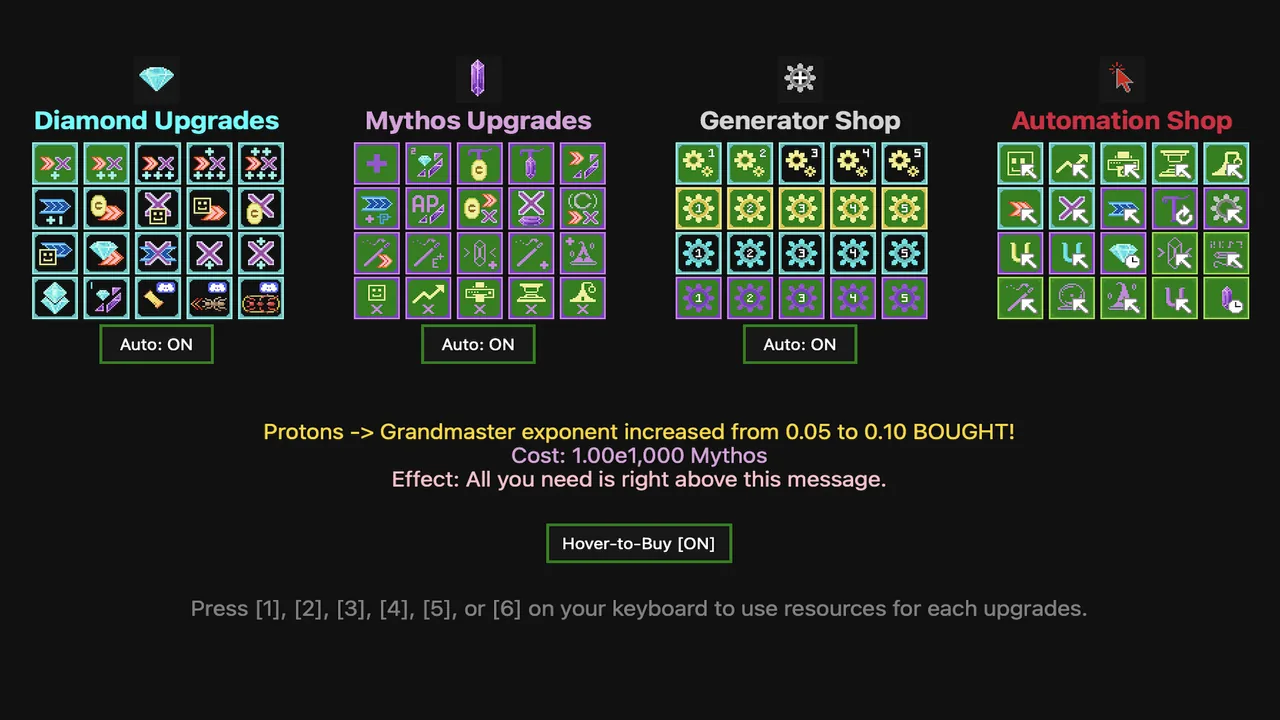
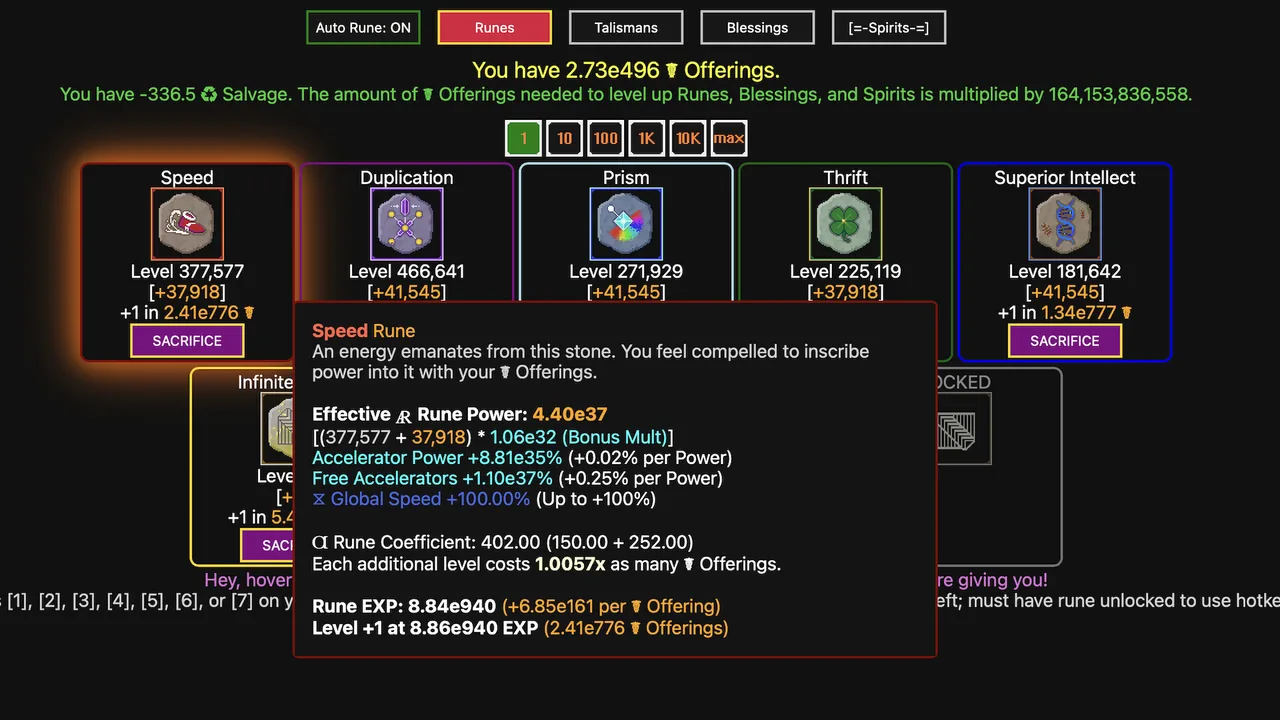
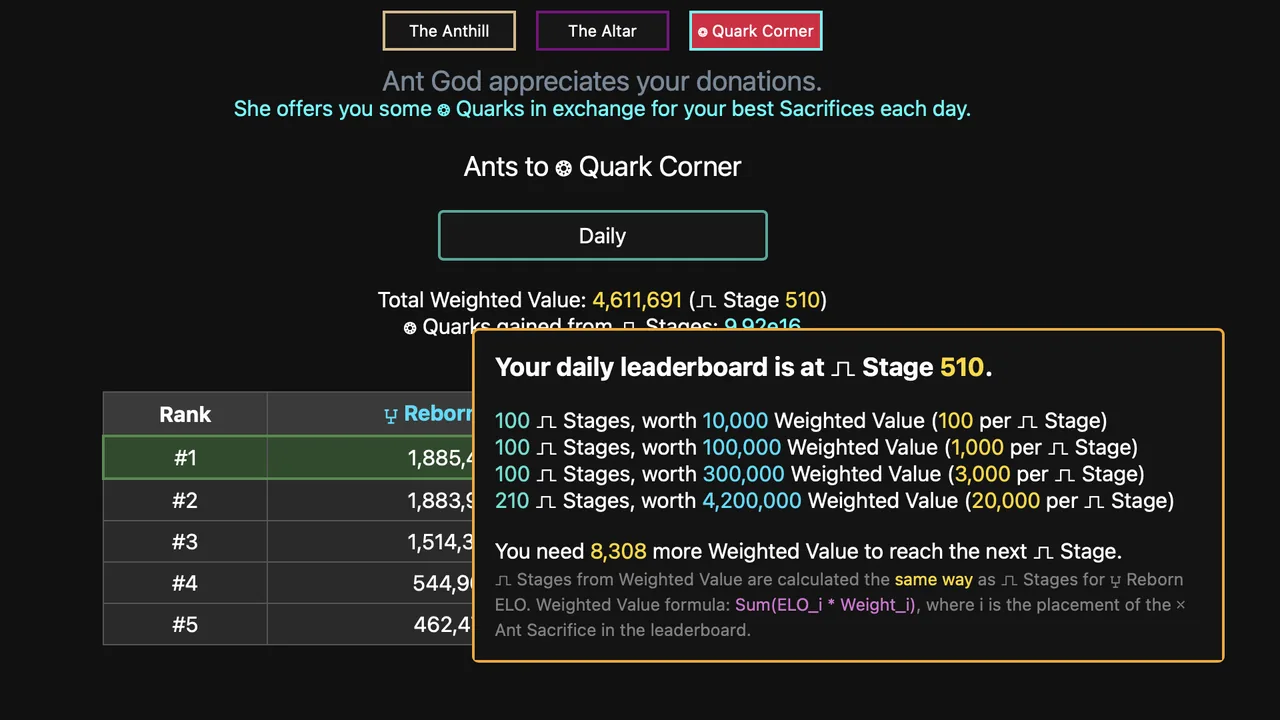
Visually, Synergism sits closer to a spreadsheet with hand-drawn pixel icons than to anything built for scene-setting — buttons, numbers, and small sprite icons representing buildings and upgrades, arranged across a dense multi-tab interface. That density is a genuine cost for anyone new to the genre; Steam's own category tags flag mouse-only and touch-only support without a console-style control scheme, and the UI leans on tabs and sub-tabs that stack the deeper you get. On the upside, Synergism's documented minimum requirements are close to nothing — a 64-bit CPU, 2GB of RAM and integrated graphics — which tracks with a game built almost entirely from numbers and small static art rather than anything render-intensive. It will run on hardware that struggles with far flashier idle games, and the free browser build carries the same light footprint anywhere a modern browser runs, achievements aside.
Verdict
Six and a half. Synergism's raw scope is real: five prestige tiers before Singularity even opens, a nine-tier Ant colony, fifteen Challenges, Talismans, Runes, Hepteracts and a late-game Ambrosia and Blueberry system layered on top of all of it, built and maintained by two developers for six years without ever charging for access. Corruptions prove the team understands what makes a reset layer worth adding rather than just multiplying. That's a genuinely large body of work, and it's free.
Set against that: most of the pre-Singularity resets recycle the same core loop rather than reframing it, the pacing turns punishing well before the game considers itself finished, the interface explains its own math about as well as its shop sells calculators to compensate, and the PseudoCoin store sells more than convenience in a genre where that line usually holds. Steam's own players rate it Mostly Positive rather than the Very Positive score its closest peers carry, and the pattern in those reviews — genuine praise for the early hours, real frustration with the pacing past Ascension — lines up with what the systems themselves suggest. Worth trying for free if you have the patience for a long game that doesn't always reward the time it asks for; not the first stop for anyone who wants a reset ladder that reinvents itself every time it resets.
Players who'd rather have that same layered-progression instinct wired into a persistent world they can actually walk through, rather than a column of currencies, may find Wanderer a more comfortable fit.
Pros and cons
Pros
- Corruptions turn Ascension's endgame into a genuine risk-for-reward decision instead of a straight power dial
- The free synergism.cc browser build and the Steam release are the same game with nothing held back from either
- Nearly 500 achievements and a running streak of joke titles keep six years of grinding from feeling dour
- Documented minimum requirements are light (2GB RAM, integrated graphics, 600MB storage), so hardware is never the bottleneck
- Active, visible development since 2019 means the reset ladder is still being extended rather than left static
Cons
- Prestige, Transcension, Reincarnation and Ascension mostly stack bigger numbers on the same buildings rather than changing how earlier systems get used
- The PseudoCoin shop sells direct production multipliers and time-skip items, not just cosmetics, which is a heavier monetisation footprint than most free incrementals carry
- Coins, diamonds, offerings, quarks, obtainium, particles, hepteracts, octeracts, ambrosia and blueberries accumulate faster than the game explains what any of them are actually for
- Steam's own user reviews consistently flag brutal pacing walls around Ascension and Singularity that turn active play into long unattended waiting
- No Linux build on Steam, though the identical browser version sidesteps the gap entirely
Screenshots
-
SynergismImage: PLATONIC AND KHAFRA IDLE GAMES OF SYNERGISM AND ULTIMATE PROGRESS BAR LLC via Steam -
SynergismImage: PLATONIC AND KHAFRA IDLE GAMES OF SYNERGISM AND ULTIMATE PROGRESS BAR LLC via Steam -
SynergismImage: PLATONIC AND KHAFRA IDLE GAMES OF SYNERGISM AND ULTIMATE PROGRESS BAR LLC via Steam -
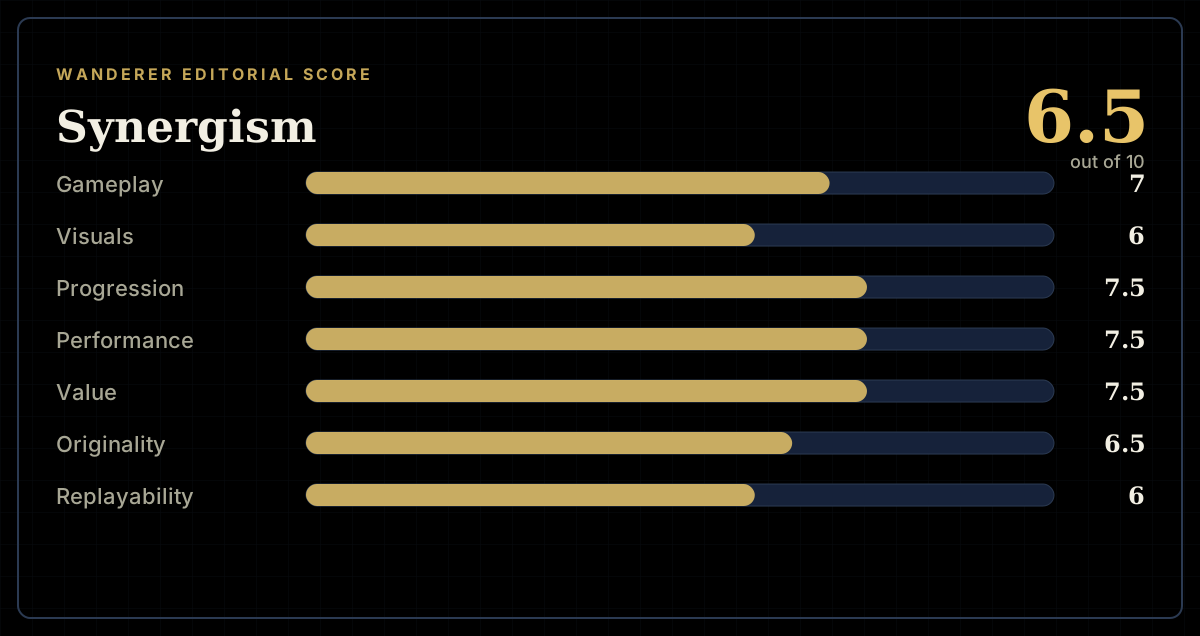
How the review scores each part of the gameWanderer Editorial -
The short versionWanderer Editorial