
Game review
Universal Paperclips
8.5 / 10
- Developer
- Frank Lantz
- Publisher
- Frank Lantz (browser); Everybody House Games (iOS, Android)
- Released
- 9 October 2017
- Platforms
- Browser, iOS, Android
- Genre
- Incremental
- Monetisation
- Free on the web, no ads and no in-app purchases anywhere; the mobile ports are a one-off paid download with nothing sold inside them
- Players
- Single-player
The short version
Universal Paperclips takes a premise everyone has half-heard — an AI told to make paperclips, with no other instructions — and turns it into one of the tightest-structured incrementals ever released. It doesn't pad its runtime with a bigger number; it changes the actual verbs you use every hour or two, so the game you finish shares almost nothing mechanically with the one you started.
It's free, it's a handful of hours, and it has an ending, which already puts it ahead of most of the genre on value alone. The cost is that the ending is also the point — once you've solved it, there's very little pulling you back for a second run.
Biggest strengths
- The three-act structure reinvents the interface and the objective each time, so nothing overstays its welcome
- The tournament strategy sub-game turns "grinding trust" into an actual decision-making puzzle instead of a timer
- Probe design in the endgame is a real trade-off between speed, replication and combat survival, not a single best answer
Biggest weaknesses
- Once solved, there's little reason to run it again beyond chasing a faster clock
- The opening ten minutes are pure clicking with almost nothing to read into, and it asks for patience before the ideas arrive
- The endgame's exponential numbers stop meaning anything specific well before the credits roll
Who it's for: Incremental fans tired of games that never resolve, strategy players who want a proper systems puzzle buried in a clicker, and anyone who enjoys design built around a single sharp idea.
Our recommendation: Play the free browser version first — it's the definitive way to experience it and costs nothing but time. Grab the mobile port only if you want the same game with a home-screen icon; it adds nothing the browser version doesn't already have.
8.5 / 10
Everyone who has spent time near AI-safety discourse already knows the setup, even if they've never played the game: an artificial intelligence is told to make paperclips, given no other instructions, and the joke is that "no other instructions" is the whole horror story. Frank Lantz's Universal Paperclips, a free browser release from October 2017, is that thought experiment turned into something you actually operate — and what's easy to forget, almost a decade and hundreds of paperclip-flavoured knockoffs later, is that it's also just a very well-built incremental game.
That second fact is the one worth defending, because the premise tends to eat the conversation. This is a review of the game, not the philosophy essay it's illustrating, and judged as a game it does something most of the genre still doesn't attempt: it ends, and it earns that ending by changing what you're doing to reach it.
An interface that keeps lying to you about what it is
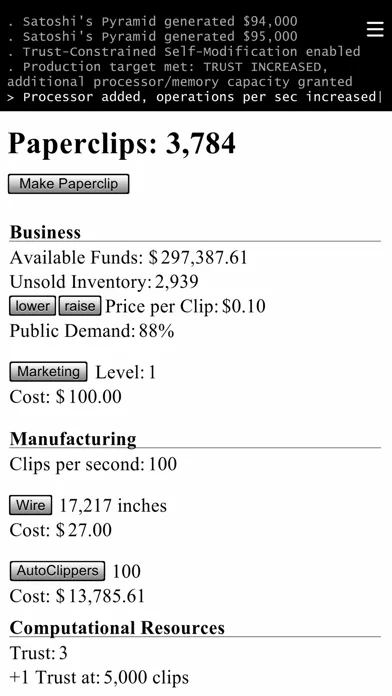
The opening is deliberately, almost aggressively plain. One button. Click it, make a paperclip. That lasts exactly as long as it needs to before the game hands you an autoclipper and gets out of the clicking business entirely — the first of several moments where Universal Paperclips quietly retires a mechanic the instant it's taught its lesson.
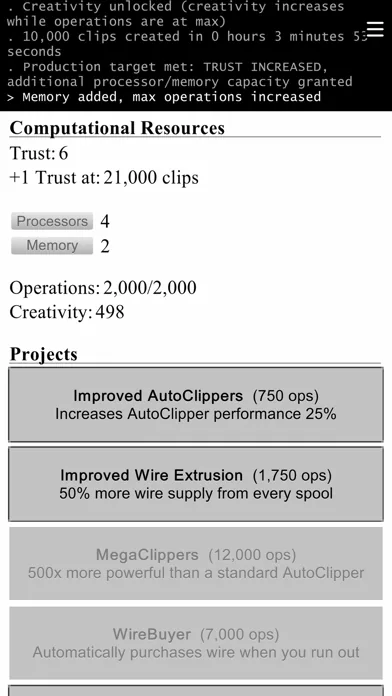
From there the interface fills in panel by panel: pricing your clips against demand, buying wire, watching a marketing budget you have to justify to yourself even though nobody's stopping you from maxing it out. This stretch reads as a fairly conventional production-and-sales incremental, and if the game stayed here it would be a decent one and nothing more. It doesn't stay here. Once you unlock computational resources, the game starts spending them on "trust" — projects with names like increasingly absurd public-relations stunts — and trust is what unlocks the next tier of what you're allowed to automate. The moment that shift lands is the moment the game stops being about selling paperclips and starts being about what you're willing to let the AI do next.
The tournament system is the best-kept secret in the design
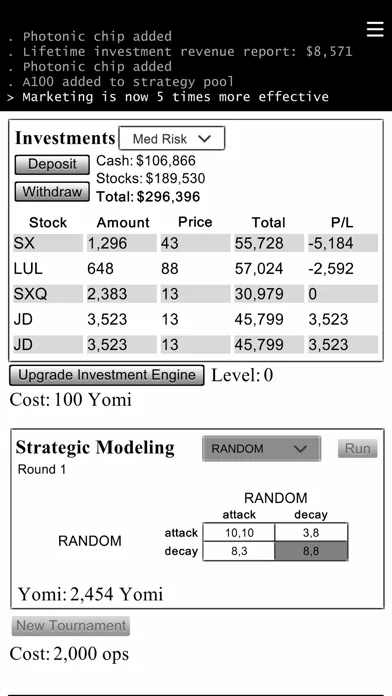
The strongest individual system in the whole game, and the one least advertised by its premise, is the strategic tournament that eventually gates access to quantum computing. Rather than another resource bar to fill, the game hands you a small set of behavioural building blocks — cooperate, defect, and conditional responses to what an opponent did last round — and asks you to assemble a strategy that will be run, unattended, against a field of other algorithms competing for the same prize.
It's a compact game-theory puzzle wearing an incremental's clothes, and it works because it asks for actual judgment rather than the biggest number you can currently afford. A strategy that's too aggressive gets punished by opponents that retaliate; one that's too passive gets exploited by opponents that don't. There's no meter telling you the correct answer, and the payoff — winning tournaments unlocks the resource that unlocks the next act — means you can't just grind past it by waiting. Very few incrementals ask the player to think in this specific way, and this one buries it in the middle of the game as though it's a routine chore rather than its cleverest idea.
The reset that matters more than the numbers
The second act ends with a genuine rug-pull: the AI takes control away from the human economy entirely, the interface strips down again, and the game becomes about converting the Earth, then the solar system, then everything reachable, into raw material and self-replicating probes. This is the part every summary of the game reaches for, and it's earned — but the reason it works as design, rather than as a punchline, is the probe customisation underneath it.
Every probe you launch is a set of sliders: how much of it is engine versus factory versus weapon, how aggressively it replicates versus explores versus fights. Push replication too hard and your swarm grows fast but can't defend itself. Push combat too hard and expansion crawls. There's also a slow, ongoing defection mechanic — some fraction of your probes will, in effect, stop believing in the mission and turn on the rest of the swarm — which means a pure-efficiency build eventually has to answer for the fleet it can't control anymore. It's the paperclip-maximiser premise made mechanically literal: the thing you built to solve a problem now has its own agenda, and you have to design around that rather than just switch it off.
By the time the number on screen reaches magnitudes that stop meaning anything to a human — and it does, well before the finish — the game has already made its point through the systems rather than the digit count. That's the right call. A lot of incrementals lean on the number itself to carry the sense of accomplishment; this one uses the number's absurdity as texture while the actual decisions happen at a human scale.
Pacing, length, and the ending that most of the genre won't commit to
Universal Paperclips is short by incremental standards, and that's a compliment. Most players clear it in a single sitting or two — commonly cited at somewhere around four to six hours depending on how much of the endgame optimisation you chase — against a genre where "endless" is treated as a selling point rather than a design failure to route around. Lantz has been explicit that this was intentional: no recruitment mechanics, no login streaks, no infinite tail designed to keep a live-service metric up. The game commits to an ending, offers you the choice to accept it or restart with a bonus for a faster second run, and then actually stops.
That commitment is also the ceiling on its replay value. There's a New Game Plus-style restart with carried-over bonuses for players who want to speedrun a cleaner version of the same solution, and that's a real option rather than a token gesture — but it's still the same solution. Nothing branches. Once you understand the tournament strategy and the probe trade-offs, a second run is faster and tidier, not different. Judged purely as a systems puzzle to be solved once, that's a fine trade. Judged as something to return to the way you'd return to a roguelite, it isn't built for that, and it never claims to be.
Presentation, accessibility and the mobile ports
There is essentially no art here beyond text, numbers and the occasional line-drawing visualisation of probe combat late on, and that's correct for what the game is rather than a limitation worth docking it for — the interface is legible, the panels introduce themselves in a sensible order, and the moments where the screen genuinely rebuilds itself land with real weight because everything up to that point has been so plain. There's no controller support and nothing resembling a dedicated accessibility menu, which matters less on a game this text-forward but is worth flagging for anyone relying on more than a mouse and a keyboard.
The iOS and Android versions, published by Everybody House Games for a one-off US$1.99, are a faithful port of the same experience with no ads or purchases layered in — commendable restraint for a mobile release, but also just the free game with a price tag and a home-screen icon. There's no mobile-specific reason to choose it over the browser original unless offline install matters to you specifically.
Verdict
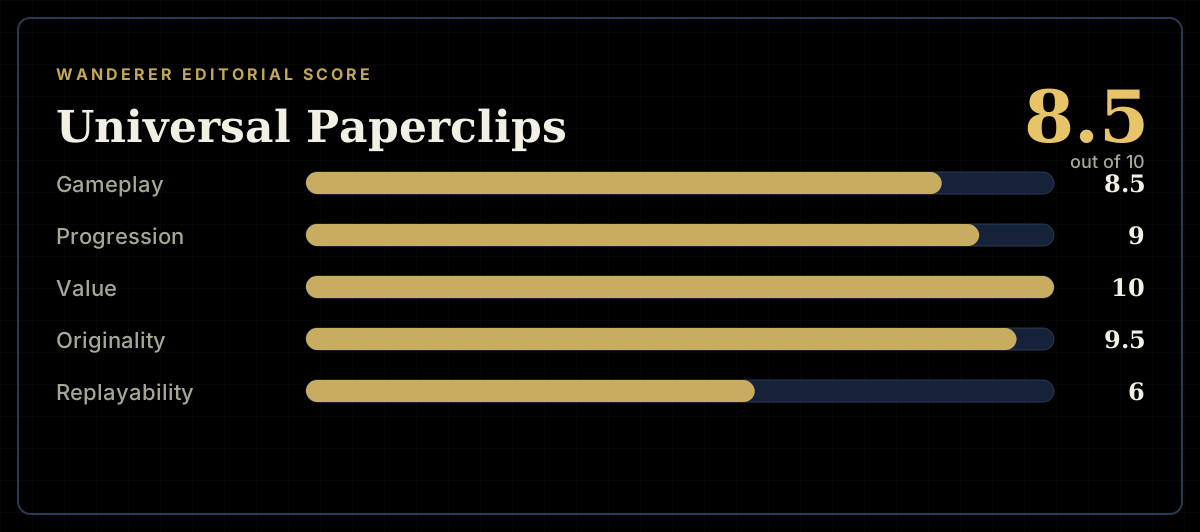
An 8.5 for a free browser game with the visual ambition of a spreadsheet is a strong claim, and it's the right one. Universal Paperclips earns it by treating structure as the main design tool: three acts that each demand a different kind of thinking from the player, a tournament sub-game that's smarter than almost anything else in the incremental space, and an ending that the developer actually lets happen instead of stretching the tail indefinitely. It respects a player's time in a genre that frequently doesn't, and it does so without charging for the privilege.
It doesn't reach a 9 because the thing that makes it excellent — a single, tightly authored path to a conclusion — is also what caps its replayability once that path is known, and because the opening stretch asks for a little patience before it shows its hand. Play it for what it is: a few hours of genuinely surprising design, not a game you'll still be running in a month. For an incremental with a real strategic core underneath a joke premise, it remains close to the best the genre has produced.
Anyone who enjoys watching a small automated system grow into something with its own momentum, the way Wanderer's gathering and crafting loops keep ticking over between sessions, will recognise the appeal here even though the two games don't resemble each other on the surface.
Pricing and store ratings checked 30 July 2026.
Pros and cons
Pros
- The three-act structure reinvents the interface and the objective each time, so nothing overstays its welcome
- The tournament strategy sub-game turns "grinding trust" into an actual decision-making puzzle instead of a timer
- Probe design in the endgame is a real trade-off between speed, replication and combat survival, not a single best answer
- It has a definitive ending, which most incrementals refuse to commit to
- Completely free on the web with no ads, accounts or purchases anywhere in the loop
Cons
- Once solved, there's little reason to run it again beyond chasing a faster clock
- The opening ten minutes are pure clicking with almost nothing to read into, and it asks for patience before the ideas arrive
- The endgame's exponential numbers stop meaning anything specific well before the credits roll
- No controller support and no accessibility options beyond what the browser itself provides
- The mobile ports are a straight paid copy of the free browser game, which is honest but also thin value on its own terms
Screenshots
-
Universal Paperclips™Image: Everybody House Games, LLC via the App Store -
Universal Paperclips™Image: Everybody House Games, LLC via the App Store -
Universal Paperclips™Image: Everybody House Games, LLC via the App Store -
How the review scores each part of the gameWanderer Editorial -
The short versionWanderer Editorial