Game review
Territory Idle
6 / 10
- Developer
- Aleksandr Golovkin
- Publisher
- Aleksandr Golovkin
- Released
- 10 September 2019
- Platforms
- Windows
- Genre
- Strategy, Incremental, Idle
- Monetisation
- Free-to-play. An optional Amber shop sells boosts and permanent perks with real money; Amber can also be earned by playing. No ads found on the store page or in reviews.
- Players
- Single-player
The short version
Territory Idle builds one of the more genuinely layered economies in the free incremental space: four base resources, tile-by-tile specialisation, a pantheon of gods with their own perk trees, hero combat for contested tiles, and three separate prestige systems (Abdicate, Create Heritage, Become a Mentor) that each change how the next run starts. Multiple reviewers with thousands of hours logged call it the deepest thing they've found in the genre.
What holds it back is pacing that reads as deliberate. The earliest reviews, from within days of launch in 2019, already accused the early game of slowing down specifically to nudge new players toward its Amber shop — and that exact complaint is still the headline objection in reviews posted this year. The developer's own store page now promotes a different game, and nothing in Territory Idle's balance has changed since a September 2023 bugfix.
Biggest strengths
- Four resources, tile specialisation, a full pantheon/god perk system and hero combat with swappable gear combine into a production web with real depth for the genre
- Three separate prestige layers stack rather than replace each other — Abdicate resets for gold, Create Heritage and Become a Mentor add permanent bonuses and hired specialists that survive every future restart
- Completely playable to the credits without spending — the game's own currency drip is enough, according to reviewers who logged thousands of hours doing exactly that
Biggest weaknesses
- Steam's own achievement data shows a steep wall: the largest content tier, roughly 30 of the game's 100 achievements, averages under 14% completion, and several reviewers report needing 6,000 or more hours to reach the game's endgame content
- The 100 most recent English reviews sit at 56% positive against a 76% lifetime score, and the complaint driving that decline — an early game paced to frustrate rather than reward — is the same one reviewers made in the first week of release
- No balance, content or bug update has shipped since a September 2023 achievements fix; the store page itself now advertises the developer's newer, unrelated game
Who it's for: Idle-game veterans who want a genuinely deep, currently-free system to dig into over hundreds of hours, and who don't mind an ugly, text-only interface or a slow, occasionally frustrating opening few hours.
Our recommendation: Worth installing since it costs nothing and several thousand-hour players insist it's finishable without spending — but go in expecting the first stretch to be the worst part of the game, not a preview of what's coming, and don't expect any further updates.
6 / 10
Territory Idle opens with a pantheon selection screen straight out of Civilization V, then hands you a single wheat field and a "Buy tile" button, and from there it never really stops adding systems. That's unusual for a free browser-scale idler, most of which are content to let one currency climb forever. It's also the source of the game's central argument with its own audience: one player with 8,863 hours logged puts it bluntly — "Territory Idle is not an Idle Game. Hands down." Reviewers who love it and reviewers who bounced off it are frequently describing the same thing, a game that asks for far more hands-on attention than its genre label promises.
Four resources, a pantheon, and three ways to restart
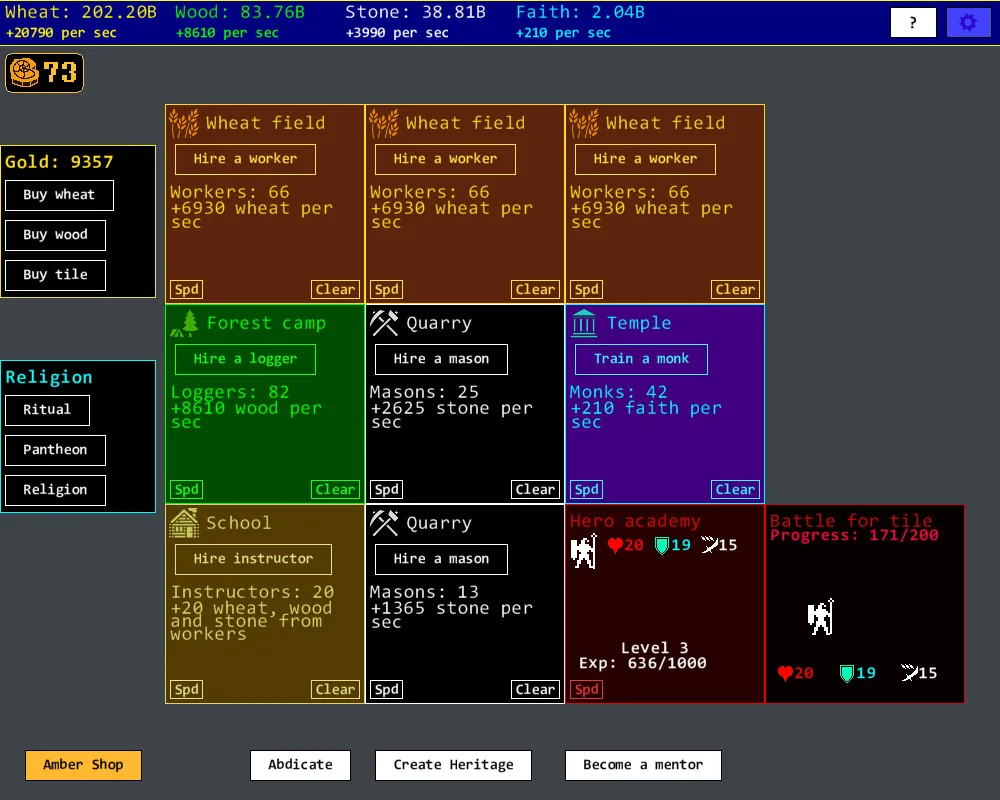
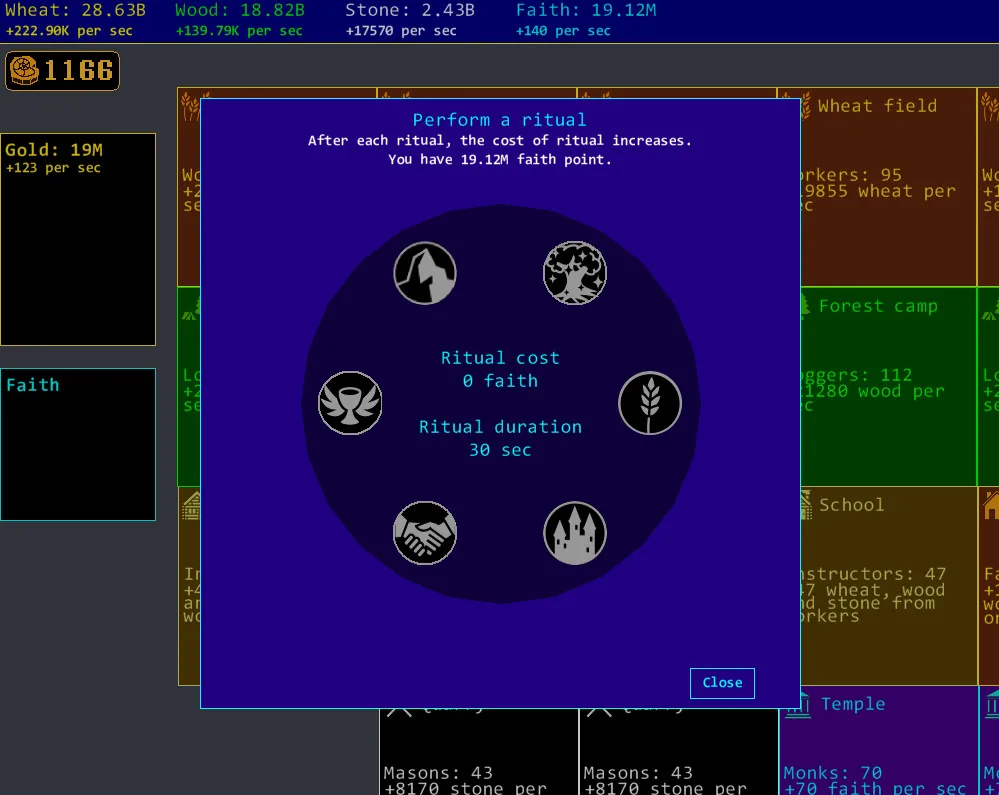
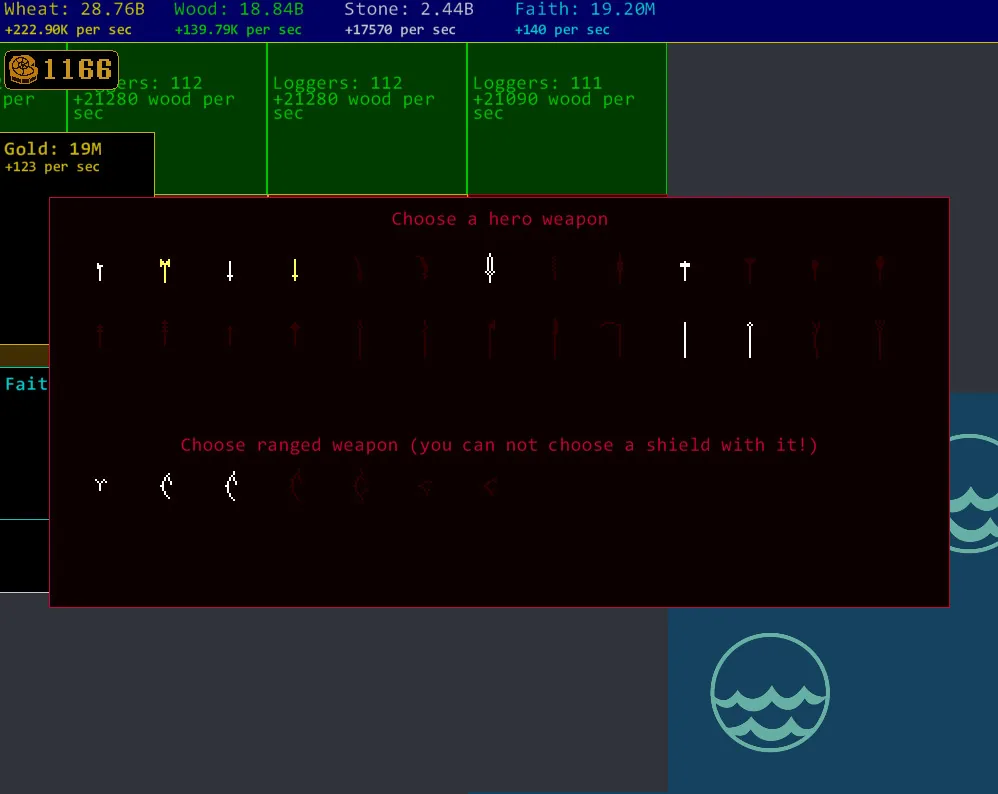
The core loop reads simply on the store page — develop the kingdom, then abdicate for gold, then spend that gold buying more tiles — but the systems stacked on top of it are not simple. Tiles specialise into wheat fields, forest camps, quarries, temples and schools, each producing one of four base resources (wheat, wood, stone, faith) that scale into the billions within the first sitting. Religion adds a genuine tech-tree layer: you pick a pantheon the way you'd pick a civilisation, then a god from within it, then one of three perks per god, each with its own effect, plus a roster of religious servants to staff the choice. An academy lets you hire a hero, equip them with a weapon, shield and helmet, and send them to fight for contested tiles in a turn-based skirmish shown right on the map.
None of that would matter much if resetting just meant losing it all. Territory Idle stacks three separate prestige systems instead of one: Abdicate trades your current empire for gold, which buys the next run's tiles faster; Create Heritage and Become a Mentor sit above that, adding permanent account-level bonuses. Specialists hired through the game's "International Trade" screen — surveyors, headhunters, cultists, nurses, each costing tens or hundreds of millions of gold — explicitly carry over through every future restart, according to the game's own interface. That's the detail that separates a real prestige system from a reset button: each layer changes what the next run looks like rather than just returning you to zero with a multiplier.
The interface is the whole aesthetic, and it isn't always legible
There is essentially no art in Territory Idle. Tiles are flat colour blocks with a label and a row of green production text; menus are stacked buttons; the only real visual flourish is watching numbers climb through millions, billions and trillions. One reviewer with over 11,000 hours logged called it "quite possibly the most in depth, graphically devoid game I have ever played... that's a compliment," and there's something to that — the game clearly spends its effort on systems rather than presentation, and it runs on essentially nothing.
The cost shows up once several systems are open at the same time. Screens with an active trade window, a religion panel and a hero-combat tile stacked together turn into walls of small green, white and red text with no consistent hierarchy telling you what to read first. It's a legitimate, functional interface for a spreadsheet game, not a comfortable one, and it's the reason the interface score here sits well below the gameplay score underneath it — the systems are doing more work than the screen showing them to you.
The Amber shop, and a complaint that hasn't changed since launch
Territory Idle is free to play, and its premium currency, Amber, buys boosts and permanent perks through an in-game shop. It is not the loudest complaint in the review corpus by volume — "pay" and "money" together appear in roughly a fifth of English negative reviews — but it is the oldest and most consistent one. The single most-upvoted negative review on the entire page, posted within days of the 2019 launch, argues the game already had "a heavily incentivized microtransaction model" and explicitly ties that to the developer's earlier idler, Realm Revolutions, describing the same pattern showing up "very early into its development." A second early review with over 800 hours logged lays out the three paths through the game as the reviewer saw them: "a) WAIT forever, b) PAY nearly $100 to get real useful bonus, c) CHEAT" — that reviewer says they resorted to changing their system clock to force offline progress rather than pay.
What keeps this from being a straightforward pay-to-win story is that the same complaint keeps showing up from players who never spent a cent. Recent reviews — the 100 most recent in English, which have slipped to 56% positive against a 76% lifetime score — make the identical argument in 2025 and 2026 language: "the early game seems to be designed to frustrate the player as much as possible in the hopes that they start spending large amounts of real-world money to make it move faster." That's a seven-year-old criticism still being made, word for word in spirit, by players arriving today. Whether or not the pacing was built deliberately that way, it reads the same to a new player regardless of the year they installed it.
The counter-evidence is real too. Several long-time players say the free currency drip is sufficient if you're patient, and the top positive reviews are largely from people who never paid and still logged thousands of hours. Steam's own achievement data supports the idea that this is a patience problem rather than a hard paywall: the game's largest content tier — roughly thirty of its hundred achievements — averages under 14% completion, against 70-80% on the earliest tiles, a shape that matches a long grind more than a wall you can't get past without paying. One reviewer put a number on it directly: about 6,000 hours to reach the game's "Space" late-game content for the first time.
Abandoned, not broken
Territory Idle's news feed stops meaningfully in September 2023, with a bugfix for its own achievement tracking. Before that, the last real content patch was a "Space" expansion back in
- The developer's own store description now opens with a banner promoting a newer, unrelated
strategy game, and a 2021 review from a player with over 7,500 hours logged puts the state of things plainly: "it's not fully developed, and it's abandoned and bugged... if you don't mind the bugs, you can still have a good time." Nothing about that has changed since; if anything, the achievements bugfix in 2023 suggests the developer did one last pass and then moved on.
That matters for how to read this review. There's no ongoing balance pass to hope for, no roadmap, and no reason to expect the pacing complaints above to get better. What's here is what you get. The developer, Aleksandr Golovkin, has a small catalogue of these idle-strategy games — Territory Idle followed an earlier title, Realm Revolutions, and the pattern of "deep systems, aggressive early monetisation, eventual quiet abandonment" described by reviewers of this game is one worth watching for if you try the others.
Verdict
Territory Idle is a genuinely unusual free idler — deep enough that veteran players still find new layers hundreds of hours in, and honest enough that finishing it without spending real money is a documented, repeated outcome rather than a technicality. It's held back by an opening stretch that a large share of its audience, across seven years, independently describes the same way: paced to make spending look attractive. Add an interface that was never designed for comfort and a developer who's moved on to other projects, and the honest recommendation is to go in with your expectations calibrated — this rewards patience and system-tinkering, not casual dipping in, and what you see today is what you'll get from here on.
Pros and cons
Pros
- Four resources, tile specialisation, a full pantheon/god perk system and hero combat with swappable gear combine into a production web with real depth for the genre
- Three separate prestige layers stack rather than replace each other — Abdicate resets for gold, Create Heritage and Become a Mentor add permanent bonuses and hired specialists that survive every future restart
- Completely playable to the credits without spending — the game's own currency drip is enough, according to reviewers who logged thousands of hours doing exactly that
- Hired specialists (surveyors, headhunters, cultists, nurses) carry across resets, so the prestige loop compounds instead of resetting to a blank slate every time
Cons
- Steam's own achievement data shows a steep wall: the largest content tier, roughly 30 of the game's 100 achievements, averages under 14% completion, and several reviewers report needing 6,000 or more hours to reach the game's endgame content
- The 100 most recent English reviews sit at 56% positive against a 76% lifetime score, and the complaint driving that decline — an early game paced to frustrate rather than reward — is the same one reviewers made in the first week of release
- No balance, content or bug update has shipped since a September 2023 achievements fix; the store page itself now advertises the developer's newer, unrelated game
- The interface is dense stacked text and overlapping panels with no visual hierarchy, and several reviewers say it becomes genuinely hard to read once multiple tiles and shop windows are open at once
Screenshots
-
Territory IdleImage: Aleksandr Golovkin via Steam -
Territory IdleImage: Aleksandr Golovkin via Steam -
Territory IdleImage: Aleksandr Golovkin via Steam -
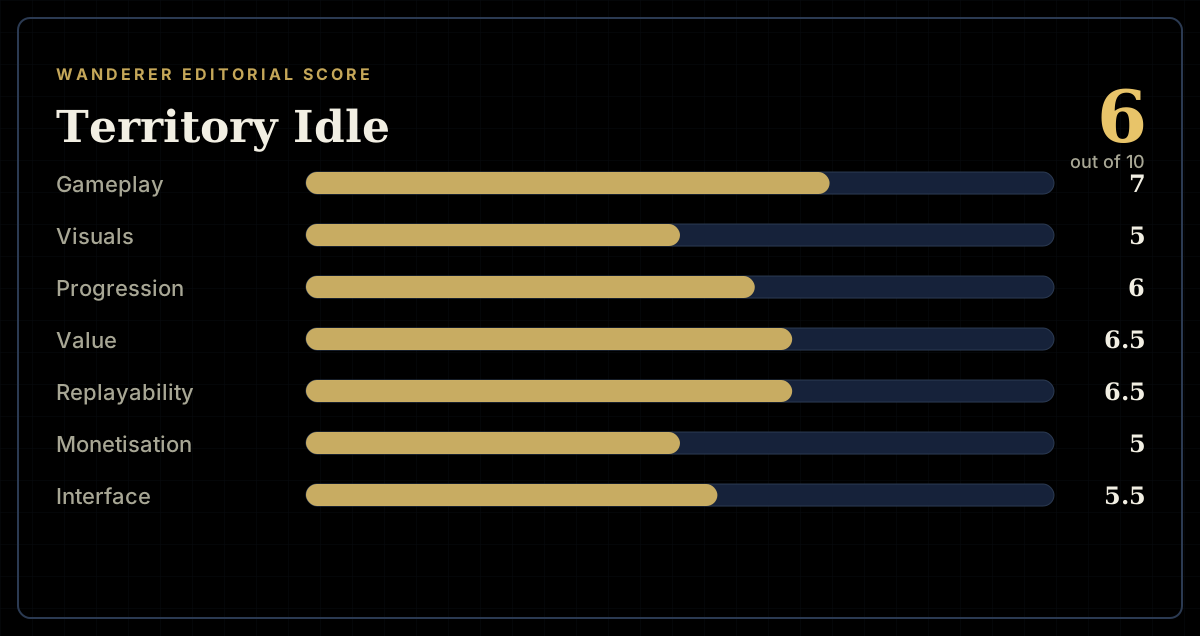
How the review scores each part of the gameWanderer Editorial -
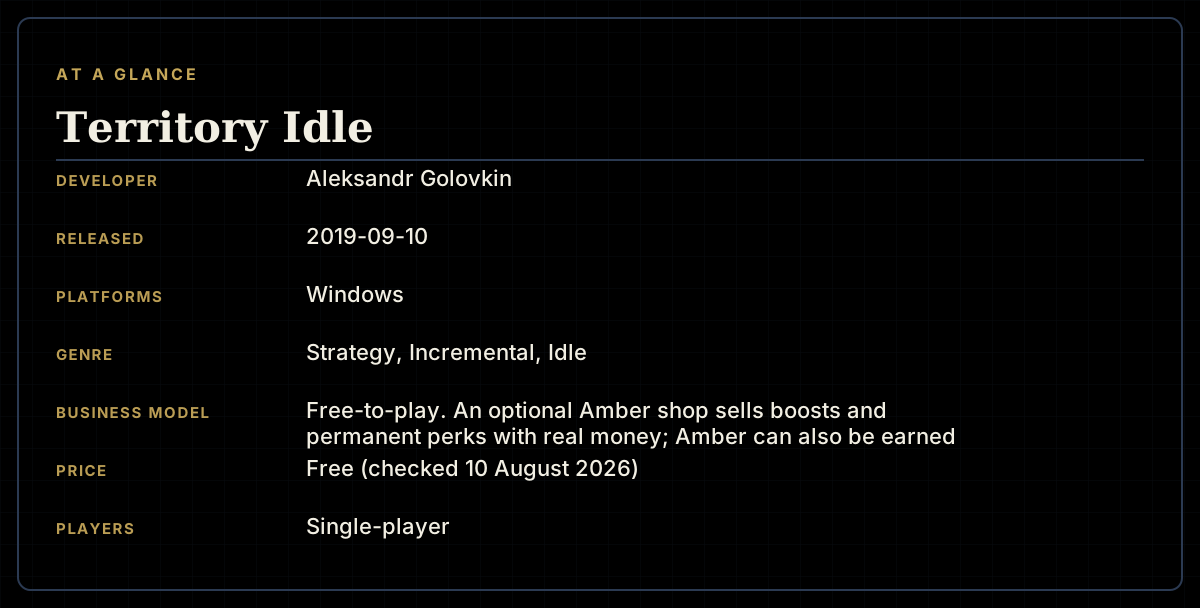
The game at a glanceWanderer Editorial -
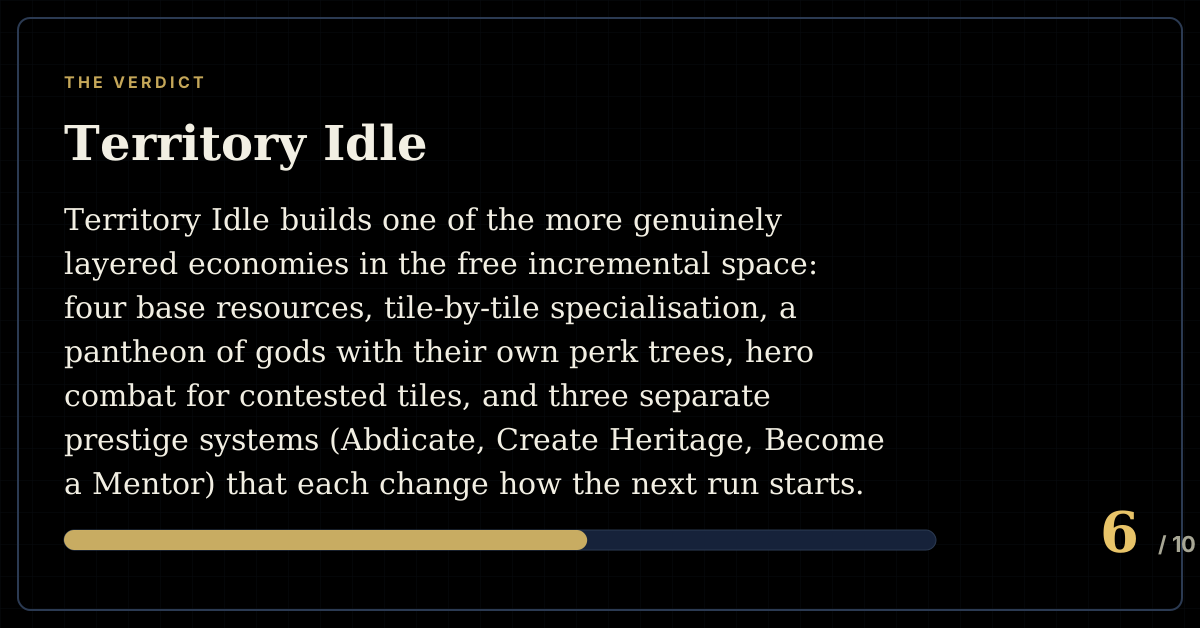
The short versionWanderer Editorial