
Game review
Idle Research
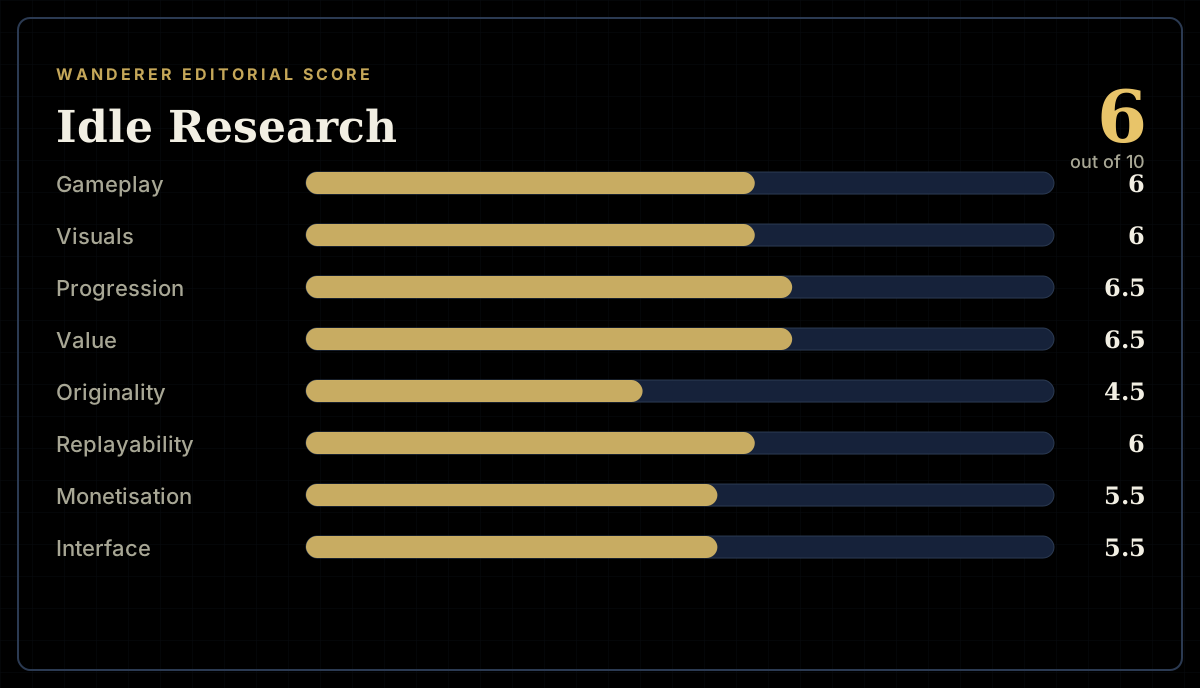
6 / 10
- Developer
- Zach (trading as Considera Games LLC, formerly CryptoGrounds)
- Publisher
- Considera Core LLC
- Released
- 31 July 2022
- Platforms
- Windows, macOS, Linux, Android, iOS, Browser
- Genre
- Incremental
- Monetisation
- Free to play. Mobile builds carry ads and in-app purchases from roughly $0.99 to $99.99; the Steam build lists in-app purchases as a store category but shows no ads
- Players
- Single-player
The short version
Idle Research wraps a genuinely broad incremental toolkit — research, crafting, accelerators, automation, mastery, prestige, and more — around a chemistry-lab theme that never actually shapes any of it. Strip away the coloured flasks and what's underneath is a competent, kitchen-sink mobile idle game that has found a real audience on phones while its Steam release quietly stalled. It's honestly free and still gets bug fixes, but a solo developer's attention has visibly moved on to a sequel with no release date, and nothing here does anything the genre's better-known names haven't already done with a clearer sense of purpose.
Biggest strengths
- Free across Steam, Android and iOS with cross-device cloud saves, and built almost entirely by one person since October 2020
- A genuinely deep systems list for a solo project — research, crafting, up to 62 accelerators, automation, mastery, and multiple prestige layers
- Real, durable mobile reception: over 500,000 Google Play installs at a 4.3-star average across more than 8,300 ratings, and 4.8 stars on iOS from 864 ratings
Biggest weaknesses
- The chemistry-lab framing is cosmetic — a bolted-on daily Solitaire minigame and generic zone-based combat sit next to Flasks and Tubes without drawing on the theme at all
- Four years after launch the Steam build is still tagged Early Access and has zero user reviews, next to a genuinely popular mobile release
- Neither storefront listing documents an offline-progress cap or rate, leaving one of the first questions an idle player asks about this game unanswered anywhere public
Who it's for: Mobile-first idle players who want a generous, ad-supported flask-and-number game to check in on between sessions of something bigger. Not for anyone hoping the research framing will do real mechanical work, and not the best entry point if you're shopping for a game on Steam specifically.
6 / 10
A lab that never does any chemistry
Idle Research asks you to research colourful Flasks, craft them into Tubes, and eventually work toward a still-unreleased third tier called Cylinders, all in service of producing three kinds of Energy. That's the pitch, and on paper it puts the game in the same neighbourhood as Kittens Game, where a theme actually constrains what you can do and when. The difference shows up almost immediately: nothing about researching a red flask behaves differently from researching a blue one, nothing about "chemistry" limits or shapes a single decision, and the game is just as happy to hand you a zone-based combat system, a skill tree with seventy nodes, and a daily Solitaire minigame that has no connection to labs, flasks or energy whatsoever. The theme is set dressing on a very ordinary incremental skeleton, and the game never pretends otherwise — there's no story, no dialogue, no sense that the fiction is doing anything but naming the currencies.
That's not automatically disqualifying. Plenty of good incrementals wear their theme lightly. But it does mean the central question this review has to answer isn't "does the research framing work" — it doesn't, really — but whether the mechanical toolkit underneath is strong enough to carry the game on its own. The honest answer is: it's broad, and it's competent, and it's rarely distinctive.
Systems on top of systems
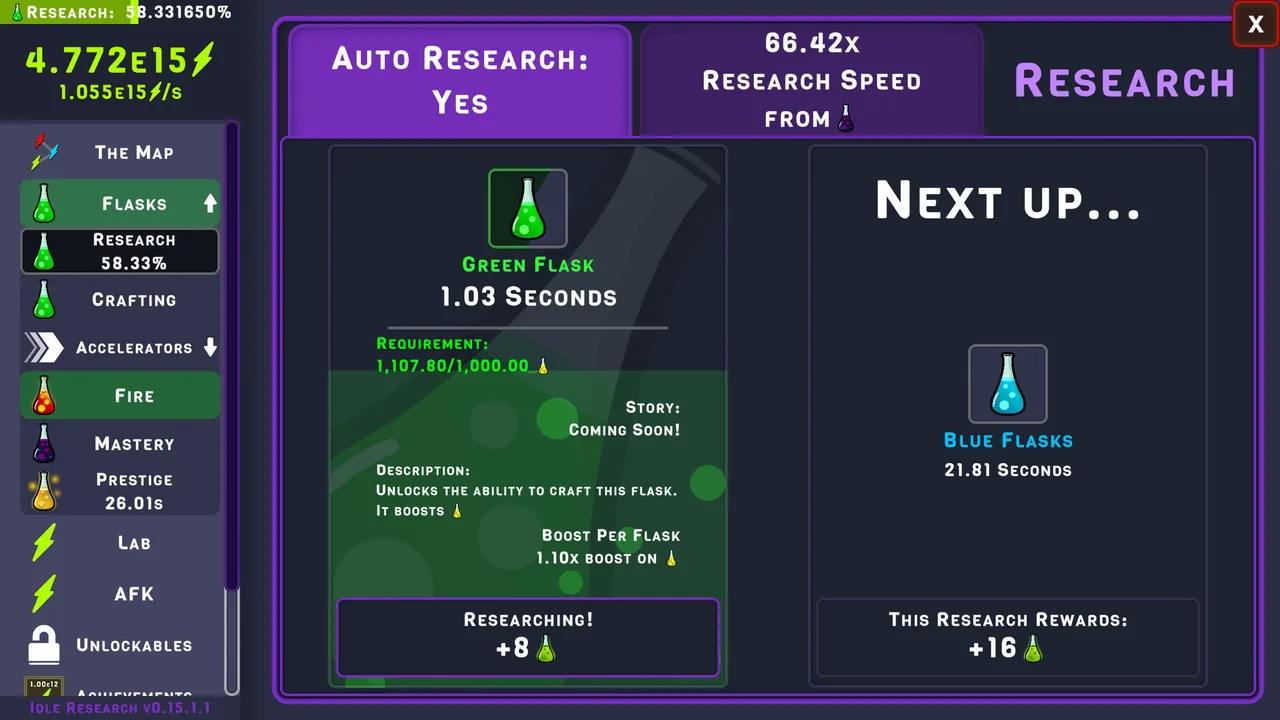
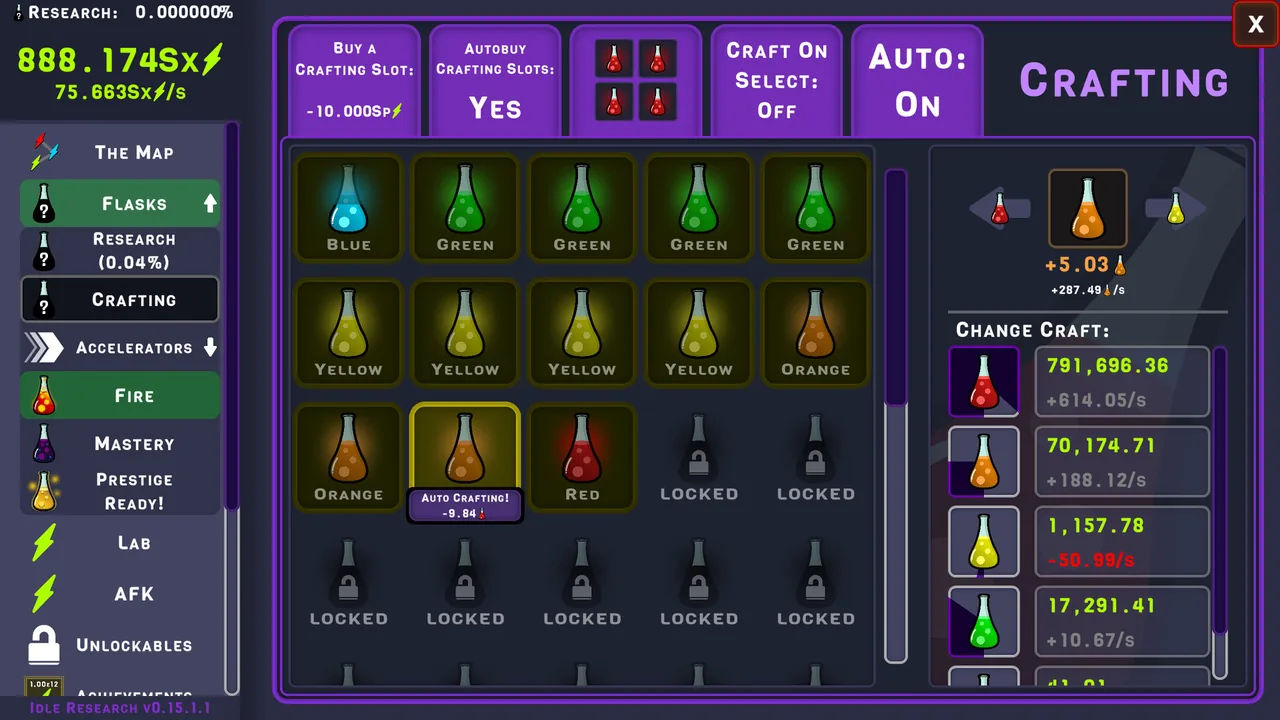
For a single developer, the feature list is genuinely large. Research unlocks up to eighteen Flasks and Tubes; Crafting turns researched items into production boosts; up to sixty-two Accelerators speed everything up; Automation lets the whole loop run itself once you've earned the unlocks; Mastery improves research speed the more you've already researched an item; Prestige resets progress for permanent Golden-item bonuses across "lots of different types" of resets, according to the store page; an Adventure mode sends you through seven zones and up to five hundred stages a piece to fight enemy Tubes for their Energy; Skilling spreads seventy separate skill nodes across that combat layer; and Potions add a twelfth system for good measure. Layer that list next to The Prestige Tree, a game built by one person that makes exactly one mechanic — resetting — its entire subject and does almost nothing else, and the contrast is stark. Idle Research goes the opposite direction: instead of committing to one idea and exploring it deeply, it stacks nearly a dozen systems side by side and asks the player to manage all of them roughly simultaneously.
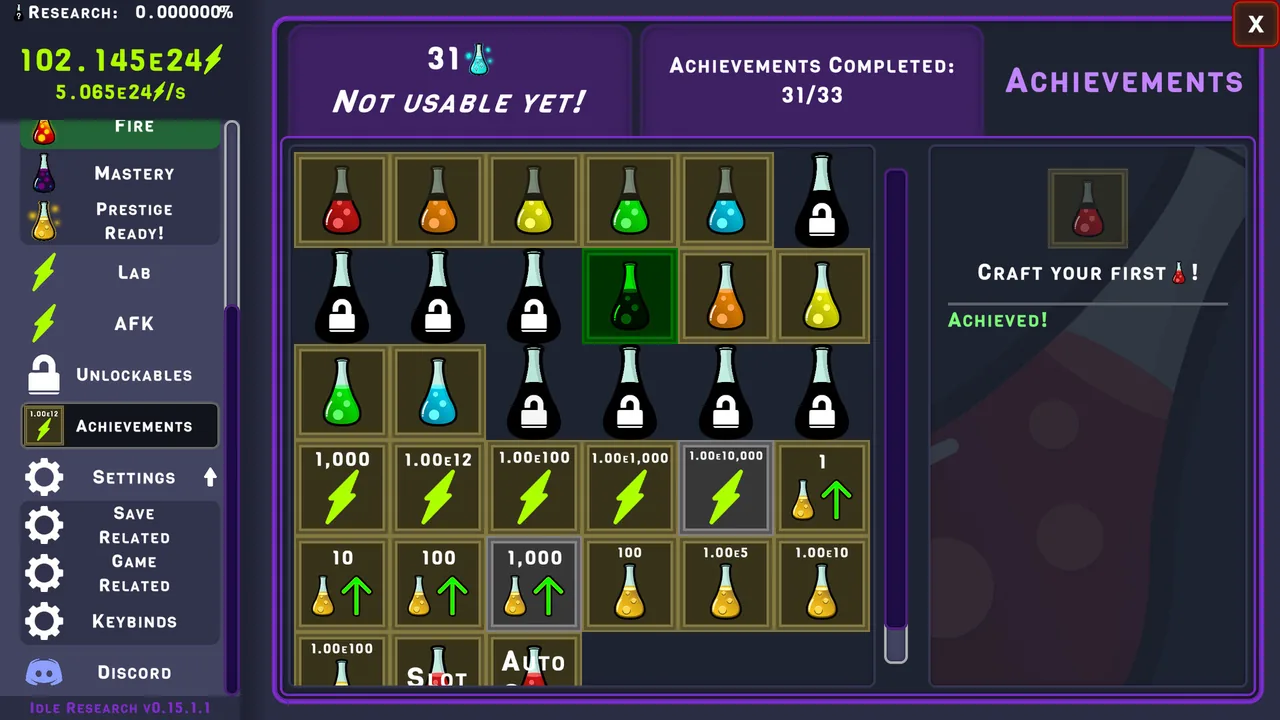
The risk with that approach is that no single system gets the attention a narrower game could give it, and the achievement list backs that up. Steam's own store page states the game has 148 achievements planned with around a hundred currently live — a number that only makes sense if a meaningful share of the tracked content is either unfinished or was cut. One of those hundred, a "Black Ice" achievement, was quietly removed in mid-2024 — a small correction that shows active maintenance, but also underlines how much of the original scope still hasn't shipped.
Offline progress: the one thing nobody will say
This is usually the first thing a Wanderer reader wants to know about an idle game, and it's the one question Idle Research's own marketing never answers. The Steam page promises the game "can be played anywhere at anytime, no internet or constant attention is required," and the App Store listing repeats the same idea without ever naming a cap, a discount rate, or a maximum away time. That's unusual restraint for the genre — most mobile idles lead with "earn 2x while you're away!" banners precisely because the offline hook sells installs — and its absence here could mean either an uncapped away rate or one deliberately left vague so it can be tuned without a promise to walk back. Neither storefront says which, and nothing in the developer's public devlogs settles it either. Readers who care most about exactly this feature won't find it documented anywhere before they commit to an account.
Interface, and where the game actually lives
The App Store listing calls the UI "a very simplistic, beautiful, modern, and colorful UI," which is the kind of claim every store listing makes about itself and worth exactly as much. What's verifiable is where the interface has to work: this is a genuinely cross-platform release, running natively on Windows, macOS and Linux through Steam, on Android and iOS, and through an in-browser build the Steam page advertises separately, with cloud saves carrying progress between all of them. That's a real engineering commitment from one person. What it also means is that a menu structure holding twelve distinct systems — research, crafting, accelerators, automation, mastery, prestige, adventure, skilling, potions, simulations and a card-game side mode — has to fit comfortably on a phone screen, a much harder design problem than fitting the same list on a desktop monitor. The numbers suggest this mostly works well enough for players to stick around: a 4.3-star average across more than eight thousand Google Play ratings and 4.8 stars from over eight hundred iOS reviews aren't scores a genuinely frustrating interface tends to sustain at that volume. But sustained mobile ratings are a signal about tolerance, not proof of elegance, and a dozen systems sharing one small screen is inherently more prone to menu sprawl than the genre's more focused entries.
Monetisation: free, but not evenly so
Idle Research costs nothing on any platform, and it deserves credit for that without a curve — a free game doesn't get graded up just for being free, but it also shouldn't be graded down for it. What's worth flagging is how unevenly the monetisation lands across builds. The mobile releases carry advertising and sell in-app purchases ranging from $0.99 up to $99.99 per item, a genuinely steep top tier for a game whose whole selling point is that big numbers are free to watch grow. The Steam build lists in-app purchases as a store category too, but shows no advertising at all, which suggests the desktop release either doesn't run ads or simply hasn't attracted enough players to make an ad integration worth shipping — Steam's zero user reviews after four years live points toward the latter. Either way, there's no premium, ad-free purchase option on mobile; the choice is tolerate the ads or pay per item, which is a familiar mobile-idle pattern rather than an unusually aggressive one, but not a generous one either next to genuinely ad-free peers like The Prestige Tree or Synergism.
Early Access after four years, and a sequel nobody can play yet
The most telling detail about where this game actually stands isn't in the game itself. Idle Research launched into Steam Early Access on 31 July 2022 and remains tagged Early Access today. Its developer, working solo under the names CryptoGrounds and later Considera Games LLC, has said in a public Steam post that the plan was always a third and final content layer beyond Flasks and Tubes, plus some educational chemistry and physics material and possibly a story. None of that has shipped. Instead, starting in mid-2024, the developer announced a decision to rebuild the game from scratch as Idle Research 2 — a new project, still listed as "coming soon" with no release date as of this review — and a string of 2025 devlog posts about that sequel's water-pipeline systems and UI rework make clear where the actual development hours have gone since. The original game hasn't been abandoned outright: the same posts promise continued bug fixes and "slight" feature tweaks, and the removed Black Ice achievement shows that maintenance is real, not just a promise. But "maintained" and "actively developed" are different claims, and only the first one is currently true of Idle Research. A four-year-old Early Access tag with a sequel already announced is a specific kind of limbo, and it's worth knowing about before committing meaningful time to the original.
Verdict
Six out of ten. Idle Research earns real credit for what it is on paper: a free, broad, honestly cross-platform incremental built almost entirely by one person, with a mobile audience — over half a million Google Play installs, thousands of consistently positive ratings on both major mobile stores — that most solo-developer games never come close to reaching. None of that changes the fact that its central conceit doesn't do any actual work. Strip the lab-flask names off Research, Crafting, Accelerators and Prestige and what's left is a competent but unremarkable systems pile that a dozen other free incrementals also offer, several with a tighter idea at their core. Add to that a Steam release stuck in Early Access with no reviews after four years, an offline system nobody will describe in public, and a developer whose real attention has visibly moved to an unreleased sequel, and the case for playing this specific game over its genre neighbours gets thin fast.
Play it if you want a free, ad-supported check-in idle game for your phone and don't mind that the theme is only skin deep. Players who want the reset-ladder idea taken more seriously should read our Antimatter Dimensions review or our Synergism review instead, both of which build considerably more mechanical identity around fewer, better-integrated systems. And anyone who wants persistent progress that keeps accumulating even when they're not actively pressing buttons, attached to an actual character walking through an actual world rather than a shelf of coloured flasks, is exactly who Wanderer is built for.
Price and monetisation details checked 1 August 2026.
Pros and cons
Pros
- Free across Steam, Android and iOS with cross-device cloud saves, and built almost entirely by one person since October 2020
- A genuinely deep systems list for a solo project — research, crafting, up to 62 accelerators, automation, mastery, and multiple prestige layers
- Real, durable mobile reception: over 500,000 Google Play installs at a 4.3-star average across more than 8,300 ratings, and 4.8 stars on iOS from 864 ratings
- The developer still ships bug fixes and stays active on Discord even during a long content lull
Cons
- The chemistry-lab framing is cosmetic — a bolted-on daily Solitaire minigame and generic zone-based combat sit next to Flasks and Tubes without drawing on the theme at all
- Four years after launch the Steam build is still tagged Early Access and has zero user reviews, next to a genuinely popular mobile release
- Neither storefront listing documents an offline-progress cap or rate, leaving one of the first questions an idle player asks about this game unanswered anywhere public
- Mobile builds run ads and sell in-app purchases as high as $99.99 with no ad-free purchase option
- Public devlogs show the developer's actual attention has been on an unreleased sequel since early 2025, with the original receiving little beyond maintenance since
Screenshots
-
Idle ResearchImage: Considera Core LLC via Steam -
Idle ResearchImage: Considera Core LLC via Steam -
Idle ResearchImage: Considera Core LLC via Steam -
How the review scores each part of the gameWanderer Editorial -
The short versionWanderer Editorial