Game review
Kittens Game
8 / 10
- Developer
- bloodrizer (Dmitrii Popov)
- Publisher
- bloodrizer
- Released
- 1 January 2014
- Platforms
- Browser, Windows, Android, iOS
- Genre
- Incremental
- Monetisation
- Free and ad-free in the browser, supported by an optional Patreon; a $2.99 one-off Android/iOS app with no ads or in-app purchases; a paid Steam Early Access build with no DLC
- Players
- Single-player
The short version
Kittens Game is proof that an incremental doesn't need a single line of art or a note of music to be genuinely absorbing. The difficulty here isn't a bigger number to grind toward — it's a granary that's about to overflow, a winter that's about to gut your catnip income, and a population you may not be able to feed. Every decision is a trade against a ceiling, and that makes it one of the smartest resource-management designs the genre has produced.
It is also one of the least welcoming. There is close to no in-game explanation for what anything does, the wiki is not optional reading so much as a second manual, and the interface looks the same today as it did a decade ago. Judge it purely as design and it's excellent. Judge it as a first hour and it's a wall.
Biggest strengths
- Storage caps on raw resources turn every building decision into a real trade-off, not a shopping list
- Seasons and winter famine risk make timing matter as much as production totals
- The paragon reset carries forward storage and production bonuses instead of wiping progress back to zero
Biggest weaknesses
- The game explains almost nothing about what a building or tech actually does numerically
- Progress without the community wiki open is close to impossible past the first couple of hours
- Visual presentation is a handful of colour themes over plain text, and there is no music or sound design to speak of
Who it's for: Players who enjoy planning around scarcity rather than scaling past it, and anyone happy to treat a wiki tab as part of the game rather than a crutch.
Our recommendation: Start in the free browser version with the wiki open in a second tab from minute one. Buy the mobile app only once you already know you'll keep playing — it's the same game, not a better one.
8 / 10
Most incrementals make their difficulty a math problem: the number you need is bigger than the number you have, so you wait, or you optimise, or you reset for a multiplier and do it again. Kittens Game barely bothers with that kind of difficulty. Its problem is logistics. You will have more catnip than you can store, more kittens than you can feed through winter, and more wood than your huts can absorb before the next building tier eats it all at once. The number was never the obstacle. The lid on the jar was.
That's the idea that makes this decade-old browser game still worth talking about, and it's also the idea that makes it genuinely hostile to anyone who opens it expecting a normal first hour.
Two kinds of resource, and only one kind of ceiling
The opening loop looks like every other village-builder: gather catnip, build catnip fields, grow the population, assign jobs, build more things. What's not obvious for a long while is that the game is quietly running two different economies side by side, and only one of them behaves the way an incremental veteran expects.
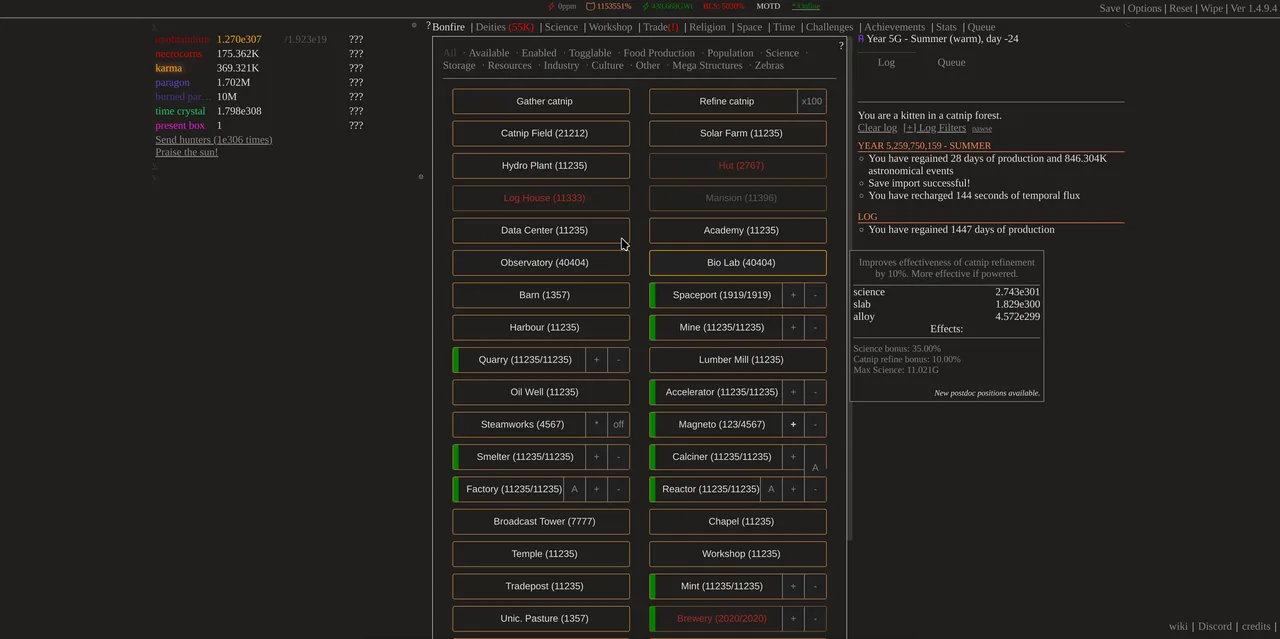
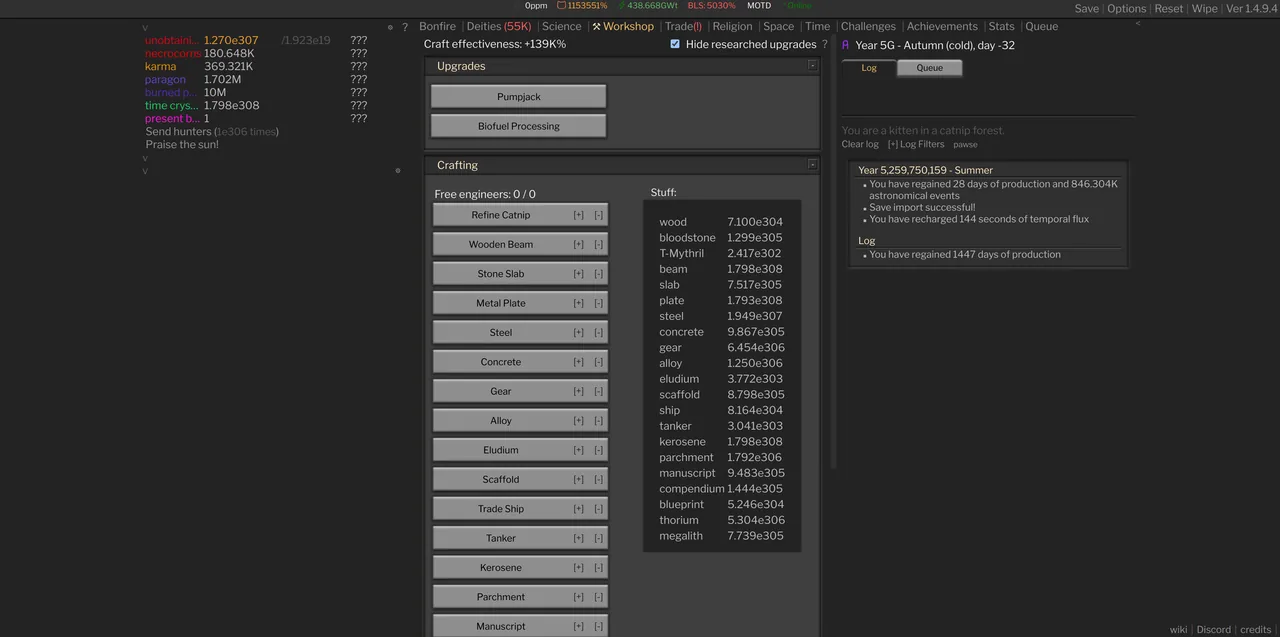
Raw resources — catnip, wood, minerals, iron, and so on — have hard storage caps set by how many barns and warehouses you've built. Once a stockpile hits its ceiling, further production is simply wasted, which means overbuilding a resource you can't yet store is a real, costly mistake rather than a harmless surplus. Manufactured resources — parchment, manuscripts, compendiums, blueprints, the chain of crafted goods the Workshop tab runs on — have no cap at all, but they cost raw materials to produce and their conversion ratios only improve through further crafting investment. The asymmetry is the whole game: you're constantly deciding whether a resource is worth storing or worth converting, and the answer changes as your buildings change. Nothing about this shows up on a tooltip. You learn it by watching a granary spill over and asking why.
That single design choice is why Kittens Game reads less like a spreadsheet and more like a supply chain. Most incrementals ask "what's mathematically optimal to buy next." This one asks "what can your storage and your labour actually absorb right now," and that question keeps changing shape as the village grows.
Winter is the boss fight
Layered on top of the storage problem is the calendar. The game runs on a season cycle, and catnip production — your entire village's food supply — swings hard with it. Winter guts catnip income at exactly the time of year your population is at its largest and hungriest, and a village that hasn't banked enough surplus catnip going into the cold months risks starvation: kittens you spent real effort recruiting simply die off, and the population you were building toward evaporates.
There's no enemy sprite for this, no health bar draining on screen. It's a spreadsheet threat, and it works precisely because the game never announces it as a threat — you find out winter is dangerous the first time it costs you something. Once you know, though, the whole rhythm of play changes: production planning stops being about steady-state throughput and starts being about building buffers ahead of a season you can see coming on the calendar but can't stop. It's a simple mechanic, and it's a genuinely effective one, because it turns "keep the numbers going up" into "keep the numbers going up while surviving a recurring crisis you have to plan around."
The tabs keep coming, and none of them hold your hand
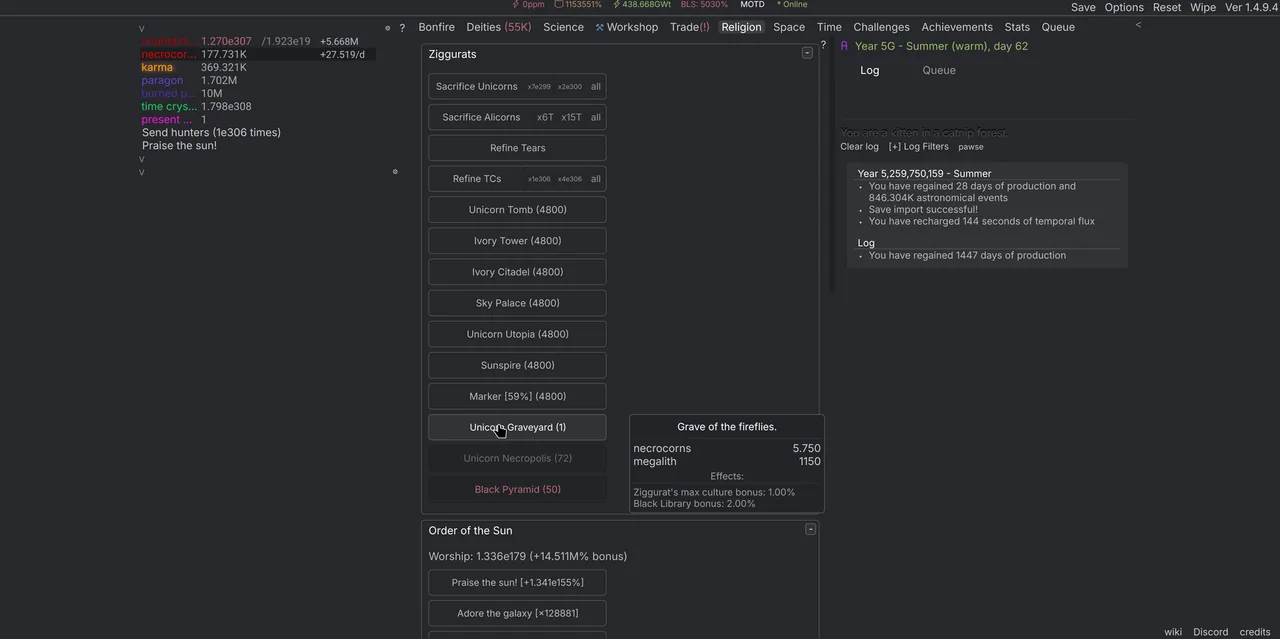
Once the village stabilises, the game opens up sideways rather than just up. Science unlocks a sprawling tech tree. Religion adds a faith economy with its own buildings and its own long-term payoff. Trade sends caravans out to distinct trading partners, each with a different resource profile worth learning. The Workshop turns crafted goods into permanent production multipliers. Much later, Space and Time tabs add rockets, exotic off-world resources, and a chronoforge system built around time crystals and temporal risk. By the time all of these are running in parallel, you are managing something closer to a small economy than a single production line, and that's where the design earns its reputation as one of the deepest free incrementals available.
It's also where the total absence of in-game explanation stops being charming and starts being a genuine barrier. Buildings, techs and upgrades are described in a sentence or two at most, with no numbers attached to what they actually change. Optional challenge runs like Iron Will — which strip away the normal village-building tools and force a different opening strategy entirely — are fascinating once you understand what they're asking of you, and nearly unreadable if you don't. The community-run Kittens Game Wiki isn't a nice-to-have here; it's the game's actual manual, and treating it as optional reading is the single biggest reason new players bounce off a design that rewards patience once you know what you're planning for.
Resetting without losing your shape
Kittens Game's prestige layer, Paragon, is worth calling out specifically because it avoids the genre's most common reset trap. Reset with a large enough population and the game hands you Paragon points — spendable on permanent production and storage-cap boosts through the Metaphysics tree — rather than asking you to rebuild identically from nothing. Paragon also trickles in slowly just from playing across enough in-game years, so even a stalled run keeps generating something. Later resets can burn accumulated Paragon entirely in exchange for specific achievement rewards, which is a small but telling design touch: even "throwing away" your meta-currency is a deliberate choice with its own payoff, not a dead end.
It's a smart structure because it respects the thing that made the first playthrough hard in the first place — storage. A second run with higher storage caps isn't just faster, it changes which of the early game's scarcity problems even exist anymore, and that reshapes the decisions you make from the very first catnip field onward.
No pixels, no music, no apology
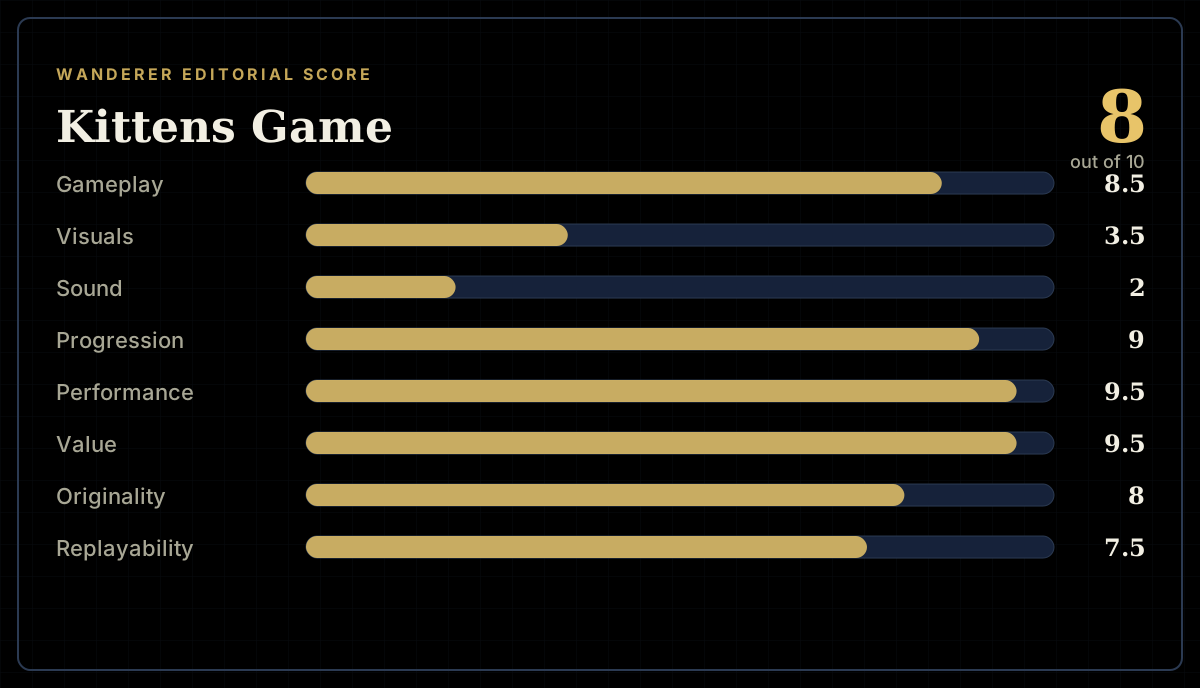
Visually, this is about as unadorned as the genre gets: a handful of colour themes over plain text and number columns, no character art, no animation, and nothing resembling a soundtrack or sound effects. That's not a technical shortcoming so much as a stated priority — every hour of development time clearly went into the systems rather than the presentation, and the game runs happily on hardware that would struggle with almost anything else released this year. Judged as an audiovisual product it scores about as low as a rating scale allows; judged as an argument about where an incremental's budget belongs, the trade looks deliberate rather than lazy.
Free, then a few dollars, then a wiki tab regardless
The browser version at kittensgame.com is genuinely free, ad-free, and has no purchases of any kind — its only monetisation is an optional Patreon that changes nothing about play. The Android and iOS apps wrap the same game for a one-off $2.99, again with no ads and nothing to buy inside, which mainly buys convenience: an offline app icon instead of a browser tab, nothing more. A Steam Early Access release arrived in February 2026 at roughly US$7, also a straight one-off purchase with no DLC and, per its own store description, positioning itself as something close to "the Dark Souls of incremental games" — a fair pitch for a game this unwilling to explain itself. All three versions are the same design; none of them buy an advantage over the others, which is a rare thing to be able to say plainly about a free-to-play-adjacent game in 2026.
Verdict
Eight out of ten. Kittens Game's central idea — that scarcity, not scale, can be the whole difficulty curve of an incremental — is still one of the smartest things the genre has produced, and storage caps combined with a seasonal famine risk do more to create meaningful decisions than most games manage with an entire prestige ladder. The paragon system's refusal to fully wipe your progress on reset is a design lesson plenty of newer incrementals still haven't learned.
What keeps it from scoring higher is entirely about the door in, not what's behind it. A game this willing to say nothing about its own systems is asking a lot of a first-time player, and treating the community wiki as mandatory reading is a real cost even for players who end up loving what's underneath. If you've bounced off it before because nothing seemed to be happening, that reaction was correct — the game genuinely won't tell you why any of it matters. Go in with the wiki open, give it a few real sessions before judging the pace, and it turns into one of the most quietly demanding village-management designs a browser has ever run for free.
Price and store details checked 30 July 2026.
Pros and cons
Pros
- Storage caps on raw resources turn every building decision into a real trade-off, not a shopping list
- Seasons and winter famine risk make timing matter as much as production totals
- The paragon reset carries forward storage and production bonuses instead of wiping progress back to zero
- Runs on effectively any device, browser tab or phone, with negligible battery or CPU cost
- Genuinely free with no ads or purchases in the browser, and no ads or purchases in the paid apps either
- Systems keep layering for dozens of hours — trade, religion, workshop crafting, space, and time all sit on top of the village loop
Cons
- The game explains almost nothing about what a building or tech actually does numerically
- Progress without the community wiki open is close to impossible past the first couple of hours
- Visual presentation is a handful of colour themes over plain text, and there is no music or sound design to speak of
- Mid-run stretches consist of watching numbers climb with no decision to make until the next threshold
- The Steam Early Access build is new and unproven next to the browser version's decade of iteration
Screenshots
-
Kittens GameImage: Nuclear Unicorn via Steam -
Kittens GameImage: Nuclear Unicorn via Steam -
Kittens GameImage: Nuclear Unicorn via Steam -
How the review scores each part of the gameWanderer Editorial -
The short versionWanderer Editorial