Game review
Matter Dimensions
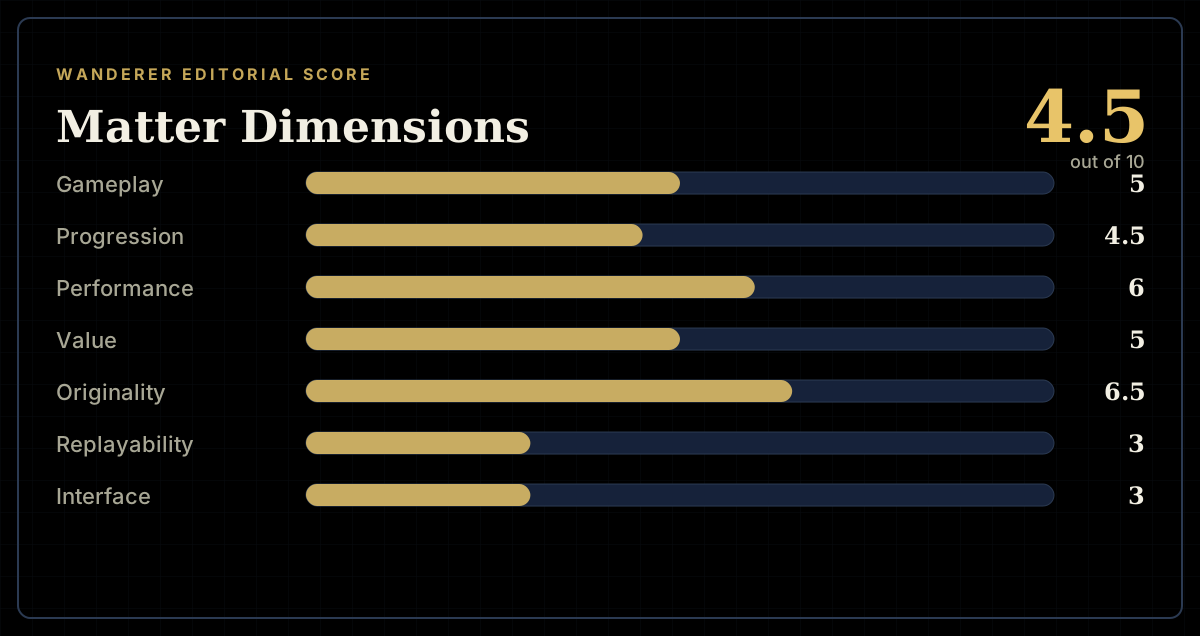
4.5 / 10
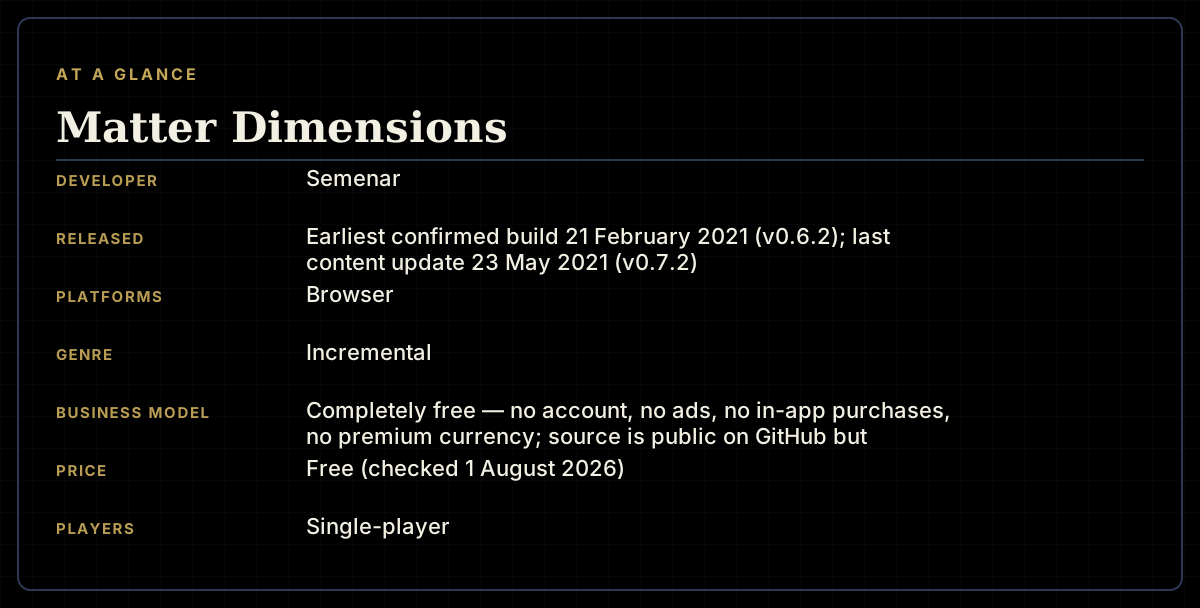
- Developer
- Semenar
- Publisher
- Semenar (self-published)
- Released
- Earliest confirmed build 21 February 2021 (v0.6.2); last content update 23 May 2021 (v0.7.2)
- Platforms
- Browser
- Genre
- Incremental
- Monetisation
- Completely free — no account, no ads, no in-app purchases, no premium currency; source is public on GitHub but carries no formal licence
- Players
- Single-player
The short version
Matter Dimensions takes a real idea from the Antimatter Dimensions modding scene — the "hardcore" challenge mods that stack punishing restrictions on top of the base game — and makes that gauntlet the actual premise instead of an optional extra. Layers named for particles and fields instead of "Infinity" and "Eternity" pile numbered nerfs onto your production, and upgrades exist mainly to claw back what the nerfs took. It's a legitimately different framing of the genre's reset ladder, built by a solo hobbyist rather than copied wholesale from the game it's answering.
It's also finished changing five years ago. Development stalled at version 0.7.2 in May 2021, the Biological layer is the last thing the game ever shipped, and the developer confirmed in 2024 that the base project isn't being worked on. What's left is a real idea trapped in an unfinished, unstyled shell, sitting a few clicks away from the free, complete, actively maintained game it's riffing on.
Biggest strengths
- Bakes the "nerf gauntlet" that hardcore Antimatter Dimensions mods bolt on afterward directly into the base progression, instead of treating it as optional endgame content
- The Biological layer's population, mortality and extinction mechanics have no real equivalent in Antimatter Dimensions' own layer list
- A temperature-and-wavelength system tied to elemental unlocks gives the Atomic layer a genuinely different rhythm than a straight dimension-stacking loop
Biggest weaknesses
- Development stopped at version 0.7.2 in May 2021, and the developer told a would-be contributor in 2024 to fork the project elsewhere rather than expect further updates to the base game
- The Biological layer is the last thing the game ever shipped, so progression simply stops rather than building toward a capstone comparable to Antimatter Dimensions' Reality
- The interface is unstyled tabs and dense inline numbers with no tooltip layer explaining what a given nerf is actually doing to your production
Who it's for: Genre veterans who already know Antimatter Dimensions' dimension ladder cold and want to see someone rebuild it around deliberate restriction instead of open growth. Not a first incremental, and not for anyone who wants a finished arc.
Our recommendation: Free to play at semenar.github.io/matter-dimensions — worth an hour for the nerf premise alone if you already speak the genre's language, but go in knowing nobody is adding to it.
4.5 / 10
There's a specific subculture inside the Antimatter Dimensions community built entirely around making that game harder on purpose. Hardcore mods that slow down time, cap your storage, and throttle every dimension tier you haven't earned back — restrictions the base game never asks for, piled on by players who finished it and wanted the fight to keep going. Matter Dimensions takes that subculture's whole premise and ships it as a standalone game: instead of a normal incremental you can optionally hardcore-mode later, every layer here comes pre-loaded with numbered "nerfs," and most of what you unlock exists to buy some of that punishment back off. It's a clever thing to notice and build around. It's also a game that stopped being built five years ago.
What it actually is, and who made it
Matter Dimensions is the work of one developer using the handle Semenar — a hobbyist who has also shipped a handful of other original incrementals (Dark Forest Village, The Ascension Tree, the multiplayer experiment Battle of Incrementals) and maintains a community directory of incremental game Discord servers. There's no studio, no publisher, and no formal relationship to Hevipelle or the official Antimatter Dimensions team. The game's own description is precise about the connection and worth taking at face value: it calls itself "a slow-paced incremental game inspired by hardcore mods for Antimatter Dimensions," not a copy or a licensed spin-off of the game itself. The code backs that up — it's an independent vanilla-JavaScript build with its own layer names, its own resource math and its own mechanics, not a fork of Antimatter Dimensions' own codebase. Several other, much smaller projects on GitHub genuinely are line-for-line learning copies of Antimatter Dimensions; this isn't one of them. It's a tribute built from scratch around a specific idea taken from that game's fan scene, which is a meaningfully different and more defensible thing than a reskin.
That distinction matters for the verdict, because "inspired by a mod culture" is a much smaller, more honest claim than "the next Antimatter Dimensions" — and it's the one the game actually earns.
The nerf is the point
Matter Dimensions renames Antimatter Dimensions' Infinity-Eternity-Reality ladder into physics-flavoured layers — Photonic, Gravitonic, Neutronic, Vacuumic, Dimensional, Atomic, Biological — and that renaming alone would be cosmetic. What isn't cosmetic is the challenge system sitting underneath it. Every layer's challenges apply one of eleven numbered "nerfs" to your production: some slow the game's internal clock, some shrink how much you can store, some throttle higher dimension tiers specifically. Upgrades scattered through every layer exist largely to reduce a specific nerf's strength, which turns the entire upgrade tree into a running negotiation with restrictions the base game imposed on you rather than a straightforward stack of multipliers. That's a real structural choice, not a skin, and it's the one idea here our Antimatter Dimensions review doesn't really have an equivalent for — Antimatter Dimensions' challenges are optional detours with their own rules; Matter Dimensions makes fighting the challenge condition the whole game.
The Atomic and Biological layers push further from the source material than the nerf system alone does. Atomic introduces a temperature mechanic driven by blackbody radiation math, unlocking infrared through X-ray wavebands and a periodic-table-style element collection running from hydrogen up through silicon. Biological adds population growth, a mortality rate, and an extinction mechanic that trades a sacrificed population for a permanent multiplier. None of that exists in Antimatter Dimensions in any form, and it's a genuinely different kind of resource math than dimension-stacking — closer to a small ecology simulation bolted onto an incremental than another reset-and-multiply layer. Whether it's fun is a separate question from whether it's original, and on originality specifically, Matter Dimensions clears a bar most fan tributes never approach.
Where it stops, and why that's not a small problem
Here's the part the premise can't cover for: Biological is also the last layer the game ever got. The changelog runs cleanly from v0.6.2 in February 2021 through v0.7.2, "Experiments Update," in May 2021, and then it just ends. A would-be contributor opened an issue in mid-2024 proposing a revival; Semenar's reply was polite and clear — fork it and build your own version, get in touch over Discord if you want it hosted alongside the original, but the base game itself isn't getting more work. That's about as direct a confirmation of abandonment as a solo dev project gets, and it puts Matter Dimensions in a different category from something like The Prestige Tree, which at least reaches a defined ending before its developer moved on. Matter Dimensions never built a capstone layer at all — no Reality-style meta-structure, no final puzzle boss, nothing that reads as an intended stopping point rather than where the commits ran out. The pacing question that opens every fan incremental review — does this front-load and thin out — doesn't really apply here, because there wasn't enough runway left to thin out. It just stops.
The code shows its age in smaller ways too. An open issue filed against the game's own repository flags its central challenge-power function as doing far too much in one place, which tracks with what's visible reading it — nerf calculations, achievement bonuses and experiment effects for eleven separate systems all threaded through one function. None of that is a player-facing bug by itself, but it's a sign of a codebase that outgrew its own plan and never got the pass that would have fixed it.
Interface and the free price tag
There's no visual identity here worth discussing — tabbed panels, dense number columns, a settings menu, the same skeleton Antimatter Dimensions itself uses without that game's decade of iteration behind it. Nerf effects are described in code comments, not in the interface a player actually sees, so understanding what "Nerf 5" is doing to your run means either careful trial and error or reading the source directly. It's playable in any browser and asks nothing of the hardware running it, which is the one interface virtue it does earn. On price there's nothing to weigh: no account, no currency, no ads, source published openly with no licence attached restricting it. That generosity is real, but it doesn't offset an interface that never got the pass the mechanics deserved.
The most interesting thing about Matter Dimensions' afterlife isn't in the game at all — it's the loose scatter of forks and renamed copies other hobbyists have built from its published source, including at least one, Exotic Matter Dimensions, that's still receiving updates years after the original stopped. Matter Dimensions functions less as a finished product at this point and more as a starting template a small corner of the incremental-games community keeps picking back up.
Verdict
4.5 out of 10. The nerf-gauntlet premise is a real contribution to the genre's vocabulary, built independently rather than copied, and the Atomic and Biological layers do things Antimatter Dimensions itself never attempted. None of that changes the fact that the game stops mid-thought, was confirmed abandoned by its own developer in 2024, and wraps its ideas in an interface that never explains itself. Play it for an hour if the specific idea of "what if the hardcore mod was the base game" is one you haven't seen executed before — it's free, and it won't cost you more than that hour to find out whether the concept lands for you. Don't expect it to hold up as a full incremental against the game it's answering; Antimatter Dimensions is still free, still finished, and still being maintained, which is the comparison Matter Dimensions can't win no matter how clever its central idea is.
Price and monetisation details checked 1 August 2026.
Pros and cons
Pros
- Bakes the "nerf gauntlet" that hardcore Antimatter Dimensions mods bolt on afterward directly into the base progression, instead of treating it as optional endgame content
- The Biological layer's population, mortality and extinction mechanics have no real equivalent in Antimatter Dimensions' own layer list
- A temperature-and-wavelength system tied to elemental unlocks gives the Atomic layer a genuinely different rhythm than a straight dimension-stacking loop
- Completely free, with no account, no ads and nothing resembling a purchase anywhere in the client
- Source is public on GitHub, which is exactly how a small ecosystem of other hobbyist "Dimensions" clones learned to build their own
Cons
- Development stopped at version 0.7.2 in May 2021, and the developer told a would-be contributor in 2024 to fork the project elsewhere rather than expect further updates to the base game
- The Biological layer is the last thing the game ever shipped, so progression simply stops rather than building toward a capstone comparable to Antimatter Dimensions' Reality
- The interface is unstyled tabs and dense inline numbers with no tooltip layer explaining what a given nerf is actually doing to your production
- An open, developer-filed issue on the game's own repository notes that its central challenge-power function "is doing too much," and the code has visibly outgrown its structure in places
- The name and premise invite constant comparison to a free, far more polished, currently maintained original that most players searching for it will already have tried
Screenshots
-
How the review scores each part of the gameWanderer Editorial -
The game at a glanceWanderer Editorial -
The short versionWanderer Editorial