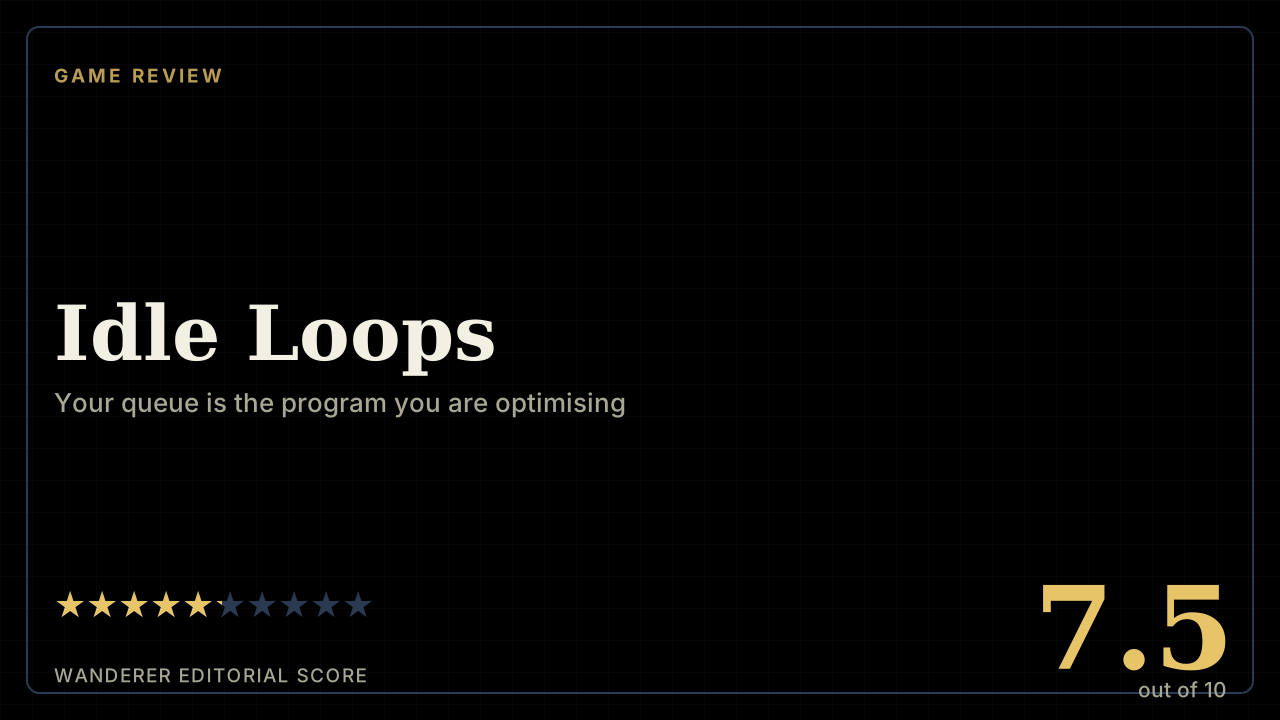
Game review
Idle Loops
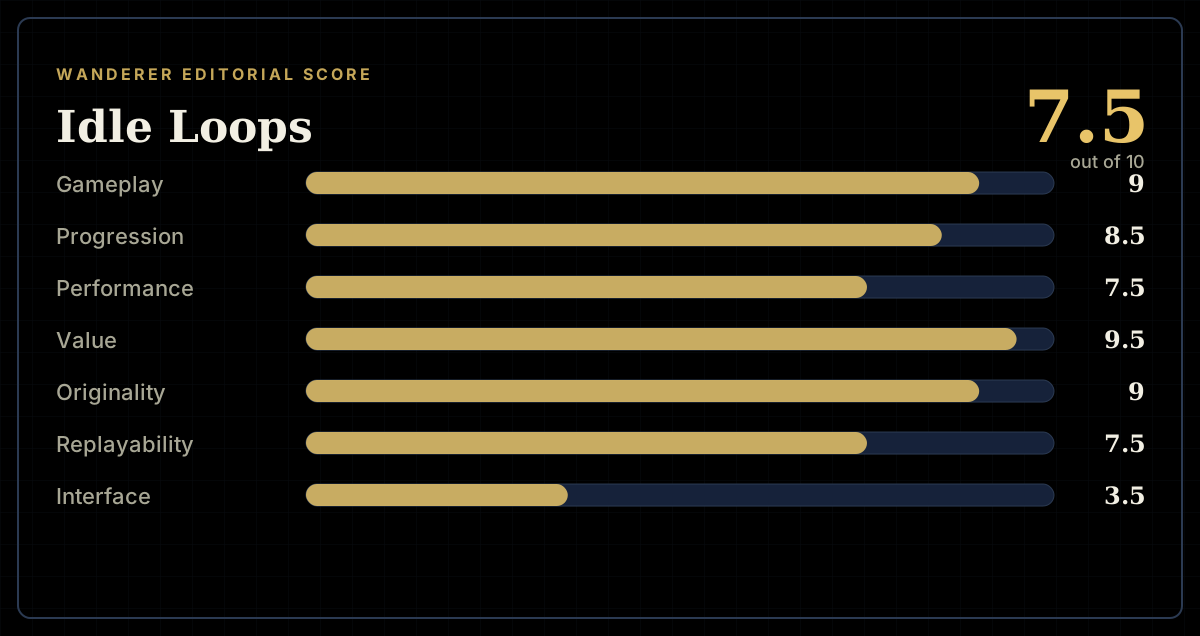
7.5 / 10
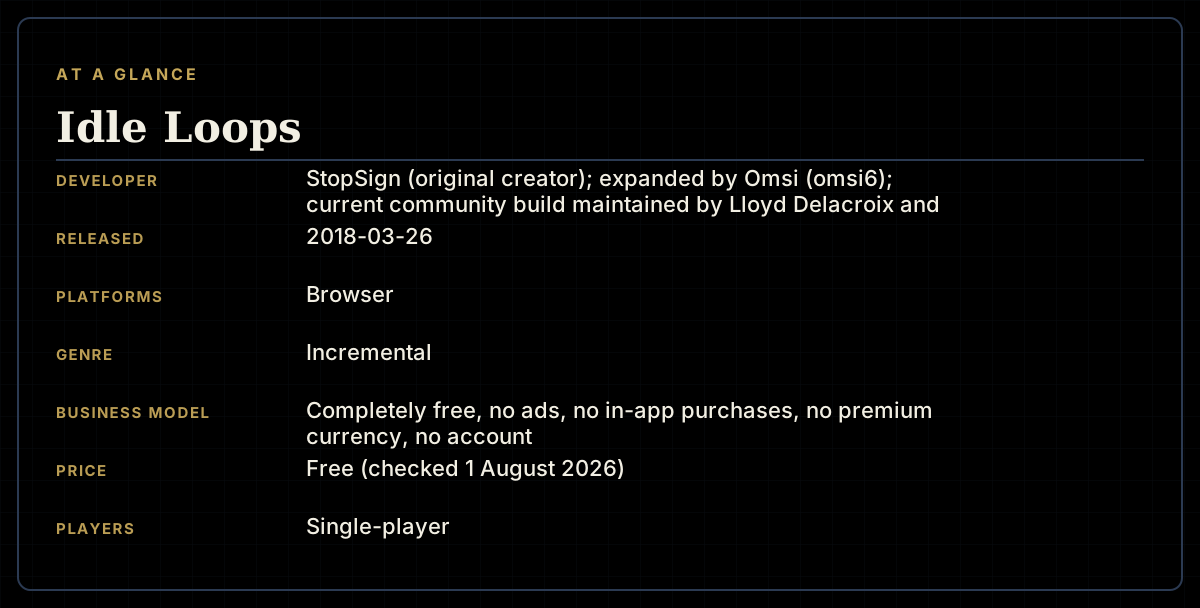
- Developer
- StopSign (original creator); expanded by Omsi (omsi6); current community build maintained by Lloyd Delacroix and contributors
- Publisher
- StopSign
- Released
- 26 March 2018
- Platforms
- Browser
- Genre
- Incremental
- Monetisation
- Completely free, no ads, no in-app purchases, no premium currency, no account
- Players
- Single-player
The short version
Idle Loops asks you to write a program, not play a game in the usual sense. Every attempt hands you a fixed mana budget and an empty queue; you fill that queue with actions in advance, hit go, and watch the loop execute exactly what you told it to, mistakes included. Skills and knowledge earned during a run persist afterward, so the next queue reaches further before mana runs dry. It's a genuinely important piece of incremental design — the queue-and-persistence loop other games have since built entire identities around started here, or at least got its clearest early demonstration here.
The catch is that the game asks a lot of you before it gives much back. There's no art, almost no onboarding, and the difference between a queue that clears a zone and one that wastes half its mana idling is invisible until you've either done the arithmetic yourself or found someone else's. Three different maintainers across roughly a decade have kept it alive without ever quite finishing it, and the game you land on today depends entirely on which fork you pick.
Biggest strengths
- The action queue turns planning into the actual gameplay, with no clicking or reflexes required once a loop starts
- Skill and knowledge persistence across resets means every failed attempt still buys real, permanent progress
- Multiple saved loadouts let you keep several tuned queues on hand rather than rebuilding one from scratch each time
Biggest weaknesses
- The interface is unstyled menus, numbers and tooltips with no visual feedback beyond progress bars
- Nothing in the game explains what a good queue looks like, so early progress depends on trial, error, or finding someone else's build order
- The most actively developed community fork hasn't had a merged commit in years, and the original creator's attempted sequel stalled mid-development
Who it's for: Players who enjoy optimisation puzzles more than they enjoy games, and who don't mind an interface that looks like a debug console. Bitburner and Increlution players will feel at home immediately; anyone who wants art direction or narrative should look elsewhere.
Our recommendation: Play the community-maintained fork at lloyd-delacroix.github.io/omsi-loops rather than the original — it has years more content built on top of the same core loop, and it's the version the game's own descendants point back to. Budget patience for the first hour; nothing explains itself.
7.5 / 10
The queue is the entire game
Most incrementals let you click, then let you stop clicking once you've bought enough automation to click for you. Idle Loops skips the clicking altogether. You start an attempt with a skill set carried over from every previous attempt and a pool of mana that only ever goes down. Before the loop begins, you build an ordered list of actions — gather wood, brew a potion, fight in the arena, meditate to raise a stat — each with its own mana cost, and then you press go. The loop runs your list from top to bottom, spending mana until either the list finishes or the mana does, and then it stops. You don't play the attempt. You wrote it, in advance, and then you watched it execute.
That's not a metaphor for programming, it's just programming with a friendlier surface. Skills like Mana Sense and Mana Control level up specifically because managing your budget accurately is the skill the game is testing, and options like "keep current list active" and "repeat last action" exist because chaining loops into a longer automated sequence is a normal, expected way to play. The action list itself even ships with a running total of mana spent so far, because the real unit of feedback in this game isn't "did that look cool," it's "did the arithmetic work." Anyone who has debugged a script by staring at where the numbers stopped matching their expectations will recognise the exact rhythm Idle Loops runs on.
What actually makes a good queue
The optimisation pressure comes from three things stacked on top of each other: the mana cost of each action, the diminishing or escalating returns of doing that action repeatedly, and the fact that some actions only become efficient once a stat or skill has crossed a threshold you can't see without either testing it or predicting it. A queue that dumps early mana into cheap, low-value actions to grind a stat past its threshold, then spends the remaining budget on the now-cheaper high-value action, will comfortably out-loop a queue that just does the "obvious" high-value action from the start. None of that is explained anywhere in the interface. You either work it out with a spreadsheet of your own, or — more commonly, given how the community has actually behaved — you lean on someone else's tooling.
And there is real tooling. A browser userscript called the IdleLoops Predictor rebuilds the game's own tick logic in miniature so it can show you, action by action, exactly how much mana, gold and reputation a queue will produce before you run it — its own documentation describes it as "a simplified, barebones rebuild of the game loop." Multiple other repositories exist purely as build-order optimizers. That's the quieter half of what makes this a programming game rather than a clicking one: a meaningful slice of the actual skill expression has moved outside the game entirely, into scripts written against its own rules.
Progress that survives the reset, on purpose
The genre's usual prestige loop resets everything and hands you one multiplier as compensation. Idle Loops does something structurally different: nothing resets on its own terms. Skills, once raised, stay raised — the game's own tooltips say so outright, flagging skill and buff panels as not resetting when you restart a loop. What ends is only the current attempt's mana pool and whatever temporary state you built up spending it. The next attempt starts with a permanently better version of your character and an empty queue you get to fill more ambitiously than last time. It's less "prestige for a multiplier" and more "each attempt is a training rep that never gets undone," which makes failure genuinely low-stakes in a way most incrementals only pretend to offer — you can't lose a run in Idle Loops so much as spend it slightly less efficiently than the next one.
Increlution, this site's other recent look at a queue-driven incremental, takes the opposite emotional bet on the same basic idea. There, every attempt ends in a scripted, inevitable death, and what survives is a smaller permanent version of what you earned — the game wants you to feel the clock the whole time. Idle Loops has no ticking mortality attached to its loop at all; the only thing forcing an attempt to end is running out of mana, which is a resource you're optimising against rather than a fate you're racing. Play both back to back and the contrast is sharper than either review manages alone: Increlution turns resets into a story about death, Idle Loops turns them into a story about better tooling.
The wiki problem, and why it isn't really a flaw
Idle Loops rewards outside knowledge more than in-game intuition, almost by design. The interface tells you costs and current totals; it does not tell you which threshold unlocks which discount, or which zone wants a completely different queue shape than the one that worked for the last three. Games built this way usually get accused of outsourcing their difficulty to a wiki, and that accusation would land here too — except the game's own systems assume you'll eventually build the tooling yourself. The predictor script isn't a workaround for bad design; it's the same simplified rebuild of the loop logic a competent player would eventually write in their head anyway. The game is teaching you to model a system well enough to predict it, and the community tools are just that lesson finished by someone else first. Whether that's the point or the flaw depends on whether you came here to think or to be told what to think, and Idle Loops makes no attempt to hide which one it expects. Bitburner pushes the same idea one step further by handing you an actual scripting language instead of a queue UI, which makes a useful yardstick: Idle Loops is what "the player writes the program" looks like when the programming language is a list of menu items, rather than JavaScript.
Presentation: none, on purpose
There is no art direction to evaluate. Idle Loops is unstyled HTML — menus, progress bars, plain text tooltips, a handful of icons for sorting and repeating actions. Numbers update, bars fill, and that's the full visual vocabulary the game has. For a design built entirely around reading exact figures, that's a defensible choice rather than an oversight — a game about precise arithmetic doesn't need a mascot. It does mean the interface offers nothing but friction to anyone who isn't already sold on the arithmetic, and there's no mobile layout at all, a real loss for a genre that usually travels well in a phone browser. Judge it as an interface and it's near the bottom of anything this site has reviewed; judge it as a data-entry tool for the system underneath, and it does exactly its job.
Three maintainers, one unfinished game
Idle Loops has never really shipped a "finished" version, and its history explains why. StopSign built the original, still playable at its first home and largely untouched since 2018. Omsi (omsi6) built a substantially expanded fork with far more content, hosted separately, and that fork's own history goes quiet after mid-2020. The version most actively touched by outside contributors is a community continuation of Omsi's build, maintained by Lloyd Delacroix with close to twenty other contributors merging fixes and small features — and even that build's most recent merged work dates back several years, not months. StopSign has since started a would-be sequel in the same personal repository, but it never reached a public, playable state and the commit history goes quiet mid-project. None of the three builds has been taken down — they're all still live and playable — but none is being actively pushed forward either. What you get today is the most complete version of an idea that stopped growing a while ago, spread across three people's unfinished contributions rather than one continuous project.
Influence, stated carefully
Idle Loops is often waved at as an ancestor of the queue-based incremental subgenre, and that claim deserves more precision than a gesture. The clearest, directly citable case is wrtsc, a newer time-loop incremental whose own documentation states it is "heavily inspired by Idle Loops," built around the same pick-a-set-of-actions-per-iteration structure, and explicitly recommends playing Idle Loops first for "something complete-ish with the same gameplay concepts." That's a straight line, acknowledged by the borrowing developer rather than assumed by a reviewer. The wider pattern — a fixed per-run budget, a queue built in advance, permanent skill carryover between attempts — has become common enough across the genre that it reads like a shared vocabulary now rather than a single game's fingerprint, and readers should treat any specific title-to-title lineage claim beyond wrtsc's own admission as informed speculation rather than settled fact.
Verdict
Seven and a half out of ten. Idle Loops earns that score on the strength of one genuinely excellent idea, executed with more rigor than polish: an action queue that turns planning into the entire gameplay loop, backed by permanent skill carryover that makes every attempt count even when it fails. That's a real contribution to how this genre thinks about progression, and it's easy to see why later designers borrowed the shape of it. Value is straightforward to settle, at least — free, ad-free, account-free, and never monetised across any of its three builds — but that isn't graded on a curve here; a free game with a hostile interface and no onboarding is still asking a real amount of a player's patience, just not their money.
What keeps the score from climbing higher is everything around that central idea — an interface that offers no help understanding its own systems, a mid-game that all but requires outside tooling to navigate efficiently, and a project history spread across three separate, each individually unfinished efforts rather than one game anyone is still actively pushing forward. Play it if the appeal of "plan a program, watch it run, refine it" sounds like a Saturday well spent. Skip it if you need the game to teach you how to win before it asks you to. Players who like progression that keeps compounding quietly while they're not actively managing it may find a gentler cousin of that same idea in Wanderer.
Availability and repository details checked 1 August 2026.
Pros and cons
Pros
- The action queue turns planning into the actual gameplay, with no clicking or reflexes required once a loop starts
- Skill and knowledge persistence across resets means every failed attempt still buys real, permanent progress
- Multiple saved loadouts let you keep several tuned queues on hand rather than rebuilding one from scratch each time
- Completely free with no account, no ads and no monetisation of any kind to evaluate
- A real, if scattered, ecosystem of fan predictors and rebalance forks shows how deeply players have engaged with the underlying system
Cons
- The interface is unstyled menus, numbers and tooltips with no visual feedback beyond progress bars
- Nothing in the game explains what a good queue looks like, so early progress depends on trial, error, or finding someone else's build order
- The most actively developed community fork hasn't had a merged commit in years, and the original creator's attempted sequel stalled mid-development
- Mid-game zones demand queues precise enough that a single misordered action can waste an entire attempt's mana
- No mobile-friendly layout and no touch support, despite being a browser game that would otherwise travel well
Screenshots
-
How the review scores each part of the gameWanderer Editorial -
The game at a glanceWanderer Editorial -
The short versionWanderer Editorial