
Game review
Scratch Inc.
6.5 / 10
- Developer
- Makopaz
- Publisher
- Makopaz
- Released
- 17 September 2025
- Platforms
- Windows, macOS
- Genre
- Incremental
- Monetisation
- Free to play with optional in-app purchases. No ads and no wait timers. A premium Gold currency is sold and is also earned in-game; players describe it as a speed-up, not a gate.
- Players
- Single-player with global leaderboards
The short version
Scratch Inc. is free, ad-free, timer-free, and people play it for hundreds of hours — the median playtime among its hundred most-helpful positive reviews is **91 hours**, and its most-upvoted positives are from players at 706 and 724 hours. That is not a game nobody likes.
It is also a game whose 91% score comes with a footnote that the players themselves keep raising. There is an achievement whose internal name is **"Reviewed"**, held by **40.0% of everyone who owns the game**, and the two most-upvoted negative reviews in the corpus are about it. Add a prestige structure that strips your automation every layer, an "idle" label the design doesn't earn, and the fact that long-time reviewers openly call it a reskin of the developer's earlier games, and 6.5 is where it honestly lands.
Biggest strengths
- Genuinely free — no ads, no wait timers, no energy meter, nothing gated behind payment
- The automation ladder is deep and the numbers scale enormously
- Hundreds of hours of content, plus New Game+ layers for people who finish it
Biggest weaknesses
- An in-game achievement is tied to the Steam review page, which makes the score hard to read
- Every new prestige layer takes your automation away and makes you re-earn it
- The store calls it idle; multiple long-playtime reviewers say idling is actively punished
Who it's for: Incremental veterans who want a very long free progression ladder to run on a second monitor and don't mind clicking. Anyone hoping to actually leave it idling should look elsewhere.
Our recommendation: It costs nothing, so the only thing you're risking is time — and this one asks for a lot of it. Give it two hours. If you're still enjoying the scratch-and-buy rhythm after the first prestige, you'll probably be there for a hundred more.
6.5 / 10
Pull the global achievement percentages for Scratch Inc. and forty-three entries come back. They descend the way you'd expect for a long incremental — 93.4% at the top, 5.9% at the bottom, a long smooth tail as the prestige layers thin the herd. Sitting at 40.0%, roughly in the middle, is one with the internal name Reviewed.
Two of the three most-upvoted negative reviews in the entire corpus are about that achievement. The top one, at 70 votes, is a single sentence: making a "rate the game" achievement sucks. The second, 41 votes from a player with 32.8 hours, says you get rewarded for reviewing. A 187-hour reviewer goes further and argues the consequence out loud — that the Steam rating is inflated because the game rewards you for visiting the review page before the slog sets in.
I want to be careful about what's actually established here, because it matters. What I can confirm is that the achievement exists, that its name is Reviewed, and that 40% of everyone who owns the game has it. What players describe is a button in-game that opens the Steam review page and grants an achievement — and, since this game attaches Gold and multipliers to achievements, an in-game reward along with it. At least one reviewer says the button only requires visiting the page rather than posting anything. Valve's rules for developers don't allow offering rewards in exchange for reviews; whether a click-through prompt crosses that line is not something a review corpus can settle, and I'm not going to pretend otherwise.
What I will say is what it does to the number at the top of the store page. A 91% score on 2,033 reviews normally means something specific. Here, a chunk of the population that wrote those reviews was standing in front of an in-game reward when it decided to. Read the badge accordingly. There is a counterweight worth knowing too: 40% is mid-curve, not near-universal, so this isn't every owner being funnelled through a prompt in the first ten minutes. And the most-upvoted positive review on the subject is from a player who complained about it, was contacted by the developer, felt bad, and came back to write a real one. Solo developers make judgement calls; this looks like a bad one rather than a cynical one.
What the game actually is
The best description in the whole corpus comes from a 724-hour player who opens by saying the reviews are useless and then fixes it: this game is not about scratchies. The scratch card is a skin over an image-reveal mechanic. You drag the mouse to expose a grid of tokens, matching tokens multiply your income, income buys upgrades, upgrades buy a bigger grid and faster reveals, and eventually buy the auto-scratcher that does the dragging for you.
Then you prestige into stores, then corporations, then planets, then New Game+. Each layer is a new container for the same loop with a wider multiplier ceiling.
That structure is the source of both the engagement and the complaints. Deep prestige laddering is a respectable design — it's what Antimatter Dimensions and The Prestige Tree are built on. The difference is what those games let you keep. Here, "prestige" appears in 15 of the 100 most-helpful negatives and the specific grievance is consistent: each new layer resets you to the bottom and takes your automation with it, so you spend the first stretch of every layer manually redoing work the game had already agreed you never needed to do again. A 287-hour reviewer put it plainly — you should be able to keep quality-of-life upgrades through a prestige, and you can't.
There's a related structural problem that a 958-hour player identified precisely: at the planet layer, the upgrade you're reaching for costs you so much automation that progress would arguably be faster if you simply refused it and let the game keep running. When declining the next tier is a viable strategy, the reset economy is upside down.
The idle problem
The store page and the genre tags say idle. Several of the highest-playtime reviewers say it isn't, and their objection isn't semantic. The game switches to a heavily reduced offline mode when it isn't in the foreground, and reviewers report that the offline calculation doesn't reflect the upgrades they actually own. One 1,586-hour player — the highest-playtime critic in the sample — calls it the worst balanced idle game they've played, because there's no phase where idling is rewarded and it still takes many hours to finish.
A 25 September 2025 patch fixed a background-throttling bug and one reviewer flipped to positive immediately, which says good things about the developer's responsiveness at launch. But complaints about offline calculation continue well past that, and the game's own store text ("Playable Offline") sets an expectation the design doesn't meet. If you want an incremental that genuinely accrues while you're gone, Melvor Idle and Unnamed Space Idle do it properly.
The interface compounds it. There's no buy-max button, so mid-to-late upgrade purchases mean clicking the same button hundreds of times in a row. A 499-hour reviewer says outright that you either accept that or get an autoclicker. In a game whose selling point is automation, having the purchasing stay manual is the one place the design forgot its own thesis.
Originality, and the elephant
Eleven of the two hundred most-helpful English reviews I read — six negative, five positive — name Pincremental, the developer's earlier pinball incremental, and several describe Scratch Inc. as the same skeleton with a new coat of paint. One traces the lineage back to a 2019 browser game called Idle Scratch-Off and reuses their own five-year-old review of Pincremental verbatim, noting it still applies. Another says roughly 90% of the upgrades are identical, "even in layout."
Reusing your own proven framework is legitimate and plenty of studios do it. But when a game's own supporters can't tell it apart from its predecessor, originality is not a category where it can score well.
The money
Everything else about the business model is clean, and that deserves saying. No ads. No wait timers. No energy. No account requirement. Gold, the premium currency, is sold and also earned, and the strong consensus across both camps is that nothing is locked behind it — one 170-hour player calls the shop a donation box, another at 174 hours specifically praises never being pushed to buy anything.
Two dissenting voices are worth recording. A 38-hour reviewer argues the grind is deliberately paced to make the speed-up look attractive, and a 1,455-hour reviewer calls the Gold prices too high for what the game is. Steam lists in-app purchases but publishes no prices, so I can't put a number against that. What I can say is that the free experience is complete and nobody in the corpus reports hitting a wall they had to pay through.
Where it ends up
Compare it to Space Rock Breaker, reviewed the same day: a NZ$4.79 incremental that lasts an evening, ends on purpose, and is finished by 85% of its buyers. Scratch Inc. is the opposite end of the genre — free, effectively endless, and finished by very few. Both are defensible designs. This one is harder to recommend because the length isn't earned by variety; it's earned by making you redo things.
6.5 out of 10. It's free, it's generous, it's clearly loved by people who've given it hundreds of hours, and the developer's instincts about progression pacing are good enough that the loop grips. But an idle game that punishes idling, a prestige system that confiscates automation, an interface that requires an autoclicker, and a store rating tangled up with an in-game reward add up to a score below its badge. If you want a free number-go-up ladder to run beside something else, it costs you nothing to find out. Just don't read that 91% as a straight verdict.
If a long progression ladder that keeps moving while you're actually away is what you're after, that's the problem Wanderer set out to solve.
Pros and cons
Pros
- Genuinely free — no ads, no wait timers, no energy meter, nothing gated behind payment
- The automation ladder is deep and the numbers scale enormously
- Hundreds of hours of content, plus New Game+ layers for people who finish it
- Runs on Windows and macOS, and got a fifteen-language translation pass
- Global leaderboards give the endgame something to aim at
Cons
- An in-game achievement is tied to the Steam review page, which makes the score hard to read
- Every new prestige layer takes your automation away and makes you re-earn it
- The store calls it idle; multiple long-playtime reviewers say idling is actively punished
- No "buy max" for upgrades, so late-game progress means hundreds of literal clicks
- Reviewers with high hours describe it as the same game as the developer's Pincremental in a new skin
- No public patch announcement since 30 November 2025, with save-corruption reports as recent as May 2026
Screenshots
-
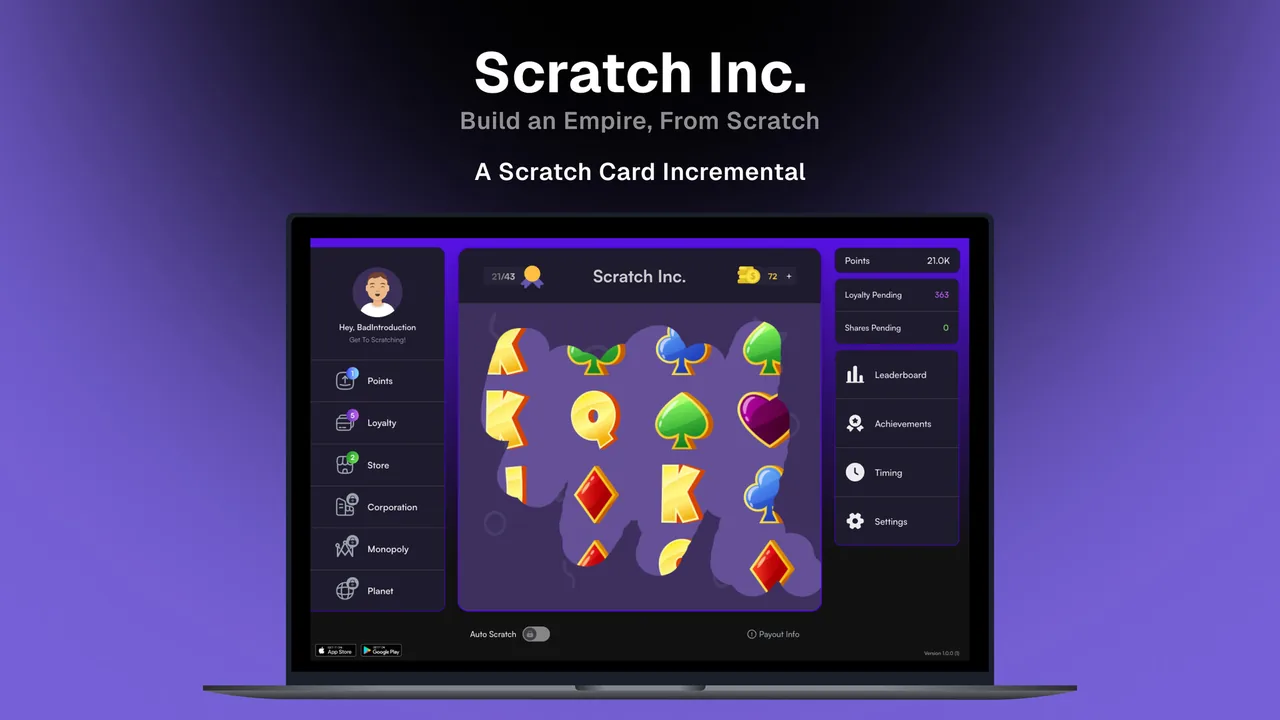
Scratch Inc.Image: Makopaz via Steam -
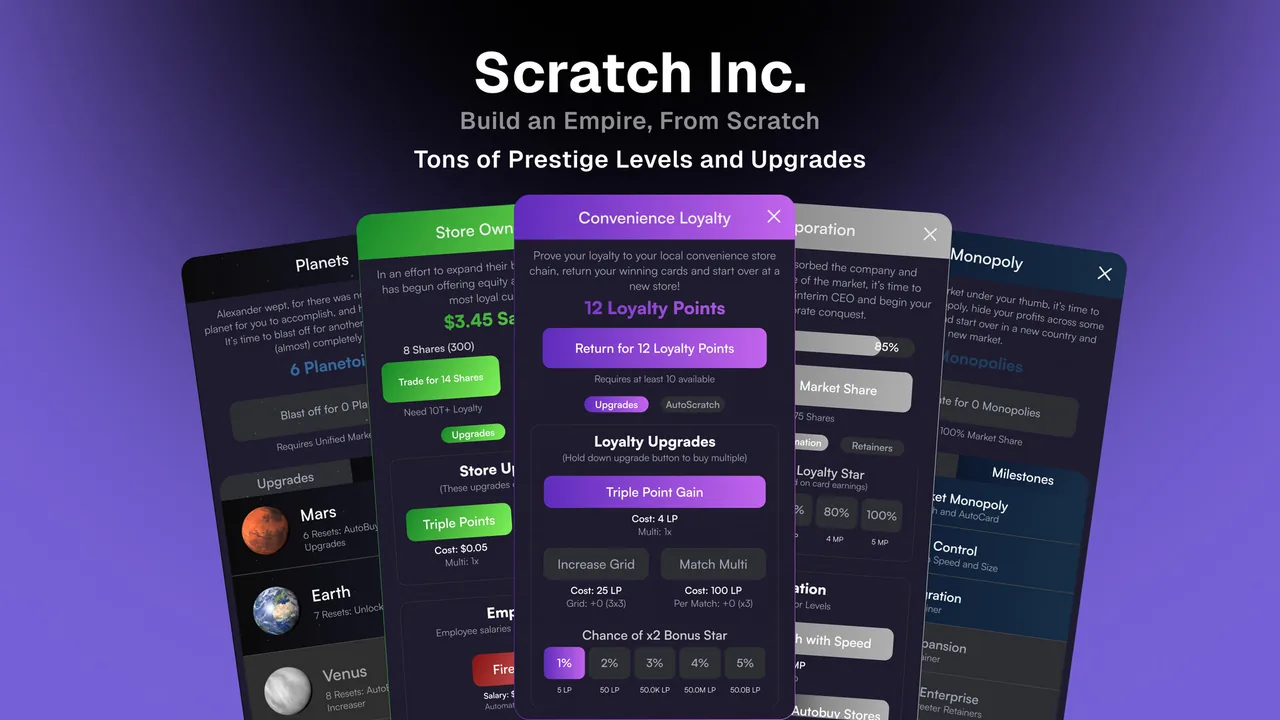
Scratch Inc.Image: Makopaz via Steam -
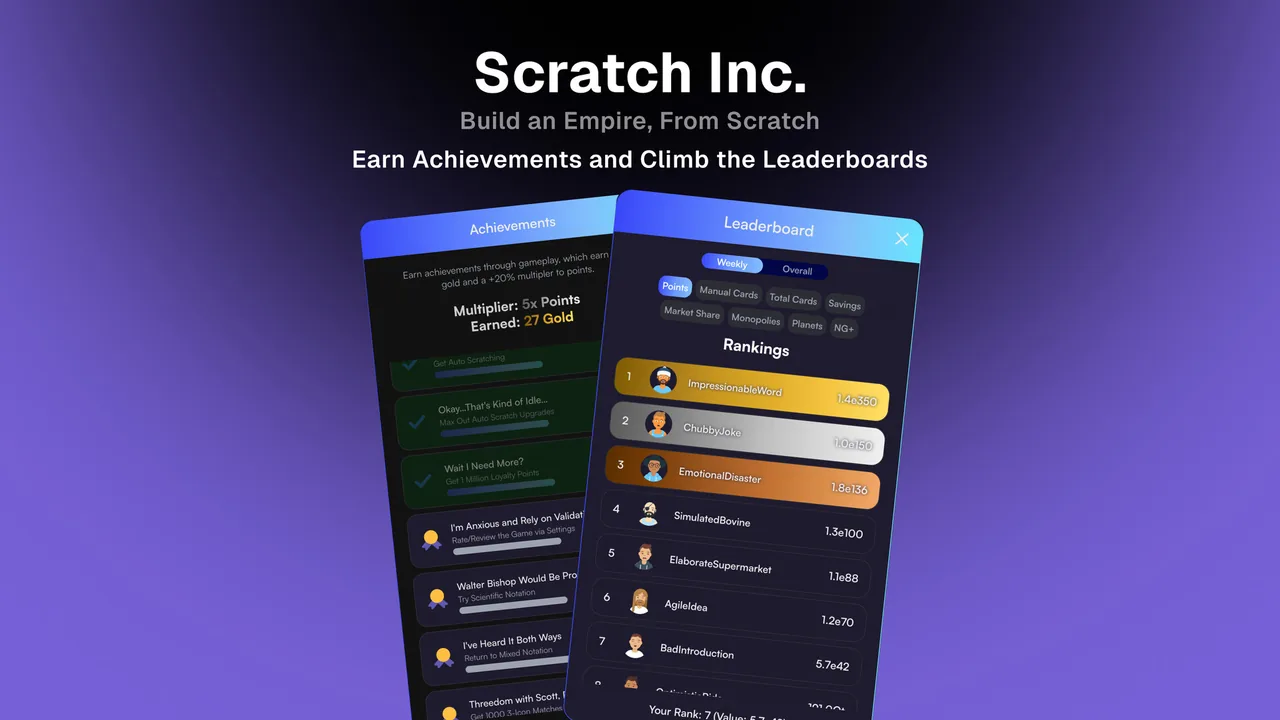
Scratch Inc.Image: Makopaz via Steam -
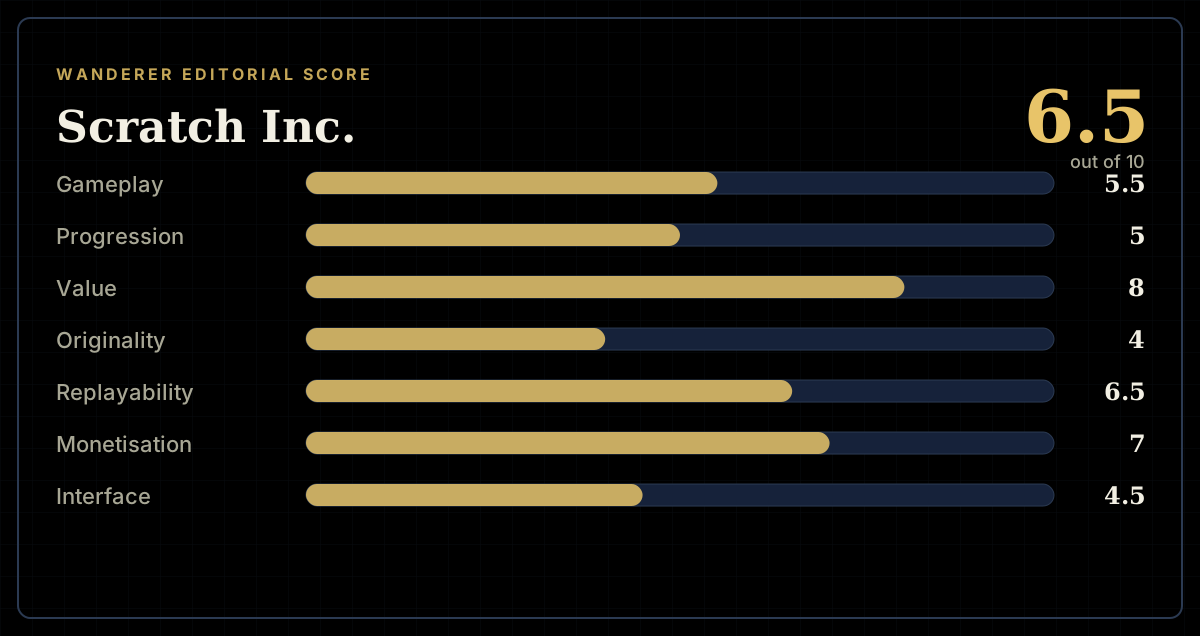
How the review scores each part of the gameWanderer Editorial -
The short versionWanderer Editorial