Game review
CryptoClickers: Crypto Idle Game
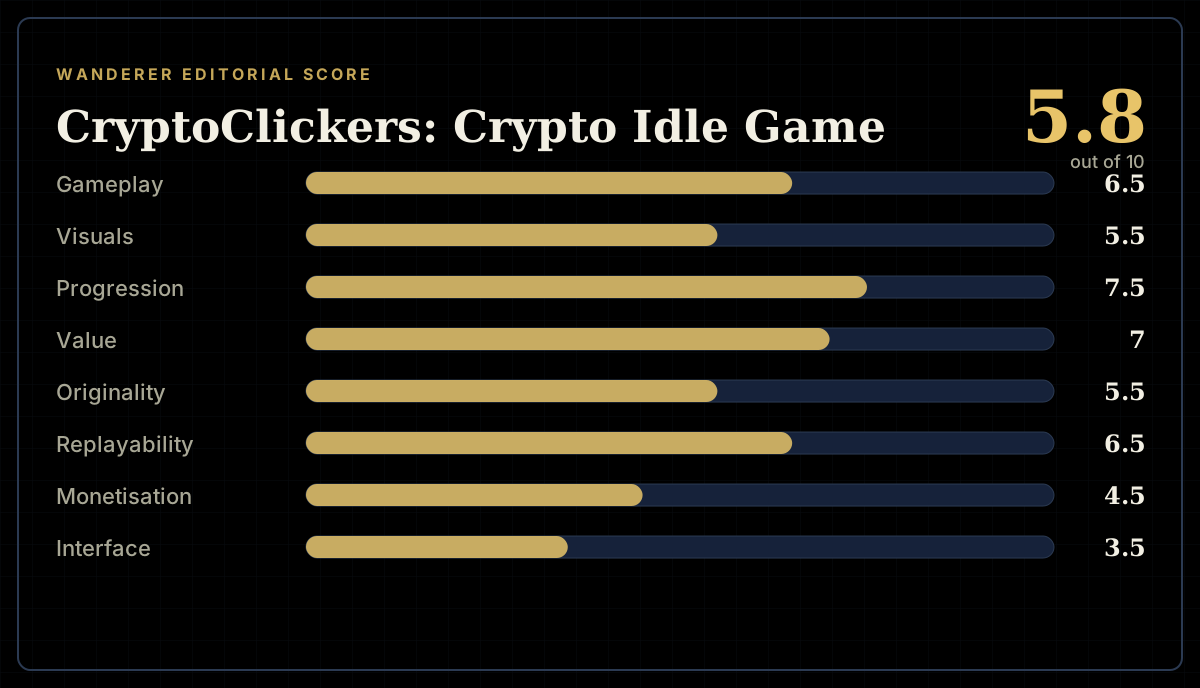
5.8 / 10
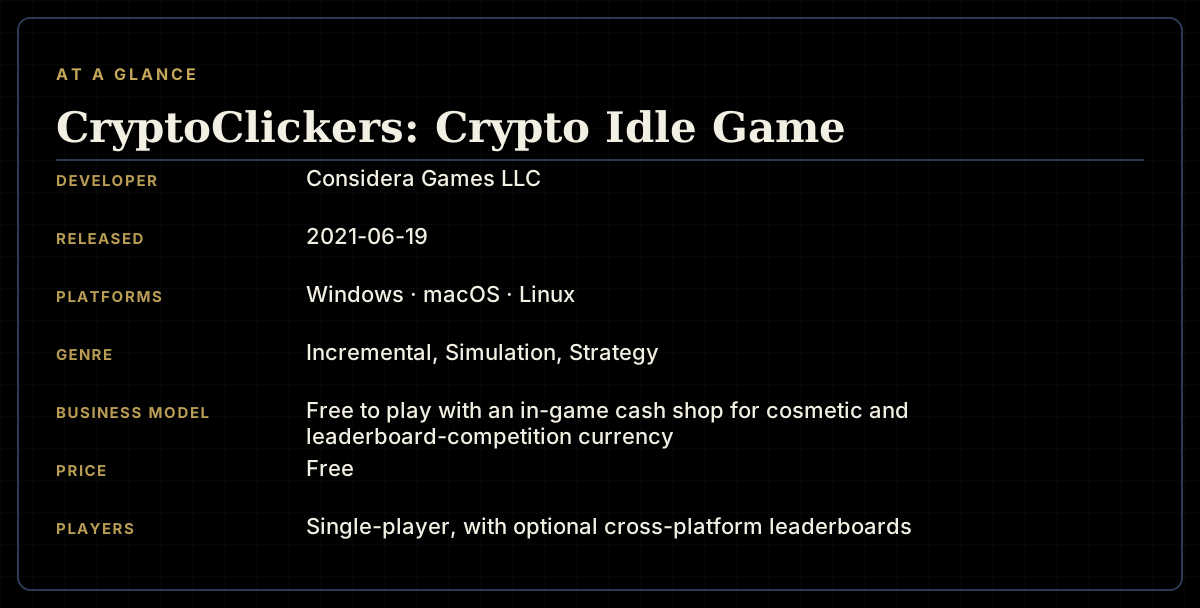
- Developer
- Considera Games LLC
- Publisher
- Considera Core LLC
- Released
- 19 June 2021
- Platforms
- Windows, macOS, Linux
- Genre
- Incremental, Simulation, Strategy
- Monetisation
- Free to play with an in-game cash shop for cosmetic and leaderboard-competition currency
- Players
- Single-player, with optional cross-platform leaderboards
The short version
CryptoClickers has real bones. Two full prestige layers, thirty-one distinct challenge modes split across an Ethereum and a Bitcoin track, and a stack of interlocking systems — Generators, Drones, Node, a "51% Attack" mode, Hacking, GPU farming — that give a dedicated player hundreds of genuine hours of number-go-up problem-solving. Steam's achievement data backs that up: over three thousand players cleared the early unlocks, but fewer than one in fourteen ever reached the mid-tier ones, which is exactly the shape of a game whose depth is real but whose ramp is brutal.
The problem is everything wrapped around that core. The interface throws jargon at new players with almost no in-game explanation, to the point that a recurring theme across negative reviews is being told to join the official Discord just to understand what a button does. Layered on top of that is a leaderboard economy that a chunk of the player base reads as predatory — a premium "time token" currency that expires before a normal week of play can use it up. Free progression is real and playable without spending a cent; competitive progression is not, and the game does not draw a clean enough line between the two.
Biggest strengths
- Two-layer prestige structure (Hardfork, then Grand Hardfork) gives long-term players a real reason to keep resetting
- Thirty-one challenge modes across two currencies add structured goals on top of the passive number-climbing
- Weekly rotating events (seven of them, hourly-repeatable) give returning players something new to chase
Biggest weaknesses
- The interface leans on unexplained jargon that the built-in tutorial doesn't cover, pushing players toward the developer's Discord to make sense of it
- A sharp early-to-mid difficulty spike turns five-to-twenty-minute challenges into week-long walls with little warning
- Cloud saves aren't handled through Steam; moving between devices means manually exporting and importing a save code
Who it's for: Incremental-genre veterans who already know the vocabulary (prestige layers, soft resets, exponential multipliers) and are willing to treat the tutorial as optional, plus anyone drawn specifically to the crypto-mining framing over Cookie Clicker's cookies or NGU's fists.
Our recommendation: Worth installing since it costs nothing, but go in expecting to either lean on the community Discord for the first hour or bounce off the UI entirely. Skip the leaderboard cash shop regardless of how the core game lands for you.
5.8 / 10
What CryptoClickers actually is
Strip away the theme and CryptoClickers is a fairly traditional double-currency incremental: click to generate a resource, spend it on generators that produce more of it automatically, and reset periodically for a permanent multiplier. The crypto-mining dressing sits on top of that skeleton rather than inside it — as one Steam reviewer with over 700 hours logged put it, the game "has little, in any kind of game-functional sense, to do with crypto currencies aside from using currency names." Ethereum and Bitcoin are the two prestige tracks; "Hardfork" and "Grand Hardfork" are what the genre usually calls a prestige reset and a meta-prestige reset. None of that is a criticism on its own — Cookie Clicker isn't really about cookies either — but it matters for setting expectations: this is not a simulation of mining economics, it's a number-go-up game that borrowed crypto vocabulary for flavour, released in mid-2021 near the peak of that particular cultural moment.
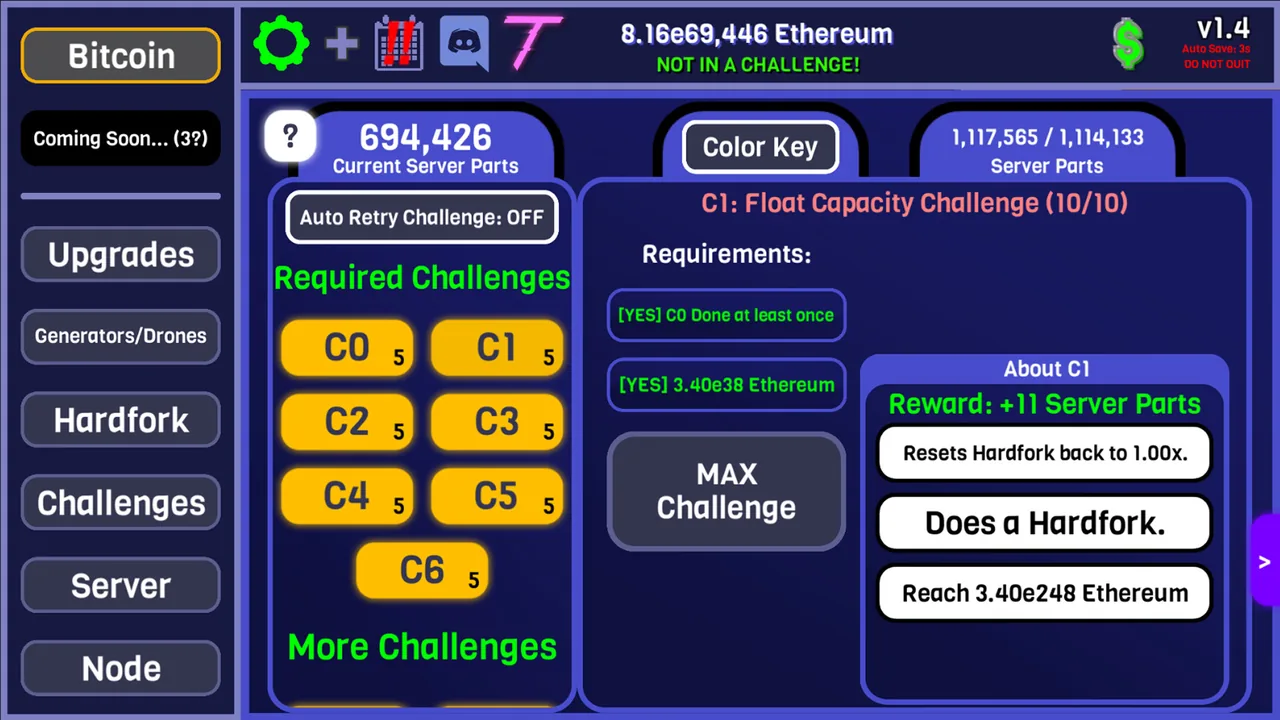
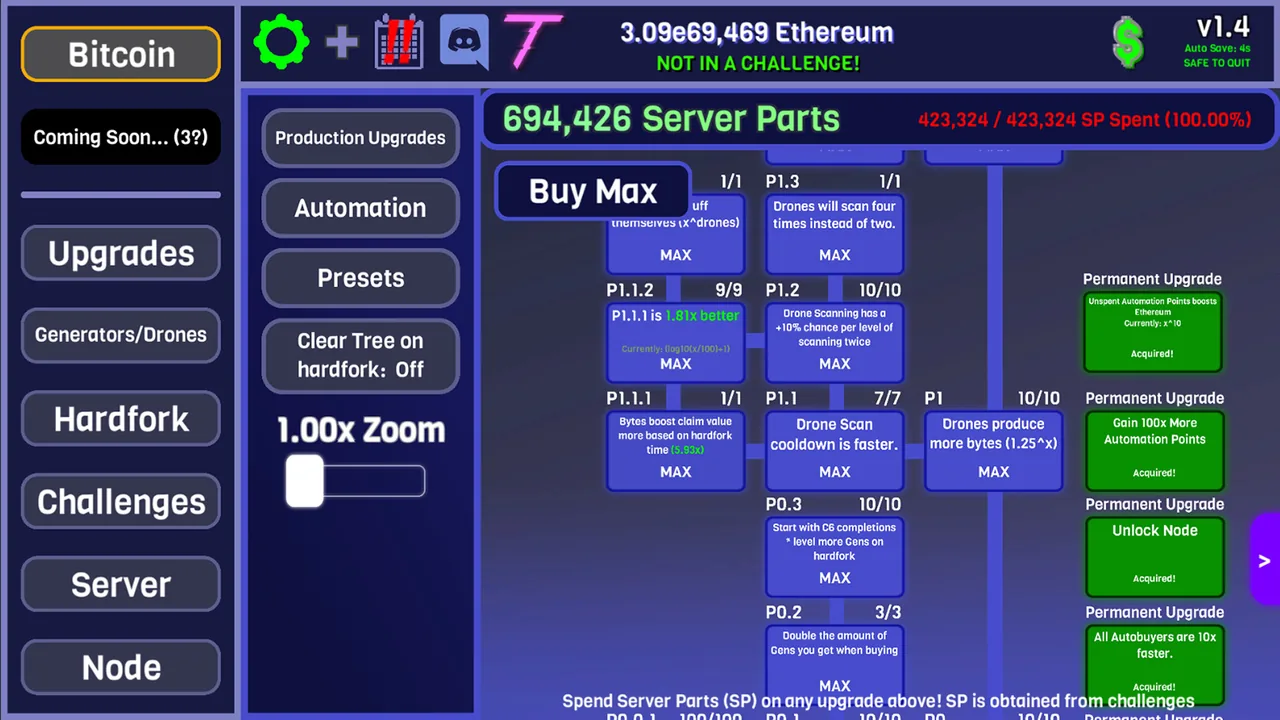
What's underneath the theme is more substantial than the average clicker. The store page lists Generators, Drones, a Node system, a "51% Attack" mode, Hacking and GPU farming as distinct mechanics layered across the two currencies, alongside two full upgrade trees — a Server tree spent with parts earned in Ethereum, and a BIT Upgrades tree spent in Bitcoin. On top of the passive climb sit thirty-one structured challenges: twenty-one in Ethereum that reward the Server parts currency, and ten Bitcoin speedrun challenges with their own reward loop. That's a genuinely large surface area for a genre where a lot of competitors are one currency and one prestige layer deep.
The double prestige loop is the real pitch
The two-tier reset structure is where CryptoClickers earns the most credit. A single prestige layer is standard for the genre; stacking a second layer on top, where the first layer's endgame currency (Server parts from clearing Ethereum's challenges) feeds into unlocking the second layer's mechanics in Bitcoin, gives long-term players a reason to keep engaging well past the point where a simpler clicker would run out of ideas. One reviewer who logged over 43,000 minutes — north of seven hundred hours — described it as having "multiple layers of depth, a number of interlinked levels that need to be opened up, all with good help/explanation and some even come with tips," which reads as a direct rebuttal to the onboarding complaints below: once a player is past the wall, several say the systems do eventually explain themselves.
Weekly events add a second axis of things to chase. Seven rotating event types reset every week and can reportedly be repeated hourly, which is a reasonable way to give returning players a short-session reason to log back in between the longer-horizon prestige grinds — a pattern that suits idle games generally, since the core loop already assumes players check in intermittently rather than sit and watch numbers climb.
The cost of that depth shows up in pacing. Multiple reviewers describe an early stretch — the first few challenge tiers — clearing in five to twenty minutes each, followed by a sudden jump where later tiers take "a week or more." Steam's global achievement data lines up with that account almost exactly: the easiest unlock sits at 62% of players, three of the next four sit in the 32–47% band, and then the numbers fall off a cliff — the hardest tracked achievement sits at 3.8%, with most of the back half of the list clustered under 7%. That's not an unusual curve for an incremental game's completion tail in general, but combined with the reported week-long mid-game walls, it reads less like natural genre attrition and more like a specific pacing problem around the point where casual players stop.
The interface is the actual barrier, not the math
The single most repeated complaint across negative reviews isn't the grind — idle-game players expect grind — it's that the game doesn't explain itself. One reviewer with over two thousand hours logged called it "a huge effin mess of a UI peppered with incomprehensible terms, vague descriptions and barely any clear formulas," and specifically noted that understanding it in practice requires joining the developer's Discord and asking. Another, also with several thousand hours logged, wrote plainly: "The UI is confusing, the tutorial doesn't cover much." A third described the early game as feeling like "reading a textbook and thrown into a fighter jet control system" before conceding the systems underneath are "so well thought out" once they click.
That pattern — heavy playtime investment paired with harsh UI criticism — is worth taking seriously rather than dismissing as impatience. Players who stuck around long enough to log thousands of hours are not casual quitters, and if they're still flagging the interface as a mess at that point, it's a structural teaching problem rather than a first-hour rough edge that resolves itself. A tutorial that explains what a "51% Attack" or a "Hardfork" actually does the first time a player encounters it would close most of this gap without touching the underlying systems at all.
Monetisation: free to finish, pay to compete
The core progression loop is playable to its full extent without spending money, and that claim holds up across multiple independent reviews — including one that explicitly says the game "does not feel P2W at all" after finishing a full playthrough unpaid. That's the right baseline for a free-to-play incremental, and it's more than some genre peers manage.
Where it gets uglier is the leaderboard layer. The game runs weekly competitive leaderboards, and at least one detailed negative review describes the premium currency used to compete on them — "time tokens" — as decaying on a short timer, meaning a purchase has to be spent almost immediately or it's wasted, which pushes repeat weekly spending rather than a one-off purchase. That reviewer called it "a cash shop scam hiding as a clicker game" built to cash in on the developer's reputation from an earlier, better-received idle title. A separate review flags the cash shop more generally as feeling like "a toxic mobile app style cash shop" that expects a credit card to be entered to "play the game" — an overstatement given the free core loop clearly works without it, but the sentiment reflects a real design choice: leaderboard placement is gated behind spend, and the currency's decay timer is specifically what turns that into a recurring cost rather than a collectible.
The honest read: the free game and the leaderboard game are two different products bolted together, and CryptoClickers doesn't do enough to signal that split to a new player before they've already formed an opinion about which one they're playing.
Visuals, saves and the smaller complaints
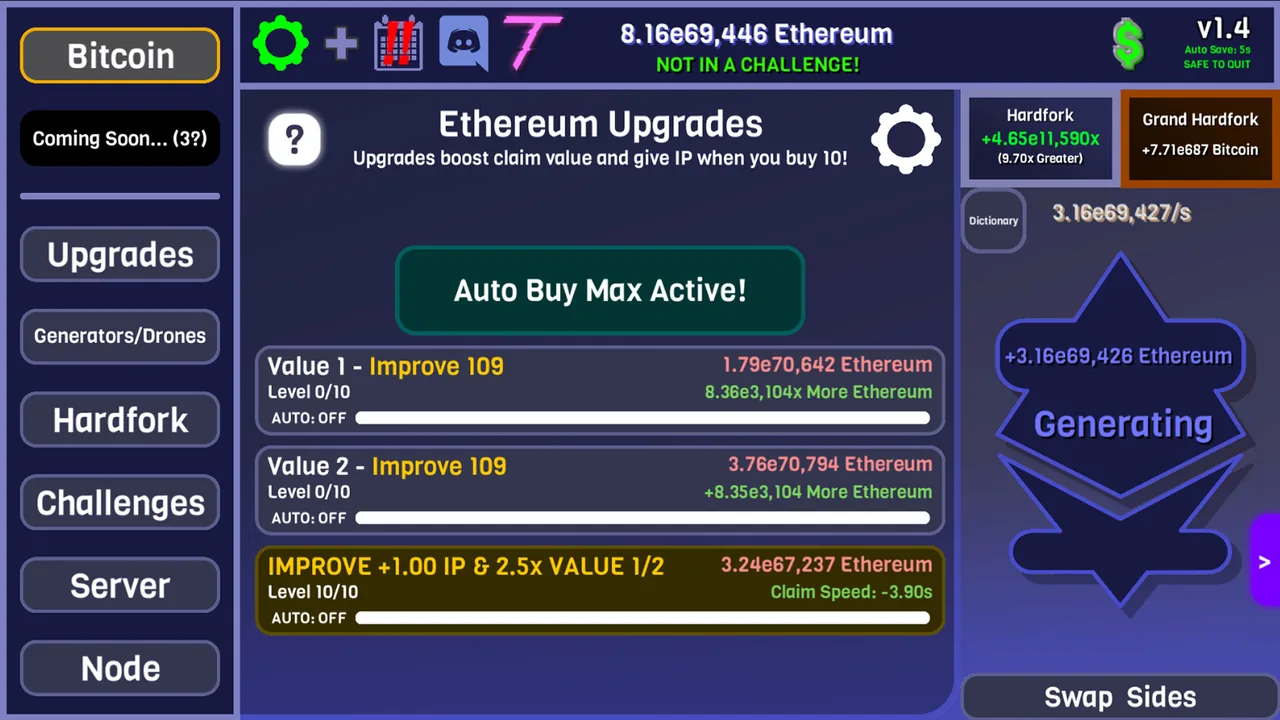
Presentation is functional rather than distinctive — a numbers-and-panels dashboard typical of the genre, without the visual identity that better-known clickers build around a mascot or a consistent art direction. One review calls the UI "kind of ugly" and the art "not that great," which matches what the storefront screenshots show: a dense grid of stat panels and progress bars rather than anything built to be memorable on its own.
A more concrete complaint is save handling. CryptoClickers doesn't sync saves through Steam Cloud; moving between machines means exporting a save code manually and importing it on the other end, and at least one reviewer reports losing progress to a crash or an unexpected shutdown corrupting the local save file. For a game that asks for the kind of long-haul time investment this one does — seven-hundred-plus-hour playtimes aren't unusual among its reviewers — the absence of automatic cloud backup is a real risk, not a nitpick.
Verdict
CryptoClickers is a case of a genuinely well-built incremental engine shipped without the onboarding or the monetisation restraint to match it. The double prestige loop, the two full upgrade trees and the thirty-one challenge modes would be a strong showing in a genre that lives and dies on long-term structure, and the players who push through the early wall consistently report that the depth holds up for hundreds of hours. But Steam's own numbers — a "Mixed" rating at 63.7% positive across 146 reviews — say the wall is turning away roughly as many players as it keeps, and the recurring advice in the negative reviews to "just join the Discord" is not a substitute for a game that teaches itself. Add a leaderboard economy that several long-term players describe as predatory by design, and the result is a game worth trying for free but hard to recommend without real caveats attached.
Pros and cons
Pros
- Two-layer prestige structure (Hardfork, then Grand Hardfork) gives long-term players a real reason to keep resetting
- Thirty-one challenge modes across two currencies add structured goals on top of the passive number-climbing
- Weekly rotating events (seven of them, hourly-repeatable) give returning players something new to chase
- Core progression is playable to completion without spending money, and several long-term reviewers back that up
- Achievement data shows a genuine minority of players logging hundreds of hours, which only happens when the loop holds up
Cons
- The interface leans on unexplained jargon that the built-in tutorial doesn't cover, pushing players toward the developer's Discord to make sense of it
- A sharp early-to-mid difficulty spike turns five-to-twenty-minute challenges into week-long walls with little warning
- Cloud saves aren't handled through Steam; moving between devices means manually exporting and importing a save code
- The competitive leaderboard layer runs on a premium currency that reviewers report decaying before a normal play week can spend it
- Visual presentation is a plain numbers-and-panels dashboard with little of its own identity
Screenshots
-
CryptoClickers: Crypto Idle GameImage: Considera Core LLC via Steam -
CryptoClickers: Crypto Idle GameImage: Considera Core LLC via Steam -
CryptoClickers: Crypto Idle GameImage: Considera Core LLC via Steam -
How the review scores each part of the gameWanderer Editorial -
The game at a glanceWanderer Editorial -
The short versionWanderer Editorial