Game review
Space Rock Breaker
7 / 10
- Developer
- WAKA WAKA
- Publisher
- WAKA WAKA
- Released
- 19 December 2025
- Platforms
- Windows
- Genre
- Incremental
- Monetisation
- One-time purchase. No DLC, no microtransactions, no ads. The in-game lootboxes are earned with in-game credits and cannot be bought.
- Players
- Single-player
The short version
Space Rock Breaker does the thing most incrementals promise and almost none deliver: it ends, on purpose, at a length that matches its price. The achievement data is remarkable — **the achievement named for the ending sits at 85.1%, and the rarest of all fifteen is still 74.4%**. There is no drop-off cliff anywhere in the curve, because there is nowhere to drop off.
What stops it being a small classic is the middle. Power scaling collapses somewhere around the second prestige and never recovers, so the last two-thirds of the run is a victory lap. **Prestige is the single most-mentioned subject in the negative reviews (19 of 79)**, and the complaint is always the same shape: the reset stops resetting anything, and once that happens there's no tension left to spend upgrades on.
Biggest strengths
- The ore-to-Plinko processing loop is a genuinely original piece of incremental design
- Finishes cleanly in one sitting, and nearly everyone who buys it does finish
- No DLC, no microtransactions, no timers, no energy — you buy it once and own all of it
Biggest weaknesses
- Power scaling breaks early; multiple reviewers finish the game on a single prestige
- Two prestige passives lock your upgrades permanently, which removes the point of prestiging
- The skill tree is a straight line with money as the only gate, not a set of choices
Who it's for: Anyone who wants a complete incremental in one evening, on a laptop or a Deck, for less than a coffee. Players who measure incrementals in months of prestige loops should look elsewhere.
Our recommendation: Play the free demo first — it's still on the store page, and it's a fair sample of the whole game. If the Plinko machine makes you grin, the full version is three to five hours of the same at NZ$4.79.
7 / 10
Achievement curves are usually where an incremental game's story falls out. You pull the global completion percentages, find the point where the line falls off a cliff, and that's where the content ran out and the wait timers began — it's how the Fisher Idle review turned "it runs dry" into a number.
Space Rock Breaker has no cliff. The first achievement sits at 98.8%, the one named for the ending at 85.1%, and the rarest of all fifteen at 74.4%. Fifteen achievements, none below three quarters. I've measured a lot of these and this is the flattest curve in the library by a distance. Achievements shipped with the game in December 2025 rather than being bolted on later, so the numbers mean what they look like they mean: five out of six people who buy this game play it to the credits.
That is an extraordinary thing for an incremental to achieve, and it happens for an unglamorous reason. The game is three to five hours long, it knows it, and it costs NZ$4.79.
Shoot rock, drop rock in Plinko machine
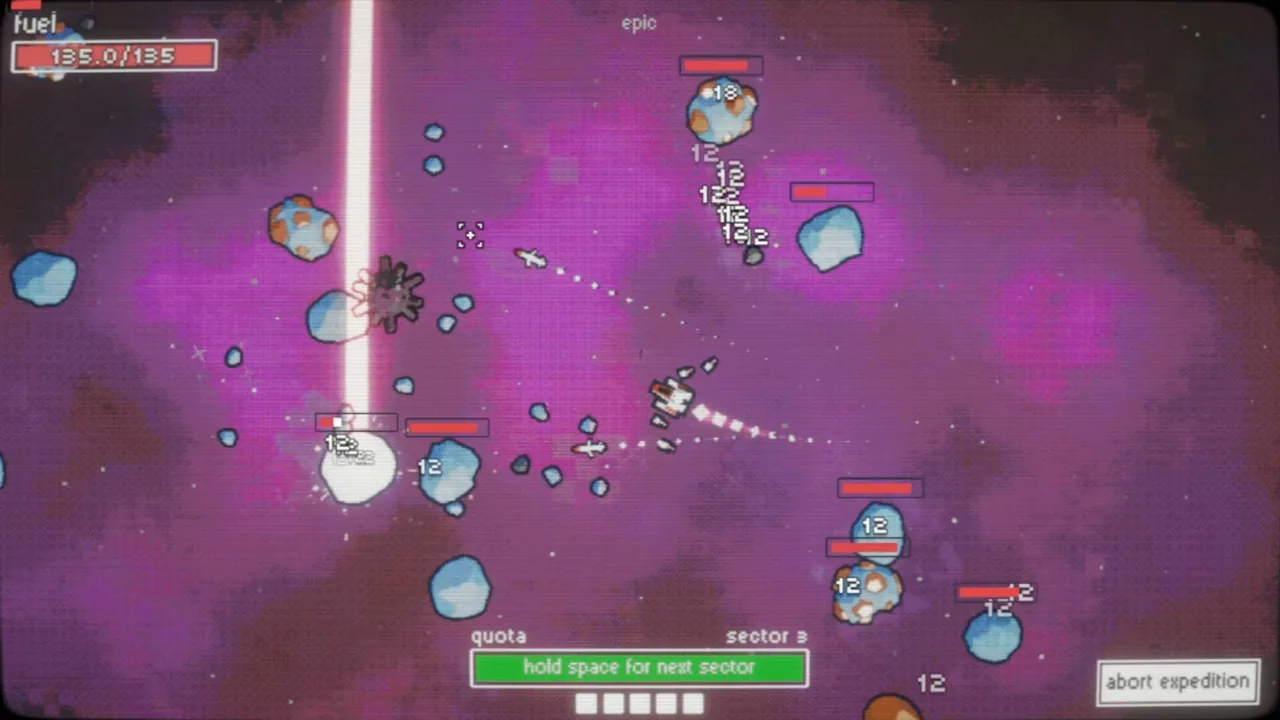
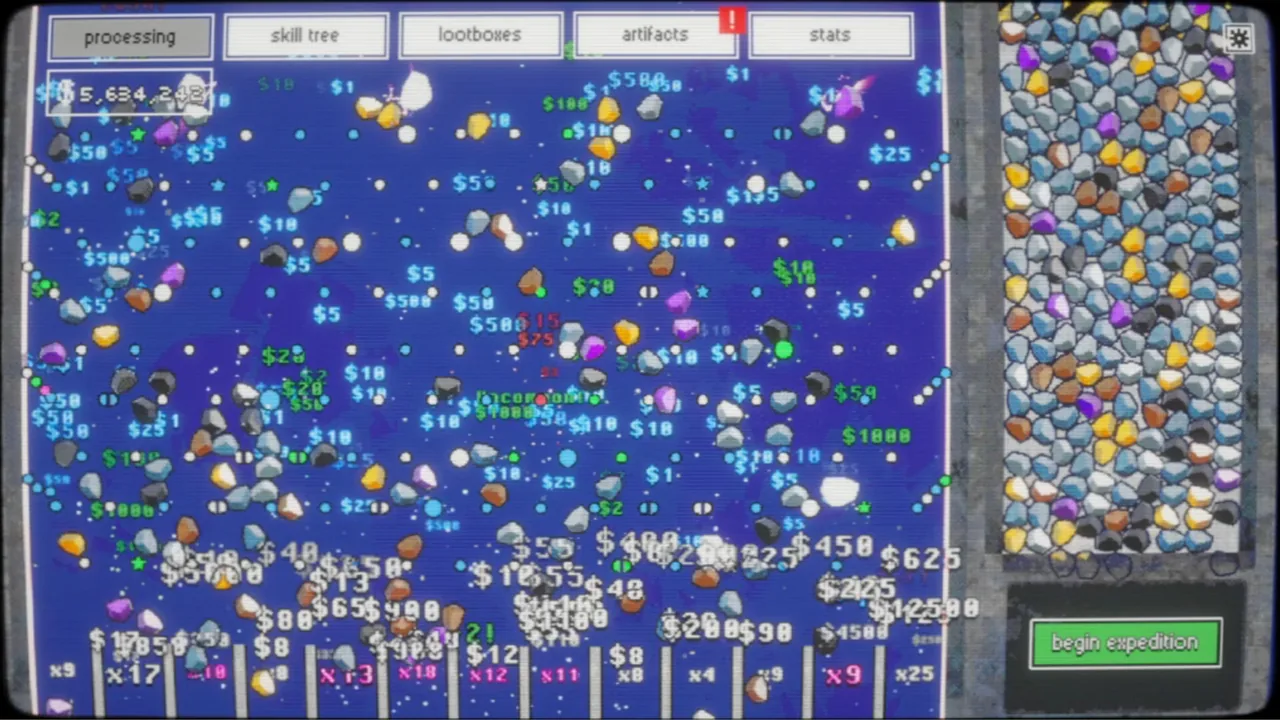
The loop is two halves that feed each other. You fly a small ship into a sector, shoot asteroids with guns, missiles and lasers until your fuel runs out, and haul the ore home. Then you dump the ore into a Plinko board and watch it bounce through pegs into multiplier slots, which converts raw rock into credits at a rate you can upgrade. Credits go into a large skill tree; the skill tree makes the next expedition longer and richer; repeat.
The Plinko processor is the best idea here and the one I haven't seen elsewhere. Incrementals nearly always convert resource A into currency B with a flat multiplier and a purchase button. Making that conversion a physical, watchable, slightly random event gives the boring half of the loop something to look at, and it gives the upgrade tree a second axis — peg counts, slot values, ball counts — that isn't just "damage, but bigger." "Plinko" appears in 24 of the 100 most-helpful positive reviews, which for a single sub-mechanic is a lot.
It also draws the sharpest criticism in the whole corpus, from a reviewer who liked the concept and then looked at it properly: the upgrades to the machine, they wrote, are "completely indiscernible from something like a flat 5% buff to income in any other game." That's fair. The Plinko board is presented as a system and behaves as a number. It's a great idea used at about forty per cent of its potential.
The part that doesn't hold
Sort the 79 English negative reviews — and 79 is all of them, not a sample — and the dominant subject isn't length. It's prestige, mentioned in 19 of 79, ahead of "short" at 17.
The complaints converge. Prestige arrives early and feels great; then two passives in the prestige tree, which reviewers name as Plinko Memory and Persistent Upgrades, carry your purchased upgrades through the reset. They're on the mandatory path, so you can't route around them. After that the reset resets nothing, and an incremental whose reset resets nothing has quietly ended. One reviewer describes hitting both within roughly half an hour of each other and having "no reason to play the game anymore." Another prestiged twice and reported the second one changing essentially nothing.
The knock-on effect is a power curve that goes vertical and stays there. A 5.1-hour reviewer put it best: "there is an early game and an end game but no middle game. It takes ages to get to sector 15 and then suddenly you can just blitz all the way through to sector 100 and you're basically invincible." A 6.8-hour reviewer, thumbs up, agreed: upgrades plus lootbox drops plus prestige compound so hard that "in just a handful of attempts the game has lost all challenge."
There's an argument that this is deliberate, and one 6.2-hour reviewer makes it well — prestige here is genuinely optional, which is unusual and quietly respectful of the player's time. But optional and pointless aren't the same thing, and the game spends a chunk of its skill tree on a system it then makes irrelevant.
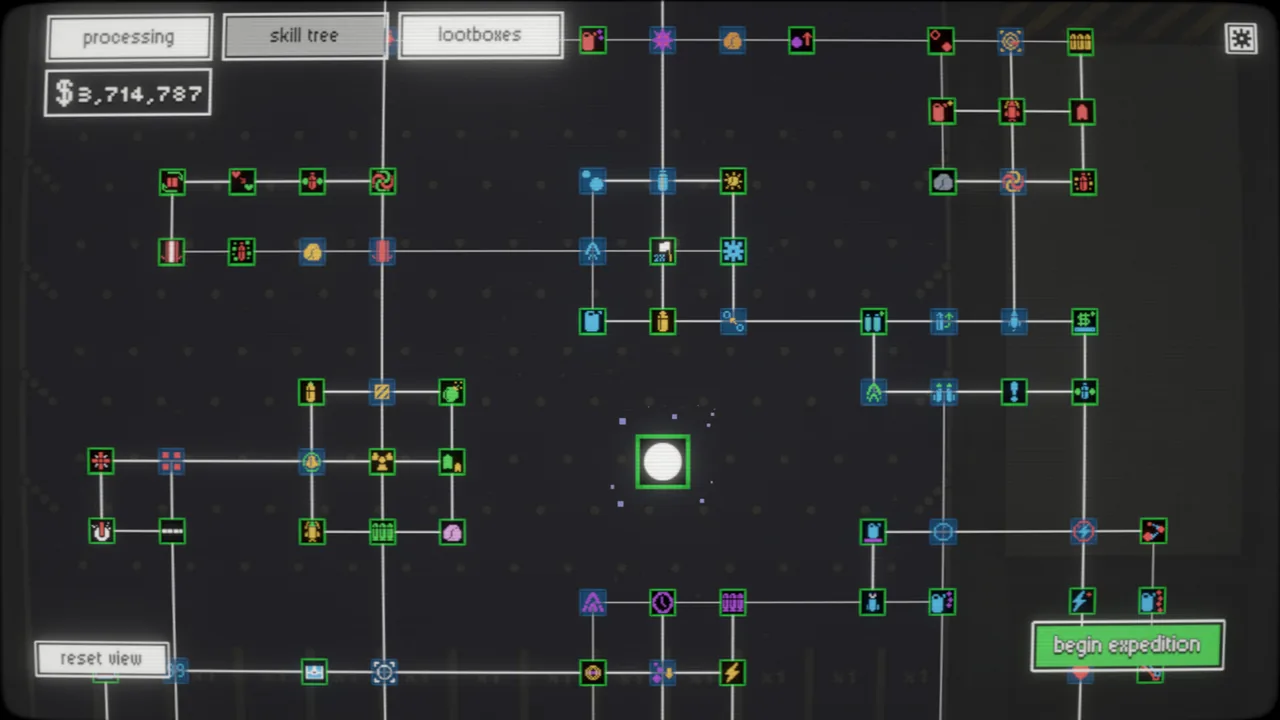
The tree itself has the same flatness problem. It's gated by cost rather than by choice: you can afford one tier, you buy all of it, you grind briefly, you buy all of the next. Several reviewers ask for branches worth specialising in. They're right, and it's the change that would most obviously turn a good three-hour game into a good ten-hour one.
The drill
One specific piece of design deserves calling out, because the community has already settled it. The second most-upvoted positive review in the entire corpus is thirty-six words long, from a player with 29.4 hours: "Fun little game. Advice, don't unlock the drill ever. Do the rest."
The mining drill is a special weapon that disables your main guns while it runs. Players describe it as a curse that switches off your damage for ten to fifteen seconds. The developer has patched at it — January's balance pass cut drill ammo costs, moved it earlier in the tree and added an upgrade that keeps guns firing during drill use — and reviews from June 2026 still say the same thing. When a downside is that legible, moving the upgrade around the tree doesn't fix it; the mechanic needs to stop turning off the fun part.
What it costs
NZ$4.79, once, checked on 5 August 2026. No DLC. No microtransactions. No energy meter, no timers, no ads, no account. The word "lootbox" turns up in the store description and in seven negative reviews, and it's worth being precise about what that means here: they're opened with in-game credits, they cannot be purchased with money, and the only complaint about them is a design one — that a forced first prestige strips the legendary drops you'd just earned, which stings.
For a solo developer's first-price-tier release that's about as clean as monetisation gets, and it's the reason the value score is where it is. Compare it to Idle Dice or Clicker Ore, where the money question is the whole review. Here it takes a paragraph.
There's also a free demo still sitting on the store page, and given how uniform the game is from front to back, it's an unusually honest one. Play it. If the Plinko board doesn't make you smile in five minutes, nothing later will.
Support, and one thing I can't settle
Twelve patches between launch and 30 July 2026, from one developer, including Steam Deck verification in February, controller support, nine additional languages, a save-corruption fix, an achievements-not-unlocking fix, and — seven months in — a pause button that actually pauses. Early Steam Deck complaints about battery drain and slideshow framerates in some sectors date from before the February verification and the two optimisation passes that followed, which is why performance scores a middling 6.5 rather than lower: the arc is in the right direction, and the current build isn't the one those reviews are describing.
Negative sentiment tracks that arc. Bucketed by quarter, the English negatives run 50 in Q1 2026, 21 in Q2, 8 in Q3 — front-loaded on launch balance and Deck problems, thinning as the patches landed. Of the 100 most recent English reviews, 95 are positive.
One loose end, reported as what it is. The most-upvoted negative review (8 votes) contains an edit claiming it was flagged and hidden for about two days, which its author reads as hostility to criticism. I have no way to verify what happened to one review's visibility, and I'm not going to guess at a cause. It's one report, it's in the corpus, and it's worth knowing about before you read a 96% score as unanimous consent.
Should you buy it
The playtime numbers make the recommendation easy. Median playtime among the negative reviewers is 3.75 hours. Median among the most-helpful positives is 3.8 hours. Both camps played the same game for the same length of time and reached opposite conclusions about whether that was enough — which means this isn't a game people bounce off, it's a game people finish and then argue about.
If you want an incremental that respects an evening, has a real ending, and asks for less than a coffee, buy it. If you want the multi-week prestige ladders of Unnamed Space Idle or Leaf Blower Revolution, this will be over before your first loop would have started, and its own prestige system will disappoint you on the way.
Readers who like the shape of this loop but want it to keep going for months rather than hours will find that in Wanderer, where the gathering and crafting ladders carry on while you're away.
7 out of 10. A small, sharp, complete game with one genuinely fresh mechanic and a broken middle act, priced so honestly that most of the criticism reads as disappointment that there isn't more of it. That's a better problem than the alternative.
Pros and cons
Pros
- The ore-to-Plinko processing loop is a genuinely original piece of incremental design
- Finishes cleanly in one sitting, and nearly everyone who buys it does finish
- No DLC, no microtransactions, no timers, no energy — you buy it once and own all of it
- A free demo that honestly represents the game
- Twelve patches from a solo developer in seven months, including a real pause and Deck verification
Cons
- Power scaling breaks early; multiple reviewers finish the game on a single prestige
- Two prestige passives lock your upgrades permanently, which removes the point of prestiging
- The skill tree is a straight line with money as the only gate, not a set of choices
- The mining drill disables your main guns, and the best-known player advice is to never unlock it
- Essentially zero replay value once the ending cutscene plays
Screenshots
-
Space Rock BreakerImage: WAKA WAKA via Steam -
Space Rock BreakerImage: WAKA WAKA via Steam -
Space Rock BreakerImage: WAKA WAKA via Steam -
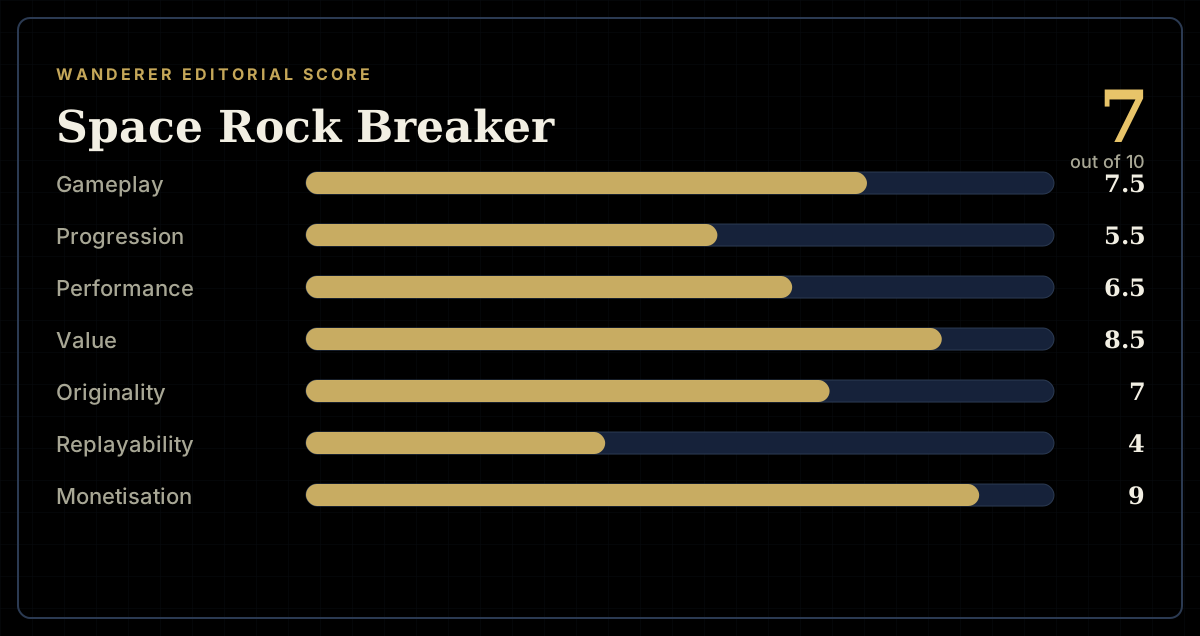
How the review scores each part of the gameWanderer Editorial -
The short versionWanderer Editorial