
Game review
Unnamed Space Idle
8 / 10
- Developer
- Sylv
- Publisher
- Jdog Corp
- Released
- 27 July 2023
- Platforms
- Windows, Linux
- Genre
- Idle RPG
- Monetisation
- Free to play. Optional purchases include timed play boosts; several long-term reviewers say quality-of-life features are also gated behind them. No mandatory spending to reach end-of-content.
- Players
- Single-player only
The short version
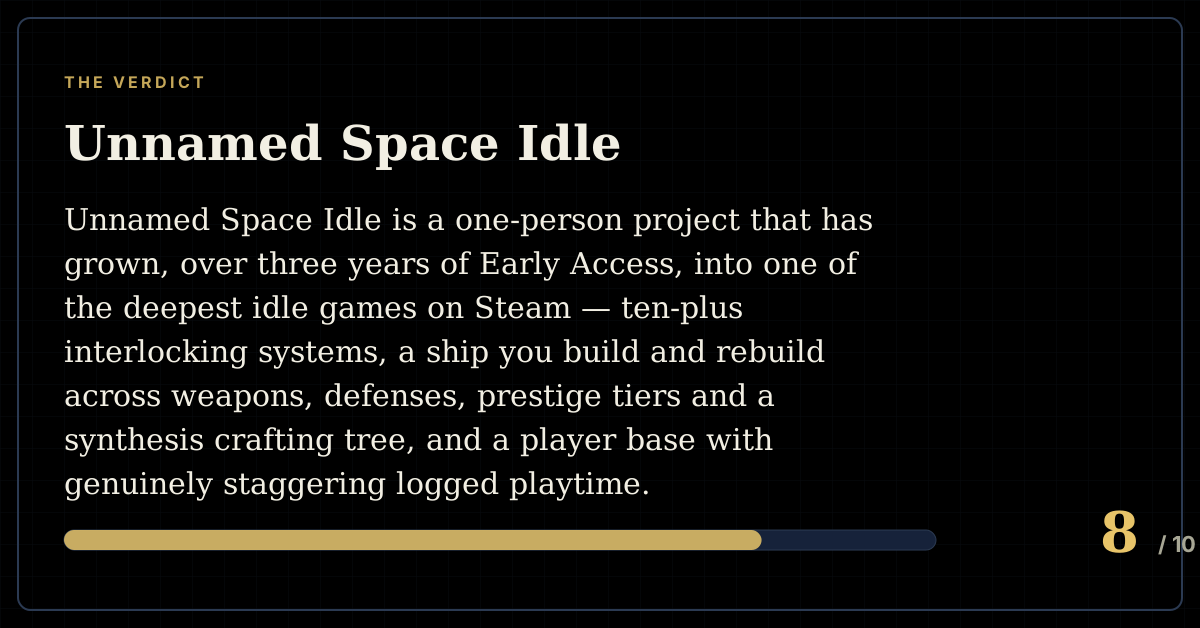
Unnamed Space Idle is a one-person project that has grown, over three years of Early Access, into one of the deepest idle games on Steam — ten-plus interlocking systems, a ship you build and rebuild across weapons, defenses, prestige tiers and a synthesis crafting tree, and a player base with genuinely staggering logged playtime. It sits at 92.6% positive across 4,329 reviews, and the sentiment among players who reach the hundreds- and thousands-of-hours mark is close to unanimous: this is a serious, well-made idle game, not a reskinned clicker.
The recurring complaint, and it comes from deeply invested players rather than drive-by reviews, is that the mid-to-late game narrows rather than opens up. Past roughly sector 50, several systems stop offering genuine choices and start demanding one specific, community-solved optimal build — a very different feeling from the freeform tinkering the early hours promise.
Biggest strengths
- Over ten distinct, interlocking systems (Core, Compute, Synth, Void Device, Prestige, Reactor, Research, Warp and more) that keep unfolding well past the point most idle games run dry
- A rare premise for the genre — you're visibly building and modifying your own spaceship, not just watching numbers climb
- An unusually dedicated player base; multiple top reviewers report 1,000 to 6,700+ hours and still recommend it
Biggest weaknesses
- Past the midgame, several reviewers say progress increasingly depends on one specific "optimal" combination of upgrades rather than genuine build choice
- Progression pacing turns sharply slower for some players around sector 47-75, with one reviewer describing single sectors taking multiple months to clear
- Some quality-of-life features are reported as gated behind optional purchases, which a number of reviewers say sours an otherwise generous free-to-play model
Who it's for: Idle and incremental fans who want genuine systemic depth and are prepared to put real hours in — this is not a five-minute-a-day game. Less suited to players who want every choice to stay meaningful for the long haul, or anyone allergic to consulting a wiki for the "correct" build once the difficulty ramps up.
Our recommendation: It's free, so there's no real reason not to try it — the early hours are approachable and the systems introduce themselves at a reasonable pace. Go in expecting the curve to steepen hard around the Standard-to-Capital transition reviewers describe, and don't be afraid to look up a build guide once you hit a wall; several long-term players say fighting the optimal-path requirement alone is where the game stops being fun.
8 / 10
The title undersells it. "Unnamed Space Idle" sounds like a placeholder someone forgot to replace; what's actually on the other side of that name is a three-years-deep solo project with more interlocking systems than most funded idle studios ship, and a fanbase whose most-upvoted reviews routinely open with playtime figures in the thousands of hours.
A ship, not just a number
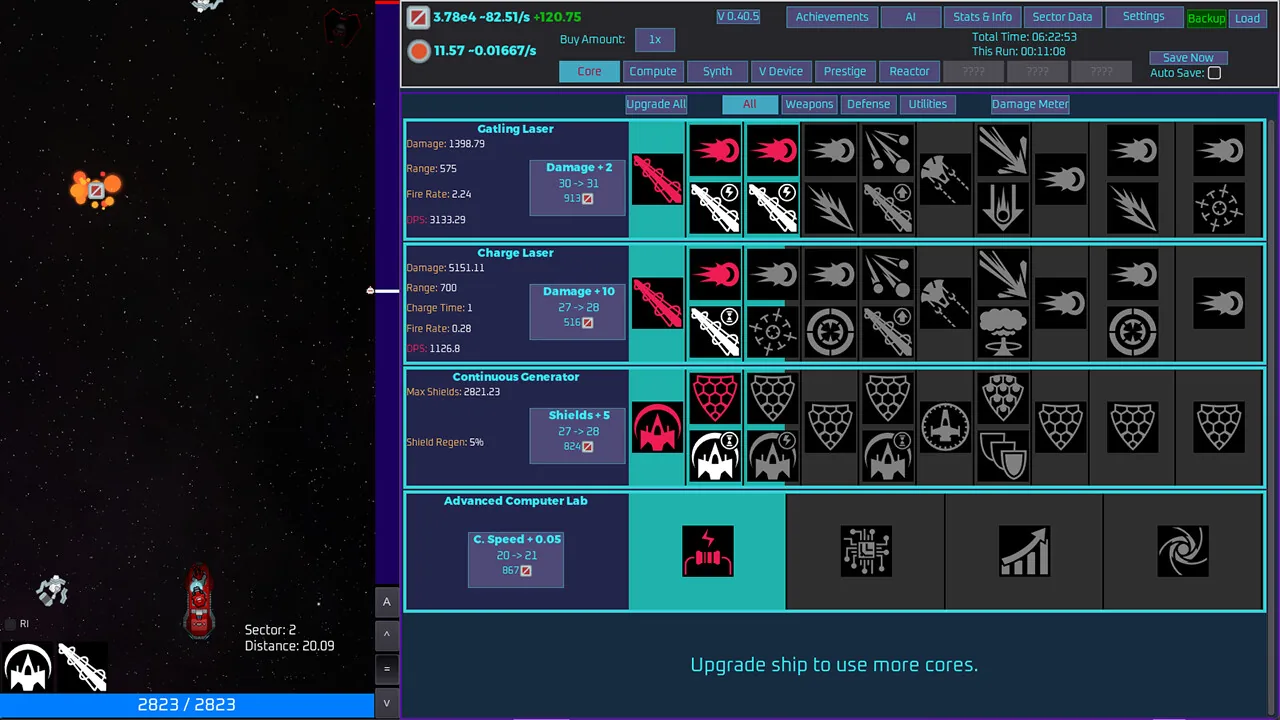
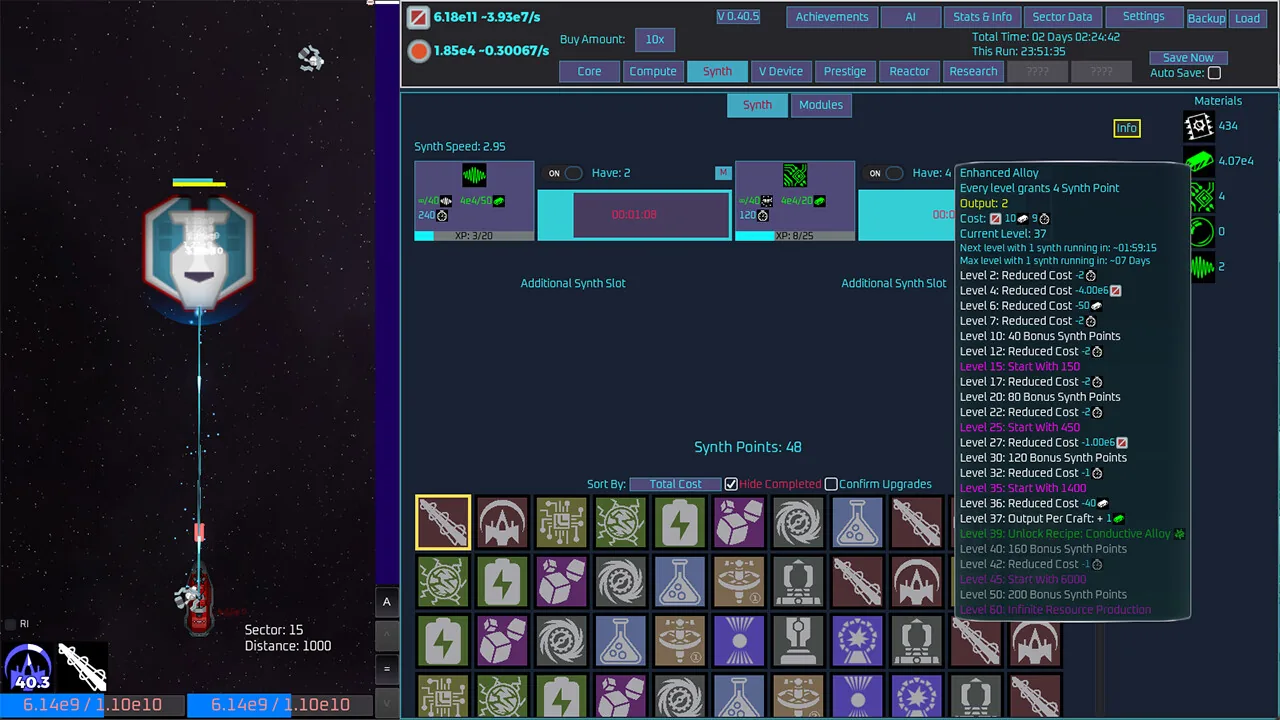
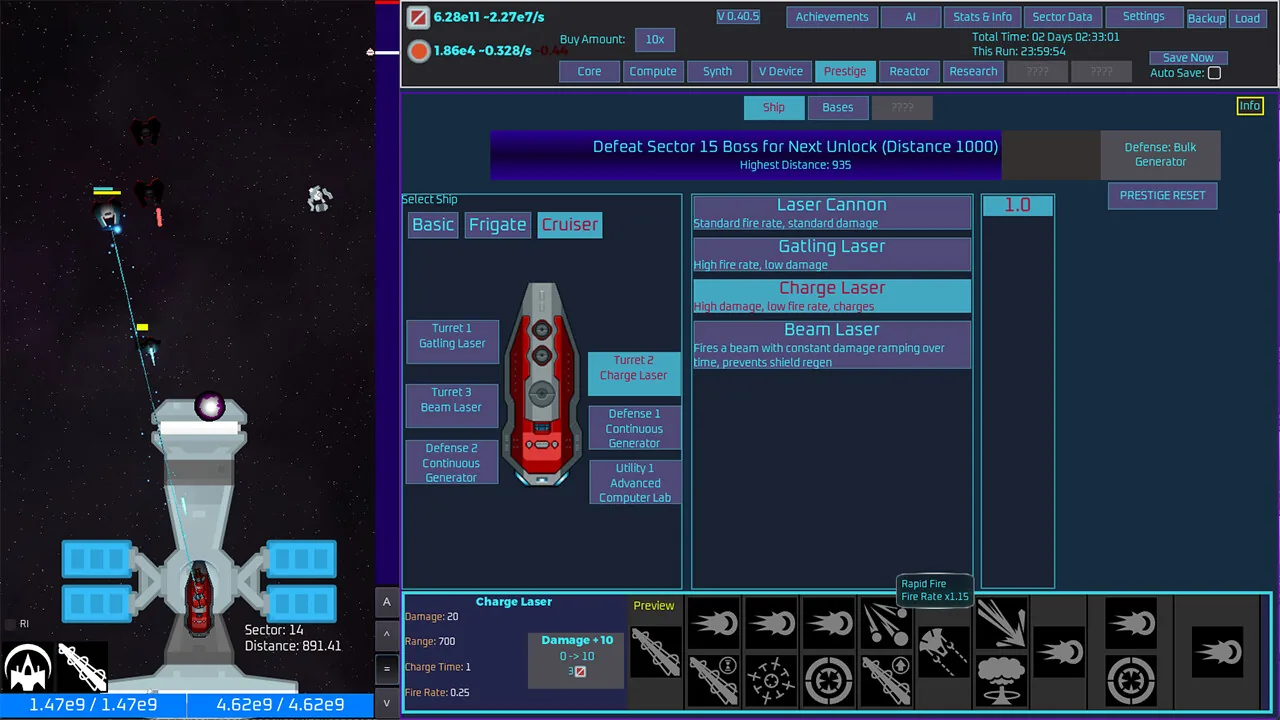
Most idle games give you one resource curve to watch climb. Unnamed Space Idle gives you a spaceship you're visibly building — weapons and defenses slotted against specific enemy types, utility modules crafted through the Synth system, void shards socketed into a Void Device tree, prestige resets that unlock entirely new ships and equipment tiers. Reviewers repeatedly call this premise "rare" for the genre, and the ten-plus named systems (Core, Compute, Synth, Void Device, Prestige, Reactor, Research, Warp, and more still being added) genuinely keep introducing new decisions well past the point where most idle games have run out of things to say.
The playtime numbers back that up in a way few games can claim. The most-upvoted positive review in the sample carries 2,797 hours; others in the top ten run past 1,500, 3,400, 4,400 and — in one case — 6,739 hours, with the reviewer noting on top of that over a hundred separate six-hour boost items consumed along the way. One player says flatly that Steam itself flagged their 4,300-hour total as unusual before they wrote the review. This is not casual-clicker engagement; it's the kind of retention normally associated with paid live-service RPGs, achieved by a free game from one developer.
Where the wall shows up
Read enough of the negative and mixed reviews and a specific, consistent shape emerges, and it isn't "the game is bad" — it's "the game changes what kind of game it is partway through."
The early-to-mid stretch, several reviewers agree, is genuinely excellent: systems introduce themselves at a sensible pace, choices feel meaningful, and progress is visible session to session. Then, in the range reviewers place around sector 47 to 75, the shape of the challenge changes. Instead of many viable builds, the community converges on one specific combination of upgrades, crew, and void devices as correct, and deviating from it stalls progress hard. One reviewer with 337 hours logged calls out being "forced" to level every stat evenly to pass a specific barrier. Another, at 527 hours, puts it precisely: the game stops being about which stat you want to grow and becomes about finding which exact combination lets you grow one stat the most, then resetting and repeating — a shift from open experimentation to solved-puzzle execution.
That's a distinct complaint from most idle-game fatigue, and it's worth naming clearly: it isn't that the game runs dry of content, since new systems keep arriving. It's that the freedom the early systems establish quietly narrows once the difficulty curve demands specific answers rather than good-enough ones. A reviewer with 1,737 hours who otherwise respects the game puts it simply — none of the later systems feel as rewarding as the earlier ones, and prestiging stops feeling valuable even as the numbers keep climbing.
There's a second, smaller thread worth flagging on its own terms: several reviewers say quality-of-life conveniences, not power, sit behind the optional purchases in an otherwise generous free-to-play model. One puts the objection sharply — paying to make the grind less tedious reads, to that player, as an admission the tedium wasn't fun in the first place. This doesn't come up as often as the build-solving complaint, but it recurs enough across the sample to be a real, if minor, mark against the monetisation.
Reading the achievement curve honestly
The global completion data matches the reviews closely. Early combat and system-introduction achievements — your first hundred kills, your first thousand compute cycles — sit between 57% and 83% of the player base. Deep-endgame achievements, tied to specific late sectors and multi-galaxy clears, fall to a single-digit fraction of a percent, several under 1%. Given the game is still in active Early Access with systems being added over time, some of that gap is simply newer content having had less time to be reached — but it lines up with what hundred-and-thousand-hour reviewers describe directly: the run to the midgame is where most of the playerbase lives, and the far end is reserved for a much smaller, highly dedicated group willing to solve the optimal path.
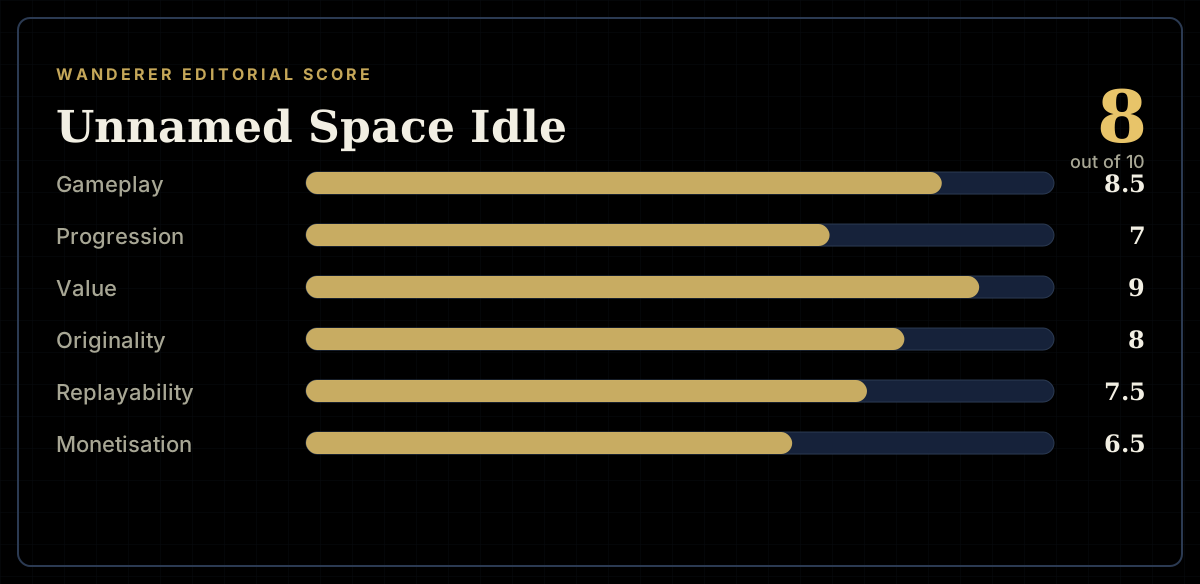
8 out of 10. Unnamed Space Idle earns its Very Positive rating honestly — it's an unusually deep, free, actively developed idle game built by one person, with a player base whose collective playtime is hard to find a comparison for in the genre. The point held back is specific and well-evidenced rather than vague: the same depth that makes the first fifty sectors so good narrows into a single solved path later on, and a handful of quality-of-life features sit behind an optional purchase in a game that otherwise asks for nothing. Try it — it costs nothing to find out whether you're the kind of player it's built for.
Pros and cons
Pros
- Over ten distinct, interlocking systems (Core, Compute, Synth, Void Device, Prestige, Reactor, Research, Warp and more) that keep unfolding well past the point most idle games run dry
- A rare premise for the genre — you're visibly building and modifying your own spaceship, not just watching numbers climb
- An unusually dedicated player base; multiple top reviewers report 1,000 to 6,700+ hours and still recommend it
- Free to play with no mandatory spending required to reach end-of-content
- Active solo development three years into Early Access, still adding systems
- 92.6% positive across 4,329 reviews, with recent sentiment matching the lifetime figure closely
Cons
- Past the midgame, several reviewers say progress increasingly depends on one specific "optimal" combination of upgrades rather than genuine build choice
- Progression pacing turns sharply slower for some players around sector 47-75, with one reviewer describing single sectors taking multiple months to clear
- Some quality-of-life features are reported as gated behind optional purchases, which a number of reviewers say sours an otherwise generous free-to-play model
- The achievement curve is steep — several early milestones sit above 60%, while deep endgame ones fall under 1%, reflecting how much longer the back half of the game demands
- As an Early Access game, systems and balance are still being adjusted, so specific numbers in any given review may already be out of date
Screenshots
-
Unnamed Space IdleImage: Jdog Corp via Steam -
Unnamed Space IdleImage: Jdog Corp via Steam -
Unnamed Space IdleImage: Jdog Corp via Steam -
How the review scores each part of the gameWanderer Editorial -
The short versionWanderer Editorial