
Game review
Bloobs Adventure Idle
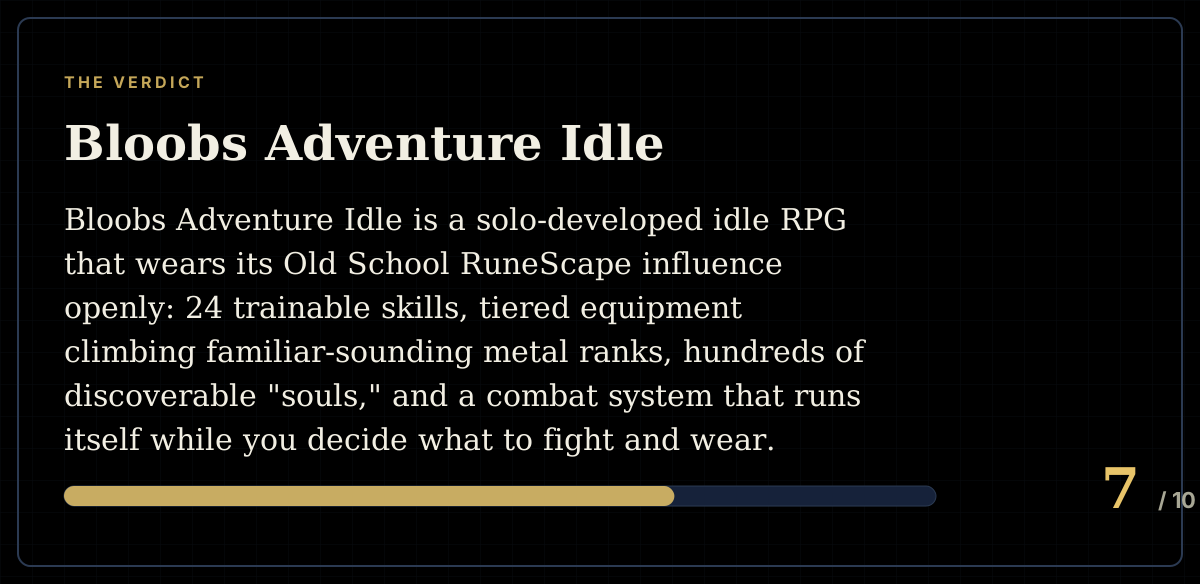
7 / 10
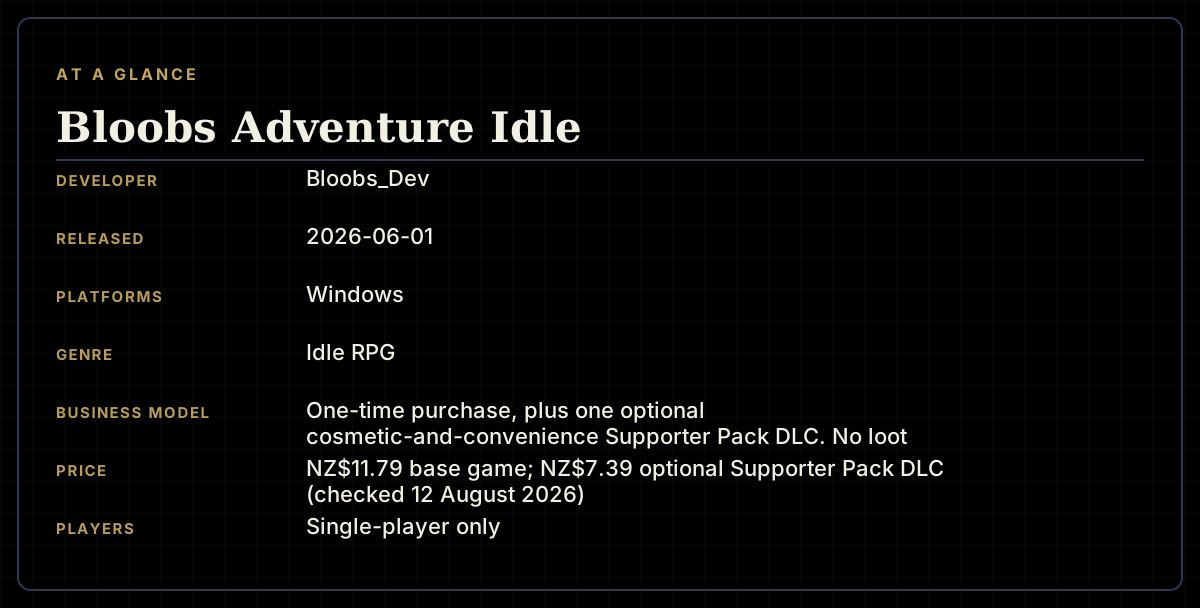
- Developer
- Bloobs_Dev
- Publisher
- Bloobs_Dev
- Released
- 1 June 2026
- Platforms
- Windows
- Genre
- Idle RPG
- Monetisation
- One-time purchase, plus one optional cosmetic-and-convenience Supporter Pack DLC. No loot boxes, no pay-to-win items.
- Players
- Single-player only
The short version
Bloobs Adventure Idle is a solo-developed idle RPG that wears its Old School RuneScape influence openly: 24 trainable skills, tiered equipment climbing familiar-sounding metal ranks, hundreds of discoverable "souls," and a combat system that runs itself while you decide what to fight and wear. It left Early Access on 1 June 2026 after nearly two years of near-daily updates, and it sits at Very Positive with roughly 90% approval across 664 reviews — a score that has barely moved between its Early Access years and its 1.0 launch.
What has moved is the shape of the complaints. Across 2024 and 2025, the recurring criticism was that Bloobs' 24 skills feel like 24 separate games running in parallel rather than one RuneScape-style web of systems that feed each other. That complaint hasn't gone away. What's been added on top of it, dated specifically to the weeks around and after 1.0, is a Challenges system that a meaningful slice of players say drags the game away from its own core promise — pushing an idle RPG toward something that increasingly demands you sit and watch it.
Biggest strengths
- The core skilling loop — chop, mine, fish, smith, cook, fight — captures the specific AFK rhythm of RuneScape and Melvor Idle convincingly, and reviewers with thousands of hours logged keep coming back to it
- Monetisation is unusually clean for the genre: one optional cosmetic-leaning Supporter Pack DLC at NZ$7.39, no energy timers, no premium currency store, and reviewers explicitly credit the developer for not adding the microtransactions some feared during Early Access
- The solo developer ships updates at a pace bordering on daily, and reviewers who've interacted with the Discord describe bug reports being fixed within hours
Biggest weaknesses
- Skills are widely described as functioning in isolation rather than feeding into each other the way OSRS's web of interdependent systems does, leaving 24 skills that mostly repeat the same "gather, wait, repeat" loop with different icons
- Offline time is capped and has to be manually banked and spent rather than accruing freely, which a consistent slice of reviewers — including some past the 1,000-hour mark — read as "not really an idle game" when the window has to stay open to make real progress
- A Challenges system introduced around the 1.0 launch requires active, manual engagement to keep its rewards flowing, and a June 2026 patch cut its best repeatable payout from 50% down to 10% of full reward — several players call this the point the game stopped feeling idle
Who it's for: RuneScape and Melvor Idle fans who want that specific skilling-and-AFK feeling in a standalone package, and who are prepared to treat the newer Challenges system as optional rather than load-bearing. Less suited to players who want every skill to meaningfully interact with every other one, or anyone shopping specifically for a game that keeps running while the window is closed.
Our recommendation: At NZ$11.79 for a game some reviewers have put over a thousand hours into, the price-to-content ratio is hard to argue with, and the monetisation is about as clean as this genre gets. Go in expecting a genre homage rather than an innovation on the RuneScape formula, and expect to opt out of the Challenges system if the idea of an idle game demanding active micromanagement doesn't appeal.
7 / 10
Introduction
Bloobs Adventure Idle doesn't hide its influences. Its skill list reads like Old School RuneScape with the serial numbers barely filed off — Woodcutting, Mining, Fishing, Smithing, Cooking, Firemaking, Thieving, Magic — and its equipment tiers climb through metals that will feel immediately familiar to anyone who has ever chopped a willow tree for hours in Lumbridge. What it adds to that formula is the genre framing: this is explicitly an idle game, built around a small blue creature that walks itself around a world doing whatever job you've assigned it, while combat resolves automatically against whatever gear and stats you've built up. Developed solo and published by Bloobs_Dev, it spent almost two years in Early Access — starting 15 July 2024 — before reaching 1.0 on 1 June 2026, and its review corpus is unusually well suited to tracking exactly how the game changed across that stretch, because 664 reviews now span both eras with barely any change in overall sentiment. That stability makes the parts of the corpus that did shift worth taking seriously.
A skilling loop that gets the feeling right
The strongest, most consistently repeated praise in Bloobs Adventure Idle's review sample isn't about any single system — it's about the texture of playing it. Reviewers describe leaving it running in a background window while working, watching a character they've built slowly climb through skill levels, and getting the specific, hard-to-fake satisfaction of AFK progression that RuneScape veterans go looking for and rarely find replicated well. One long-time player summed it up bluntly: "Simply the best Idle Game I have ever played. It combines RuneScape levelling, with endless QoL features to make the Idle game aspect work alongside it really well." That sentiment recurs across reviewers logging anywhere from a few hundred to several thousand hours, and it's the foundation the rest of the game's reputation sits on.
Combat is fully automated once positioned — you choose what to fight, what to wear and which combat style to train, and the game resolves the actual exchange of blows on its own, closer to a management layer than an action system. That's a deliberate design choice rather than a shortfall of an unfinished game, and most of the corpus accepts it on those terms. Where the criticism lands is on variety within that automation: several reviewers describe every enemy sharing the same handful of animations and describe boss fights as visually and mechanically indistinct from trash mobs, just with bigger numbers attached.
Twenty-four skills, but do they talk to each other?
The single most consistent structural criticism across two years of reviews — not a launch complaint, but a standing one that predates 1.0 by well over a year — is that Bloobs' 24 skills mostly don't interact with each other the way OSRS's web of interdependent systems does. One reviewer put the comparison precisely: "what makes a game like OSRS great is the fact that improving on one skill is gonna unlock thing or improve other skills in some way. This game is lacking in that department making skill act more island instead of one greater whole." Another, with over 1,700 hours logged, was harsher: "its just runescape but like, worse, but idle instead... everything is designed to take thousands upon thousands of hours and theres nothing new past 99, so 99 to 1000 is the same thing."
That "nothing new past a certain point" complaint is checkable against the game's own achievement data, and it holds up reasonably well. Of the 246 Steam achievements, the most commonly earned sits at 94.5% — simply having played the game — and the next cluster, tied to reaching level 20 in individual skills, sits in the high 40s to high 50s percent. From there the curve drops sharply: 91 of the 246 achievements sit under 5% completion, and 31 sit under 1%. That's a wide, healthy spread of players clearing the early game and a genuinely small fraction reaching the deep endgame — not proof the deep content is bad, but solid corroboration that the time investment required to reach it is very large relative to what most buyers actually put in.
The offline question, and the system built to answer it
"Doesn't actually progress while I'm away" is close to a standing complaint across this genre, and Bloobs Adventure Idle draws it repeatedly and specifically. Reviewers across 2025 and into 2026 write versions of the same frustration: "There is not even offline progress so you can farm ores, lumber, etc overnight," and "no offline function," and, as recently as August 2026, "there is no offline progress at all... it was rly fun till then but 0 offline progress kills the game."
The game does have an answer to this, and it's worth explaining precisely because the store page and the negative reviews describe two different things. Bloobs Adventure Idle ships a Banked Time system: players accumulate up to 36 hours of storable time (extendable to 96 hours through a Dexterity prestige track), which can then be spent to accelerate skills, combat and crafting at a multiplier — reviews describe a turbo mode running up to 10x speed. That's a real form of offline value, but it's capped, has to be manually triggered, and functions more like a rechargeable battery than the always-on background accrual players of Melvor Idle or Cookie Clicker-style games expect when they hear "idle." Even players who defend the game are explicit about this trade-off: one 1,600-hour reviewer described it as "an idle game of incredibly idle proportions with no offline progress... you get a game speed boost for having the game c[losed]" rather than genuine passive gain. The complaint isn't that the system doesn't exist — it's that "idle" implies something the Banked Time design doesn't quite deliver, and that gap between expectation and mechanic is the single most repeated friction point in the entire review corpus.
The Challenges controversy
If the offline-progress complaint is a slow-burning, years-old fault line, the newest and sharpest one arrived with 1.0 itself. Bloobs Adventure Idle's Challenges system — a set of trackable, repeatable objectives across combat, skilling, exploration and collection — sits at the center of a tight cluster of negative reviews dated specifically to June and July 2026, immediately around and after the full release. The complaints are consistent: "The Challenges update makes the game not idle anymore until you actively play for hours," "there's no point in having multiple tiers of every challenge and constantly having to manually increment them," and, most pointedly, a player who requested a refund over what they called a "misleading title, as the game is more active than idle in the current state" — a request Steam denied on playtime grounds, which the player then converted into a negative review instead.
The economics of the system changed during this window in a way the patch notes confirm directly. Version 1.0.6.4, released 15 June 2026, rebalanced repeatable Challenge rewards: previously, reward scaling bottomed out at 50% after ten completions of a repeatable challenge; the update changed that floor to 10% after twenty completions — a real reduction in efficiency that one player quantified as an "18x worsening" once combined with a simultaneous increase in Time Bank purchase costs. The developer continued iterating on the Challenges system through July with UI clarity passes and reward-scaling tweaks (Version 1.1.0.4, "Challenge Improvements, Experience Buffs & QoL," on 13 July), but the core complaint — that Challenges ask for sustained active attention in a game sold on not requiring it — hasn't been reversed. It's worth being precise about scope here: this is a real and specifically dated cluster, not the dominant sentiment. Recent English review sentiment (88 of the 100 most recent) is barely different from the lifetime figure, so most current buyers are not hitting this friction hard enough to sour on the game overall. But for an idle-specific audience, "you'll want to actively manage Challenges to keep pace" is exactly the kind of design drift worth knowing before buying.
A clean business model, and a developer reviewers trust
Set against those structural complaints, Bloobs Adventure Idle's monetisation draws close to unanimous relief rather than praise-with-caveats — which, for a genre this often gets hit for predatory design, is itself notable. The base game is a one-time NZ$11.79 purchase. The only additional product is a NZ$7.39 Supporter Pack DLC, sitting at 9 positive reviews out of 9 on its own separate review page — a small sample, but a clean one, and consistent with the base game's sentiment. There's no energy system, no premium currency storefront, and only one isolated 2024 review alleging broken monetisation promises, dated well before the pattern repeated anywhere else in the sample. Multiple reviewers specifically credit the developer for holding the line here, describing the game as "without predatory monetization" and citing it as a reason to recommend the purchase even when they have other complaints about pacing or depth.
That trust extends to development pace. The Steam news feed shows updates landing at a pace close to daily through July and August 2026 — QoL passes, bug fixes, a substantial new Homesteading Ranching expansion added 5 August — and several reviewers describe direct, fast interaction with the developer through the game's Discord, including live-implemented feature requests and bugs confirmed and fixed within hours of being reported. That responsiveness doesn't resolve the Challenges complaint on its own, but it's the reason a meaningful share of frustrated reviewers frame their criticism as "needs adjustment" rather than "abandon ship."
Final Verdict
Bloobs Adventure Idle earns its comparisons to Melvor Idle and Old School RuneScape honestly — the core skilling loop is well-built, the presentation is charming without getting in its own way, and the price is difficult to argue with against the hundreds or thousands of hours its most dedicated players report logging. Where it falls short of its influences is depth of interconnection: 24 skills that mostly run in parallel rather than reinforcing each other, and an offline system that answers the genre's central promise with a capped, manually-managed battery rather than the always-on background progress RuneScape-idle fans specifically go looking for. The Challenges system added at 1.0 sharpens that tension rather than resolving it, asking for exactly the kind of active attention an idle game is supposed to let you skip. None of that sinks the game — the review corpus is stable and strongly positive both before and after 1.0 — but it does mean the "idle" in the title should be read with one asterisk attached. Players chasing that specific RuneScape-at-work feeling will likely still get it here. Players who want the game to run itself with zero manual upkeep should treat the Challenges system as optional the moment it starts to feel like a second job.
Wanderer players who enjoy skilling loops that keep progressing whether or not they're staring at the screen may find Bloobs Adventure Idle's Banked Time system a useful point of comparison — worth knowing exactly what it does and doesn't promise before deciding it solves the same itch.
Pros and cons
Pros
- The core skilling loop — chop, mine, fish, smith, cook, fight — captures the specific AFK rhythm of RuneScape and Melvor Idle convincingly, and reviewers with thousands of hours logged keep coming back to it
- Monetisation is unusually clean for the genre: one optional cosmetic-leaning Supporter Pack DLC at NZ$7.39, no energy timers, no premium currency store, and reviewers explicitly credit the developer for not adding the microtransactions some feared during Early Access
- The solo developer ships updates at a pace bordering on daily, and reviewers who've interacted with the Discord describe bug reports being fixed within hours
- 246 Steam achievements and a Souldex tracking over 500 collectible souls give committed players a genuinely long tail of goals beyond raw skill levels
- No pay-to-win pressure of any kind; the game's economy runs entirely on time invested
Cons
- Skills are widely described as functioning in isolation rather than feeding into each other the way OSRS's web of interdependent systems does, leaving 24 skills that mostly repeat the same "gather, wait, repeat" loop with different icons
- Offline time is capped and has to be manually banked and spent rather than accruing freely, which a consistent slice of reviewers — including some past the 1,000-hour mark — read as "not really an idle game" when the window has to stay open to make real progress
- A Challenges system introduced around the 1.0 launch requires active, manual engagement to keep its rewards flowing, and a June 2026 patch cut its best repeatable payout from 50% down to 10% of full reward — several players call this the point the game stopped feeling idle
- The achievement curve falls off a cliff after the earliest skill tiers: roughly a third of all 246 achievements sit under 5% completion, corroborating complaints that content past the opening hours thins out fast relative to the time it demands
- Interface complaints are common and specific — icon-heavy menus that require hovering to identify, a bank search reviewers say misses items, and a reliance on an external wiki for item uses the game itself doesn't explain
Screenshots
-
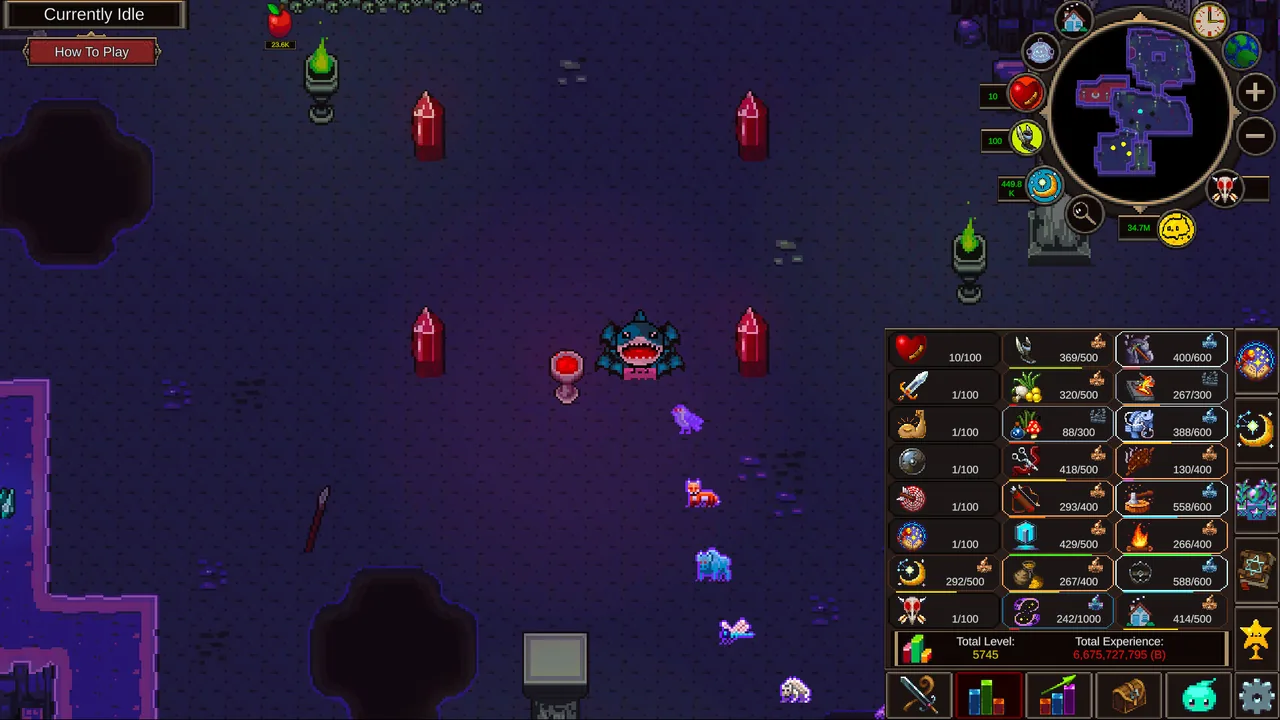
Bloobs Adventure IdleImage: Bloobs_Dev via Steam -
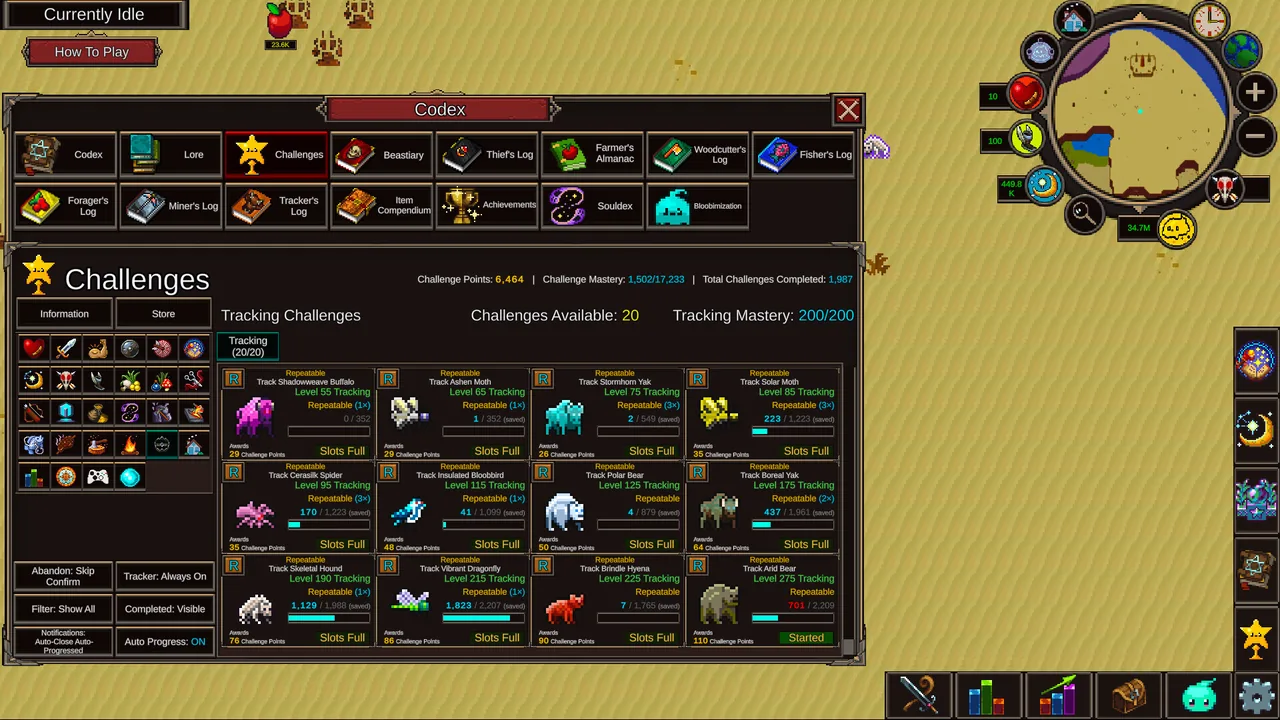
Bloobs Adventure IdleImage: Bloobs_Dev via Steam -
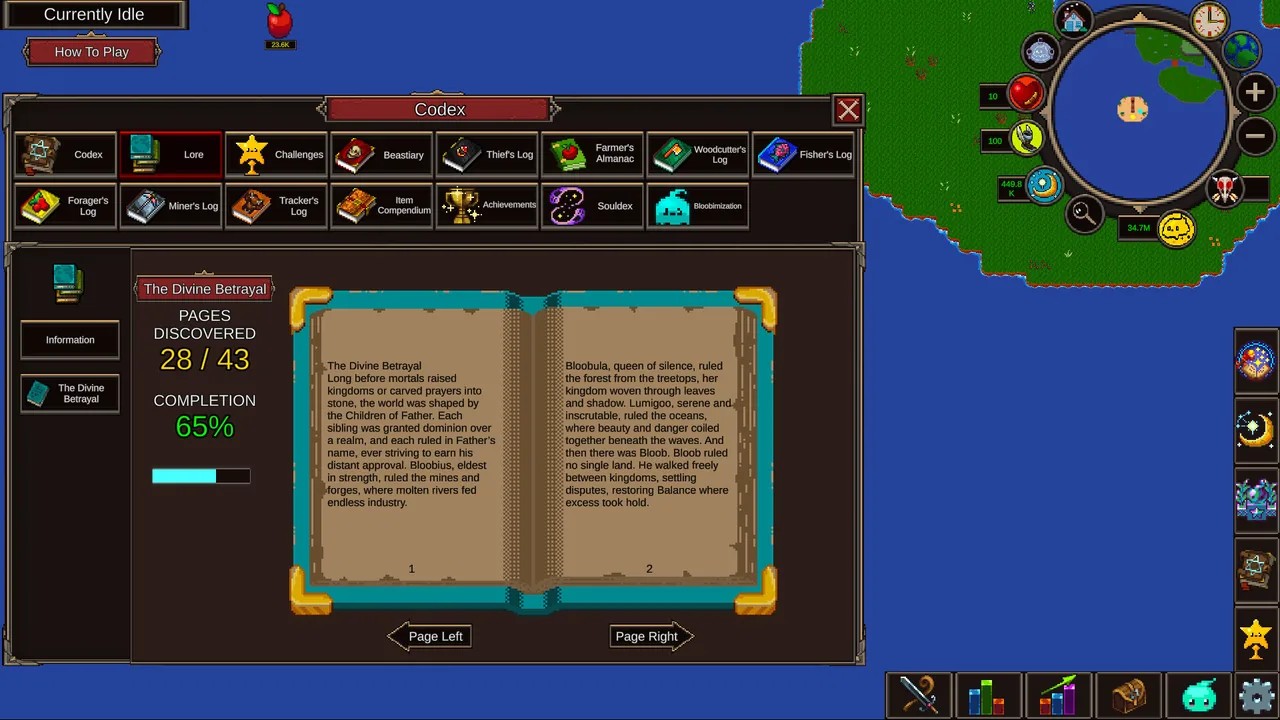
Bloobs Adventure IdleImage: Bloobs_Dev via Steam -
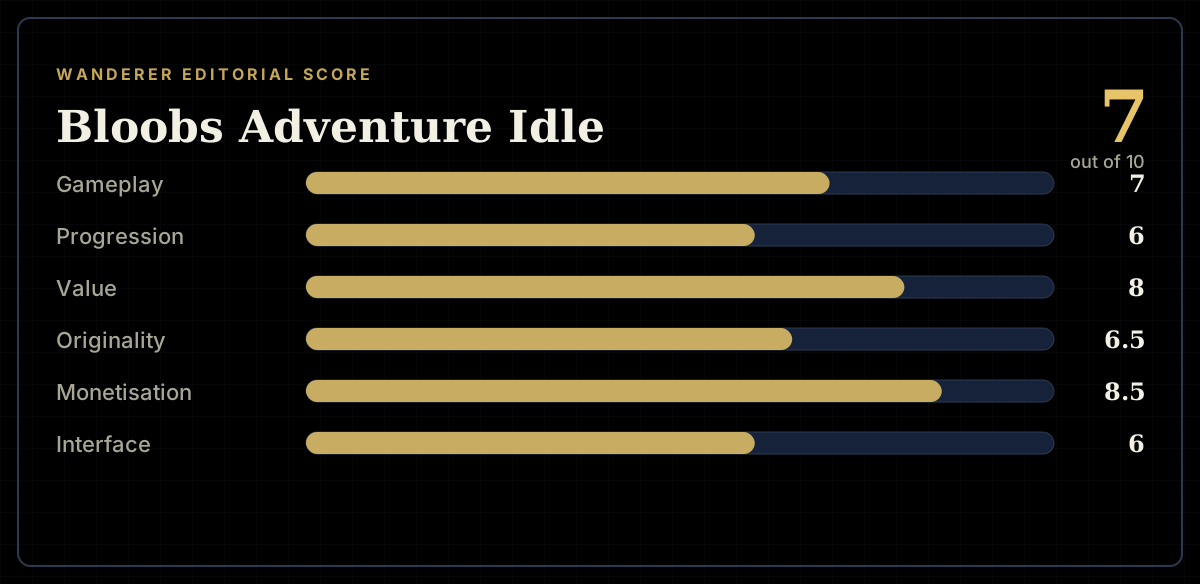
How the review scores each part of the gameWanderer Editorial -
The essentials at a glanceWanderer Editorial -
The short versionWanderer Editorial