Game review
Infinite Ruins
6.5 / 10
- Developer
- Kileka Games
- Publisher
- Kileka Games / SpaceJazz
- Released
- 27 July 2026
- Platforms
- Windows
- Genre
- Incremental / Idle Mining
- Monetisation
- One-time purchase. No in-app purchases, no ads, no currency, no DLC. Listed at NZ$8.99 with a 10% launch discount bringing it to NZ$8.09 (roughly US$5) — checked 3 August 2026.
- Players
- Single-player only
The short version
For about five hours Infinite Ruins is one of the better small incrementals of the year. Eight golem types with genuinely different elemental behaviours, chain reactions that tear through a screen of blocks, an upgrade cadence that always has something worth saving for, and pixel art with real charm. Then the story ends, the upgrade list empties, and the prestige loop that is supposed to carry it turns out to be the weakest system in the game. It's five dollars and worth five dollars — just don't buy it for the word in the title.
Biggest strengths
- The eight golem types are genuinely differentiated in behaviour — ice spreading to neighbouring blocks, lightning cutting vertically through a layer — and combining them into chain reactions is the whole appeal, executed well
- Upgrade pacing is excellent through the first several hours; there is always a next purchase worth working toward, across close to a hundred upgrades
- It idles honestly — resources keep flowing while you're away, and the automation genuinely takes over rather than teasing at it
Biggest weaknesses
- It's short. Players report finishing the story in five to seven hours, and 28% had bought every upgrade in the game within a week of release
- The prestige system is the game's load-bearing pillar and several players single it out as the reason they stopped; only 16% have gone around a second time
- Golem variety is more visual than tactical past a point — a recurring criticism is that they all resolve into damage sources rather than distinct strategies
Who it's for: Incremental players who want an evening or two of well-tuned automation and elemental synergy puzzles, and anyone who enjoys watching a screen dissolve into chain reactions. Not for players hunting a months-long idle habit, and not for anyone who needs cloud saves.
Our recommendation: Buy it at the launch price, play it over a weekend, finish the story, and stop when the upgrade list runs dry rather than grinding a prestige loop that won't reward you for it. Back up your save folder if you care about your progress — there's no Steam Cloud support, and at least one player has lost a save to an unclean shutdown.
6.5 / 10
Infinite Ruins opens with a promise it repeats in its own store copy: there is no end, only deeper layers. Seven days after release, 28% of everyone playing it had earned an achievement called Nothing Left To Buy.
That gap is the review. What sits inside it is a genuinely good small game — better made than most things at this price, with an hour or two of real delight in it — that has been marketed as an infinite one and structurally isn't.
The golems are the good idea
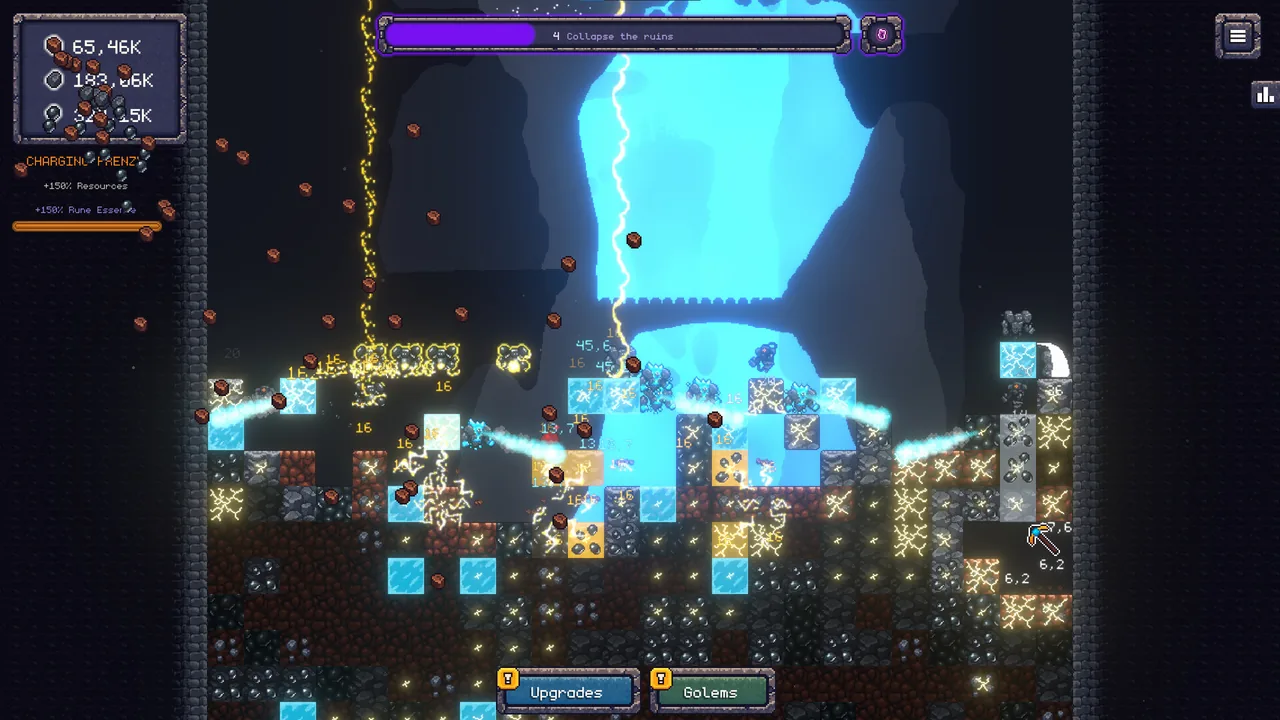
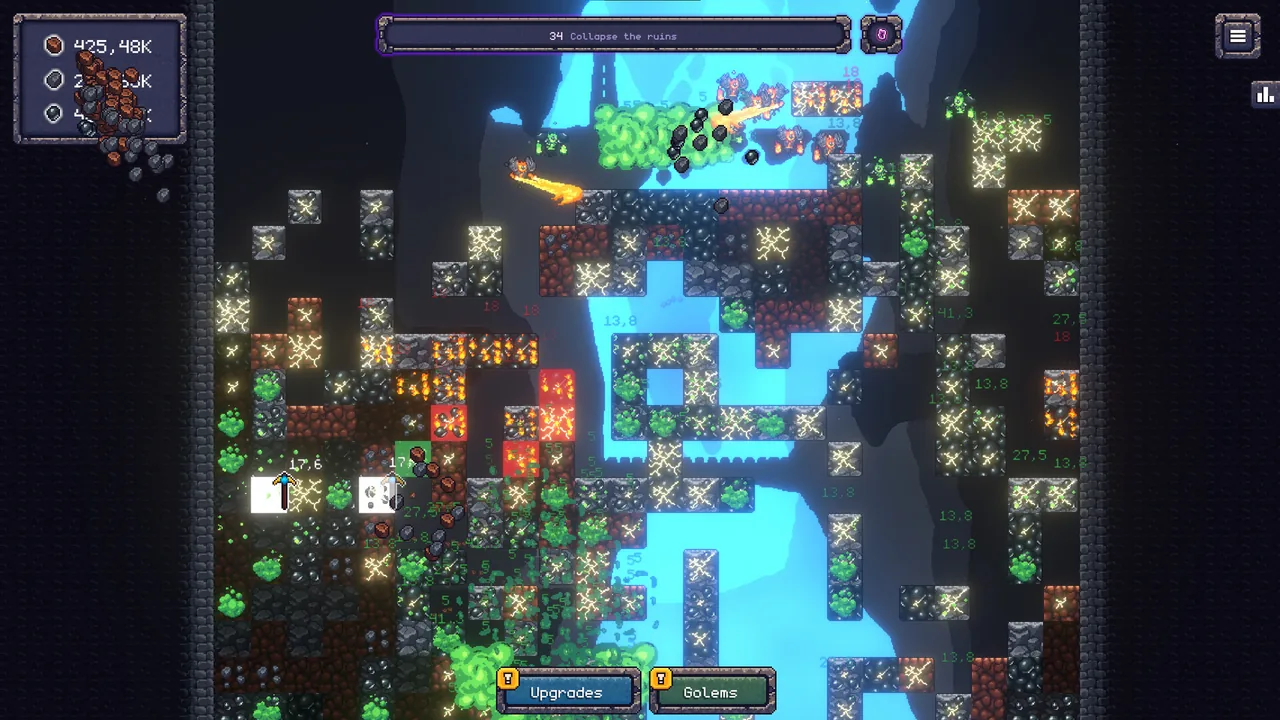
You command a team of elemental golems chewing through layers of blocks. Ice spreads to neighbouring tiles and locks them up. Fire detonates. Lightning cuts a channel straight down through a layer. Poison lingers. Eight types unlock across the run, each with its own behaviour, and the game's central pleasure is arranging them so one golem's effect feeds the next — a lightning cut that opens a seam, ice spreading along it, fire finishing the section in one detonation.
When it lands, it's excellent. The screen fills with overlapping effects, the resource counters blur, and you sit back and watch a machine you built dismantle a layer without you. That's the sensation every incremental is chasing, and Infinite Ruins gets there faster and looks better doing it than most of its shelf-mates. The pixel art is charming, the golems have personality, the audio sells the depth. For five dollars this is a lot of craft.
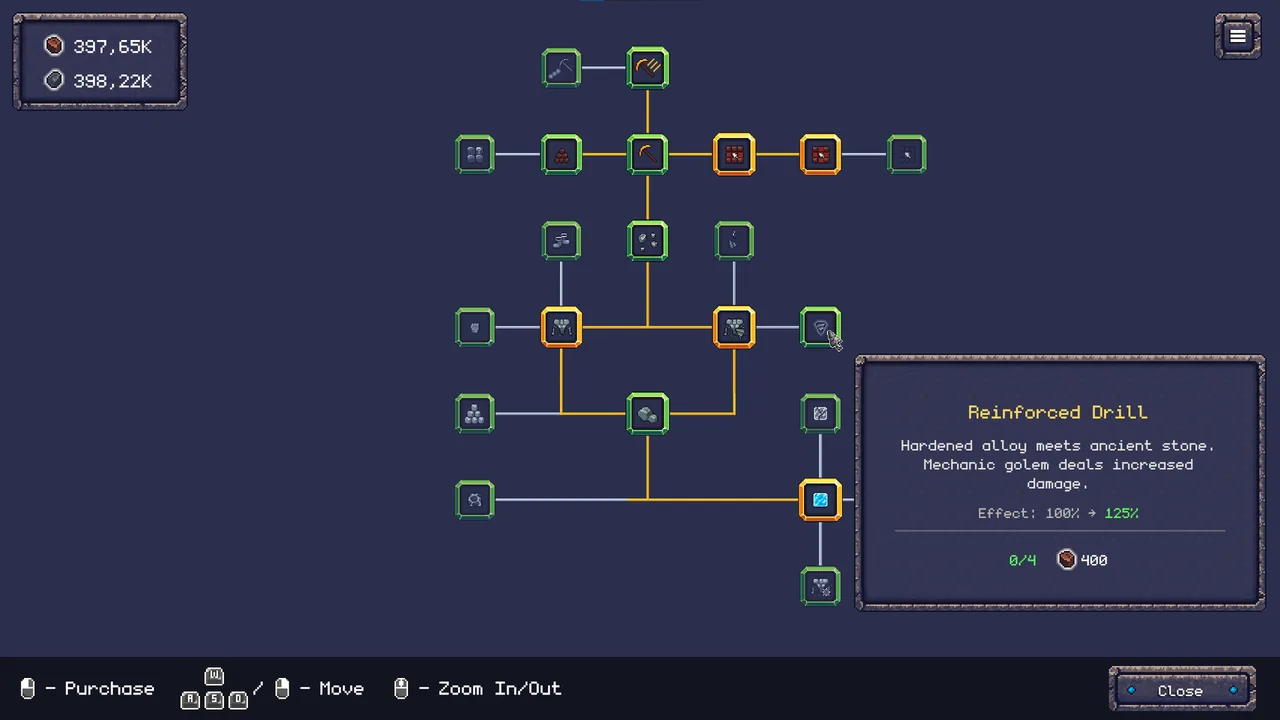
The upgrade economy holds it up for a good while too — close to a hundred upgrades, paced so there's always a next purchase within reach. Nothing about the first several hours feels cheap.
Where it stops being a design and starts being a list
The most useful criticism in the review corpus comes from a player who put it plainly: the game hints at big things and delivers tedium, and the golems stop being different from each other. That's the fault line. Early on, picking ice over lightning is a decision about how a layer will break. Later, when every golem's numbers have been upgraded into the same order of magnitude, they resolve into interchangeable damage. The elemental identity is still on screen; it just stops mattering to your choices.
It also can't settle on what it wants from you. Hand-mining loses its impact quickly, which is correct for an idle game — but random events like resource vortices still require manual intervention or they eat your materials. So the game is too automated to reward attention and too interrupt-driven to leave alone. Several reviewers describe exactly this discomfort without quite naming it.
And then there's prestige. It is the system meant to convert a five-hour game into a hundred-hour one, and it is the single most criticised thing here — one player says flatly that the prestige system is bad, another that its very presence killed their interest. The reset doesn't hand back enough to make the second descent feel meaningfully different from the first, which is the one thing a prestige loop has to do.
What the achievements actually show
This is a good case for reading a completion curve, because the 53 achievements shipped with the game rather than being added later, so nothing is skewed by an Early Access backlog.
The top of the curve is remarkably healthy: 97% clear the opening, 90% are still there at Magnate, 88% at Master of Flame. Four fifths reach The Cycle Begins — the first prestige. That is not a game people are bouncing off; compared with most launches this is deep, committed engagement, and it's the strongest objective evidence that the core loop works.
Then look where it flattens. The elemental mastery achievements sit between 38% and 48%. Perfect Control is at 37%. Nothing Left To Buy — the entire upgrade list purchased — is at 28% inside seven days. And the achievement called Again, which the naming strongly implies is a second full cycle, sits at 16%.
Read together: four out of five players prestige once, one in six does it twice, and more than a quarter have exhausted the shop already. The curve doesn't show players quitting in frustration. It shows them finishing.
The rough edges
Two technical issues come up often enough to name. Multiple players report memory leaks that make the game lag until it's restarted — one positive reviewer helpfully includes the workaround in their recommendation, which tells you both that it's real and that people are willing to live with it.
More seriously, there's no Steam Cloud support. That isn't a player's misunderstanding; the store listing's feature set confirms it. One player reports a save that stopped working after a power cut took the machine down mid-session, leaving the New Game button unresponsive. In a genre built entirely on accumulated progress, no cloud backup is a real omission rather than a nitpick, and it's the one thing here I'd expect a patch to fix first.
Verdict
Infinite Ruins is a 6.5 that could have been an 8 with a better second half. Everything before the prestige screen is well-judged: the golems, the chain reactions, the upgrade cadence, the presentation. What's missing is a reason to go back down, and no amount of polish on the descent fixes a loop that doesn't reward the second lap.
Priced at around five dollars, that's still a straightforwardly good deal — this is a better-built weekend than Market Chain 98 manages at a similar length and a similar price, and considerably prettier. Just calibrate: buy it the way you'd buy a short indie game, not the way you'd buy Melvor Idle. If the developer's promised support turns the prestige loop into an actual reason to descend again, this becomes an easy recommendation. Right now it's a very good five hours with an ambitious noun in the title.
Players who want the depth to keep going after the upgrade list empties — a world that's still adding layers a month later — may also enjoy Wanderer.
Pros and cons
Pros
- The eight golem types are genuinely differentiated in behaviour — ice spreading to neighbouring blocks, lightning cutting vertically through a layer — and combining them into chain reactions is the whole appeal, executed well
- Upgrade pacing is excellent through the first several hours; there is always a next purchase worth working toward, across close to a hundred upgrades
- It idles honestly — resources keep flowing while you're away, and the automation genuinely takes over rather than teasing at it
- Pixel art, animation and sound punch well above a five-dollar price, and the late-game screens of overlapping elemental effects are a spectacle
- Achievement data shows unusually deep engagement for a launch week: most buyers are getting well past the opening rather than bouncing
Cons
- It's short. Players report finishing the story in five to seven hours, and 28% had bought every upgrade in the game within a week of release
- The prestige system is the game's load-bearing pillar and several players single it out as the reason they stopped; only 16% have gone around a second time
- Golem variety is more visual than tactical past a point — a recurring criticism is that they all resolve into damage sources rather than distinct strategies
- It can't decide whether it's idle or active: hand-mining stops mattering early, yet random events still demand manual intervention to keep progress moving
- No Steam Cloud support, and multiple players report memory leaks that need a restart to clear
Screenshots
-
Infinite RuinsImage: Kileka Games via Steam -
Infinite RuinsImage: Kileka Games via Steam -
Infinite RuinsImage: Kileka Games via Steam -
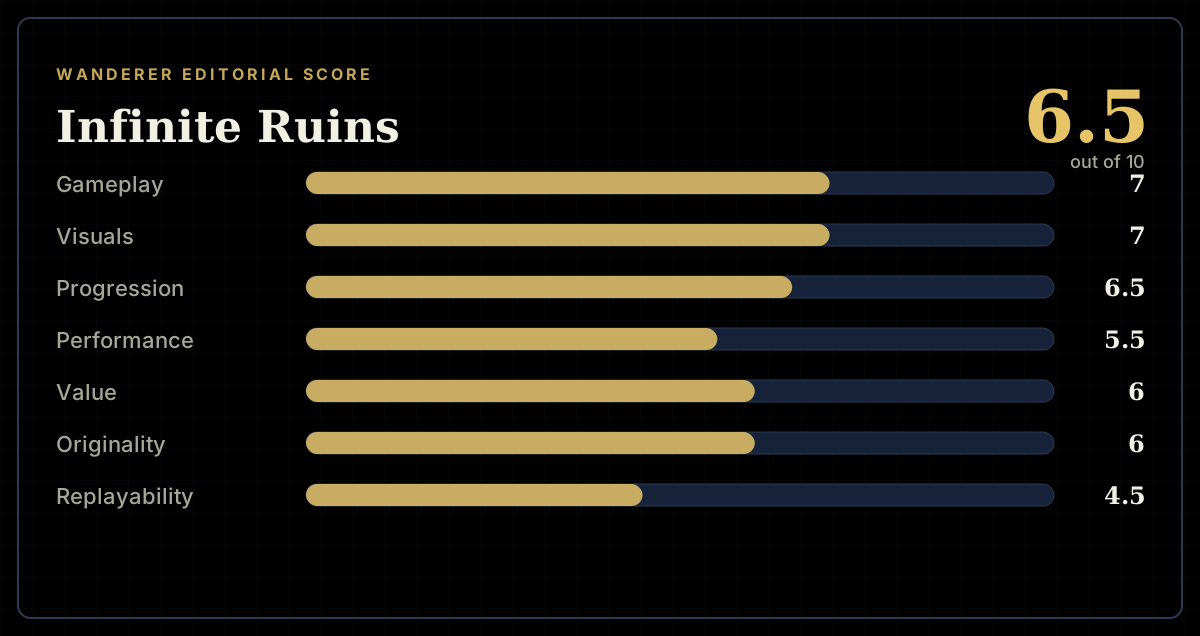
How the review scores each part of the gameWanderer Editorial -
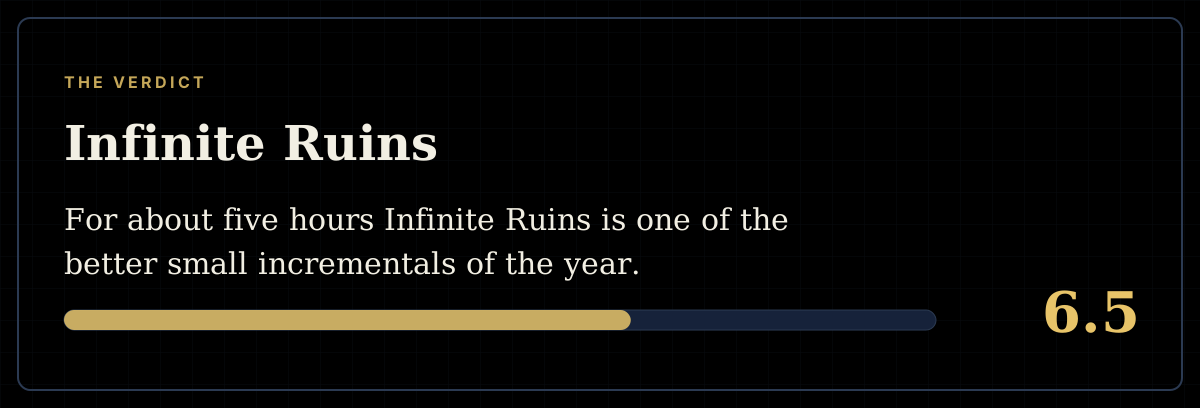
The short versionWanderer Editorial