Game review
Dragon Quest XI S: Echoes of an Elusive Age — Definitive Edition
8.5 / 10
- Developer
- Square Enix
- Publisher
- Square Enix
- Released
- 27 September 2019
- Platforms
- Windows, PlayStation 4, PlayStation 5, Xbox One, Xbox Series X|S, Nintendo Switch
- Genre
- JRPG
- Monetisation
- Premium, one-off purchase; no in-game currency, no season pass, no gameplay DLC
- Players
- Single-player
The short version
Dragon Quest XI S is the most traditional JRPG in wide circulation, and it earns that label through craft rather than nostalgia. Turn-based combat, a silent chosen hero, a world map to cross town by town — none of it is new, and the Definitive Edition doesn't try to make it new. What it does is execute the formula about as well as it's ever been executed, and back that up with a genuine second way to play the whole game in 16-bit form.
It asks for a serious time commitment and rarely tests you along the way. Random encounters almost never threaten a party that's kept pace with the story, the opening hours move slower than the game they're leading into, and the interface hasn't aged as gracefully as the orchestra has. None of that undoes what a hundred hours of sincere, unfussy JRPG design actually delivers.
Biggest strengths
- The Pep Power system turns randomly-triggered "pepped up" states into a real timing decision that rewards holding or spending a buff at the right moment
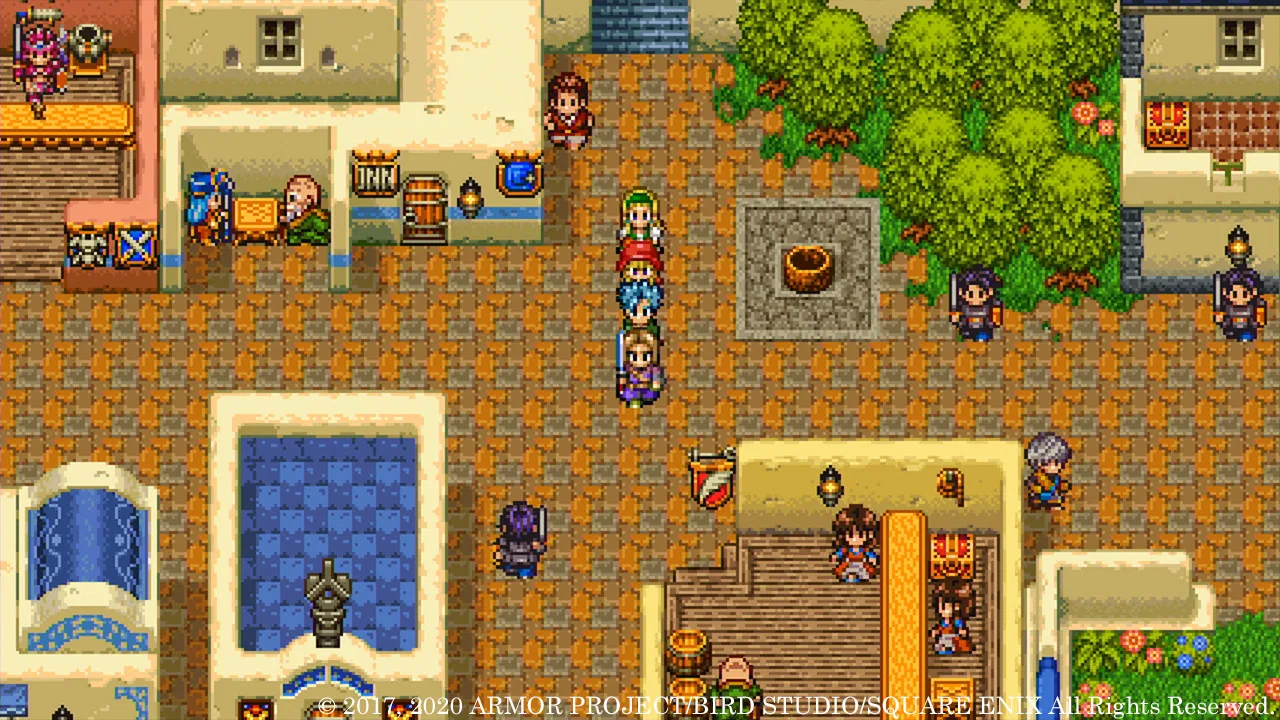
- The 2D mode is a fully separate 16-bit top-down presentation of the entire campaign, switchable at any save point rather than a graphics filter
- Definitive Edition side stories give supporting cast members like Sylvando and Rab material the 2017 original never had room for
Biggest weaknesses
- Random encounters and most non-boss fights rarely threaten a party that's kept pace with the story, leaving boss fights as the only real difficulty spike
- The opening several hours establish the world at a noticeably gentler pace than the game that follows, and several early chapters can feel like throat-clearing
- The hero stays completely silent through every major story beat even with the rest of the cast fully voiced, which flattens scenes the game is otherwise playing for real weight
Who it's for: Turn-based RPG players who want the genre played straight rather than deconstructed, plus anyone curious what an entire game looks like rebuilt as a second, 16-bit-style presentation of itself.
Our recommendation: A confident buy at NZ$59.95 if you have the hours for a 60-to-100-hour campaign and no interest in live-service systems eating into it. Turn on Draconian Quest options from the start if the base difficulty sounds too gentle — it will be.
8.5 / 10
Dragon Quest XI S doesn't argue with the JRPG format. It doesn't subvert the chosen-hero plot, doesn't restructure turn-based combat around a gimmick, doesn't ask you to question whether saving the world is worth doing. It just does the thing — a silent hero, a party of eight distinct companions, a map that opens town by town, spells and skills chosen from a menu — with a level of polish that makes the argument for you: sincerity, played straight, at this level of craft, still works. That's the whole review in one sentence, and everything below is about whether a hundred hours of it holds up under that promise.
Two games, one purchase: what "S" actually buys you
Worth settling first, because the naming is genuinely confusing. The original Dragon Quest XI: Echoes of an Elusive Age launched in Japan in July 2017 on Nintendo 3DS and PlayStation 4, then internationally in September 2018 on PS4 and Windows. Dragon Quest XI S: Echoes of an Elusive Age — Definitive Edition is a separate, expanded relaunch: Switch first in September 2019, then PS4, Xbox One and Windows together in December 2020, briefly on the now-defunct Google Stadia in 2021, and an enhanced Switch 2 version scheduled for September 2026 that hadn't shipped as of this review. On Steam, searching for the game today turns up only the S edition and its demo — the 2018 original has been superseded, and there's no version of this game for sale on any storefront that isn't S.
What the S actually adds justifies treating it as a distinct product rather than a patch: a full orchestral rerecording of the score sitting alongside the original soundtrack as a toggle, an entirely separate 2D top-down presentation of the whole game, new character-specific side scenarios, Japanese voice acting as an option, a battle-speed multiplier, the Draconian Quest difficulty system, photo mode, and the retro-styled Tickington side area. Everything below is a review of that package — nobody buys the 2018 original any more.
Turn-based combat and the one real wrinkle
Combat here is menu-driven and turn-based in the most conventional sense: pick an attack, spell or item for each character, watch the round resolve, repeat. It's comfortable rather than tense for most of the game's length, worth stating plainly rather than dressing up — this is not a combat system built to threaten a competent player who's kept their levels and gear roughly in line with the story.
The one mechanic doing real work is Pep Power. Characters randomly enter a "Pepped Up" state during tough fights, and while pepped, certain combinations of two or three party members unlock powerful combined attacks — devastating damage, full-party heals, status immunity — unavailable any other way. Pep states are semi-random and temporary, so a fight becomes a real-time judgment call: burn the window the instant it appears, or hold out hoping a second character peps up so you can chain a stronger combo before either wears off. That's a genuine decision layered on top of an otherwise unremarkable turn order, sharp enough to make boss fights — where the AI actually punishes a mistimed turn — feel like the game's only real tactical pressure. Outside of bosses, Pep states mostly turn already-easy fights into slightly faster ones. Draconian Quest options exist to close that gap, and turning a couple on from the start — no items in battle, tougher enemies, no fleeing — is the single best thing a strategically-minded player can do before starting a save.
Sixty to a hundred hours: where the pacing sags, and whether the post-game earns it
Dragon Quest XI S routinely runs 60 to 100 hours depending on how much side content and post-game a player chases, and a campaign that long has room to sag, which this one does in its opening stretch. The first several hours introduce Erdrea's geography and cast at a pace built for a slower kind of RPG than the one the mid-game turns into; players who bounce off the early chapters are bouncing off pacing choices the rest of the game doesn't repeat. Once the world properly opens up — multiple regions, a ship, a full roster of eight companions — the pacing tightens considerably and stays reasonably well-managed through the main story's climax.
The post-game is where the difficulty conversation resolves itself. A story campaign that never seriously threatens a competent player hands off, after the credits, to superbosses that demand a completely different investment: deliberate grinding, optimised Pep combos, and equipment most players wouldn't have bothered chasing on a story-focused run. It's a legitimate answer to "where's the challenge," but it's a steep cliff rather than a ramp — abrupt enough that it reads as content for players who came in planning to stay, not a natural extension of the difficulty curve everyone else just experienced.
The 2D mode: a genuine second way to play, not a novelty
The 2D mode is the strangest and most interesting thing about this release, and it's worth taking seriously rather than filing under "nice bonus." Switchable at any save point, it re-renders the entire game — every town, every dungeon, every cutscene beat — as a 16-bit-style top-down JRPG in the visual lineage of the SNES-era Dragon Quest games, with its own faster overworld movement and its own arranged take on the score. This isn't a filter over the 3D assets; it's a separately built presentation of the same hundred-hour game, complete enough that a player could finish the entire campaign in 2D mode and never see the 3D one.
Whether that's a genuine second way to play or a curiosity you sample and abandon depends on what you want from the experience. As spectacle, the 3D mode's landscapes and Akira Toriyama-designed cast are the stronger showcase, and most players settle there for the long haul. As a design achievement, though, the 2D mode is the more interesting choice — full retro-JRPG traversal speed without sacrificing any story content, and a genuinely different feel to exploration that some players end up preferring outright, not as nostalgia but because it's simply faster to move through. Few games this scale bother building an entire second self-contained way to experience themselves; that this one does, well enough to be a real option rather than a tech demo, is one of the Definitive Edition's most underrated additions.
Skill panels, respeccing, and how much build freedom actually exists
Each character grows through a Skill Panel — a branching grid of nodes purchased with points earned on level-up, unlocking new abilities, stat boosts and equipment proficiencies along several themed paths per character (a Hero split between sword and spear mastery, for instance, or Jade split between martial arts and whip skills). It's a real choice system rather than a cosmetic one: which path a character walks changes what skills and stat growth they end up with, and every character's panel is shaped differently enough that build decisions feel personal to that character rather than a shared template with different names.
Respeccing exists but costs real, accumulating in-game currency, so experimentation is possible without being free. The ceiling on that freedom is lower than the deepest class systems in the genre — nobody would call the Skill Panel as expansive as a job-based JRPG's class-swapping, and there's no multiclassing or hybrid builds pulled from unrelated trees. What it offers instead is depth within a fixed identity per character: legible choices that don't require a spreadsheet to plan, which suits a game this long better than a heavier system might have.
Why sincerity works here
The chosen-hero plot, the silent protagonist, the world-in-peril stakes — none of it reinvents what a JRPG story can be, and the game never pretends otherwise. What makes it land regardless is craft applied without irony: Toriyama's character designs give every party member an immediately readable silhouette, the writing gives even minor NPCs enough specific detail that towns feel inhabited rather than staged, and the plot's mid-game turn — genuinely one of the more memorable structural surprises the series has pulled off — earns its impact because the first half plays its cards straight enough that the twist actually lands. A game this committed to earnestness has no cynicism to hide behind if the execution falters, and for most of its runtime, it doesn't. That's a harder trick than deconstruction, not an easier one — subversion gets credit for cleverness even when the underlying craft is thin; playing it straight has nowhere to hide.
The one place sincerity costs the game something specific is the hero himself. Every other major character got full voice acting in the Definitive Edition, and the contrast makes his silence more noticeable than it would be in a fully-silent cast — scenes built around his reactions occasionally play a beat behind everyone else in the room actually talking.
Value: a full JRPG with nothing else to buy
At NZ$59.95, Dragon Quest XI S is priced like a standard premium release and delivers well past what that price usually buys: a 60-to-100-hour campaign, a full alternate 2D version of that same campaign, an orchestral score alongside the original, character-specific bonus content, and a completely separate retro side-area in Tickington, all in one purchase. There's no season pass, no in-game currency and no gameplay-affecting DLC to track. In a market where even single-player releases increasingly carry a premium-currency shop or a paid expansion roadmap, a game this size shipping as one flat purchase and staying that way for six years is worth stating plainly.
Where it comes up short
The honest weaknesses cluster in three places. Difficulty is the biggest: outside of boss fights and the post-game superbosses, very little in this game asks a prepared party to think, and players expecting real tension will need to opt into Draconian Quest options from the start rather than discover the challenge organically. Quest design is the second: side quests lean heavily on fetch-and-deliver structures that were already dated in 2017 and haven't been modernised for the rerelease. The interface is the third: equipment comparison, item sorting and menu navigation are clear and functional but visibly a console-era JRPG's UI rather than something built to 2020s usability standards — workable, never actively broken, but never a strength either.
Where this sits next to the rest of the genre
The useful comparison isn't Sea of Stars or Chained Echoes, even though both are also turn-based and both are reviewed here — it's the difference those two games represent. Sea of Stars and Chained Echoes are retro-styled revivals, built by small teams paying tribute to a JRPG era from outside it. Dragon Quest XI S is the genuine article: a mainline entry in a series running continuously since 1986, made by the studio that never stopped making these games, still built on the same silent-hero, turn-based, world-map structure it started with. Sea of Stars and Chained Echoes are answering "what made those old games good"; Dragon Quest XI S is simply still being one, forty years in.
Against Square Enix's own turn-based library, Octopath Traveler 0 is the more mechanically ambitious game — Break and Boost asks more of a player turn to turn than Pep Power does — while Metaphor: ReFantazio offers a genuinely deeper class-building layer than the Skill Panel attempts. Dragon Quest XI S doesn't win either argument on mechanical depth. What it wins is total absence of friction: no calendar to manage, no gacha history to account for, no checklist open world of the kind that drags down even a combat system as strong as Final Fantasy VII Rebirth's.
Verdict
Dragon Quest XI S succeeds by refusing to complicate a formula that's worked for decades, and backing that decision with genuine craft: an orchestral score worth switching on immediately, a Pep Power system that gives boss fights real tactical stakes even if regular encounters rarely earn the same tension, and a full second 2D presentation of the entire game that's good enough to be a real choice rather than a bonus mode. The Definitive Edition's additions — voice acting, side stories, Draconian Quest, Tickington — aren't padding; they're the difference between a good JRPG and one worth calling a genre landmark.
It doesn't climb higher than 8.5 because the things holding it back are real and specific rather than nitpicks: a slow opening, an interface that hasn't aged as gracefully as the score, a difficulty curve that leaves most of the game undemanding until an abrupt post-game cliff, and a silent hero who increasingly stands out once everyone around him got a voice. None of that threatens what the game gets right. Turn-based RPG players who want the format played with complete sincerity and total commitment, rather than reinvented or ironised, will find this is close to as good as that specific promise gets.
Price and platform details checked 2 August 2026.
Pros and cons
Pros
- The Pep Power system turns randomly-triggered "pepped up" states into a real timing decision that rewards holding or spending a buff at the right moment
- The 2D mode is a fully separate 16-bit top-down presentation of the entire campaign, switchable at any save point rather than a graphics filter
- Definitive Edition side stories give supporting cast members like Sylvando and Rab material the 2017 original never had room for
- Draconian Quest lets players opt into genuinely harder rules from the first save, so difficulty complaints are a choice rather than a design flaw
- Koichi Sugiyama's orchestral rerecording upgrades the entire soundtrack, not a handful of key tracks, and can be toggled against the original chiptune-adjacent score at will
- One flat NZ$59.95 purchase with no expansions, no premium currency and nothing else to buy across a 60-to-100-hour campaign
Cons
- Random encounters and most non-boss fights rarely threaten a party that's kept pace with the story, leaving boss fights as the only real difficulty spike
- The opening several hours establish the world at a noticeably gentler pace than the game that follows, and several early chapters can feel like throat-clearing
- The hero stays completely silent through every major story beat even with the rest of the cast fully voiced, which flattens scenes the game is otherwise playing for real weight
- Menus, item sorting and equipment comparison are functional rather than modern, closer to a well-organised 2017 JRPG than a genuinely refined interface
- The post-game's superbosses expect a level of grinding the main 100-hour campaign never demanded, a steep gate for players who coasted through on story difficulty
Screenshots
-
DRAGON QUEST® XI S: Echoes of an Elusive Age™ - Definitive EditionImage: Square Enix via Steam -
DRAGON QUEST® XI S: Echoes of an Elusive Age™ - Definitive EditionImage: Square Enix via Steam -
DRAGON QUEST® XI S: Echoes of an Elusive Age™ - Definitive EditionImage: Square Enix via Steam -
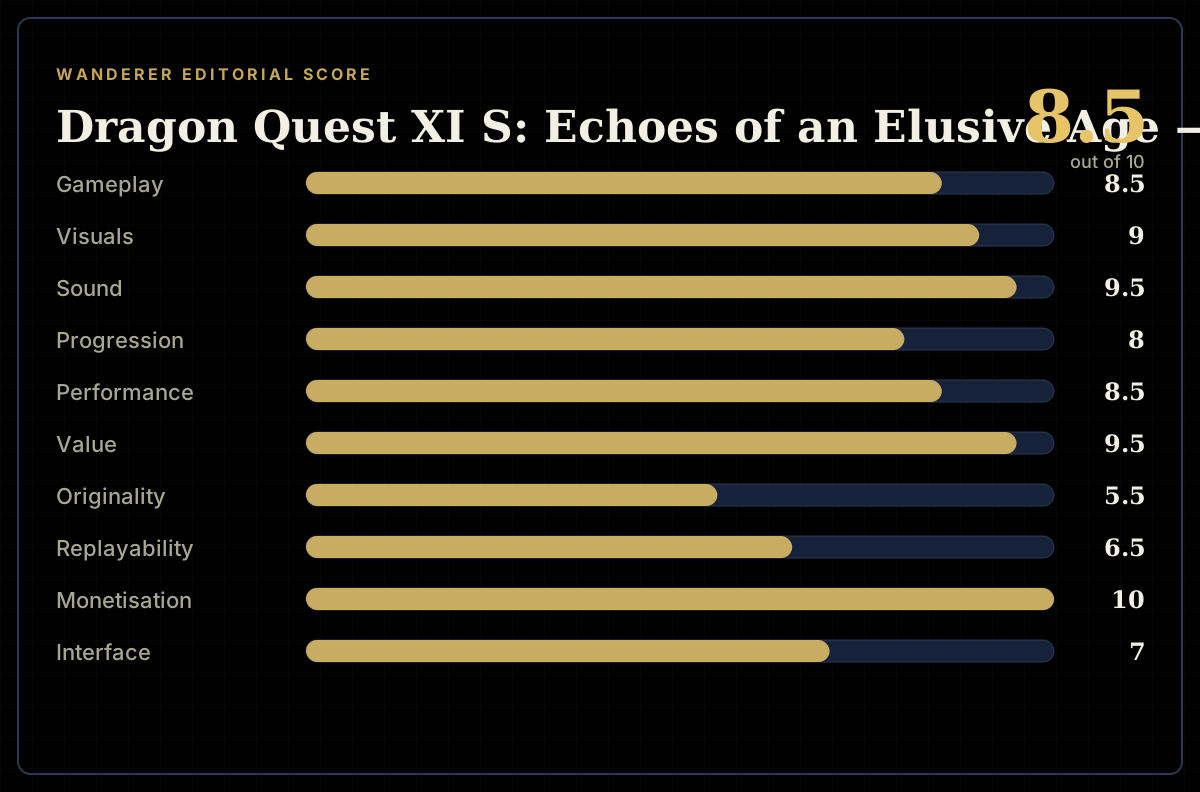
How the review scores each part of the gameWanderer Editorial -
The short versionWanderer Editorial