Game review
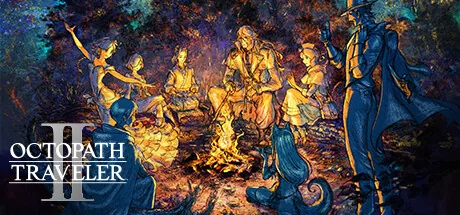
Octopath Traveler II
8.5 / 10
- Developer
- Square Enix, Acquire
- Publisher
- Square Enix
- Released
- 24 February 2023
- Platforms
- Windows, PlayStation 4, PlayStation 5, Xbox One, Xbox Series X|S, Nintendo Switch
- Genre
- JRPG
- Monetisation
- Premium, one-off purchase; no DLC or expansions
- Players
- Single-player
The short version
Octopath Traveler II keeps the Break and Boost combat that made the first game's reputation and finally builds a structure around it that treats eight protagonists as a cast rather than eight separate games sharing a save file. Crossed Paths episodes, shared banter and a genuine multi-character finale don't erase the series' habit of writing some travelers far better than others, but they turn the central complaint about the original into something this game actually answers.
Biggest strengths
- Crossed Paths episodes and constant travel banter make the ensemble feel like it's actually traveling together, and the story converges on a real shared finale instead of eight endings
- Break and Boost combat is as sharp as ever, and Latent Powers give each traveler a late-game trump card without breaking the turn economy that makes the system work
- Every traveler's two Path Actions change with the day/night toggle, so the same town offers a different set of tools depending on when you walk into it
Biggest weaknesses
- Recommended chapter levels routinely outpace natural playthrough progress, which turns story momentum into stop-and-grind momentum
- Story quality swings hard by traveler — two or three arcs carry real weight while others read as filler with a job title attached
- Only four of eight travelers fight at once, so half the roster sits benched in any given battle no matter how much you like them
Who it's for: Turn-based JRPG players who wanted the first Octopath's combat without its structural problem, and anyone with the patience for an eighty-plus-hour campaign built on chapter-gated leveling.
Our recommendation: A clear step up from the original and worth the asking price for anyone already sold on turn-based JRPGs. At its current discount it's one of the stronger value propositions in the genre right now.
8.5 / 10
The first Octopath Traveler had one persistent problem, and it wasn't the combat. It was that eight protagonists ran eight almost entirely separate stories, occupying the same party without ever really occupying the same narrative. You could clear the whole game and never see two of your travelers exchange a line of dialogue that mattered. Octopath Traveler II is a sequel built by a team that clearly heard that complaint, and the difference shows in almost everything it does differently from the first game.
Developed once again by Acquire with Square Enix's Creative Business Unit 2 and published by Square Enix, Octopath Traveler II launched on Switch, PlayStation 4, PlayStation 5 and Windows in February 2023, with Xbox One and Xbox Series X|S versions following in June 2024. It's a premium, single-player, story-driven JRPG with no DLC, no subscription and no live-service layer of any kind — you buy it once and that's the whole transaction. That plainness is worth stating up front, because so much of the genre now ships with season passes and cosmetic shops that a game without either feels almost old-fashioned.
An ensemble that finally behaves like one
Octopath Traveler II's answer to the original's structural flaw is a system called Crossed Paths: scripted two-character episodes that pair up travelers who wouldn't otherwise interact, giving each pairing its own short story beat outside their main chapters. It's supplemented by constant low-key travel banter as your active party walks the world map, and by a late-game convergence where the eight separate plots actually meet at a shared climax instead of resolving in isolation.
None of that erases the fact that this is still eight writers' rooms working on eight characters of wildly uneven quality. Some arcs carry genuine weight — the mercenary Throné and the scholar Osvald are the two travelers whose stories consistently get singled out for actually engaging with morally messy territory. Others lean hard into archetype, and at least one traveler's plot reads as written for a much younger audience than the rest of the cast, which creates a tonal whiplash the game never quite resolves. Crossed Paths papers over some of that unevenness by forcing characters to react to each other, but it can't rewrite a weak individual arc into a strong one.
What it does do, convincingly, is fix the actual complaint. This isn't eight games in a trench coat anymore. Fans of the original noted, correctly, that the strongest evidence of the fix arrives in the final stretch, when the cast is finally sharing scenes with narrative stakes rather than just walking in a line together — a payoff that's real, even if it arrives later than it should. If you bounced off the first Octopath specifically because its cast never earned the word "party," this is the sequel that answers that objection directly rather than shrugging at it again.
Break and Boost, now with a clock attached
The combat hasn't been reinvented, and it didn't need to be. Every enemy has hidden elemental or weapon-type weaknesses; landing enough hits against the right ones breaks their shield and opens a window where they take extra damage and lose a turn. Boost Points let you bank an extra use of any skill or attack, so nearly every turn is a small bet: spend now for immediate pressure, or hold for the turn that actually breaks the enemy open. It's still the best idea the series has, and eighty hours in, the tension between spending and saving BP hasn't gone stale the way a lot of turn-based systems do once you've seen every enemy type.
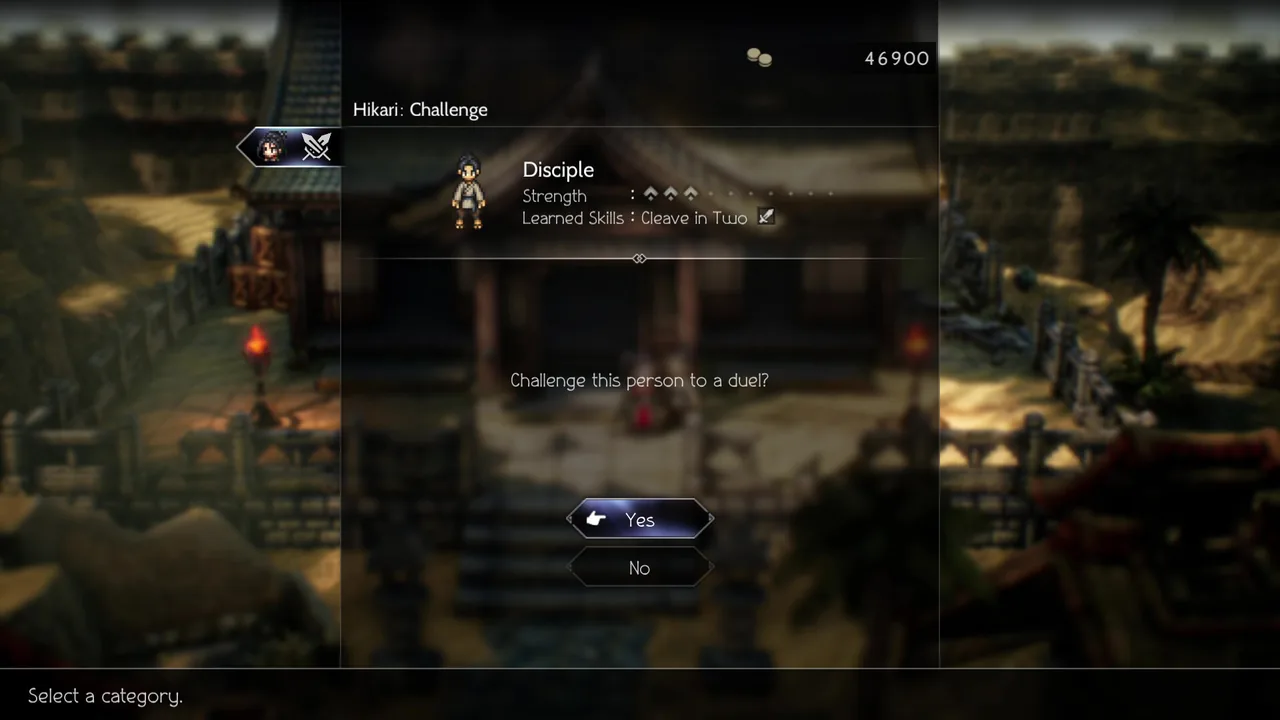
What's new is Latent Powers — a unique passive-or-active ability per traveler that charges over the course of a fight and, once full, can swing a losing battle in a single turn. They're well-judged additions: strong enough to matter, gated tightly enough that they don't turn every boss fight into a formality. The bigger structural addition is the day/night toggle, which you can flip at will outside combat. It changes which NPCs are on the street, what shops are open, and — more interestingly — which of each traveler's two Path Actions is actually usable. A merchant who can buy goods from townsfolk by day might need to challenge them to a duel for the same items after dark; a thief who can steal openly at night has to work by stealth in daylight. It's a system-level choice rather than a cosmetic one, because it means the same street corner is effectively two different puzzles depending on when you arrive.
Path Actions and the job system: real freedom, not a menu of flavors
Every traveler carries two Path Actions total — one usable by day, one by night — and they're not interchangeable window dressing. Guiding an NPC away from their post, challenging one to a fight, scrutinizing them for hidden items, or purchasing goods below market rate are all genuinely different tools that open different routes through a town, and stacking travelers with complementary actions changes what your party can actually accomplish before you've fought a single battle.
The job system underneath is where the build freedom actually lives. Starting jobs are fixed to each traveler, but secondary jobs are earned from shrines scattered across the map and can be assigned freely, meaning any traveler can eventually pick up any support role, any elemental damage type, any utility skill in the game — the combination is yours to choose, not the character's backstory. It's a real system, not a cosmetic skin over a fixed skill list, and it's the reason party composition stays interesting well past the point where most JRPGs have settled into a fixed lineup.
HD-2D as a tool, not just a look
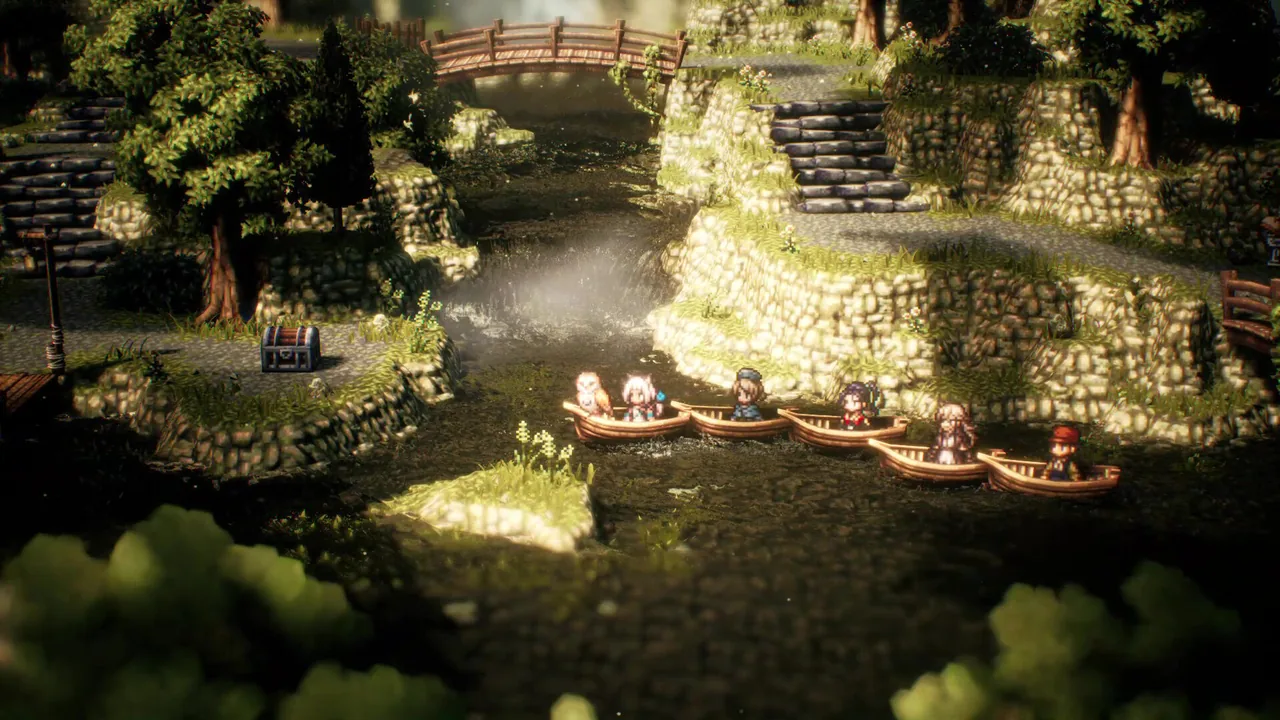
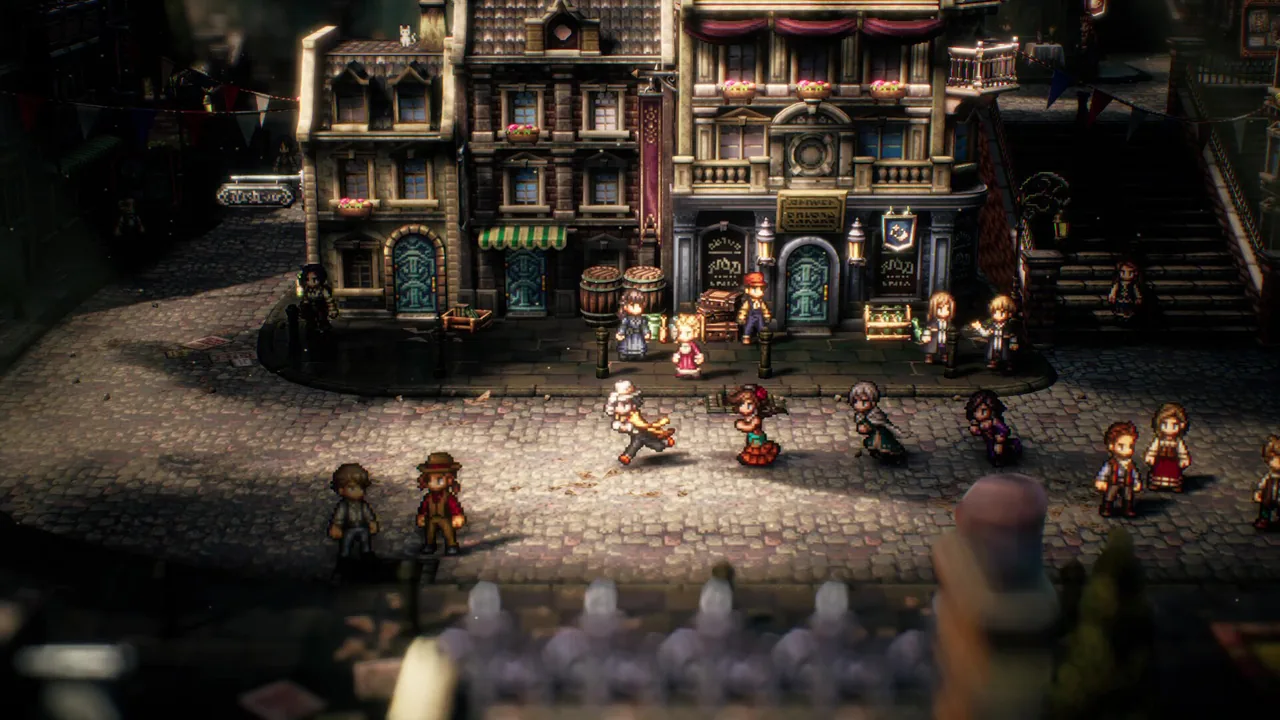
It's easy to talk about HD-2D purely as an aesthetic, but the style is doing functional work here. The layered lighting and depth-of-field separate interactive elements from background clutter more clearly than the original managed, which matters in towns dense with NPCs who may or may not be relevant to a Path Action. Diorama-scale environments read clearly at a glance because the lighting tells you where to look before you've consciously scanned the screen. The soundtrack, again composed by Yasunori Nishiki, is a clear strength in combat specifically — the stakes of a Break land harder with the right sting underneath them — though a fair amount of player feedback settles on it being a shade less immediately memorable than the first game's score, a "difficult act to follow" problem more than a decline in quality.
The grind the story keeps tripping over
Here's the honest part. Octopath Traveler II gates its story chapters behind recommended levels, and those recommendations routinely sit ahead of where a player following the main path naturally lands. The result is a familiar JRPG rhythm broken in an unfamiliar place: instead of grinding before a hard boss, you're grinding between story beats just to be allowed into the next one. That kills momentum in exactly the sections where the newly improved narrative structure is trying to build it. It's also the most consistently repeated criticism among players who otherwise rate the combat and presentation highly — frequent random encounters stretching already-long individual fights across a campaign that easily runs past eighty hours.
There's a second, quieter cost to the eight-traveler structure that Crossed Paths doesn't solve: you only ever field four characters in combat. Recruiting and bonding with all eight is the narrative pitch, but in any given fight, half your roster is sitting on the bench. The job system gives you a reason to rotate people through, but it doesn't change the fact that a cast this large, in a battle system built for four, means somebody's favorite traveler is always watching from the sidelines.
What the price actually buys
At full list price this sits at the top of the JRPG market, and there's no arguing around that — it's a big single-player purchase with an eighty-hour-plus expectation baked in. What it doesn't do is nickel-and-dime you afterward: there's no DLC, no expansion pass, nothing to buy once you've bought the game. At its current discount, the hours-per-dollar math is straightforwardly good for anyone who already knows they like turn-based JRPGs. For anyone unsure, that's still a lot of upfront cost and time to gamble on a maybe — this isn't a game that rewards a cautious dabble, it rewards a real commitment.
Final verdict
Octopath Traveler II takes the series' best mechanical idea, leaves it essentially intact, and finally builds a story structure worthy of it. Crossed Paths, constant travel banter and a real convergent finale don't make all eight travelers equally well written — they don't, and the gap between the best arcs and the weakest is still wide — but they solve the specific problem that defined criticism of the first game: eight strangers sharing an inventory instead of a story. The day/night Path Action system and the open job structure give it more systemic depth than its predecessor, and HD-2D continues to earn its reputation as something more than a pretty coat of paint.
The grind between chapters and the sheer size of the commitment are real costs, and a party system that only ever uses half its cast at once undercuts the "get attached to everyone" pitch a little. Neither is enough to undo what the sequel gets right. If the original's disconnected structure was the thing keeping you out, this is the version that removes that excuse. Readers who want the series' emotional throughline without the mobile-game DNA still audible in Octopath Traveler 0 should start here instead — this is the entry built console-first, from the ground up. Anyone drawn to turn-based parties with a genre-savvy sense of pacing might also want to look at Chained Echoes or Sea of Stars for shorter, tighter takes on the same broad idea, or Dragon Quest XI S for a JRPG willing to spend even more of your time on a single unified cast rather than eight separate ones.
Pros and cons
Pros
- Crossed Paths episodes and constant travel banter make the ensemble feel like it's actually traveling together, and the story converges on a real shared finale instead of eight endings
- Break and Boost combat is as sharp as ever, and Latent Powers give each traveler a late-game trump card without breaking the turn economy that makes the system work
- Every traveler's two Path Actions change with the day/night toggle, so the same town offers a different set of tools depending on when you walk into it
- HD-2D's layered lighting does real legibility work, making interactive townsfolk and points of interest readable at a glance rather than just decorative
- A single upfront price with no DLC, battle pass or live-service layer sitting behind it
Cons
- Recommended chapter levels routinely outpace natural playthrough progress, which turns story momentum into stop-and-grind momentum
- Story quality swings hard by traveler — two or three arcs carry real weight while others read as filler with a job title attached
- Only four of eight travelers fight at once, so half the roster sits benched in any given battle no matter how much you like them
- Random encounter frequency remains the most consistent complaint from players who otherwise rate the combat highly
- No New Game Plus mode gives a finished save little reason to be reopened
Screenshots
-
OCTOPATH TRAVELER IIImage: Square Enix via Steam -
OCTOPATH TRAVELER IIImage: Square Enix via Steam -
OCTOPATH TRAVELER IIImage: Square Enix via Steam -
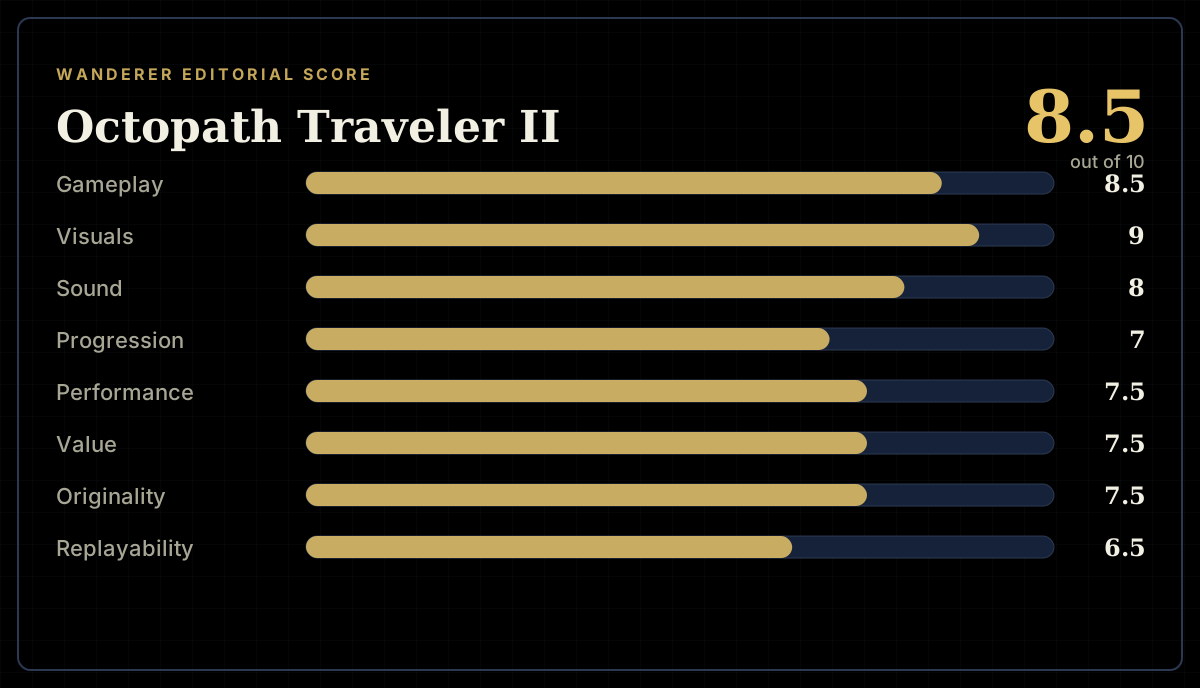
How the review scores each part of the gameWanderer Editorial -
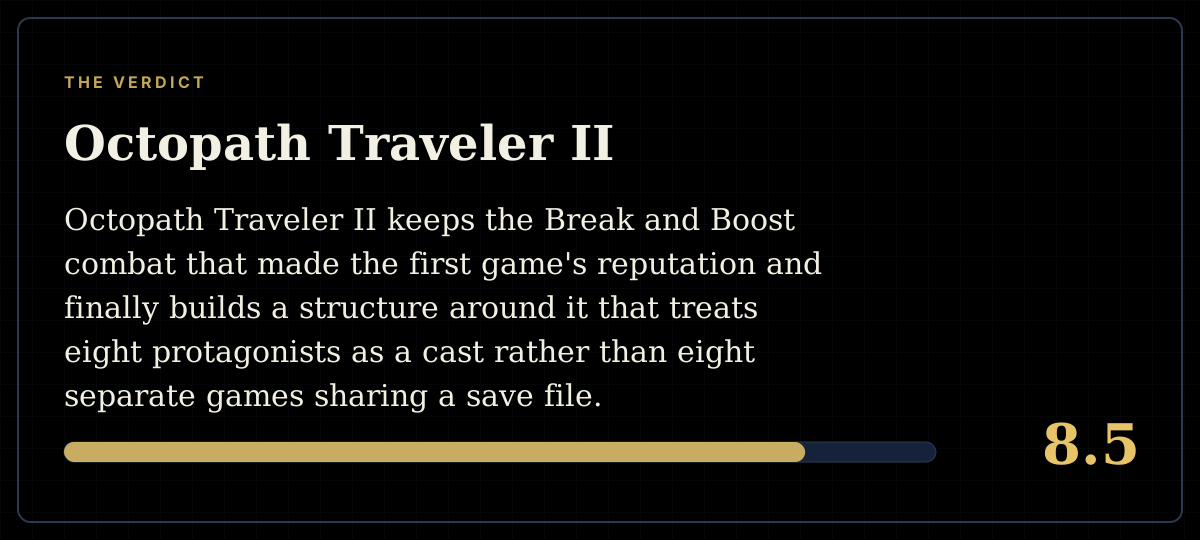
The short versionWanderer Editorial