
Game review
Persona 5 Royal
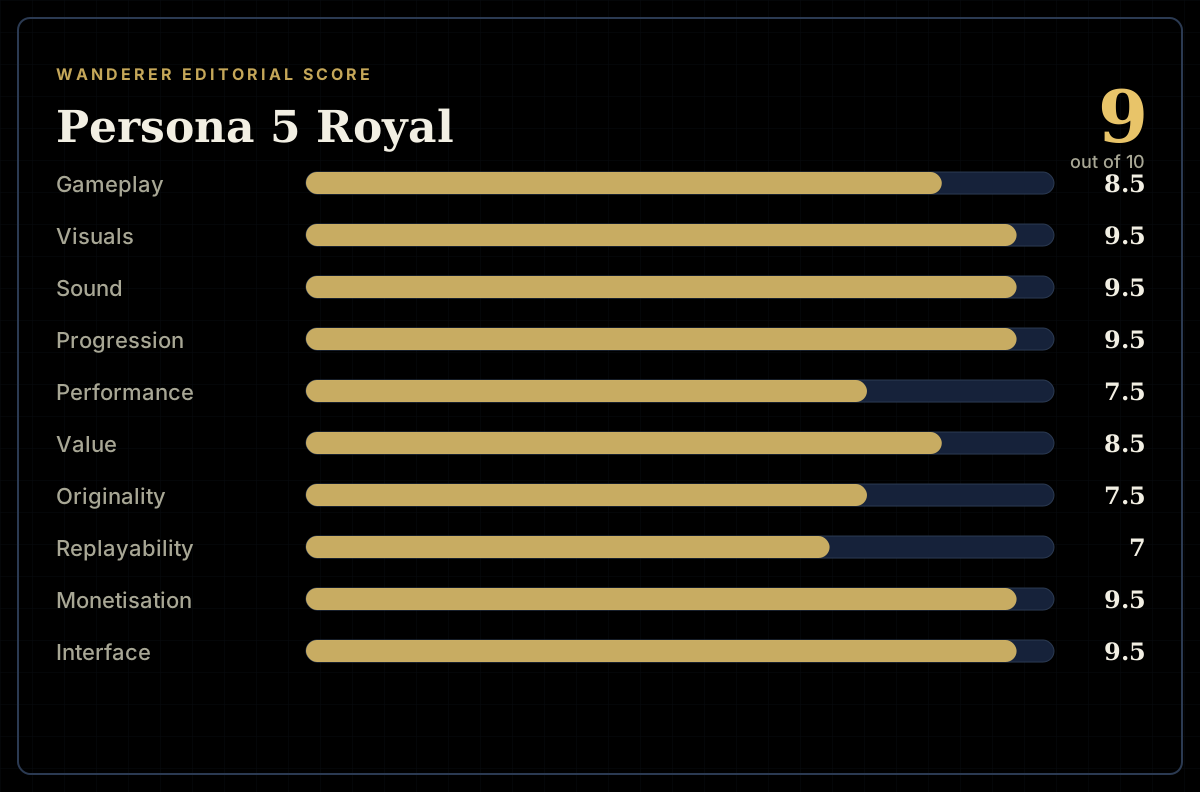
9 / 10
- Developer
- ATLUS
- Publisher
- SEGA
- Released
- 31 October 2019
- Platforms
- Windows, PlayStation 4, PlayStation 5, Xbox One, Xbox Series X|S, Nintendo Switch
- Genre
- JRPG
- Monetisation
- Premium, one-off purchase; over 40 items of DLC sold separately on the original PS4 release are bundled into the price on every platform Royal shipped on afterward, and a Merciless difficulty option was added later as free DLC
- Players
- Single-player
The short version
Persona 5 Royal gets discussed as a fashion statement more often than as a system, and that undersells what it actually built. The calendar governing every in-game day is a genuine resource-allocation engine — dungeon progress, confidant relationships and stat grinding all draw from the same finite pool of evenings, and confidants aren't a dating-sim layer bolted onto the RPG, they're where your combat abilities and fusion bonuses come from. Baton Pass turns the series' weakness-exploit combat into a team-wide tempo system that still has teeth a hundred hours in, and the interface isn't just stylish, it's some of the most functional UI design turn-based RPGs have ever shipped with.
It's also long even by JRPG standards, slow to open, and its Mementos dungeon is a repeating corridor the game keeps pulling you back into because it's the fastest way to grind. The calendar's opportunity-cost pressure quietly rewards knowing the optimal route in advance, which pushes players toward guides rather than genuine improvisation on anything but a blind first run. And a handful of scenes — sexual harassment played for comedy early on, chief among them — sit oddly next to a story explicitly about confronting abuses of power. None of that unseats what the Confidant system and the calendar built around it accomplish; it's still one of the best-designed JRPGs of its console generation.
Biggest strengths
- Baton Pass turns the weakness-exploit loop into a team-wide tempo system, stacking buffs across passes until an all-out attack detonates
- Confidant ranks gate real fusion bonuses and combat skills, so choosing who to spend an evening with is a build decision, not just a relationship meter
- The interface's diagonal type, sudden colour blocks and needle-drop menu stings make a status screen as engaging to look at as a boss fight
Biggest weaknesses
- The opening ten-plus hours front-load tutorial pop-ups and restrict free movement long after a player has already understood the system being explained
- Mementos stays a repeating procedural corridor with palette-swapped floors, and because it's the fastest way to grind, the game keeps pulling you back into its worst space
- The two-activity-per-day calendar rewards knowing the optimal confidant-and-stat route in advance, and guide-following becomes the path of least resistance on anything but a blind first run
Who it's for: Turn-based JRPG players willing to commit sixty-plus hours to a single campaign, and anyone curious how a life-sim calendar and a dungeon-crawling RPG can be built as one interlocking system rather than two separate games glued together.
Our recommendation: A confident buy at NZ$107.95 if a hundred-hour turn-based RPG with a real time-management layer sounds appealing rather than exhausting. Players unsure about that time commitment should treat the slow opening ten hours as the actual demo before deciding — the game doesn't show its real hand until the calendar pressure kicks in.
9 / 10
Most coverage of Persona 5 Royal spends its word count on the UI and the style, and both deserve it — but neither is the reason the game holds up a hundred hours in. The reason is duller to describe and harder to build: every single day in the game's calendar is a finite resource, and almost everything else in the design exists to make that resource actually scarce. Push a dungeon this week and a confidant relationship stalls. Study for an exam and you lose the evening you needed to raise a stat gating a different confidant entirely. The game hands you a fixed number of days before each Palace's deadline and never apologises for how little that is. Everything else — the combat, the Persona fusion, the school-life sim trappings — is downstream of that pressure.
What Royal actually is, and isn't
Persona 5 released on PlayStation 3 and PS4 in 2016/2017 and never left PlayStation — it's still sold today as its own PS4 product, separate from Royal, for anyone who wants the original cut. Royal is not a graphical remaster or a cosmetic edition of that game; it's a substantially rebuilt version with a new playable character and confidant (Kasumi Yoshizawa, whose arc becomes considerably more complicated than the trailers suggested), a new city district to explore, reworked Palace content, new combat mechanics, and an entire additional playable arc — the third semester — that doesn't exist in the original at all. It launched on PS4 first, in Japan in October 2019 and worldwide the following March, then reached Windows, Nintendo Switch, PlayStation 5 and Xbox in October 2022, which is also when every platform outside PS4 got its first Persona 5 experience at all. Two other games share the Persona 5 name and neither is this one: Persona 5 Strikers is a real-time musou action spin-off, and Persona 5 Tactica is a tactics game built around a completely different combat system. This review covers Royal alone.
The calendar as a resource-allocation problem
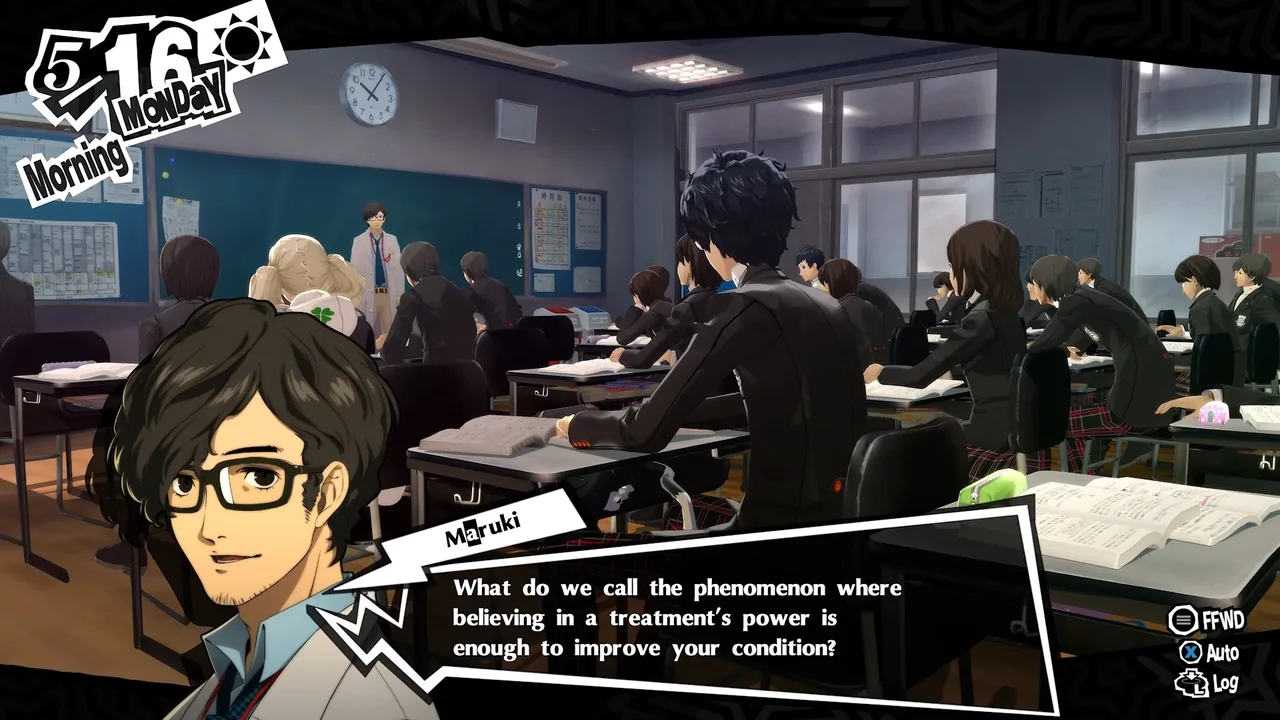
Structurally, each day gives you one daytime slot and one evening slot, spent against a fixed deadline before the current Palace's deadline expires. That's the entire game in miniature: dungeon crawling costs in-game days, confidant hangouts cost a slot each, and the part-time jobs and study sessions that raise the stats gating which confidants you can even approach cost slots too. There's no way to max out all three tracks in a single playthrough, and the design wants you to feel that scarcity rather than paper over it with generous slack.
Whether that pressure produces genuine decisions or just optimisation anxiety depends heavily on how you're playing. On a first, unspoiled run, the trade-offs are real: you don't know yet which confidant unlocks which fusion bonus, so choosing to spend an evening with one character over another is a guess with a real cost attached, and that uncertainty is where the system is at its best. The trouble shows up on repeat exposure to the genre's structure, because the optimal route through Royal's calendar is now extremely well documented, and the game itself does nothing to discourage checking it — there's no in-fiction penalty for planning your entire year around a spreadsheet, only a mechanical one for guessing wrong. That turns a system built to feel like meaningful scarcity into, for a large share of its audience, a checklist executed against a guide. The design deserves credit for making the scarcity real in the first place; it just can't fully control what players do with that information once it's public.
Confidants are a combat build, not a subplot
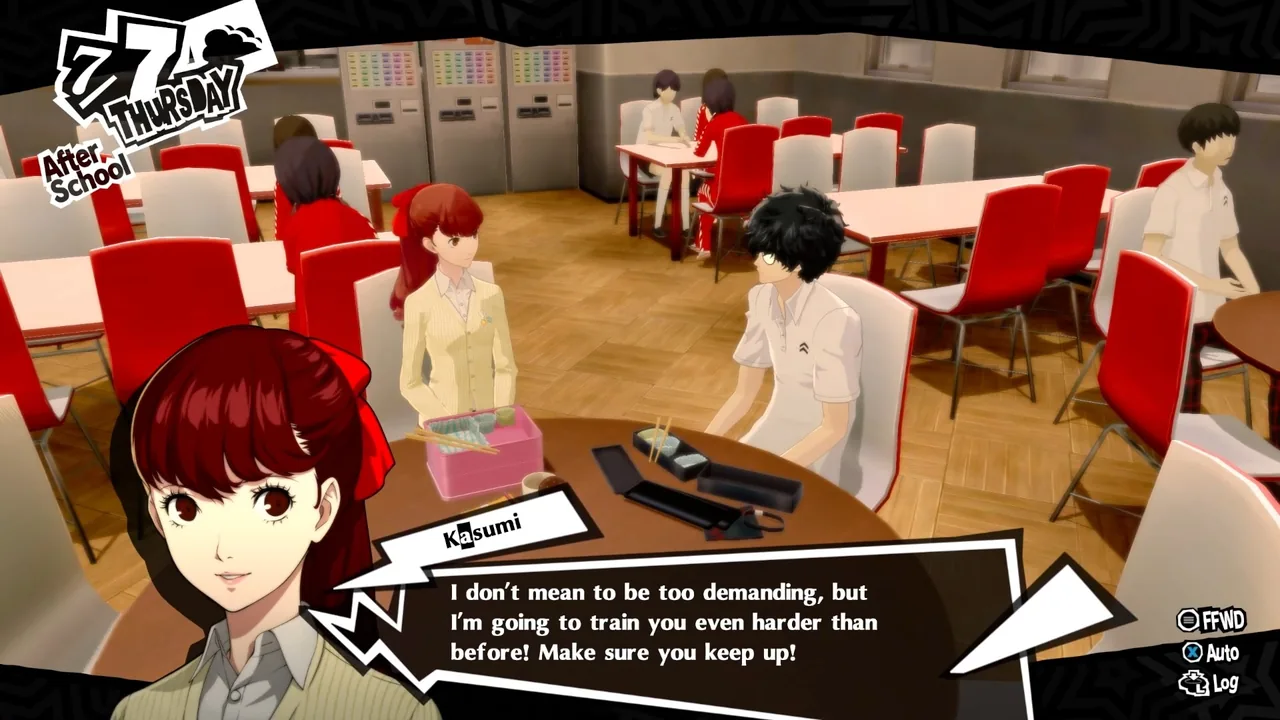
The confidant system is the piece most reviews treat as story dressing, and that undersells what it's actually doing mechanically. Ranking up a confidant doesn't just unlock dialogue — it grants specific combat abilities, unlocks stronger fusion results for Personas linked to that arcana, and in several cases gates skills your party can't get any other way. Choosing who to spend an evening with is functionally choosing which part of your build to invest in next, which is exactly why the calendar's opportunity cost matters as much as it does: skipping a hangout isn't skipping a scene, it's skipping a permanent mechanical unlock. Players who treat the confidant list as pure story content are leaving real combat power on the table, and the game is quietly built around punishing that assumption.
Combat: One More, Baton Pass, and a hundred hours of the same idea
The core combat loop — hit an enemy's elemental or physical weakness, knock them down, spend a bonus turn — was already in the original Persona 5. Baton Pass is Royal's addition on top of it, and it's the mechanic that keeps the loop from going stale across the campaign's full length. Instead of spending a bonus turn immediately, you can hand it to a teammate, who gets a stacking stat boost that grows with every pass down the chain before someone finally cashes it in on an attack. Chained well, a single successful weakness read early in a turn can cascade into the whole party acting at massively boosted stats, which turns "read the weakness chart" from a one-time payoff into a chain-optimisation puzzle that rewards planning several moves ahead rather than reacting turn by turn. Layer in Showtime attacks — powerful dual finishers between specific confidant-linked pairs, unlocked through story progress — and the combat has enough moving parts that late-game fights still ask something different of you than early-game ones did, which is more than a lot of hundred-hour RPGs can claim.
Palaces earn their design budget; Mementos doesn't
Each Palace is a hand-built dungeon themed entirely around its target's psychology — the layout, the puzzles, the guard patterns and even the platforming gimmicks all reinforce the same idea about who that person is and what they're hiding. It's some of the most thematically coherent dungeon design the genre has produced, and Royal's new grappling hook adds a verticality option that makes traversing them feel less like a corridor crawl. Mementos is the opposite: a procedurally generated, palette-swapped tunnel system that exists mainly because the game needs somewhere to put grinding and side-quest fetch targets. It's also the fastest route to levelling up, so the design keeps pulling you back into its least interesting space purely because it's efficient — a trade-off the hand-built Palaces never have to make.
The interface is function, not decoration
Persona 5's UI gets called stylish so often that it's worth stating plainly what it actually does: it compresses an enormous amount of simultaneous information — party HP and SP, turn-order, weakness data, calendar deadline, confidant status — into screens that stay legible at a glance, using colour and motion to draw the eye exactly where a decision needs to be made. The diagonal typography and sudden red-and-black colour blocks aren't just branding; they're doing the same job a well-designed dashboard does, just with more personality than the genre usually allows itself. Few RPGs this systems-dense manage to keep every screen this readable, and it's the reason the game's other systems can be as dense as they are without the interface becoming the bottleneck.
The third semester, and who has time for this
Royal's headline addition is a full third playable semester that opens up after what used to be the original game's ending, built around a new confidant, a new Palace, and a genuine branch in how the story resolves. It's a substantial, well-constructed addition rather than an epilogue tacked on to justify the re-release, and it gives the back half of an already enormous campaign real new stakes instead of just extending the credits. The honest cost is length: this was already one of the longest turn-based JRPGs in wide release before Royal added a full extra arc on top, and the calendar structure that makes early hours feel purposeful means there's no way to speed-run past the slow parts without also skipping mechanical progression. Dragon Quest XI S asks for a comparable time commitment without any of this calendar management sitting on top of it; if the appeal is a long, traditional turn-based campaign and the scheduling layer sounds like a chore rather than a feature, that's the easier hundred hours to spend.
It's also worth being direct about who this design lineage belongs to. Metaphor: ReFantazio, from the same core team, took this exact calendar-and-relationships structure and rebuilt it around an original fantasy setting and its own Archetype class system years later. The comparison isn't about which game does the calendar better — they're solving slightly different problems, since Metaphor's followers feed a class tree and Royal's confidants feed skills and fusion — but it does confirm the calendar here isn't incidental to Persona 5's identity. It's the mechanic ATLUS's own developers considered worth building an entirely separate game around afterward.
Where the writing doesn't live up to its own themes
The story's central argument is about resisting corrupt authority and the abuse of power, and most of the time the writing backs that up. But several scenes — including sexual harassment directed at teenage party members, played for comedy rather than treated with any weight — sit badly next to that argument, and it's a criticism that's followed the game since its original release rather than fading with time. Persona 5 Royal doesn't fix this; it inherits it wholesale from the base game. It's a real flaw in an otherwise carefully constructed script, and readers sensitive to that tonal whiplash should know it's there before buying in.
Price, DLC and the PC port
At NZ$107.95 on Steam with no current discount, this is a premium purchase, but the value argument is more straightforward than most JRPGs its size: every piece of paid costume and BGM DLC sold separately on the original 2020 PS4 release is bundled into the price on every platform Royal reached afterward, there's no premium currency, and the free Merciless difficulty option added after launch is exactly the kind of no-strings update publishers rarely bother shipping for a single-player game. The one real technical caveat is Denuvo DRM on the PC version, alongside a scattering of player reports of freezing and lost saves that don't affect console players — not universal, but present enough in the feedback to flag before buying on Windows specifically rather than a console platform with a cleaner track record.
Verdict
Persona 5 Royal earns its reputation through a system most coverage undersells: the calendar that turns dungeon progress, confidant relationships and stat-building into competing draws on the same finite pool of days, backed by a Baton Pass combat loop that still has real depth a hundred hours in and an interface that's genuinely doing mechanical work rather than just looking sharp. The third semester is a real, well-built addition rather than re-release padding, and every scrap of legacy DLC now ships in the box.
What keeps it a notch below perfect is the gap between the pressure the calendar is designed to create and what actually happens once its optimal route is public knowledge, a slow opening stretch that over-explains systems long after the player has understood them, a Mementos loop that's the fastest grind and the least interesting space in the game, and writing that doesn't always live up to the politics it's arguing for. None of that undoes what the Confidant system and the combat built on top of it accomplish — this is still one of the best-designed turn-based RPGs of its generation, and worth the asking price for anyone willing to give it the time it demands.
Price, platform and Steam review data checked 2 August 2026.
Pros and cons
Pros
- Baton Pass turns the weakness-exploit loop into a team-wide tempo system, stacking buffs across passes until an all-out attack detonates
- Confidant ranks gate real fusion bonuses and combat skills, so choosing who to spend an evening with is a build decision, not just a relationship meter
- The interface's diagonal type, sudden colour blocks and needle-drop menu stings make a status screen as engaging to look at as a boss fight
- Every Palace is hand-built around its target's psychology, with puzzles, guards and layout that all reinforce the same theme rather than existing as generic dungeon filler
- The third semester rewrites the back half of the story with a genuine new Palace, confidant and branching choice rather than a bolted-on epilogue
- Every piece of paid DLC sold separately on the original PS4 release now ships included in the one purchase price, with no premium currency anywhere in the game
Cons
- The opening ten-plus hours front-load tutorial pop-ups and restrict free movement long after a player has already understood the system being explained
- Mementos stays a repeating procedural corridor with palette-swapped floors, and because it's the fastest way to grind, the game keeps pulling you back into its worst space
- The two-activity-per-day calendar rewards knowing the optimal confidant-and-stat route in advance, and guide-following becomes the path of least resistance on anything but a blind first run
- A handful of writing choices, especially sexual harassment played for laughs in early scenes, sit uncomfortably next to a plot about confronting abuses of power
- Denuvo DRM and scattered PC-specific stability reports are the one place the port doesn't match the console version's reputation
- A hundred-plus hour campaign with one ending path per playthrough asks a lot before New Game+ gives meaningfully different content back
Screenshots
-
Persona 5 RoyalImage: SEGA via Steam -

Persona 5 RoyalImage: SEGA via Steam -
Persona 5 RoyalImage: SEGA via Steam -
How the review scores each part of the gameWanderer Editorial -
The short versionWanderer Editorial