Game review
Final Fantasy VII Rebirth
8 / 10
- Developer
- Square Enix
- Publisher
- Square Enix
- Released
- 23 January 2025
- Platforms
- Windows, PlayStation 5
- Genre
- Action RPG
- Monetisation
- Premium, one-off purchase; Digital Deluxe upgrade and separate soundtrack DLC, no gameplay-affecting purchases
- Players
- Single-player
The short version
Final Fantasy VII Rebirth is the middle chapter of the Remake trilogy, and it plays like a team that knew exactly what it wanted its combat and its party to feel like, and much less sure what to do with a map once it got big. The Synergy system turns Remake's already-strong ATB action combat into the best version of itself yet — every party member has a reason to be on the field, and switching between them mid-combo rather than locking into one character is where the design peaks. Queen's Blood, the card game nobody asked for, is better than most of the systems the marketing actually promoted.
Then there's everything Chadley hands you: towers, tagged enemies, lifespring hunts, and regional checklists that gate real progression — weapon skill points, party abilities — behind content that plays like a different, worse game bolted onto this one. On PC, that uneven design meets an uneven port: shader-compilation stutter and traversal hitching that Digital Foundry flagged at launch in January 2025 are still being reported by players a year and a half later, independent of hardware tier. The 75% positive score on Steam isn't one problem, it's two, and neither excuses the other.
Biggest strengths
- Synergy Skills and Abilities make active party switching mid-fight the best it's ever been in this combat system
- Materia, Folio skill trees and weapon upgrades combine into a genuinely deep, non-redundant build layer per character
- Queen's Blood is a fully-realised card game with its own escalating meta, not a throwaway distraction
Biggest weaknesses
- Chadley's tower-and-checklist open-world design gates real progression behind repetitive busywork across every region
- Shader-compilation stutter and traversal hitching on PC have been reported since the January 2025 launch and persist for many players after multiple patches
- The minigame density is high enough that a meaningful share of side content, and even some main-story beats, run through a minigame rather than the core systems
Who it's for: Existing Final Fantasy VII Remake players who want the story to continue, and open-world action-RPG fans who don't mind a combat system deep enough to reward real party-management, as long as they can tolerate — or skip — a large volume of Ubisoft-shaped side content along the way.
Our recommendation: Worth playing if you finished Remake, ideally on a well-specced rig or PS5 rather than mid-range PC hardware, and with the understanding that you can bypass most of the tower and world-intel content without missing the story. Wait for a deeper discount if the checklist design or PC stutter reports are dealbreakers for you.
8 / 10
Final Fantasy VII Rebirth opens with a promise Remake never quite made: the world gets bigger. Midgar's slums and sector plates gave that first game a corridor to run down; Rebirth's Steam page describes it plainly as "the second game of the FINAL FANTASY VII remake trilogy," and the handoff is literal — Cloud and the party step outside the city's walls in the opening hours and don't stop for the rest of the game. Grasslands, canyons, coastal towns and an entire chocobo-back traversal loop replace the linear set pieces of Remake, and for a genre that spent the 2010s deciding bigger automatically meant better, Rebirth is a useful test case for whether that's actually true. The combat says yes. The map design says it's complicated. The PC port, over a year after launch, is still arguing about it.
This is a review split cleanly down a line the aggregate Steam score doesn't show you on its own: a 75% positive rating across roughly 33,700 reviews reads like a single verdict, but the negative quarter of that number is telling two different stories, and Wanderer's readers — who spend their time thinking about progression systems and what a game asks of your attention — should know which one applies to them before they decide whether to buy in.
The trilogy, briefly
Rebirth is not a standalone game and doesn't pretend to be. It picks up immediately after Remake closes, follows Cloud's party out of Midgar and across the wider world of the original 1997 Final Fantasy VII up through the game's most-discussed and most-adapted story arc, and ends before the trilogy's final act — a third game, still unreleased at time of writing, will close it out. If you haven't played Remake, start there; Rebirth assumes its cast, its combat foundations and its narrative departures from the source material as read. This review won't relitigate what Remake changed about the story or spoil where Rebirth's own arc lands — both are well-trodden, heavily-discussed territory this piece is deliberately staying out of — but it's worth knowing going in that this is a middle chapter in the classic sense: it has its own shape, but it isn't built to resolve everything by its credits.
Synergy: the best version of this combat system yet
Remake's Active Time Battle hybrid — real-time movement and basic attacks feeding an ATB gauge that unlocks menu-driven abilities, spells and Limit Breaks — returns as the foundation, and Rebirth's one unambiguous, spend-no-time-arguing-about-it improvement is what it builds on top of that foundation: Synergy.
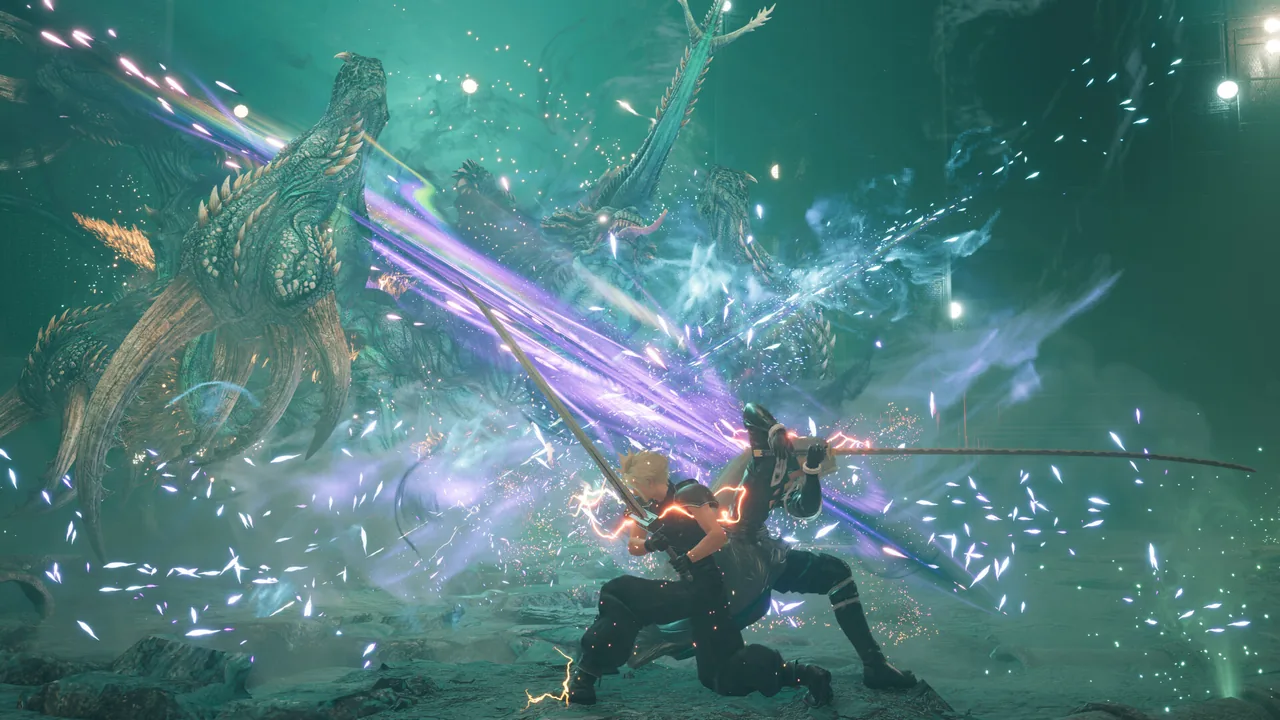
Synergy comes in two forms. Synergy Skills are free-to-use cooperative moves — team dodges, combined counters, follow-up strikes — available at any time between two specific party members, costing nothing but building ATB for both characters involved. Synergy Abilities are the payoff: powerful two-character combination attacks gated behind a Synergy resource that accumulates through fighting alongside a partner, turning "which two characters are standing next to each other" into a real tactical question rather than a cosmetic one. The practical effect is that switching actively between all three party members mid-fight — something Remake technically allowed but rarely rewarded doing constantly — becomes the correct way to play Rebirth. Sit on one character and use them as a straightforward action-RPG protagonist, and you're leaving a meaningful chunk of the combat system unused.
Materia hasn't been reinvented so much as refined: the same slot-and-link system from Remake carries over, but the roster of new Materia, elemental interactions and the returning Synergy Materia (which lets a linked ally auto-follow a leader's spell with a free lesser version of it) gives party building more moving parts without making any individual piece harder to understand. Layered on top is Folio — a per-character skill tree unlocked as Team Level rises, mixing stat boosts, elemental resistances and unlocks for those Synergy Abilities. None of Materia, Folio or weapon upgrades feels redundant with the others; a build decision usually touches at least two of the three systems at once, which is the kind of interlocking design a lot of action RPGs claim and few actually deliver.
Queen's Blood and the minigame problem, together
It says something about Rebirth's priorities that its best new system is a card game nobody asked for. Queen's Blood — a territory-control card battler played against NPCs across every region — has its own rule set, its own escalating deck-building meta as you unlock rarer cards from tougher opponents, and enough tactical depth that a genuine sub-community of players treats it as close to a stand-alone product. It's not a curiosity; it's one of the strongest arguments in the whole game for how much design attention Square Enix's team was willing to spend on something that isn't the headline combat system.
The trouble is that Queen's Blood shares its billing with a genuinely large stack of other minigames — chocobo racing, box-smashing, a rhythm-battle sequence, a 3D-brawler set piece, piano performances, and more — and player feedback across Steam reviews consistently draws the same distinction Wanderer's readers would recognise from any progression system: not every minigame earns its place, and a meaningful amount of main and side content is gated behind completing one. Several of the most-upvoted negative reviews single this out specifically — not as "there are minigames," which is a Final Fantasy tradition going back decades, but as "progression, weapon upgrades and story beats are locked behind mediocre minigames often enough that skipping them isn't really an option." That's a fair distinction to draw, and it's the more forgivable of Rebirth's two headline complaints — the density is real, but a player willing to push through the weaker ones for the story and the strong ones (Queen's Blood chief among them) still comes out ahead.
The open-world checklist, and why it's the sharper complaint
The less forgivable complaint, and the one that shows up constantly across negative reviews alongside the minigame fatigue, is the open-world structure itself. Each region is stitched together by Chadley — a returning support character who, in Rebirth, effectively becomes the game's quest-marker delivery system — dishing out World Intel objectives: activate a tower to reveal the map, clear a combat challenge, track down a hidden Materia cache, photograph a creature, dig up something with the chocobo. Clearing these earns Skill Points that feed directly into Folio, which means the checklist isn't cosmetic completionism sitting beside the real game; it's load-bearing for how strong your party actually gets.
That's the design problem in one sentence: the systems worth engaging with — Synergy, Folio, Materia — are genuinely excellent, but a real portion of the content gating access to them is directly borrowed from open-world formula that other games have been retreating from for years. Reviews describe it plainly as "Ubisoft-style," and it's not an unfair comparison — towers that unlock map markers, region-wide checklists tied to a single NPC's dialogue, optional caves that exist mainly to be ticked off. It's not that the content is broken; several regions dress the formula up with enough environmental variety and side-character writing to make it more enjoyable than the description suggests. But the friction between "our combat system is one of the best in the genre" and "getting the most out of it means doing chore-list open-world content" is the single biggest tension in Rebirth's actual design, independent of anything technical.
Presentation and music
None of the above touches Rebirth's presentation, which is close to unimpeachable. Character models, environmental variety across drastically different regional biomes, and a script that gives long-underserved party members — Red XIII and Yuffie in particular — genuine arcs rather than the original's economy-of-words characterisation, all land. The score is the standout: long-time composer contributions alongside new arrangements give major story and battle themes a weight that a JRPG on this scale rarely commits studio time to, and it's the kind of soundtrack that holds up echoing in your head well after a session ends.
Performance: where the port earns its own, separate score
It's worth being direct about something the discourse around this game often blurs: the design critique above and the technical critique below are not the same complaint, and conflating them does a disservice to both. A game can have a checklist problem and a stutter problem independently, and Rebirth has both.
Digital Foundry's analysis at the January 2025 PC launch identified shader-compilation stutter and traversal hitching in the open world as the port's core technical issues — not an edge case affecting only weak hardware, but a pattern reproducible across a range of configurations. Steam's own negative-review sample bears this out directly: players running high-end rigs report the same stutter as players on recommended-spec systems, AMD GPU owners report recurring shader-cache corruption that manifests as missing textures or unlit scenes requiring a shader-cache wipe to temporarily fix, and one recurring report describes a VRAM leak that degrades frame rate over a play session until the game is restarted. None of this is a one-patch-and-done story: as of mid-2026, well over a year after release, players are still filing the same class of complaint, including reports that a patch adding DLSS Frame Generation support introduced new stutter for some users rather than resolving the old kind.
This is a real, still-partially-unresolved technical shortfall, and it should weigh independently in any purchase decision — hence the separate performance score below the rest of the review. Two things are worth naming in the port's favour, though. First, there's no Epic Games Store history to account for here: unlike the original Remake, whose PC version was a year-long Epic exclusive before reaching Steam in December 2022, Rebirth launched day-and-date on Steam in January 2025 with no timed-exclusivity detour, which removes one entire category of PC-player resentment this franchise has previously earned on its own. Second, there's no Denuvo listed on the Steam page and no anti-tamper DRM complaints surfacing in reviews — the technical frustrations are about the engine's shader pipeline and hardware compatibility, not launcher friction or authentication requirements.
Value
At NZ$79.95 with no standing discount, Rebirth is priced like the premium single-player release it is, and the campaign backs that up with length — a full playthrough chasing story content alone runs well past the original 1997 game's back half, and pursuing regional completion and Queen's Blood's deeper tiers extends that considerably further. Whether that's good value depends entirely on which of the two complaints above matters more to you: players who can tolerate or skip the checklist content get a genuinely long, combat-rich game for the price; players on mid-range PC hardware sensitive to stutter are paying full price for a rougher experience than the PS5 original delivered at launch, and should weigh a discount-window purchase or the console version instead.
Verdict
Final Fantasy VII Rebirth's Synergy-driven combat, layered Materia-and-Folio progression, and Queen's Blood are strong enough on their own to make this one of the better action-RPG systems shipping in this console generation — genuinely deserving of the acclaim the game picked up at launch. Set against that is an open-world structure that borrows its worst habits from a design era the rest of the industry has been quietly walking back, and a PC port whose shader-compilation stutter was flagged at release and is still being reported well over a year on. The 75% Steam score isn't the game's combat getting punished for being mediocre — it's a strong game's checklist design and an unresolved technical debt both showing up in the same aggregate number, and they deserve to be weighed separately rather than blamed on each other.
Wanderer's audience tends to forgive a slow, systems-heavy grind when the underlying loop is sound and the busywork is optional rather than load-bearing — Rebirth's Synergy and Folio systems clear that bar easily, its Chadley checklist mostly doesn't, and which one wins for you will depend on how much you can let a tower marker go unclimbed.
Price, platform and Steam review data checked 30 July 2026.
Pros and cons
Pros
- Synergy Skills and Abilities make active party switching mid-fight the best it's ever been in this combat system
- Materia, Folio skill trees and weapon upgrades combine into a genuinely deep, non-redundant build layer per character
- Queen's Blood is a fully-realised card game with its own escalating meta, not a throwaway distraction
- A gorgeous, varied regional art direction and one of Square Enix's best-recorded scores in years
- Faithful to the original's emotional beats while giving side characters real material the 1997 game never had room for
Cons
- Chadley's tower-and-checklist open-world design gates real progression behind repetitive busywork across every region
- Shader-compilation stutter and traversal hitching on PC have been reported since the January 2025 launch and persist for many players after multiple patches
- The minigame density is high enough that a meaningful share of side content, and even some main-story beats, run through a minigame rather than the core systems
- Story pacing sags across the open-world middle stretch in a way the tighter Midgar-bound Remake never had to manage
- No Steam Deck verification and inconsistent AMD-side shader/texture bugs make the PC version a harder recommendation than the PS5 original
Screenshots
-
FINAL FANTASY VII REBIRTHImage: Square Enix via Steam -
FINAL FANTASY VII REBIRTHImage: Square Enix via Steam -
FINAL FANTASY VII REBIRTHImage: Square Enix via Steam -
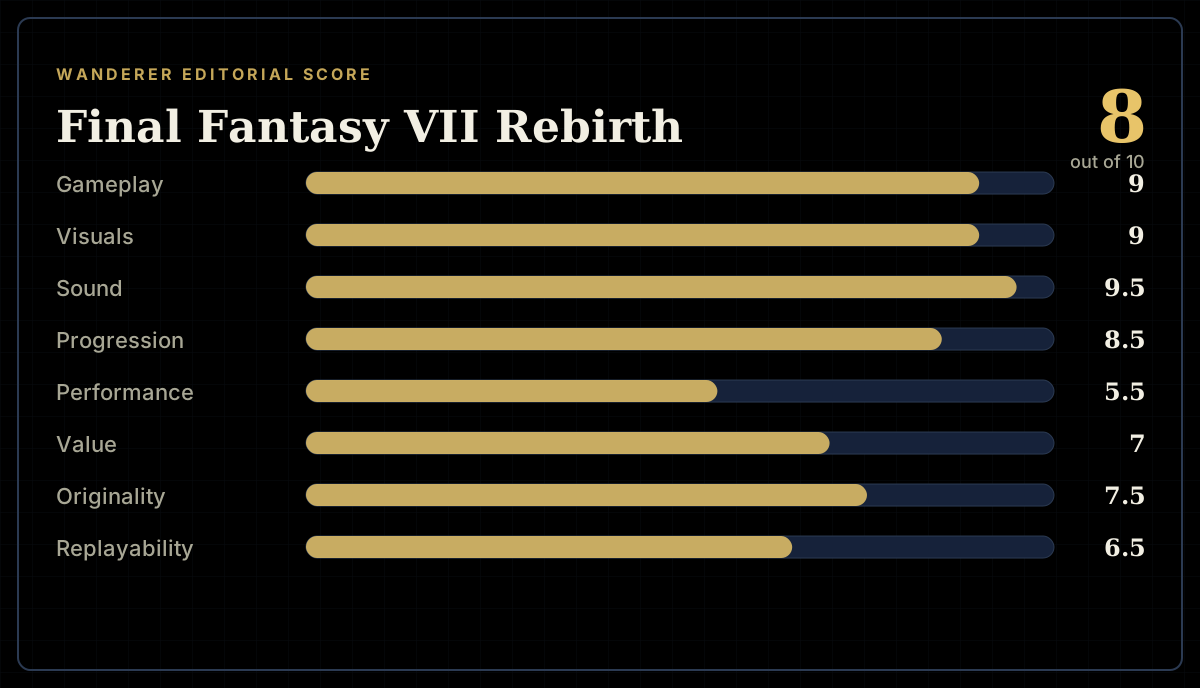
How the review scores each part of the gameWanderer Editorial -
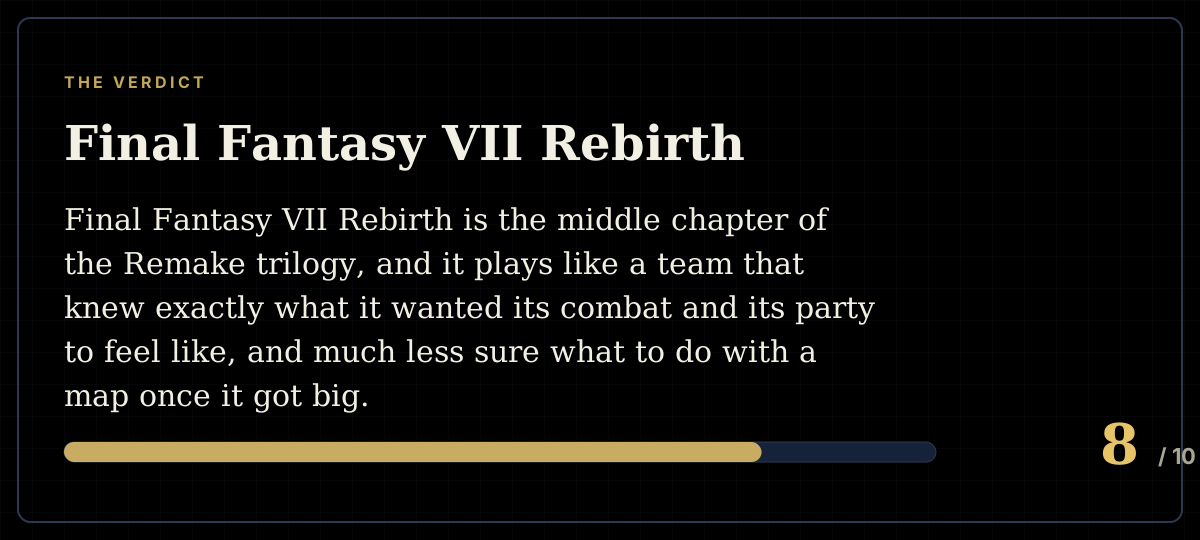
The short versionWanderer Editorial