Game review
Paver: Tidy Up Together Review
6 / 10
- Developer
- Games Together
- Publisher
- Games Together
- Released
- 18 September 2026
- Platforms
- ["Windows"]
- Genre
- Simulation
The Third Sorting Game From The Same Team, Now With Pavers
Paver: Tidy Up Together is a $4.99 first-person organizing game from developer and publisher Games Together, released on Steam on September 18, 2026 with a clean, single-item launch history and no early access period behind it. The premise is simple: an old castle's plaza is being restored, its pavers have been scattered everywhere during construction, and the player follows an original layout plan to place all 4,064 of them, alone or in online co-op, sorting by shape and color rather than by the item-on-a-shelf logic that dominates this "tidy up" subgenre. With 38 English reviews a day after launch, 33 of them positive, the reception lands as broadly warm but genuinely split, several reviewers explicitly frame it as this developer's third entry in the same sorting-game formula, following an earlier title about sorting VHS tapes in a TV archive, and that history colors how generously the pool is willing to forgive its rough edges.
Shapes And Colors Instead Of Shelves
The mechanical hook reviewers keep highlighting favorably is that Paver replaces the genre's usual "match the label, put it on the shelf" loop with actual spatial tessellation: rectangle, square, octagon, trapezoid, and H-shaped pavers that have to physically fit their corresponding slot in the plaza's pattern. "Super chill first-person organizing sim with surprisingly deep tile variety. Going through octagon, radial, and trihex shapes according to the master plan requires just enough focus to keep your brain engaged without causing frustration," wrote one reviewer, while another made the direct genre comparison explicit: "Among the flood of 'librarian-style' games, this one stands out as rather unique, breaking away from the standard paradigm of simply placing items onto shelves... this fill-in-the-blank matching logic is undoubtedly more intuitive and reflects a clever touch of ingenuity." For a genre this saturated, that's a real point of differentiation rather than a coat of new paint on the same idea.
Three Ways To Play, Built Around How Much Hand-Holding You Want
Paver offers Normal Mode, where skills unlock gradually through play, Sandbox Mode, which hands the player every skill immediately, and No-Skill Mode, a fully manual challenge run with every shortcut disabled. Multiple reviewers specifically sought out the harder end of that spectrum. "I saw some reviews mentioning bugs, but i played for 3 hours and didn't experience any," wrote one reviewer who deliberately skipped every skill, while another reported doing "a full no-skill run with a friend and we managed 3h3m on our first try," praising how "the game feels right. Movement is nice, picking up and placing feels good." That range of difficulty options is a genuinely thoughtful piece of design for a genre that's often take-it-or-leave-it on challenge.
A Bug List That's More Than One Person's Bad Luck
The pool's negative reviews converge on the same specific, reproducible complaints rather than scattered one-off gripes. "Buggy af. pavers don't register, then theres just straight up spots where you're supposed to put something but cannot," wrote one reviewer, and a second independently reported the identical class of problem in far more detail: "Game is fundamentally broken. There are over 20 missing pieces. I spent 20 minutes running all over the map looking for the 20+ pieces that still need placing, and they don't appear anywhere, I even tried using the 'stuck pieces reset' button in the menu to see if that was the solution, but it was not." A third reviewer, otherwise positive, flagged the same category of issue more mildly: "Random tiles cannot be placed due to obstacles in the way, when there were no visible obstacles." That's three independent reports of the same missing-or-unplaceable-piece bug on launch day, a real, corroborated problem rather than an isolated bad install.
Short, Cheap, And Exactly As Long As It Needs To Be, Or Not
Length and value split the pool along predictable lines. "This one took a little under 3 hours to complete. Given that, is it really worth the price tag? Up to the buyer," wrote one reviewer who used the unlockable skills, a fair framing given how directly playtime scales with how many shortcuts a player allows themselves. Several other reviewers explicitly weigh that shortness against the $4.99 asking price and land on the side of forgiveness: "Despite being very cheap, would only recommend if you're a sorting addict like me, and if you see it on sale." At this price point a two-to-three hour relaxing session isn't an unreasonable trade, but it's worth going in with the expectation of a single sitting's worth of content rather than a long-term project.
The Franchise-Fatigue Critique Worth Taking Seriously
The single most detailed negative review in the pool isn't really about this game in isolation, it's about the developer's track record. "The devs have made three of these type of sorting games so far, and for this one being the third, there's no real feeling of improvement in the game design, and I will probably pass if they make another one on this genre without rethinking their design choices," that reviewer wrote, adding that the tile patterns don't randomize between playthroughs and that completing a section carries no real visual payoff, "no flourish per section, or tile type, or color, that shines or twinkles or anything on its completion. It's just completed." That's a substantive critique of the studio's overall trajectory rather than a complaint about this specific build, and it's a useful counterweight to the pool's more enthusiastic reviews.
Verdict
Paver: Tidy Up Together takes a crowded, formulaic cozy-sim genre and finds a genuinely fresh mechanical hook in it, tessellating shaped pavers instead of stacking labeled objects on shelves, and reviewers who've played the wider "tidy up" catalog consistently credit that as real differentiation rather than a coat of paint. Set against that is a launch-day bug list that's corroborated across multiple independent reviews, missing pieces, unplaceable tiles, invisible obstacles, and a genuine, fair question about whether two-to-three hours of static, non-randomized content justifies even a five-dollar price tag for anyone who isn't already a fan of the developer's prior sorting games. At this price, with friends in co-op and modest expectations for length, it's an easy enough recommendation for genre fans; players hoping for the developer's third outing to meaningfully evolve the formula, or to launch bug-free, should wait for a patch or two first.
Screenshots
-
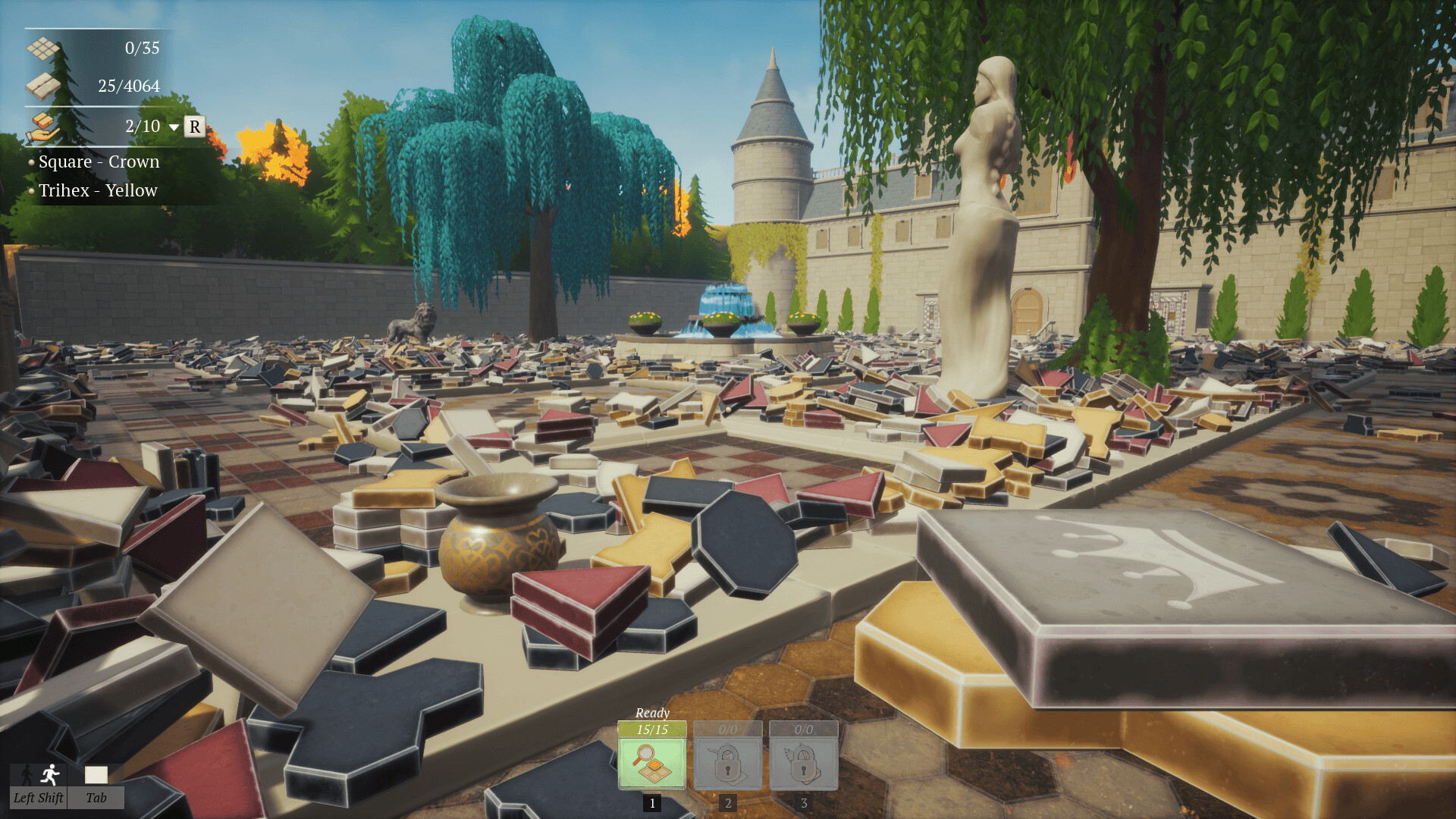
The plaza at the start of a run: a fountain, a statue, and 4,064 scattered pavers waiting to be sorted by shape and color.Image: Games Together via Steam -
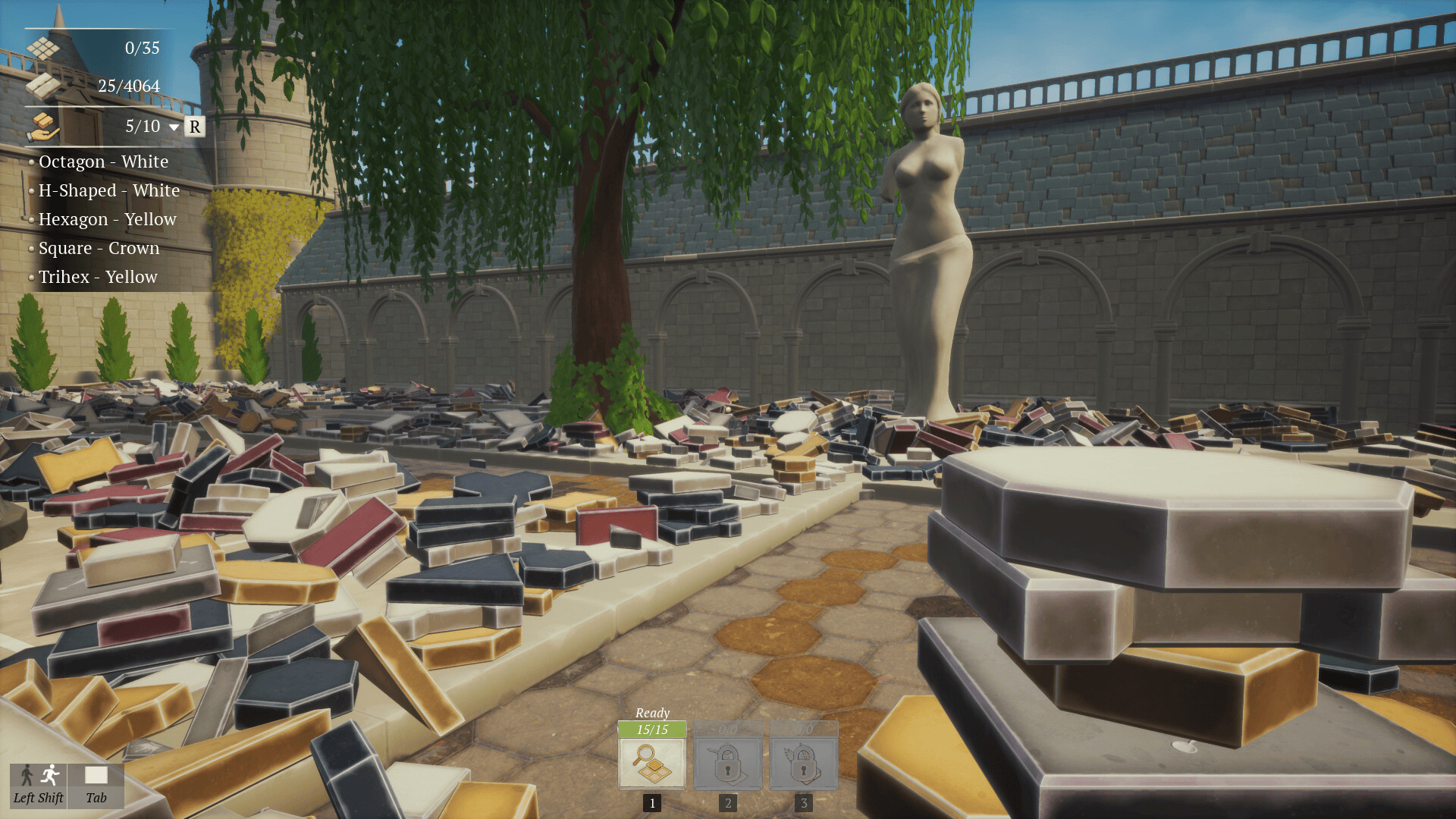
Only 25 of 4,064 pavers placed so far, with a growing queue of specific shapes and colors still to find in the pile.Image: Games Together via Steam -
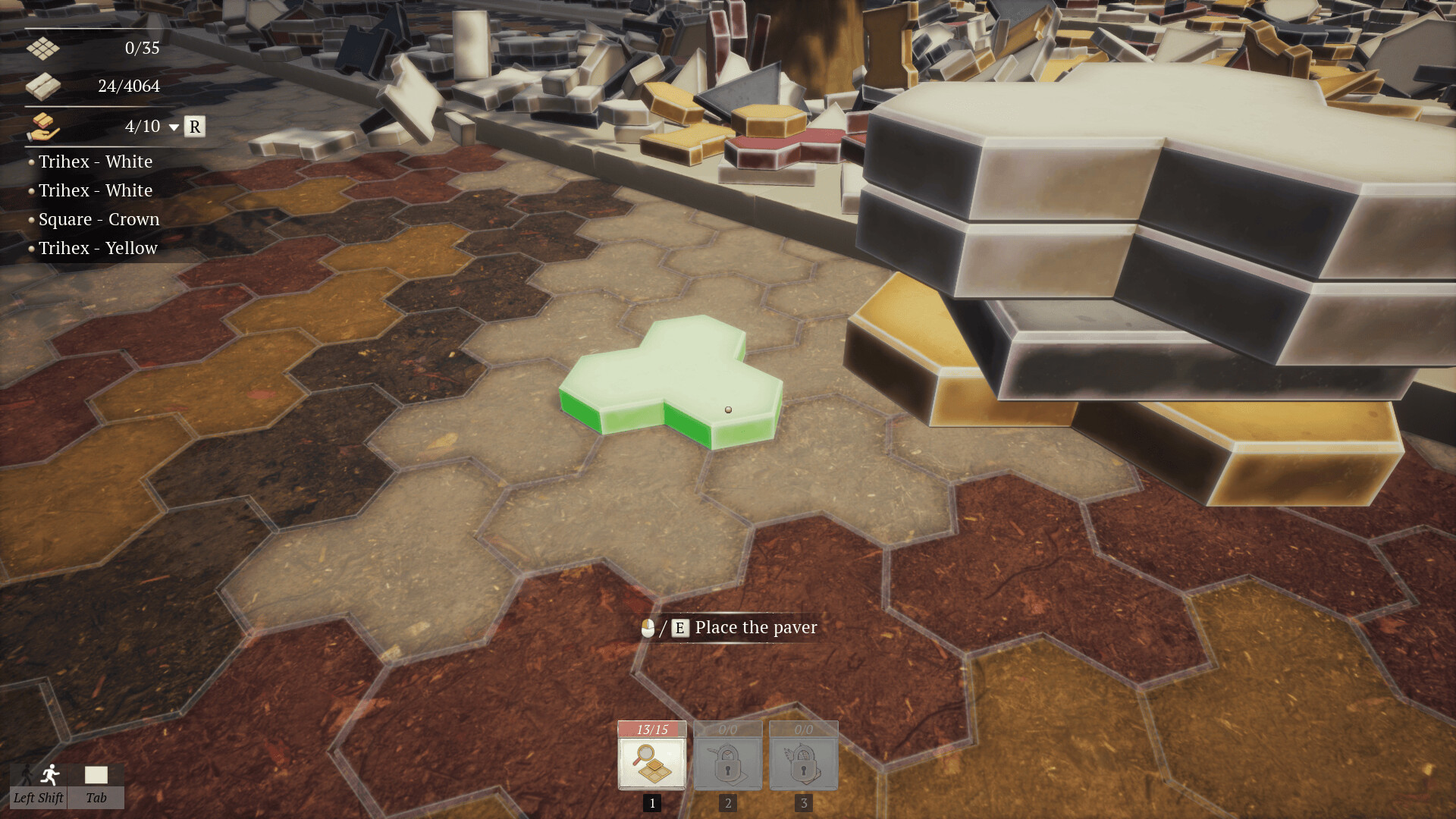
The moment-to-moment loop: line up the right shape, and the game highlights the correct slot in green before you place it.Image: Games Together via Steam