Game review
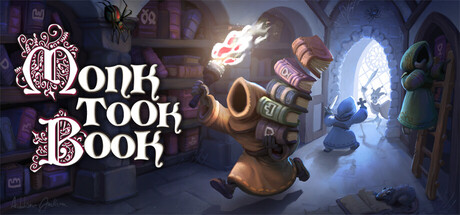
Monk Took Book
8 / 10
- Developer
- SquarePlay Games
- Publisher
- SquarePlay Games
- Released
- 3 September 2026
- Platforms
- ["Windows"]
- Genre
- Simulation
- Monetisation
- Paid
- Players
- Online co-op (up to 4)
The short version
Monk Took Book takes the Wilmot's Warehouse sorting formula, adds a monastery, some very forgivable monsters, and a deep well of settings to tune the chaos to taste, and the result is one of the most quietly satisfying small releases of the year.
Biggest strengths
- A genuinely freeform sorting system where reviewers repeatedly describe devising their own private logic for where books belong, then having to remember and defend it under time pressure
- An unusually deep set of accessibility and difficulty toggles, letting players remove or tune individual enemy types, fire hazards, camera shake, and more to land on their own preferred pace
- A warm, clearly handmade presentation from a tiny team, praised almost universally for its music, pixel art, and a beloved, entirely useless library cat
Biggest weaknesses
- Combat and enemy variety are widely described as the weakest part of the package, with only a handful of monster types and little incentive to engage them meaningfully
- A short overall runtime, with most reviewers finishing the full 100-plus book collection in well under 20 hours and describing the post-completion loop as running out of shelf space rather than new content
- Assorted early jank, from finicky pickup controls to an achievement system some co-op players call unfair, that a small dev team is still actively patching
Who it's for: Fans of freeform sorting and organization games (Wilmot's Warehouse, Unpacking-adjacent titles), players who enjoy short co-op sessions with friends, and anyone who wants a system-building puzzle without a rigid answer key.
Our recommendation: An easy recommendation at its low price point, especially for a co-op session with friends, though solo players who dislike any combat should check the accessibility settings first.
8 / 10
A Sorting Game That Trusts You to Make Your Own Rules
Monk Took Book puts players in the sandals of a hooded monk tasked with organizing and expanding a monastery library, one book at a time, while a handful of other monks (up to four in online co-op) can join to share the load. Made by a small team, primarily two developers with two more contributing music and additional programming, it released fully on September 3, 2026 after a public demo and beta period stretching back to late 2025, and at the time of writing it sits at a remarkable 127 positive reviews out of 129, a ratio strong enough that even the game's small number of critics tend to frame their complaints as suggestions rather than dealbreakers.
The core idea will be instantly familiar to fans of Wilmot's Warehouse, a comparison that comes up in a large share of the reviews and one the developers seem happy to invite. Each day, a batch of new books arrives, each marked only with an ambiguous symbol on its cover, a lightning bolt, a pair of praying hands, a seashell, and it's entirely up to the player to decide what category that symbol belongs to and where its shelf should live. Do the wave-shaped icons belong with the other water symbols, or with the animal books because a specific creature happens to live in the sea? There's no correct answer provided by the game, only the system a player invents and then has to remember later. Reviewers describe this ambiguity as the game's central hook: it's less a tidying game with a right answer than an ongoing negotiation with yourself, or with your co-op partners, about how a private taxonomy should work.
Cosy by Day, Genuinely Tense by Night
That freeform organizing happens during an unlimited daytime phase, but the tension arrives at night, when scribes request specific books and players have to physically retrieve them from wherever they were shelved, on a generous but real countdown timer, while rats, spiders, skeletons, and the occasional towering poltergeist actively try to disrupt the process. Torches are needed to see in the dark, but torches throw off embers that can set books on fire if left unattended, adding a light resource-management layer to what is otherwise a game about spatial memory. Several reviewers single out this day-night structure as the game's smartest design decision, since it turns simple shelving into something closer to a memory puzzle under mild duress, with one reviewer comparing the sensation to calculating chess lines in their head as their collection grows.
What comes up again and again, across nearly every review, is how thoroughly the game lets players dial that duress up or down. Every enemy type, environmental hazard, and event can be individually adjusted or switched off entirely in the settings, alongside dedicated accessibility options for arachnophobia, epilepsy-triggering effects, camera shake, and head bob. Reviewers describe using this to build wildly different experiences: some turn everything on and describe the resulting chaos as "Oops, all spiders" mode, while others switch off every monster to play a purely meditative sorting game. A couple of reviewers do note the arachnophobia setting has a rough edge, since it makes spiders invisible rather than replacing them with a less alarming visual, meaning players still have to watch carefully for an unmarked threat. Multiple reviewers who specifically avoid combat in most games say this flexibility was the reason they were able to enjoy Monk Took Book at all, and it's clearly load-bearing for how broadly the game has been received.
Where the Loop Runs Thin
The most consistent criticism, echoed even inside many of the enthusiastically positive reviews, targets the combat and enemy roster. Reviewers repeatedly describe the actual fighting as extremely basic, walking up to an enemy and swinging a weapon, and several note that even with every monster type turned to maximum spawn rate, encounters rarely feel dangerous or varied enough to demand real strategy. A small number of reviewers who came in expecting a tighter survival-combat loop, rather than a sorting game with light combat sprinkled in, describe this as a disappointment, with one comparing it unfavorably to the memory-focused "Arcane Library" they'd hoped for instead. Enemy variety is similarly limited to a handful of types (rats, spiders, skeletons, and a few larger threats), and reviewers who logged the most hours are the ones most likely to wish for more of them.
Length is the other recurring theme. Most reviewers describe finishing the full collection of over 100 book types somewhere between three and twenty hours depending on group size and self-imposed difficulty, and several note that once the collection is complete, continued play essentially becomes "play until you run out of shelf space" rather than a meaningfully new phase. A few reviewers explicitly ask for post-completion content: new book types, additional monastery areas, or a mode that stops sending new books once collection is finished, since currently there's no way to pause the influx short of running out of room. None of this seems to have dampened enthusiasm much; reviewers consistently frame it as a short, focused, inexpensive experience rather than treating the brevity as a flaw in itself, and the price, under fifteen New Zealand dollars, is repeatedly cited as very fair for what's on offer.
Presentation, Co-op, and a Cat Named Lord Fluff
Presentation draws warm, near-universal praise. The pixel art, book iconography, and particularly the music are called charming and clearly handmade by reviewers across the board, several of whom explicitly contrast it with a wave of similarly-themed "librarian clone" releases they say lean on generic or AI-generated assets. A resident library cat, affectionately dubbed Lord Fluff by the community, draws its own small but devoted fan following in the reviews, mostly for being entirely decorative and doing nothing whatsoever to help with the rat problem, a running joke that shows up in a surprising number of write-ups. Co-op is well regarded too, with proximity chat and a division-of-labour dynamic, one player sorting while another retrieves and fights, that several reviewers say turns the game into their preferred way to spend an evening with a partner or friends, and multiple reviewers report the game working just as well solo. A handful of rougher edges get mentioned: fiddly pickup and hand-swap controls that a couple of reviewers say never quite clicked, a co-op achievement system that doesn't always credit every player fairly, and a preference for higher-resolution art from at least one reviewer who otherwise enjoyed the game. The developers are described repeatedly and consistently as active on Discord and fast to patch, which several reviewers cite directly as a reason for their confidence in recommending the game despite its current rough edges.
Verdict
Monk Took Book succeeds by trusting players with genuine freedom: the sorting logic is yours to invent, the difficulty and monster mix are yours to tune, and the result is a game that manages to feel both cosy and quietly tense depending entirely on how you want to play it. Its combat is thin and its runtime short, and a small dev team is still ironing out control quirks and achievement bugs, but at its price point, and with accessibility options few games in its genre bother to include, it's very easy to see why the review base has responded so overwhelmingly well. Anyone who has ever enjoyed devising their own filing system, in a game or otherwise, should take the very cheap plunge; just don't expect Lord Fluff to help with the rats.
Pros and cons
Pros
- A genuinely freeform sorting system where reviewers repeatedly describe devising their own private logic for where books belong, then having to remember and defend it under time pressure
- An unusually deep set of accessibility and difficulty toggles, letting players remove or tune individual enemy types, fire hazards, camera shake, and more to land on their own preferred pace
- A warm, clearly handmade presentation from a tiny team, praised almost universally for its music, pixel art, and a beloved, entirely useless library cat
Cons
- Combat and enemy variety are widely described as the weakest part of the package, with only a handful of monster types and little incentive to engage them meaningfully
- A short overall runtime, with most reviewers finishing the full 100-plus book collection in well under 20 hours and describing the post-completion loop as running out of shelf space rather than new content
- Assorted early jank, from finicky pickup controls to an achievement system some co-op players call unfair, that a small dev team is still actively patching
Screenshots
-
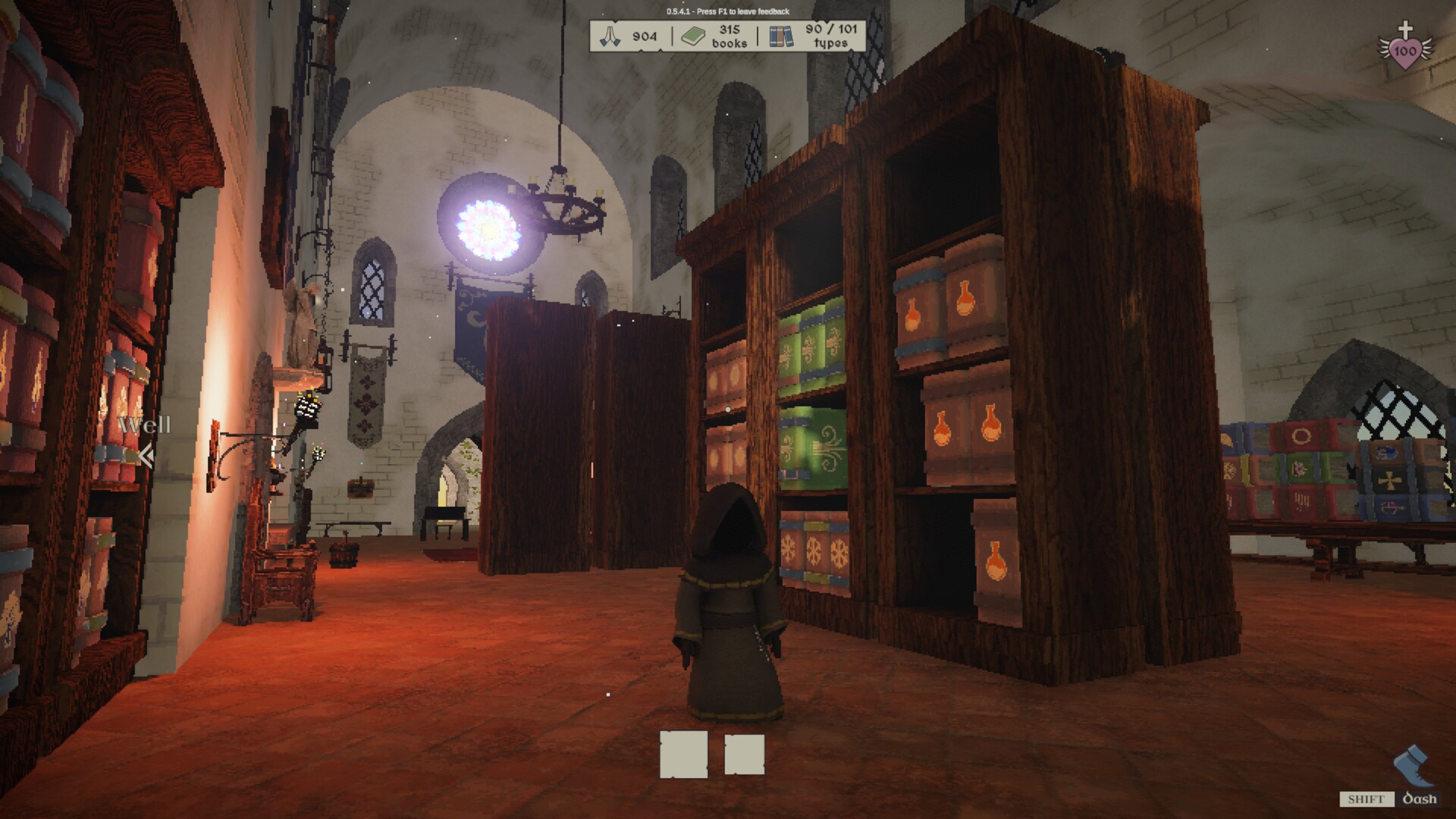
Sorting the ever-growing collection into shelves of the player's own devisingSquarePlay Games -
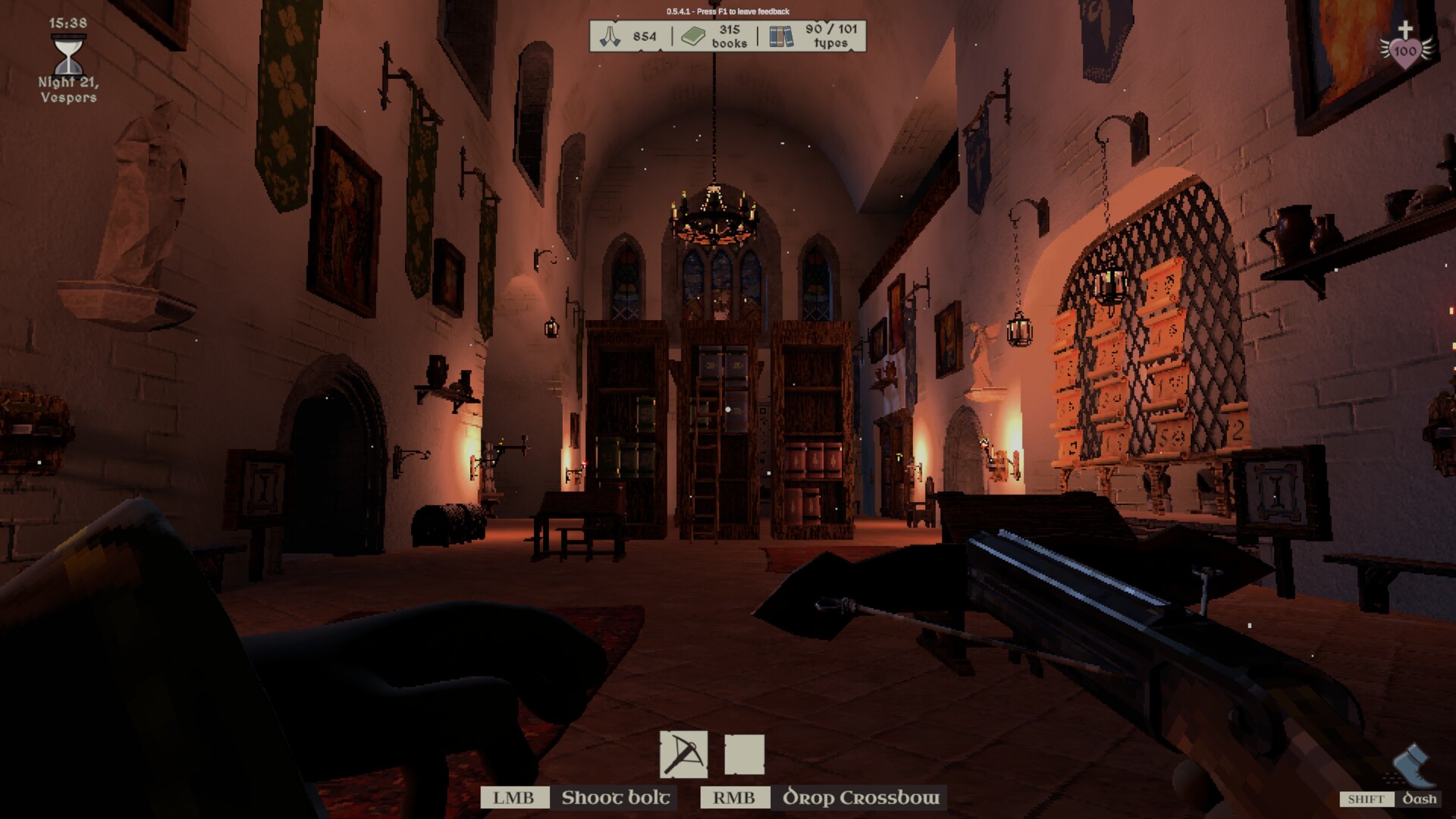
Night brings scribe requests, a countdown timer, and a crossbow for the monsters that come with itSquarePlay Games -
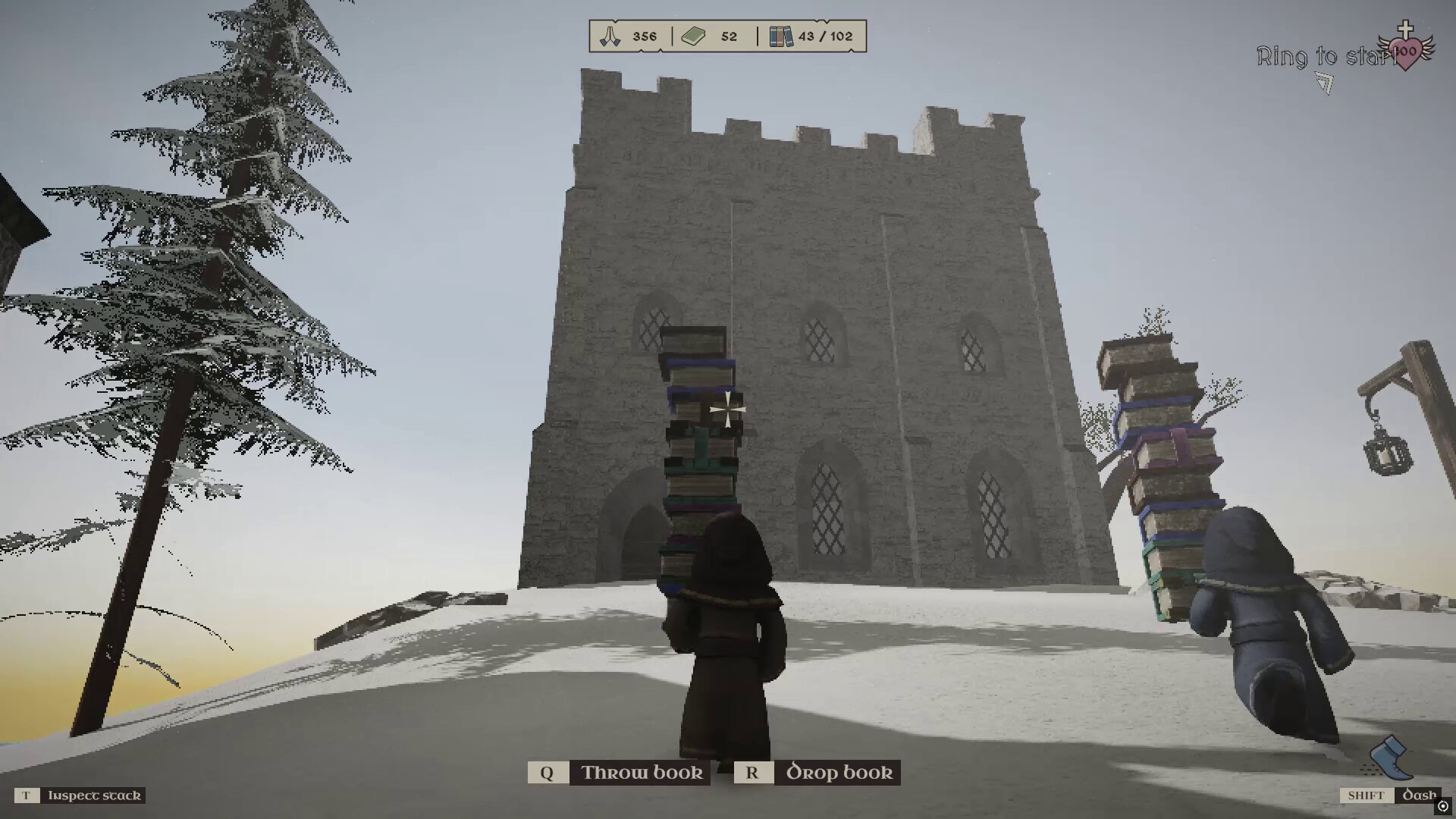
Ferrying stacks of books back to the monastery as the collection expandsSquarePlay Games -
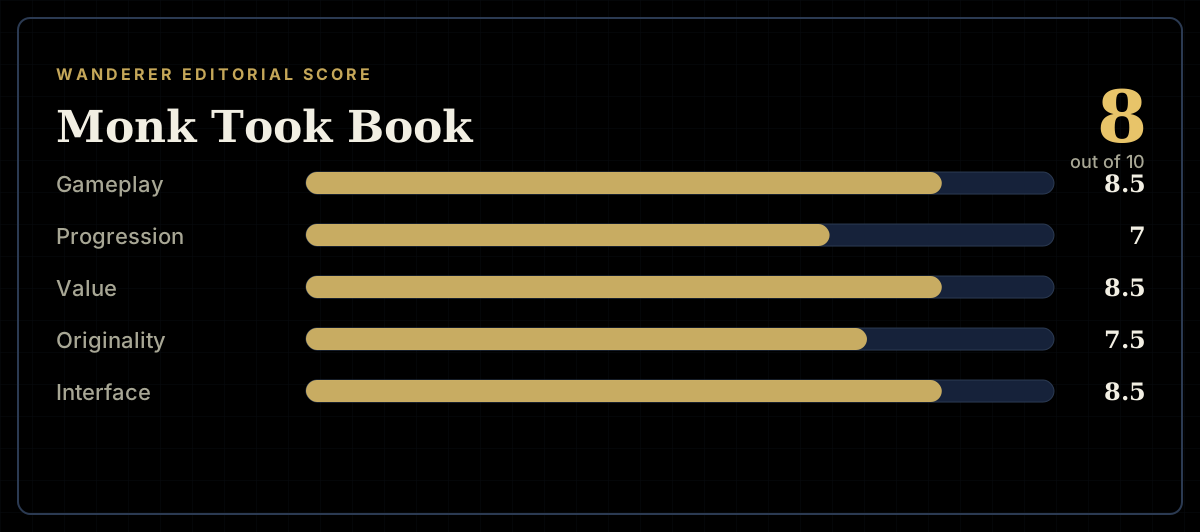
How the review scores each part of the gameWanderer Editorial -
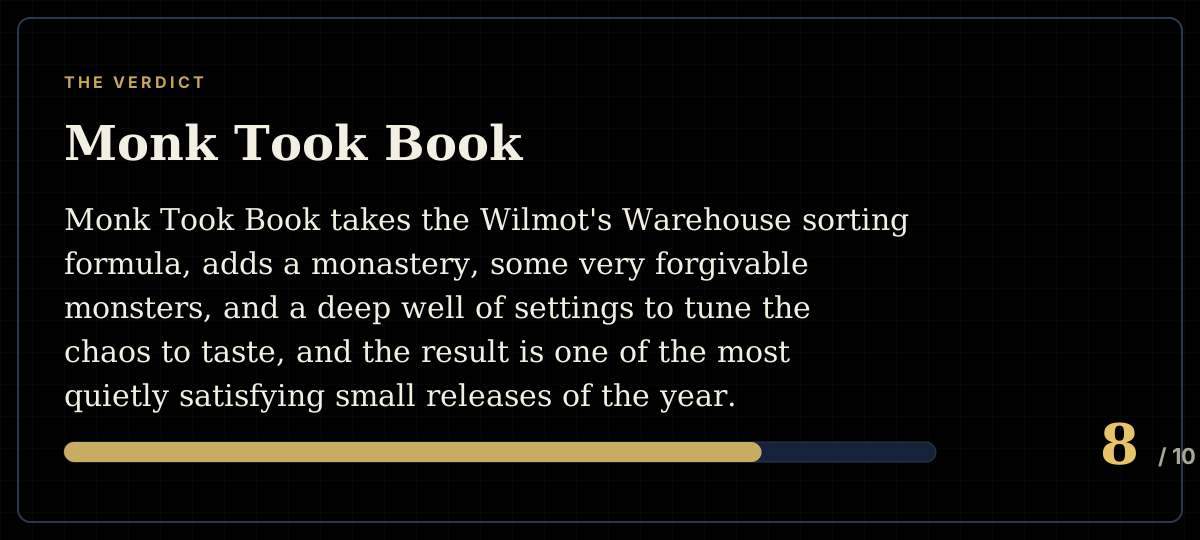
The short versionWanderer Editorial