Game review
Italian Pizza Simulator
7.1 / 10
- Developer
- Games Incubator
- Publisher
- Games Incubator, PlayWay S.A.
- Released
- 14 August 2026
- Platforms
- ["Windows"]
- Genre
- Simulation
- Monetisation
- Paid
- Players
- Single-player
The short version
Italian Pizza Simulator won't reinvent the crowded cozy-cooking-sim genre, but it's an unusually relaxed, good-looking entry in it, one that trades timers and angry customers for sunlit Tuscan hills and the simple pleasure of building a better pizza, held back mainly by a rough opening tutorial and a narrow menu.
Biggest strengths
- A genuinely stress-free loop, no timers, no angry customers, that reviewers repeatedly describe as more relaxing than most games in the genre
- Strong Tuscan atmosphere and presentation, with warm scenery, music, and a well-received family storyline about reviving a grandmother's pizzeria
- Real customization depth for a small-team release: unlockable pizza box designs, pizzeria decor, and a modest skill tree tied to recipe progression
Biggest weaknesses
- A poorly explained opening stretch, with at least one core mechanic, combining ingredients in the pot, left almost entirely unexplained and only discoverable through trial and error
- A narrow menu limited to pizza alone, with reviewers asking for breadsticks, calzones, slicing, and more customer variety to break up the repetition
- Scattered small bugs and rough edges, including items getting stuck in inventory slots and an inability to rename a pizzeria once the opening choice is made
Who it's for: Fans of low-stress cooking and restoration sims like Cooking Simulator and the beloved, since-abandoned Chocolate Factory, and anyone who wants a cozy management game without a clock ticking against them.
Our recommendation: A solid pick-up for cozy-sim fans, especially on sale, though players who want depth or variety in what they're cooking may find the pizza-only menu wears thin before the credits roll.
7.1 / 10
Grandma's Pizzeria, Reopened
Italian Pizza Simulator drops players into a decrepit family pizzeria somewhere in the Tuscan hills, inherited after fifteen years of neglect, with a simple task: clean the place up, relearn Grandma's recipes, and turn it back into somewhere the village wants to eat. Developed and published by Games Incubator alongside PlayWay S.A., the studio behind a long line of similarly structured "Simulator" titles, it released fully on August 14, 2026 after roughly ten months of public devlogs, a playtest, and a Steam Next Fest demo appearance, the kind of methodical, transparent runway that tends to produce a polished launch rather than a rushed one. Of the reviews logged at the time of writing, the overwhelming majority are positive, and the tone across almost all of them is some version of the same word: relaxing.
That's a deliberate choice, and reviewers notice it immediately. There's no clock counting down while a pizza burns, no queue of customers growing visibly furious, and running out of an ingredient mid-order simply means pausing to restock rather than losing the sale. It's a meaningfully different pitch from most of its genre-mates, including the studio's own back catalogue and closer relatives like Cooking Simulator, and several reviewers single it out specifically for letting them cook at their own pace without feeling like they're falling behind.
Kneading Dough, Not Watching a Clock
The core loop covers most of the steps a real pizzeria would involve: mixing and kneading dough by hand, preparing sauces and toppings from a growing list of ingredients, working a wood-fired oven, and finally handing finished pies off to customers who react to quality rather than speed. Reviewers describe the process itself as satisfying and tactile, with one long-time player who logged nearly fifty hours praising the range of doughs, sauces, and pizzas available to make, alongside the ability to design custom pizza box artwork that gets unlocked as the shop grows. A modest skill tree ties recipe unlocks to progression, and money earned from sales feeds back into upgrading the kitchen, the shop's decor, and eventually the surrounding garden, giving the loop a clear, if unhurried, sense of forward motion.
The presentation does a lot of the heavy lifting for the game's reception. Multiple reviewers call out the sunlit Tuscan countryside, the ambient music, and the small environmental details as the reason the game feels like somewhere worth spending time rather than a checklist of chores, several explicitly contrasting it with simulators that treat their setting as wallpaper around a spreadsheet. The framing device, a grandchild learning a late grandmother's craft one recipe at a time, also lands well; reviewers describe it as genuinely warm rather than perfunctory, helped by character writing that leans into gentle humour without overplaying it.
A Rough First Slice
The most consistent complaint in the review base isn't about what the game lacks so much as how poorly it explains what it has. Multiple reviewers describe the core act of assembling ingredients, in one case a specific, unintuitive control of holding both mouse buttons simultaneously to combine olive oil, salt, and oregano in a pot, as left almost entirely unexplained, discovered only through repeated failed attempts. For a game whose entire pitch rests on being calm and unhurried, that kind of front-loaded confusion is a real tonal mismatch, and it's the one thread that shows up even among otherwise glowing reviews rather than being confined to the handful of negative ones. A separate, much harsher one-line review calling it one of the worst simulation games its author has played offers no specifics to weigh against the detailed, generally positive accounts making up the rest of the sample, and reads as an outlier rather than a representative view.
Smaller technical rough edges show up too, though none are described as serious: items occasionally getting stuck in inventory slots, an inability to rename a pizzeria once the opening choice is locked in, and a leaderboard feature that a couple of reviewers found confusing or poorly explained. None of these come up often enough to look like a systemic problem, but they're consistent enough across otherwise unrelated reviews to suggest the kind of launch-week polish pass a small studio hasn't quite finished yet.
One Topping, Many Toppings
The other recurring theme is scope. Everything on the menu is, unavoidably, pizza, and several reviewers who otherwise enjoy the game ask for more: breadsticks, calzones, the ability to slice a finished pie into orderable portions, extra-cheese requests, and a wider variety of customers to keep things from feeling repetitive over a long session. It's a fair criticism rather than a fatal one; reviewers who've put ten, twenty, even nearly fifty hours into the game generally still recommend it, but the same voices tend to frame that recommendation around the atmosphere and the chill pace rather than around mechanical depth. A few also note the absence of a visible dining room or customers to interact with directly, something they say costs the game a layer of immersion that games like Cooking Simulator - Pizza, mentioned by name in more than one comparison and generally rated worse by the same reviewers, also lack but that a restoration-and-hospitality game with this much atmosphere feels primed to deliver.
Those same reviewers are quick to note what does land, and it isn't nothing: a well-received Steam Deck controller compatibility, smooth performance with no reported crashes or major slowdown, and a customization suite, pizza box art, shop decor, an unlockable garden, that gives the loop more to work toward than the bare-bones "make food, sell food" structure the genre often settles for.
Verdict
Italian Pizza Simulator succeeds at what it clearly set out to do: give cozy-sim fans a good-looking, unhurried alternative to the genre's usual stopwatch anxiety, wrapped in a warm family story and a Tuscan setting reviewers keep describing as somewhere they'd genuinely like to spend an afternoon. It won't satisfy anyone looking for real mechanical depth or variety, the menu never grows past pizza, and a badly explained opening stretch undercuts the calm the rest of the game works hard to establish, but for the specific mood it's chasing, low-pressure, high-atmosphere cooking with a story attached, it delivers convincingly. Worth a look for genre fans, particularly if a rough tutorial isn't going to sour the whole experience.
Pros and cons
Pros
- A genuinely stress-free loop, no timers, no angry customers, that reviewers repeatedly describe as more relaxing than most games in the genre
- Strong Tuscan atmosphere and presentation, with warm scenery, music, and a well-received family storyline about reviving a grandmother's pizzeria
- Real customization depth for a small-team release: unlockable pizza box designs, pizzeria decor, and a modest skill tree tied to recipe progression
Cons
- A poorly explained opening stretch, with at least one core mechanic, combining ingredients in the pot, left almost entirely unexplained and only discoverable through trial and error
- A narrow menu limited to pizza alone, with reviewers asking for breadsticks, calzones, slicing, and more customer variety to break up the repetition
- Scattered small bugs and rough edges, including items getting stuck in inventory slots and an inability to rename a pizzeria once the opening choice is made
Screenshots
-
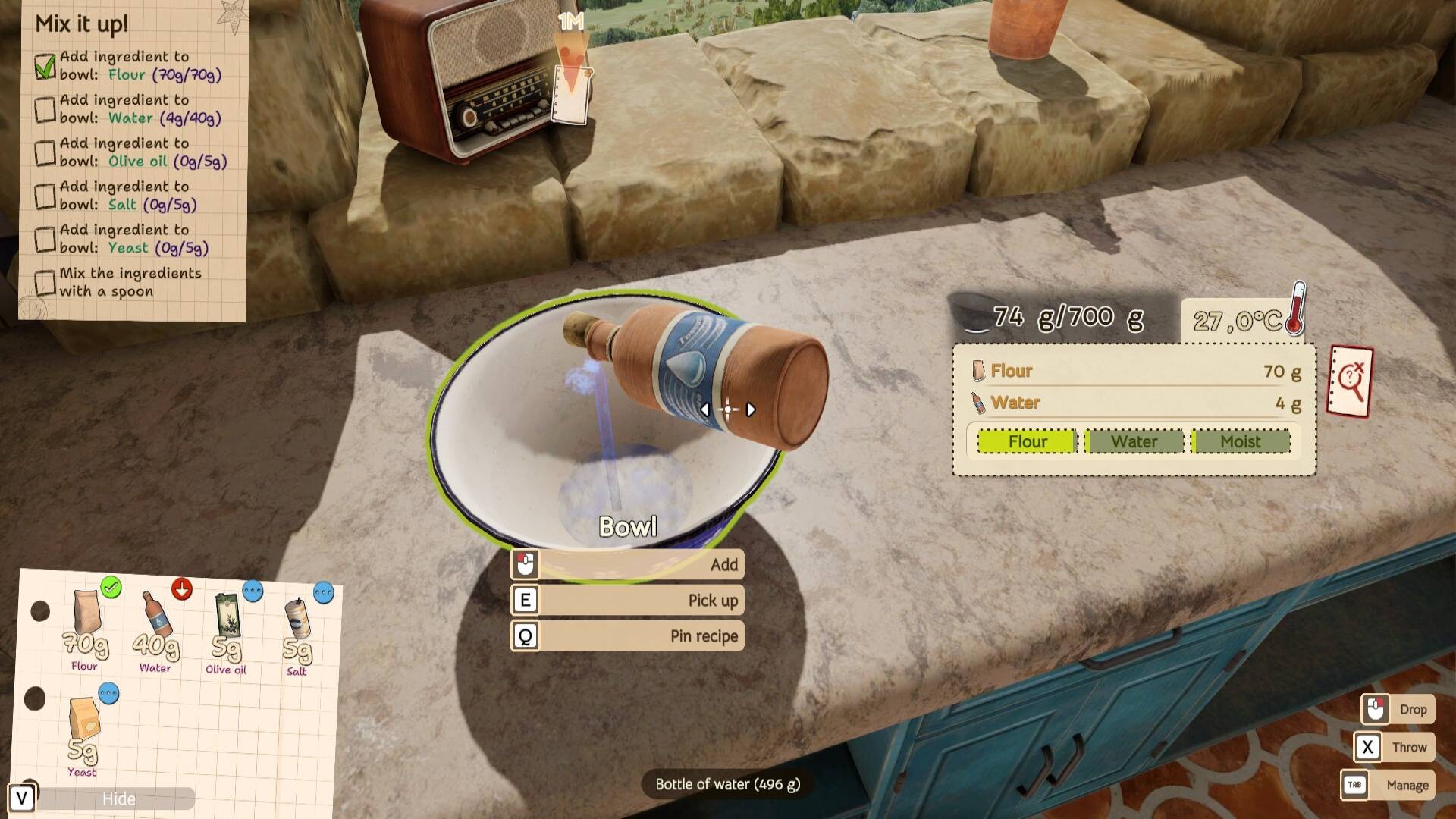
The step-by-step process of mixing dough from scratchGames Incubator -
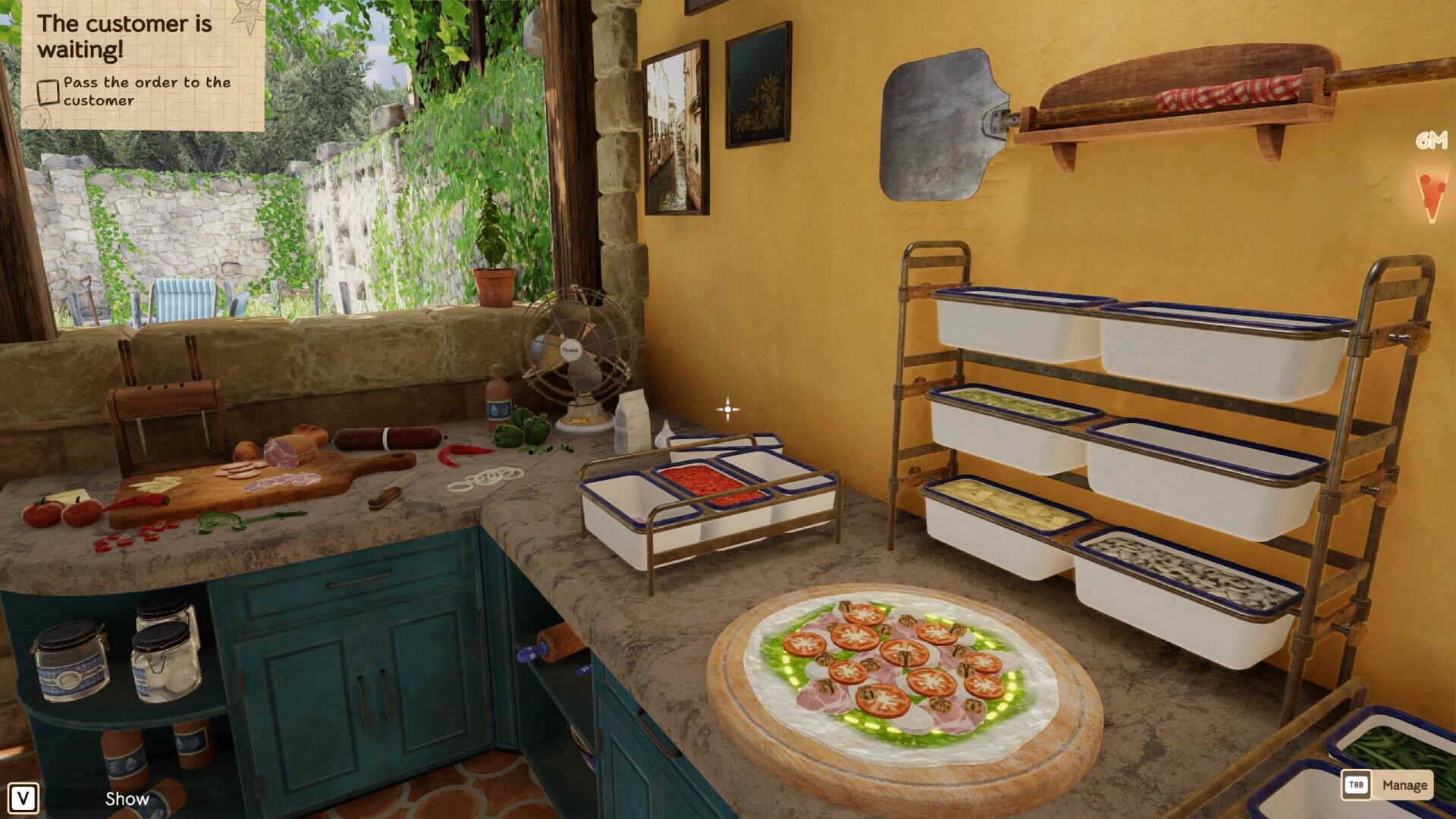
Prepping toppings in the pizzeria's rustic kitchenGames Incubator -
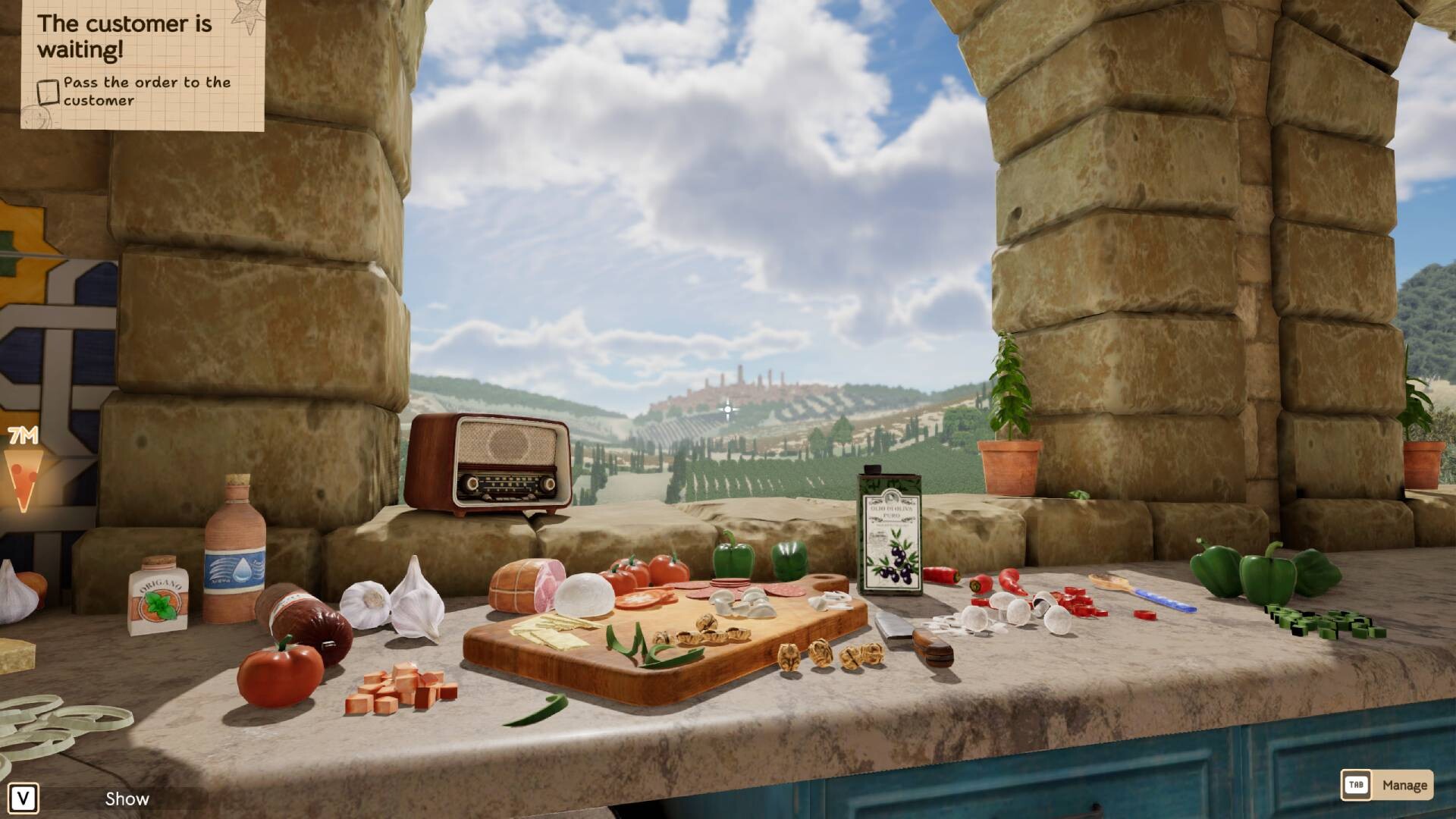
The Tuscan hillside view from the pizzeria's prep counterGames Incubator -
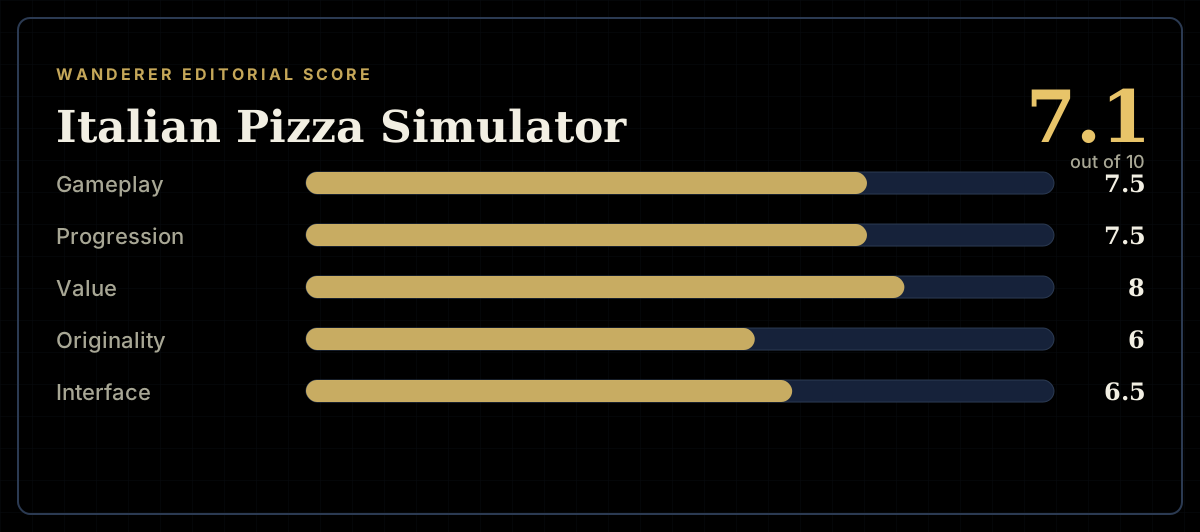
How the review scores each part of the gameWanderer Editorial -
The short versionWanderer Editorial