
Game review
Alchemist's Alcove Review
6.4 / 10
- Developer
- Nefarious Brew Games
- Publisher
- Nefarious Brew Games
- Released
- 6 March 2026
- Platforms
- Windows
- Genre
- Roguelike
- Monetisation
- Premium
- Players
- Single-player only
The short version
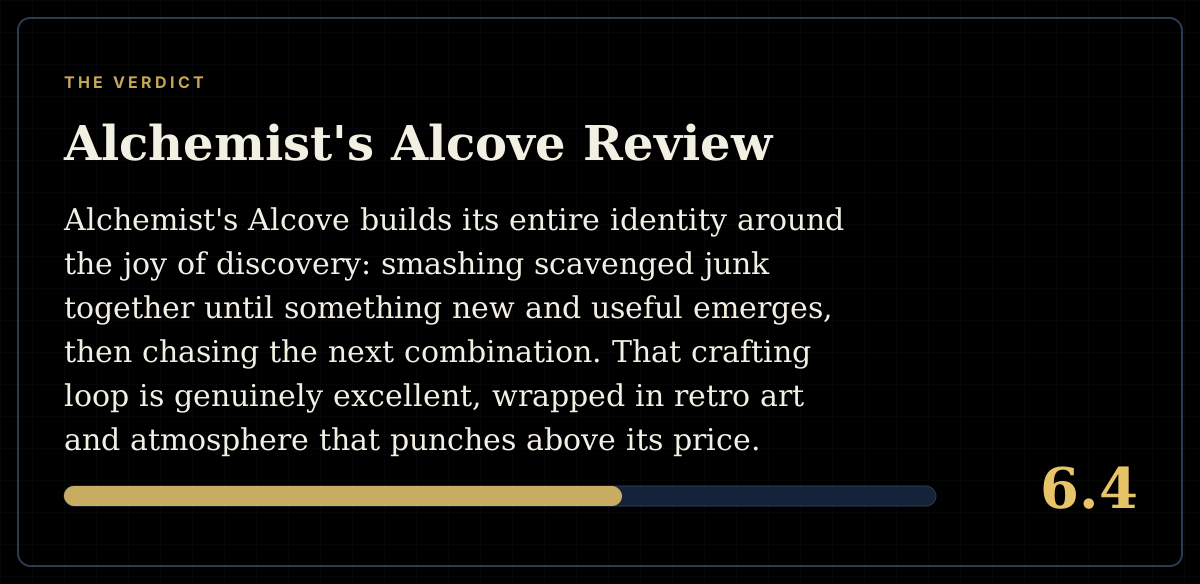
Alchemist's Alcove builds its entire identity around the joy of discovery: smashing scavenged junk together until something new and useful emerges, then chasing the next combination. That crafting loop is genuinely excellent, wrapped in retro art and atmosphere that punches above its price. The dungeon-crawling around it is far less convincing, with shallow combat, fiddly inventory management, and a lack of meaningful variation once the recipes are known.
Biggest strengths
- A genuinely satisfying item-combination system with hundreds of discoverable recipes
- Distinctive retro art style and atmosphere that far exceeds its budget
- Controller support built in from the start, alongside solid accessibility options
Biggest weaknesses
- Combat is shallow, often reducible to whoever has the bigger crafted weapon
- Limited inventory space forces constant, tedious backtracking to gather crafting components
- Little real meta-progression, so repeat runs can feel like replaying the same solved puzzle
Who it's for: Roguelike fans who love Noita-style experimentation and discovery-driven crafting more than they need deep tactical combat.
Our recommendation: Recommended for crafting-obsessed roguelike fans; players who want combat depth or strong run-to-run variety should temper expectations.
6.4 / 10
Smash Two Things Together, See What Happens
Alchemist's Alcove strips the roguelike dungeon crawl down to a single obsession: combining. Every run begins with almost nothing — a dagger, a glove, maybe a scroll, and a blank journal — and everything else has to be scavenged from cleared rooms and slain monsters, then combined two items at a time to see what emerges. A stick and a glove might become a reaching tool. A rotting carcass and floor fungus might become poison gas, which can then be set alight for a makeshift flamethrower. Not every pairing works, and the game only hints at viable combinations rather than spelling them out, leaving genuine trial-and-error discovery at the centre of play.
That discovery loop is what the review sample keeps returning to, often in strikingly enthusiastic terms. Reviewers repeatedly describe the moment a new recipe clicks into place as the game's best feeling, and more than one compares the sensation directly to Noita's alchemical experimentation or to browser toys like Little Alchemy and Doodle God, translated into a turn-based dungeon with real stakes attached. The journal that records every discovered recipe becomes a genuine record of mastery, carried in the player's head as much as on the page, and the sample is full of players who logged twenty, thirty, even forty-plus hours chasing exactly that feeling.
A Roguelike Structure Around the Crafting
Structurally, this is a fairly traditional turn-based roguelike: procedurally arranged rooms, each with a handful of exits that a compass helps track, populated by monsters that scale in threat the deeper a run goes. An in-game achievement tied to reaching the "Church of Sulfur" area functions as an informal midgame marker, and the sample suggests only a modest fraction of players get that far, which points to a real difficulty curve rather than a token challenge gate. Permadeath resets a run entirely, but the knowledge of which combinations work carries over in the player's memory, which the game leans on as its primary form of progression between attempts.
The presentation earns consistent praise too. The retro, minimalist art style draws direct comparisons to roguelikes from the 1990s and 2000s, several reviewers single out the soundtrack specifically, and controller support works out of the box — a detail more than one player flagged as an unexpectedly welcome inclusion for a game this size. The developer also comes up repeatedly and favourably: several reviewers who played the pre-release demo or beta note that specific complaints, from awkward controls to a particularly disliked design problem, were addressed during development, and the pattern continues post-launch with players reporting quick fixes to reported quality-of-life issues.
Accessibility gets more attention than a niche roguelike typically bothers with. Alongside full controller support, the game ships with custom volume controls, a mouse-only control option, and play that isn't gated behind timed input — all useful for a genre that can otherwise demand fast reflexes alongside its puzzle-like crafting. Steam Achievements are also present for players who want concrete milestones like reaching the Church of Sulfur to chase beyond the crafting journal itself.
Where the Loop Runs Thin
The most detailed critical review in the sample draws a sharp line between the crafting tree, which it calls genuinely fun, and the act of actually using what gets crafted, which it does not. Combat comes in for the harshest specific criticism: with no line of sight, no real way to outrun enemies, and little in the way of tactical positioning, several reviewers describe fights as largely a question of whether the player has already crafted the right item — a binary outcome with little room for outplay once the crafting itself is done. One reviewer summarised combat as boiling down to "whoever brings the bigger stick," and nothing else in the sample seriously disputes that framing, even among broadly positive reviews.
Inventory management draws similar frustration. With slots capped at sixteen, and items scattered across every cleared room, several reviewers describe backtracking to gather ingredients as needlessly fiddly — walking to items on the floor to combine them rather than being able to manage everything from a menu, picking up items via a dedicated keypress rather than on contact, and generally spending more time shuffling inventory than crafting. None of this is described as broken, but it's flagged often enough, across otherwise positive reviews, to read as a real design friction rather than a one-off complaint.
The deepest structural criticism concerns replayability. Because recipes and their required components stay fixed once discovered, and because there's little random variation to how a fresh run plays out beyond the map layout, at least one detailed review describes later attempts as executing "the same sequence in the same order" rather than genuinely new runs — closer to a puzzle with a known solution than a roguelike built for repeated surprise. That's a meaningful tension for a genre whose appeal usually rests on variety between attempts, and it's the clearest gap between what the crafting system promises and what the run-to-run structure actually delivers.
Verdict
Alchemist's Alcove succeeds at the one thing it clearly set out to do: make combining junk into spells and weapons feel like genuine discovery, wrapped in art and atmosphere well beyond its modest price. Where it falls short is everything built around that loop — combat with little tactical texture, inventory management that adds friction rather than tension, and a lack of real variation once a player has learned the recipe tree. For roguelike fans who prioritise experimentation and discovery over deep combat systems, it's an easy, cheap recommendation, especially with a developer who has shown a consistent pattern of listening and iterating. Anyone hoping for Noita-level combat depth or a roguelike built for dozens of meaningfully different runs should adjust expectations accordingly.
Pros and cons
Pros
- A genuinely satisfying item-combination system with hundreds of discoverable recipes
- Distinctive retro art style and atmosphere that far exceeds its budget
- Controller support built in from the start, alongside solid accessibility options
- An active, responsive developer who has already shipped several community-requested fixes
Cons
- Combat is shallow, often reducible to whoever has the bigger crafted weapon
- Limited inventory space forces constant, tedious backtracking to gather crafting components
- Little real meta-progression, so repeat runs can feel like replaying the same solved puzzle
- Some reported control and remapping frustrations, though the developer has fixed several already
Screenshots
-
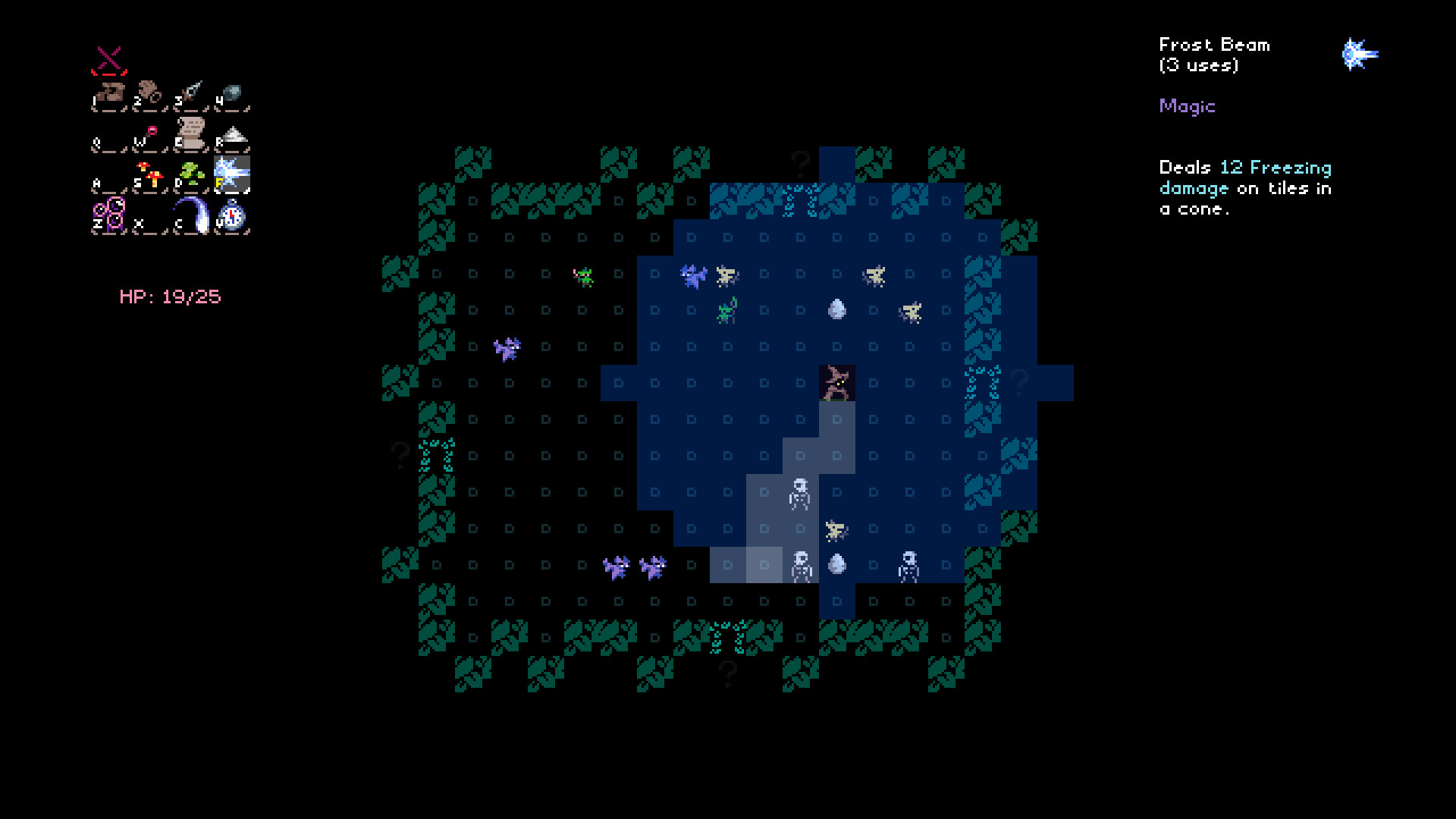
Crafted spells like Frost Beam turn scavenged ingredients into real tactical optionsNefarious Brew Games -
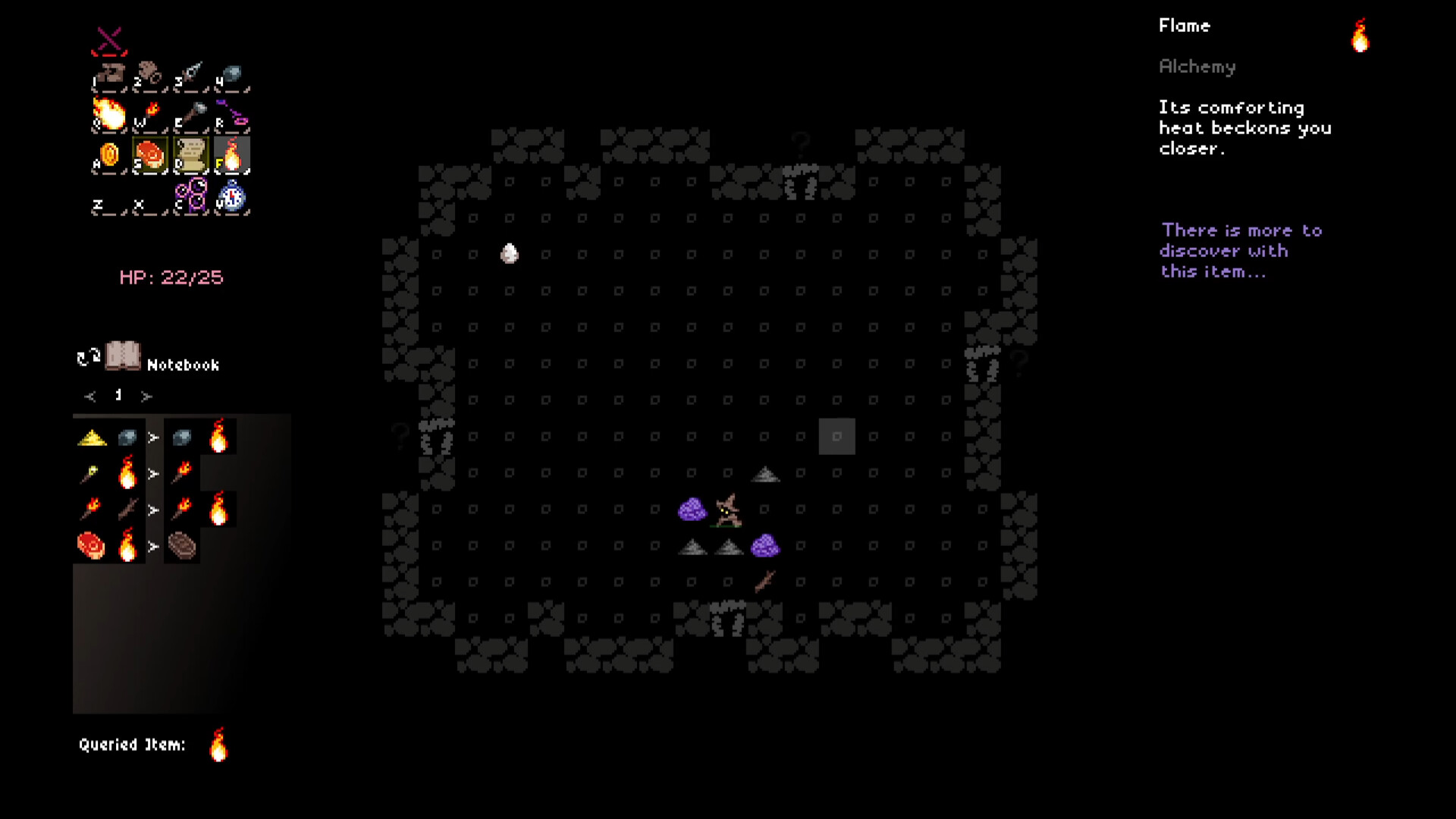
The notebook records every discovered recipe, from campfires to combined torchesNefarious Brew Games -
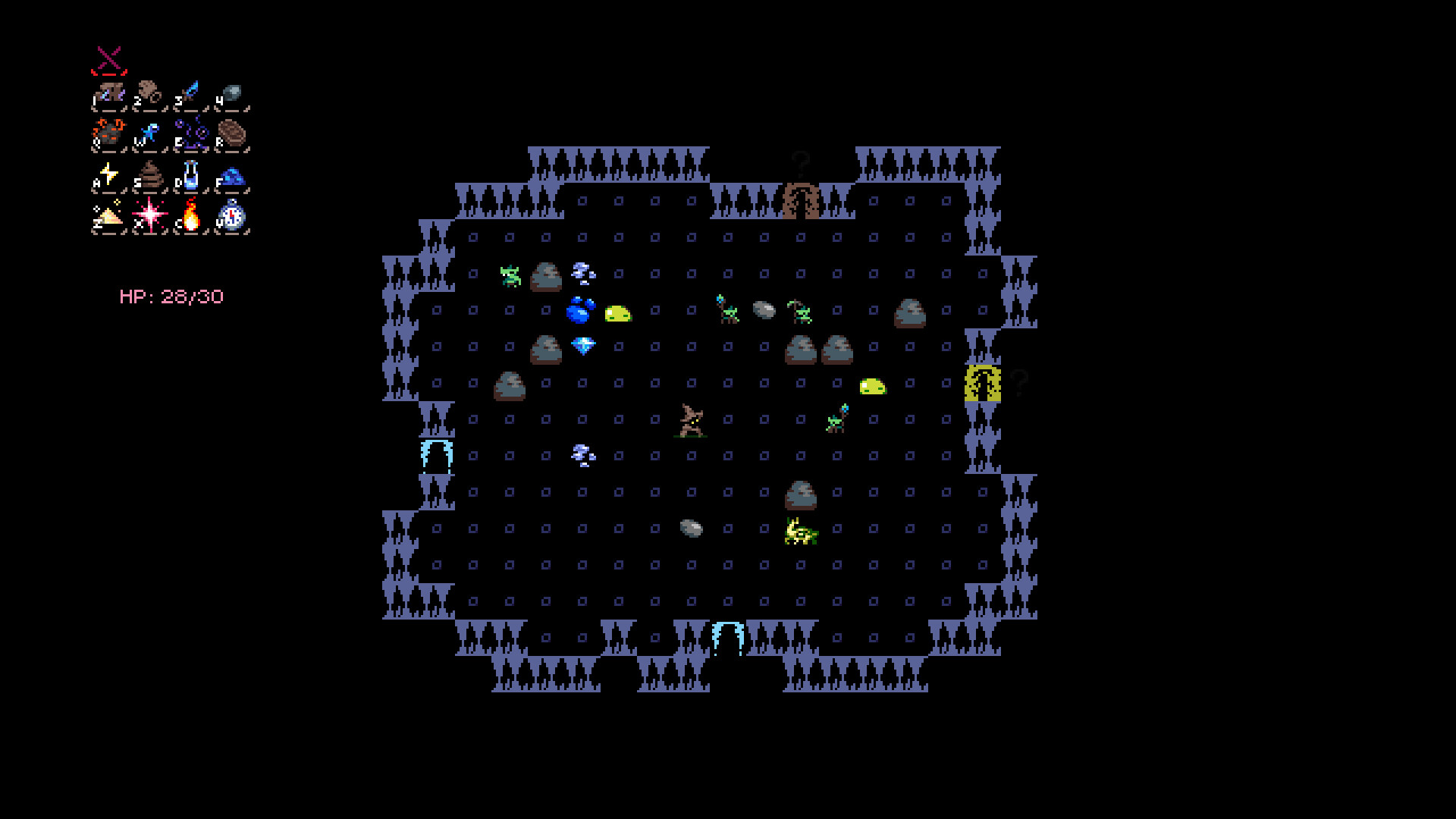
Rooms are littered with the raw ingredients every run's crafting tree depends onNefarious Brew Games -
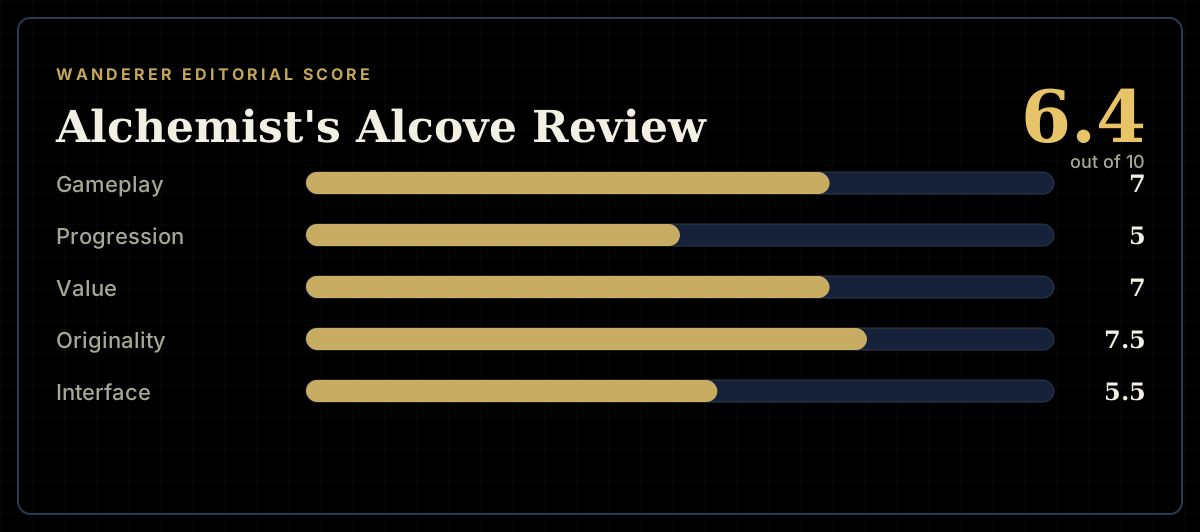
How the review scores each part of the gameWanderer Editorial -
The short versionWanderer Editorial