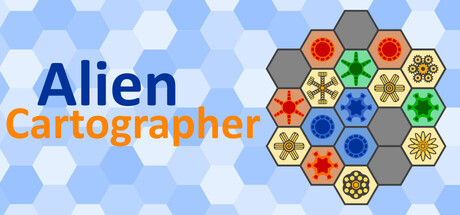
Game review
Alien Cartographer Review
7.4 / 10
- Developer
- FachchefGames
- Publisher
- FachchefGames
- Released
- 22 January 2026
- Platforms
- Windows, macOS
- Genre
- Puzzle
- Monetisation
- Premium
- Players
- Single-player only
The short version
Alien Cartographer takes the deterministic, no-guessing spirit of the best Minesweeper variants and builds a genuinely inventive rule system on top of it, where houses, gold mines, and power cores all constrain each other across a hexagonal grid. Ninety handcrafted levels deliver real deduction more often than not, even if a handful of busier late-game puzzles trade satisfying logic for symbol-hunting tedium.
Biggest strengths
- A genuinely novel deduction ruleset that stacks and cascades in satisfying ways
- Never requires guessing — every level is solvable through pure logic if you have the patience
- A clear in-game rulebook, drawing tools, and colourblind mode support the puzzling rather than getting in its way
Biggest weaknesses
- A handful of busier late-game levels favour tedious symbol-scanning over satisfying deduction
- One mistake forces a full level restart for players chasing perfect-solve achievements
- The in-game rulebook can require a lot of back-and-forth clicking to confirm an edge case
Who it's for: Fans of logic-deduction puzzle games like Tametsi or 14 Minesweeper Variants who want a fair, guessing-free challenge with a fresh ruleset.
Our recommendation: Recommended for puzzle fans specifically; players who bounce off Sudoku-style checklist logic should try the demo first.
7.4 / 10
A Minesweeper for a Different Kind of Grid
Alien Cartographer belongs to a small, dedicated subgenre of logic-deduction puzzlers that grew out of Minesweeper's bones while discarding the parts that made it a game of chance. Rather than flags and hidden mines, players are mapping out alien settlements on a hexagonal grid, identifying which cells contain houses, gold mines, power cores, markets, and towers using nothing but environmental hints and a fixed set of architectural rules — a house must be adjacent to another house, a gold mine needs at least one neighbouring power core, a market can only exist flanked by a pair of towers, and so on. None of these rules ever change or hide new tricks mid-puzzle; the challenge is entirely in working out how they interact once several are layered onto the same small patch of grid.
That premise puts it in direct conversation with genre touchstones like Tametsi and 14 Minesweeper Variants, and the review sample treats it that way — repeatedly, explicitly, as a worthy new entry in that specific lineage rather than a generic puzzle game reaching for a Minesweeper label. What earns it that comparison is the same thing every good entry in the genre needs: every level is, by design, solvable through pure deduction. No guessing is ever required, a point several reviewers raised unprompted as central to why the game works.
Rules That Stack Into Real Deduction
The strongest praise across the sample is for how naturally the ruleset is introduced and how well it scales. The ninety-level handcrafted campaign eases players in with a small subset of rules, then gradually reintroduces and combines them until later levels demand juggling several interacting constraints at once — never adding an entirely new concept before the player has had time to internalise the last one. One detailed review called out this pacing specifically as the game's biggest strength: rules are taught once and never betrayed, so the growing difficulty comes entirely from combination rather than surprise.
The presentation supports that design well. The visual style is minimalist but legible, an in-game Codex documents every rule and stays a click away at all times, and a built-in drawing board lets players sketch out working hypotheses directly on the grid rather than tracking deductions in their head. Accessibility gets real attention too, with a colourblind mode and controls that work equally well with mouse or touchscreen. For the genre's core audience — players who specifically want Sudoku-adjacent deduction without Sudoku's checklist mechanics — this is close to a model example of how to teach and escalate a constraint system.
The game also had a public demo well before launch, and reviewers who played both noted concrete improvements between the two: a markup tool for annotating tentative deductions directly on the grid was singled out as a welcome addition to the full release, suggesting the developer was actively iterating on player feedback rather than treating the demo as a fixed preview. That kind of visible follow-through matters in a genre this niche, where the difference between a good ruleset and a great one often comes down to exactly these small usability details.
When the Puzzle Turns Into Busywork
Not every level lands as cleanly, and the criticisms in the sample are worth taking seriously rather than treating as outliers. The most detailed negative review in the batch draws a sharp distinction between the game's first twenty levels, which it enjoyed even as they grew more complex, and the levels beyond that point, where the puzzle-solving increasingly became about scanning a crowded grid for the one symbol that could be placed with certainty rather than reasoning through the logic step by step. That reviewer's core complaint is structural: several levels stay wide open until very near the end rather than narrowing toward a clear solution the way the best deduction puzzles do, which makes both the thinking and the execution feel more like hunting than solving.
Execution friction compounds this at the margins. A single mistake forces a full level restart if a player wants a perfect solve for achievement purposes, and re-placing every symbol after a big level goes wrong is tedious given the click-and-hold input the game relies on. Consulting the Codex mid-puzzle to confirm an edge case involves real back-and-forth rather than a quick glance, and at least one player found the game surprisingly CPU-intensive given how visually simple it is. None of these are severe on their own, but they're the kind of rough edges that compound across a ninety-level campaign, particularly for players who lean toward the "busywork" experience described above rather than the "satisfying cascade" experience most of the sample reports.
Extras: Procedural Challenges and a Level Editor
Beyond the handcrafted campaign, the game offers five procedurally-generated challenge modes with a global leaderboard for players chasing faster solve times, extending its lifespan without diluting the handcrafted feel of the main ninety levels. A level editor rounds out the package, letting players build and share their own puzzles using the same ruleset — a feature more than one reviewer called a genuine bonus rather than a token inclusion, and one that gives the game a longer tail than its asking price would suggest. Combined, the campaign, challenges, and editor add up to considerably more content than a five-dollar puzzle game typically offers, and several players in the sample logged fifteen to thirty hours without exhausting it.
Verdict
Alien Cartographer earns its place alongside the genre's better-regarded names: a fresh, well-taught ruleset, a fair no-guessing design philosophy, and a campaign generous enough to reward the investment. It isn't uniformly excellent — a stretch of late-campaign levels favour tedious scanning over the satisfying cascades the early game promises, and a few interface frictions add up over a long session — but for logic-puzzle fans specifically, this is an easy, cheap recommendation. Anyone unsure whether Sudoku-style deduction is their thing should try the demo before committing; everyone else can go in with confidence.
Pros and cons
Pros
- A genuinely novel deduction ruleset that stacks and cascades in satisfying ways
- Never requires guessing — every level is solvable through pure logic if you have the patience
- A clear in-game rulebook, drawing tools, and colourblind mode support the puzzling rather than getting in its way
- Extremely cheap for ninety handcrafted levels plus procedural challenges and a level editor
Cons
- A handful of busier late-game levels favour tedious symbol-scanning over satisfying deduction
- One mistake forces a full level restart for players chasing perfect-solve achievements
- The in-game rulebook can require a lot of back-and-forth clicking to confirm an edge case
- Reportedly more CPU-intensive than a puzzle game this visually simple has any right to be
Screenshots
-
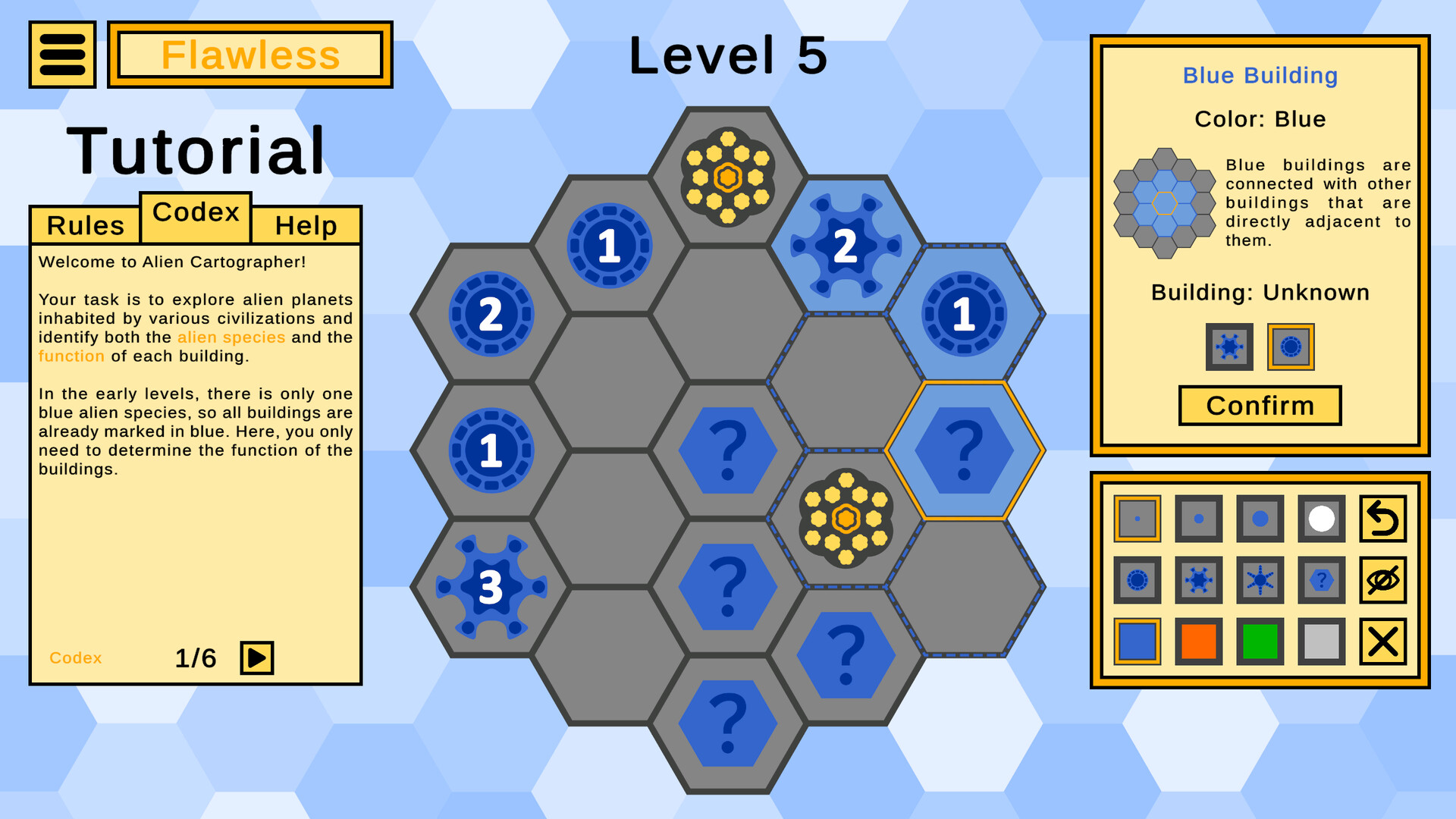
The in-game Codex explains each alien species' connection rules as new tiles are introducedFachchefGames -
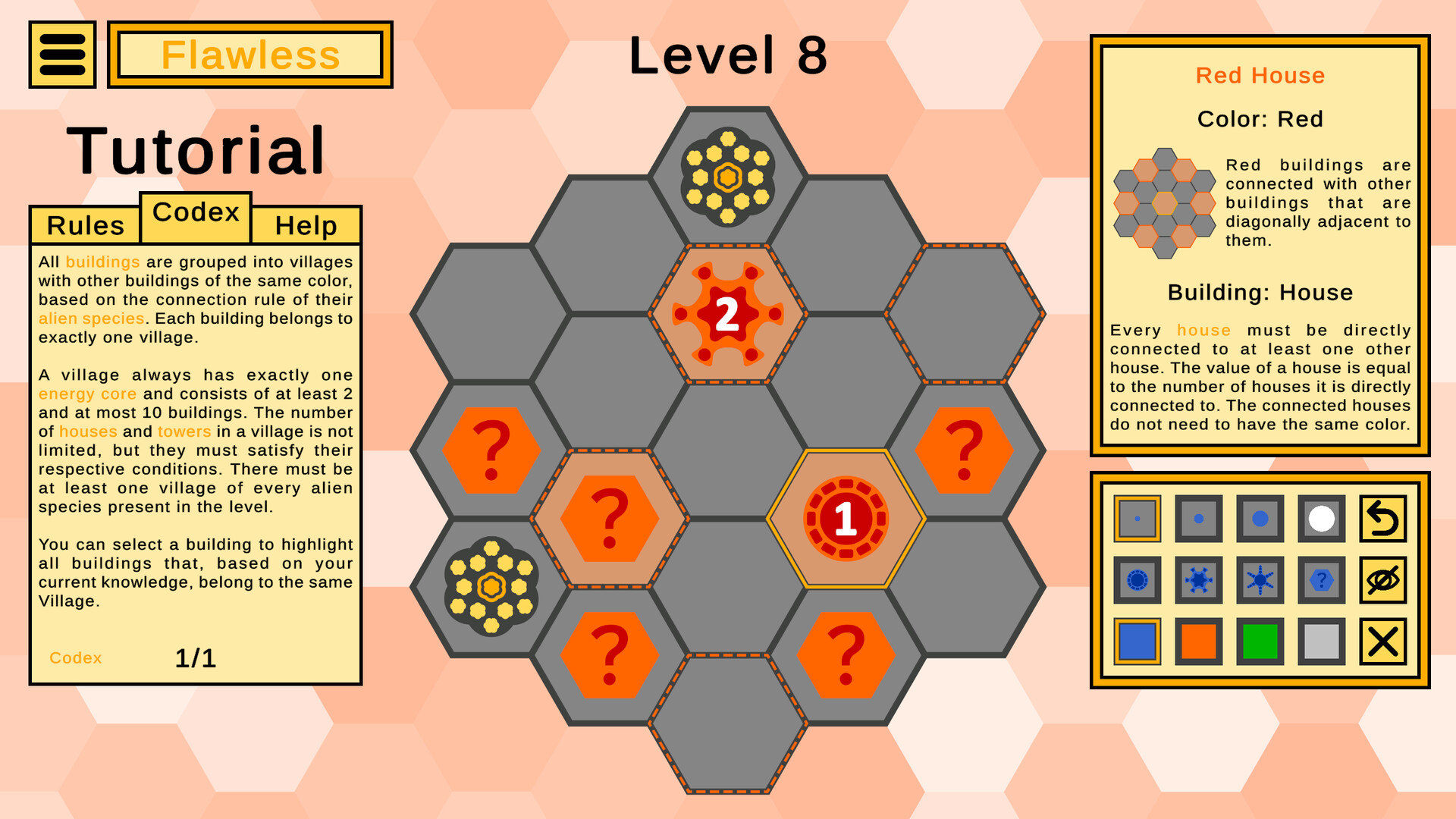
Houses, villages, and energy cores stack into the game's central deduction puzzleFachchefGames -
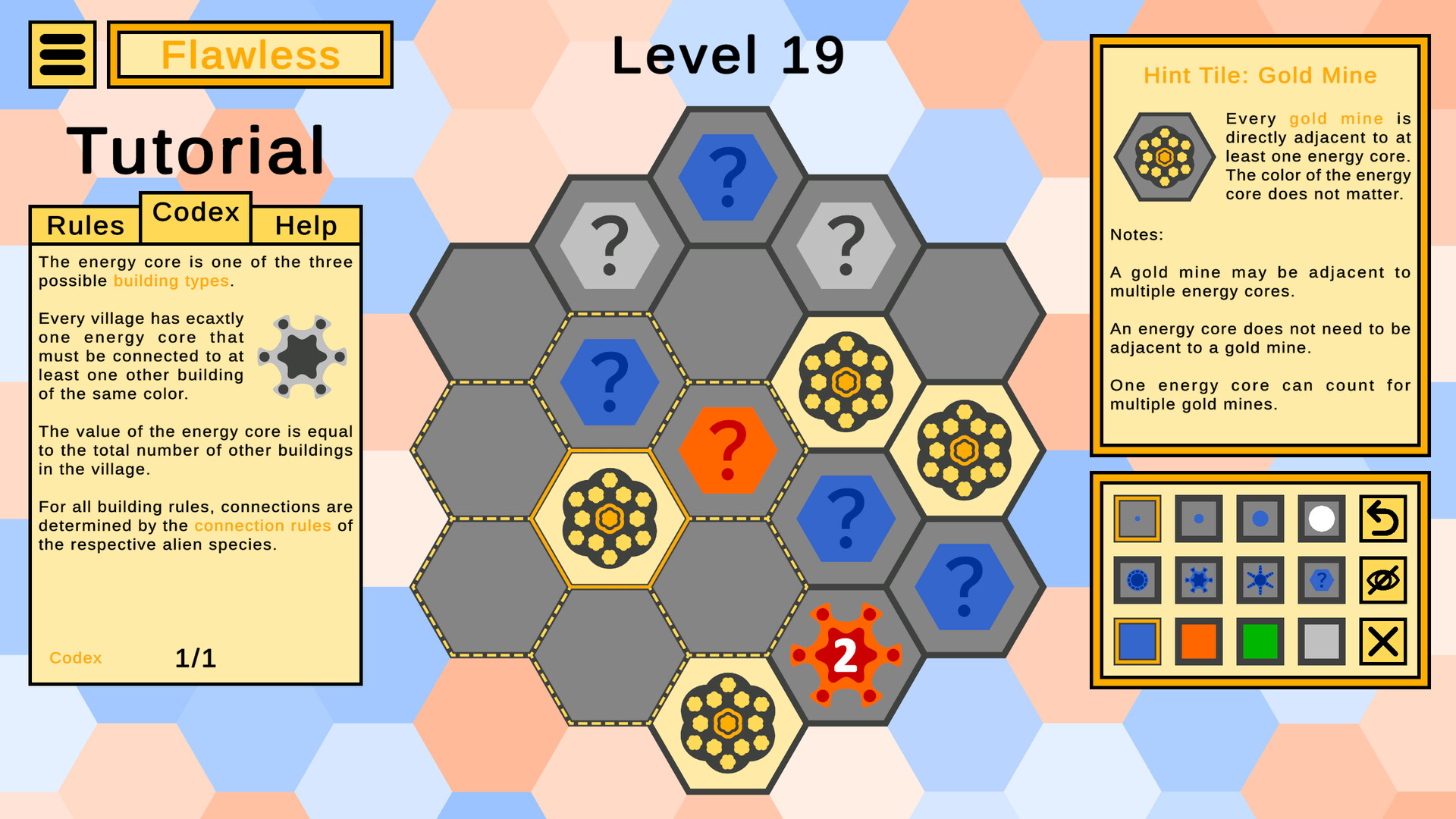
Later levels layer several building types onto the same small patch of gridFachchefGames -
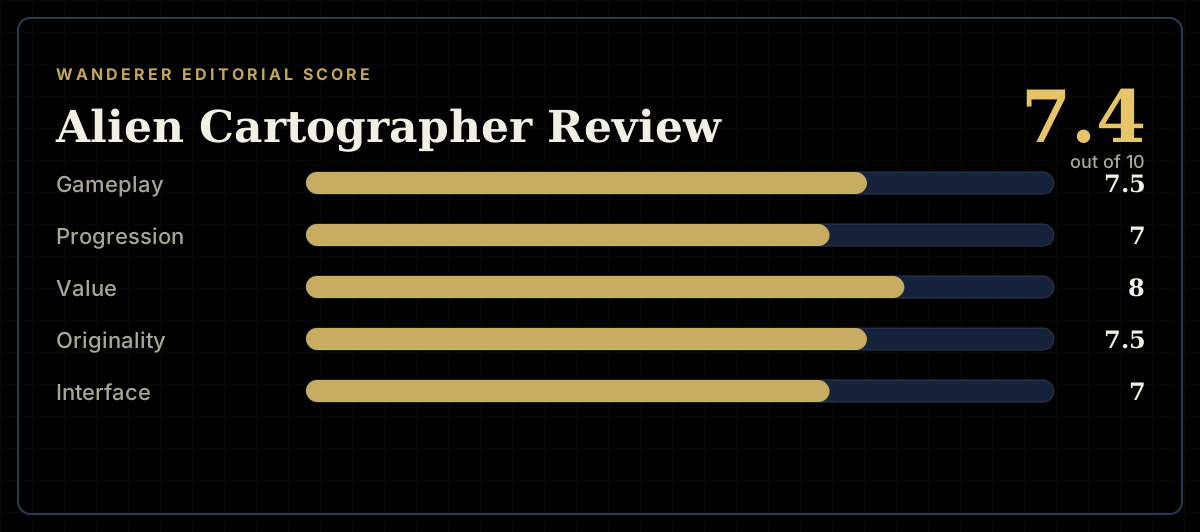
How the review scores each part of the gameWanderer Editorial -
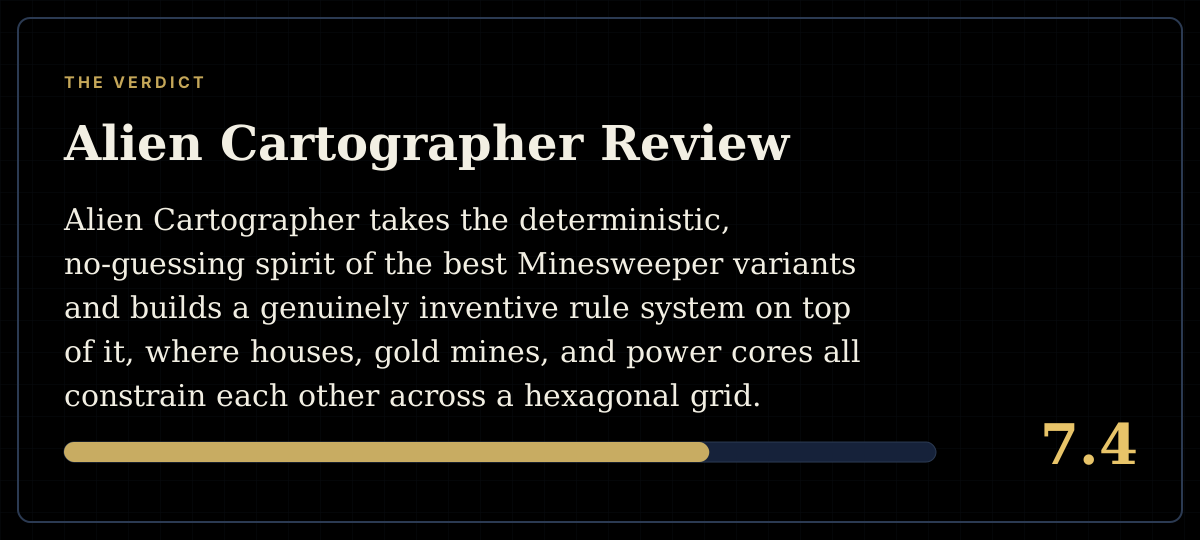
The short versionWanderer Editorial