
Game review
King of the Bridge
6.5 / 10
- Developer
- Finn Schuuring
- Publisher
- Finn Schuuring
- Released
- 8 March 2024
- Platforms
- Windows, macOS
- Genre
- Narrative chess-variant puzzle game
- Monetisation
- One-time purchase, no in-game store or additional currency purchases
- Players
- Single-player only
The short version
King of the Bridge asks you to cross a bridge guarded by a troll who insists on settling the matter with chess — his own chess, governed by a constantly expanding rulebook of homebrew house rules he isn't shy about breaking when it suits him. It's a genuinely funny, genuinely clever premise, executed with real wit and handcrafted pixel art at a price that undercuts almost everything else in this lane. Reviewers consistently praise the writing and the specific pleasure of correctly calling out the troll's cheating, but an unusually candid and consistent share of that same review sample, including many enthusiastic five-star-style accounts, admits the whole experience is over in two to five hours, with the game's own rule-revealing system meaning there's very little left to discover once you've played it once. This is a small game that knows exactly what it wants to be and executes it cleanly — it simply doesn't try to be more than that, and its own fans are the first to say so.
Biggest strengths
- The central premise of catching a cheating opponent mid-game and being rewarded with a one-turn cheat of your own is consistently praised as genuinely clever and satisfying, distinct from typical puzzle or deduction game structures
- Writing and humour draw wide, specific praise, with reviewers repeatedly quoting favourite lines and describing the troll's personality as memorably well-realised for such a small game
- The game is explicitly designed to be approachable regardless of chess skill, and multiple reviewers who describe themselves as poor chess players report enjoying it fully despite that
Biggest weaknesses
- The single most repeated complaint, made by reviewers who otherwise clearly enjoyed the game, is that its roughly twenty rules are revealed automatically over time regardless of player skill, meaning there's little left to discover after a first playthrough and no meaningful replayability
- Several reviewers report the cheat-detection system misfiring, with correct accusations of cheating registering as "false accusations" in specific circumstances, undermining the core mechanic the whole game is built around
- At least one reviewer describes a specific soft-lock risk tied to the "good ending," where a piece being off the board makes it impossible to reach that ending without technically cheating yourself
Who it's for: Puzzle and deduction fans who want a short, sharply written, very cheap curiosity built around a genuinely clever central joke. Not for players looking for lasting replay value or a game that rewards repeated playthroughs with meaningfully new content.
Our recommendation: An easy, low-risk purchase at its price for a few hours of genuinely funny, clever puzzle-solving. Go in expecting a tight, self-contained experience rather than a game you'll return to, since even its biggest fans say there's little left to explore after your first successful crossing.
6.5 / 10
King of the Bridge's pitch fits in one sentence and still manages to sound funnier the more you think about it: to cross a bridge, you must beat a troll at chess — except it's his chess, governed by a homebrew rulebook of over twenty house rules, and he isn't above breaking even those when he thinks he can get away with it. Catch him cheating, and you earn a single turn to cheat right back. It's a small, cheap, single-developer game, and the review sample treats it almost entirely on its own terms: a genuinely clever joke, executed well, that both its fans and its critics agree runs its full course faster than most players would like.
A joke that lands, mechanically and comedically
The reviews aren't shy about how well the central hook works in practice. "Being decent at chess is actually more of a hindrance than it is necessary for this game," one reviewer writes, capturing how the game deliberately undercuts chess mastery in favour of paying attention to the troll's specific, absurd rule violations. The writing draws consistently specific praise too — "this game feels like if Bobby Fischer had a mental breakdown after his 100,000th game of chess," one review jokes, while another compares the experience to "playing chess against a 6-year old who changed a bunch of the rules without telling you, and cheats, but is bound by honor to reward you any time [you] catch them cheating." That's an unusually precise, well-observed description of exactly what makes the premise funny rather than merely gimmicky.
The complaint its own fans keep making
What makes this review sample genuinely useful is how often the exact same reviewers who praise the game unprompted also flag its central limitation. "God this game needs a content update. It has near infinite potential, and yet I did all the achievements in under 5 hours," one enthusiastic reviewer writes. Another, more measured account explains the mechanical reason why: "the rules are revealed automatically over time, so even if you are struggling to discern them yourself, after 2 hours there is nothing left to discover... it is just regular, skill-based chess with rule variants." This is a genuinely useful distinction for a game explicitly built around player deduction — once the game itself hands you every rule regardless of whether you worked them out, the deduction half of the pitch quietly disappears, leaving straightforward (if amusingly reskinned) chess behind.
Real bugs in the mechanic the whole game hinges on
Beyond the pacing complaint, several reviewers report a more concrete problem: the cheat-accusation system itself misfiring. "I just played three games in which I factually correctly called black for cheating and it says false accusation," one reviewer writes, describing repeated instances where a correct read was rejected by the game's own logic. A separate, more specific complaint concerns the "good ending," which at least one reviewer describes as effectively soft-locked in certain board states, since retrieving an off-board piece technically requires the very cheating the good ending is meant to punish you for engaging in. These are the kinds of bugs that undercut the exact mechanic the entire premise depends on, and they're worth taking seriously even in a short, cheap game.
A complete, small thing, unlikely to grow further
This review can confirm directly that the developer supported King of the Bridge actively around its launch — a dense pre-release update cadence added new endings, localisation, and a Speed Chess mode, and a dedicated "Ascension Challenge" community event with real prizes ran in the weeks after the 8 March 2024 launch. But the visible update history goes quiet not long after that, with the developer's next public move being the reveal of an entirely different, unrelated game in 2026. For a game whose own fans are actively requesting more content, that's a clear signal: what's here now is very likely what's staying, a fully realised but deliberately small idea rather than a foundation for future expansion.
What the achievement data confirms about how far players actually go
Steam's own completion figures line up neatly with the review sample's account of a short, front-loaded experience. Early rulebook and accusation-related achievements sit above 90%, meaning nearly everyone who buys the game engages with its core hook successfully, but full completion of every achievement — including harder speed-chess variants and specific stylistic challenges like winning by "juggling" pieces — sits at just 5.6%. That's a real drop-off, but a meaningfully gentler one than many far longer, far more expensive games in this lane show at their own hardest tiers, consistent with a game whose difficulty ceiling is modest by design rather than a game whose late content is being abandoned by a frustrated audience.
A useful comparison point for value
It's worth being specific about what "value" means for a game this cheap and this short. At NZD 4.49, King of the Bridge costs meaningfully less than a single coffee, for an experience multiple reviewers estimate at two to five hours depending on chess familiarity. One reviewer, a self-described longtime fan of roguelike deckbuilders like Slay the Spire and Balatro, calls it "probably singlehandedly the best bang for my buck of enjoyment to cost I've had for a video game, ever," explicitly noting they'd have happily paid three times the asking price. That's a genuinely useful data point for calibrating expectations: judged purely on a dollars-per-hour basis against much longer games, King of the Bridge looks unremarkable; judged on the more honest metric of whether the specific hours it does offer feel worth what you paid, the review sample suggests most buyers come away satisfied regardless of the game's modest scope.
Final verdict
King of the Bridge is a genuinely clever, well-written, cheaply-priced puzzle game that does exactly one thing and does it charmingly — catching a cheating troll at his own rigged game is a real, satisfying pleasure for the few hours it lasts. Its own fans are refreshingly honest that those few hours are all there is, and a handful of real bugs in the core cheat-detection mechanic are worth knowing about going in. Worth the low asking price for a short, funny, memorable curiosity; don't expect it to hold your attention much past your first successful crossing.
Pros and cons
Pros
- The central premise of catching a cheating opponent mid-game and being rewarded with a one-turn cheat of your own is consistently praised as genuinely clever and satisfying, distinct from typical puzzle or deduction game structures
- Writing and humour draw wide, specific praise, with reviewers repeatedly quoting favourite lines and describing the troll's personality as memorably well-realised for such a small game
- The game is explicitly designed to be approachable regardless of chess skill, and multiple reviewers who describe themselves as poor chess players report enjoying it fully despite that
- At its very low price, value is one of the most consistently repeated praises in the sample, with several reviewers explicitly comparing its enjoyment-per-dollar favourably against far more expensive games
- The solo developer shipped a dense pre-launch update cadence adding new endings, localisation, and a Speed Chess mode, and ran a dedicated community "Ascension Challenge" with prizes shortly after launch
Cons
- The single most repeated complaint, made by reviewers who otherwise clearly enjoyed the game, is that its roughly twenty rules are revealed automatically over time regardless of player skill, meaning there's little left to discover after a first playthrough and no meaningful replayability
- Several reviewers report the cheat-detection system misfiring, with correct accusations of cheating registering as "false accusations" in specific circumstances, undermining the core mechanic the whole game is built around
- At least one reviewer describes a specific soft-lock risk tied to the "good ending," where a piece being off the board makes it impossible to reach that ending without technically cheating yourself
- Multiple reviewers explicitly request post-launch content such as a roguelike mode or additional rule sets to extend the experience, noting the premise has "near infinite potential" that the shipped game doesn't fully explore
- The developer's own update history shows a single meaningful patch shortly after launch followed by an extended quiet period before announcing an entirely new, unrelated game in 2026, suggesting further content for this specific title is unlikely
Screenshots
-

King of the BridgeImage: Finn Schuuring via Steam -

King of the BridgeImage: Finn Schuuring via Steam -

King of the BridgeImage: Finn Schuuring via Steam -
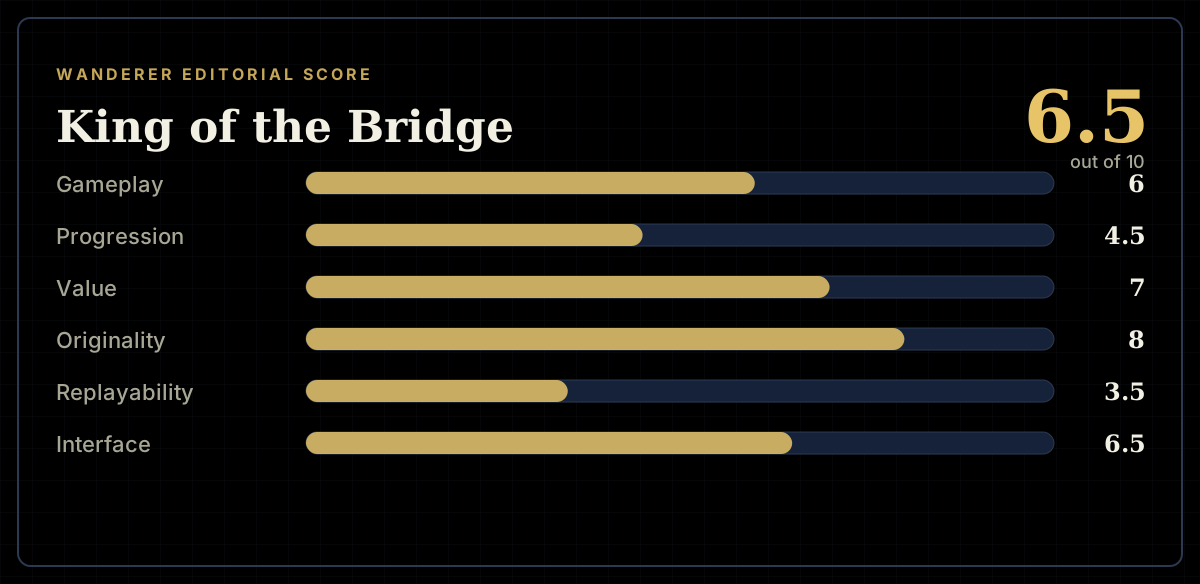
How the review scores each part of the gameWanderer Editorial -
The short versionWanderer Editorial