
Game review
Homicipher
6 / 10
- Developer
- 八名木Games
- Publisher
- Gamirror Games
- Released
- 1 November 2024
- Platforms
- Windows
- Genre
- Horror-otome point-and-click adventure
- Monetisation
- One-time purchase, no in-game store or additional currency purchases
- Players
- Single-player only
The short version
Homicipher drops its protagonist into a house full of monstrous residents who speak an invented language with no grammar to lean on — you learn what their gestures and expressions mean purely through context, one guess at a time, with instant death or dead-end branches as the price of getting it wrong. That premise is genuinely unusual, and it has earned the game a large, devoted, and often very funny fanbase built substantially around its cast of monster love interests. Set against that enthusiasm is a real, detailed, and widely repeated set of concerns: many reviewers describe the story's endings as unfinished or unsatisfying, several report a serious and specific controversy around the developer's conduct on social media following criticism, and multiple accounts describe endings being altered or removed after launch under a change in development team. This review could not independently verify those specific claims through Steam's own channels, since the game's official events feed carries no posts at all, but the consistency and detail across many separate reviewers makes them worth reporting directly rather than ignoring.
Biggest strengths
- The core language-deciphering mechanic is repeatedly praised as genuinely original, with reviewers specifically highlighting how satisfying it feels to piece together meaning from gestures and context rather than through a conventional dialogue tree
- The monster cast draws enthusiastic, specific, often comedic praise, with reviewers describing genuine attachment to individual characters well beyond typical genre engagement
- A no-penalty retry system for game overs and instant deaths is specifically praised as letting players experiment with the language-guessing mechanic without punishing failure
Biggest weaknesses
- A large number of reviewers describe the story's endings, including major character routes, as unfinished, rushed, or lacking proper resolution to the mysteries the game spends most of its runtime building up
- Multiple reviewers report a significant post-launch controversy involving the developer's public conduct on social media in response to criticism, which several state directly cost the game their recommendation despite otherwise enjoying it; this review could not independently verify the specific claims through Steam's own channels
- Several reviewers separately describe endings being altered, removed, or reduced following an alleged change in the development team after launch, with related official posts reportedly later deleted; again, this review found no independent corroboration through Steam's partner-events feed, which returned no posts for this title at all
Who it's for: Fans of unconventional puzzle mechanics and horror-tinged otome romance who enjoy piecing together meaning through trial and error, and who are prepared for a story that a large share of its own audience says doesn't fully resolve its central mysteries.
Our recommendation: Worth trying specifically for its genuinely unique language-deciphering hook and its distinctive cast, at a price that feels steep relative to the roughly five-hour length most reviewers report. Go in aware that the story's endings are widely described as incomplete, and be aware of the post-launch developer-conduct concerns reported by many reviewers before buying if that would affect your decision.
6 / 10
Homicipher's central idea is the kind of thing that sounds almost too clever to actually work: you wake up somewhere unfamiliar, surrounded by monstrous residents who communicate in a language with no shared grammar to hang onto, and your entire job is to learn what a gesture, an expression, or a sound means purely by watching what happens next. Get it wrong, and you might trigger an instant death or a dead-end branch; get it right, and the world slowly starts making sense. It's a genuinely distinctive hook for a horror-otome hybrid, and it's clearly the reason a large, devoted, often very funny fanbase has formed around the game. It's also, according to a real and detailed cluster of the same review sample, a hook attached to a story that a meaningful share of players say never properly finishes what it starts.
A puzzle mechanic that mostly delivers on its premise
The language-deciphering system earns real, specific praise from reviewers willing to engage with it on its own terms. "I've been craving this kind of concept of deciphering language as a game mechanic for a while," one reviewer writes, and a formally trained linguist among the sample goes further, praising the underlying design as "peak mechanics" alongside their enthusiasm for the cast. The no-penalty retry system draws its own specific praise for letting players experiment freely: instant deaths and bad endings become opportunities to learn rather than punishments to fear, and multiple reviewers describe genuine satisfaction the moment a previously baffling gesture finally clicks into meaning.
A fanbase built as much on its cast as its mechanics
It would undersell this review sample to leave out how much of its enthusiasm centers specifically on Homicipher's monster characters, led by fan-favourite "Mr. Crawling." Reviews range from earnestly affectionate to gleefully unhinged — "I have 50 hours in this game because I leave it on my monitor so I can pretend Mr. Crawling is sleeping in my bed with me at night," one writes — and that intensity of attachment is itself a real signal of successful character design, whatever else the story does or doesn't resolve. Several reviewers explicitly note that the horror elements fade in intensity once you become familiar with the cast, reframing the back half of a playthrough as something closer to comedy than dread.
A story reviewers say doesn't stick the landing
Set against that enthusiasm, a substantial share of the negative sample raises the same specific concern: the game's endings don't deliver satisfying answers to the mysteries it spends most of its length building up. "The game has a unique concept with a likeable cast and an interesting MC, but fails in many aspects such as explaining lore, having no proper conclusions to the endings," one detailed reviewer writes. Another, more blunt: "all the ends feels unfinished." This isn't one disappointed player — it's a pattern specific enough, and repeated by enough otherwise positive reviewers, to treat as a real structural weakness in the writing rather than a minority taste mismatch.
A serious controversy this review could not independently confirm
Multiple reviewers describe a specific and, by their account, serious controversy involving the developer's public conduct on social media in response to player criticism, with at least one reviewer linking directly to what they describe as a translated post they found genuinely troubling. Several others separately describe a related sequence of events: an alleged change in the development team after launch, endings reportedly altered or removed as a result, and official posts about the change reportedly deleted afterward, with follow-up questions from players also removed. This review takes reports like these seriously, but must be direct about its limits here: Steam's own partner-events feed for this title returned no posts whatsoever, meaning none of these specific claims could be corroborated through the game's official Steam channel the way this review has verified similar concerns for other titles. Given how consistently and specifically multiple independent reviewers describe the same sequence of events, it would be misleading to omit the concern entirely — but readers should understand it's reported here on the strength of a consistent player-feedback pattern, not independently confirmed developer communication.
Marketing that oversells two genres at once
A smaller but repeated complaint concerns expectations set by the game's own marketing as both a horror title and an otome romance. "If you are more interested in the horror and puzzle aspects than the otome one from this game, you don't wanna buy this," reads one review, while others report the opposite frustration — minimal actual romantic content despite the "otome" framing. Both complaints land in the same place: buyers going in with a specific genre expectation drawn from the store page are likely to find one half of that expectation considerably thinner than advertised.
Final verdict
Homicipher's core idea — a language you have to learn entirely through context, with real stakes for guessing wrong — is a genuinely clever piece of design, and it's clearly enough to have won the game a large and devoted fanbase built around its distinctive cast. But a real, detailed, and widely repeated set of concerns runs alongside that enthusiasm: endings many players call unfinished, and a specific, serious developer-conduct controversy this review could report but not independently confirm through the game's own official channels. Worth trying for the mechanic and the cast if either genuinely appeals to you — go in with tempered expectations about narrative closure, and do your own reading on the reported controversy if a developer's public conduct factors into your buying decisions.
Pros and cons
Pros
- The core language-deciphering mechanic is repeatedly praised as genuinely original, with reviewers specifically highlighting how satisfying it feels to piece together meaning from gestures and context rather than through a conventional dialogue tree
- The monster cast draws enthusiastic, specific, often comedic praise, with reviewers describing genuine attachment to individual characters well beyond typical genre engagement
- A no-penalty retry system for game overs and instant deaths is specifically praised as letting players experiment with the language-guessing mechanic without punishing failure
- Multiple reviewers who initially expected a straightforward horror or dating-sim experience describe pleasant surprise at how much genuine puzzle-solving satisfaction the language system provides once it clicks
- At least one reviewer with a formal linguistics background specifically praises the underlying design of the invented language system as genuinely clever rather than superficial
Cons
- A large number of reviewers describe the story's endings, including major character routes, as unfinished, rushed, or lacking proper resolution to the mysteries the game spends most of its runtime building up
- Multiple reviewers report a significant post-launch controversy involving the developer's public conduct on social media in response to criticism, which several state directly cost the game their recommendation despite otherwise enjoying it; this review could not independently verify the specific claims through Steam's own channels
- Several reviewers separately describe endings being altered, removed, or reduced following an alleged change in the development team after launch, with related official posts reportedly later deleted; again, this review found no independent corroboration through Steam's partner-events feed, which returned no posts for this title at all
- The language-deciphering mechanic itself draws a specific counter-complaint from other reviewers, who describe it as inconsistent or lacking a discoverable underlying pattern, making progress feel like guessing rather than genuine deduction for some players
- Marketing as both a horror game and a romance-focused otome title draws criticism from reviewers who found very little of either genre convention delivered in full, with several specifically warning prospective buyers not to expect meaningful romantic content
Screenshots
-

HomicipherImage: Gamirror Games via Steam -

HomicipherImage: Gamirror Games via Steam -

HomicipherImage: Gamirror Games via Steam -
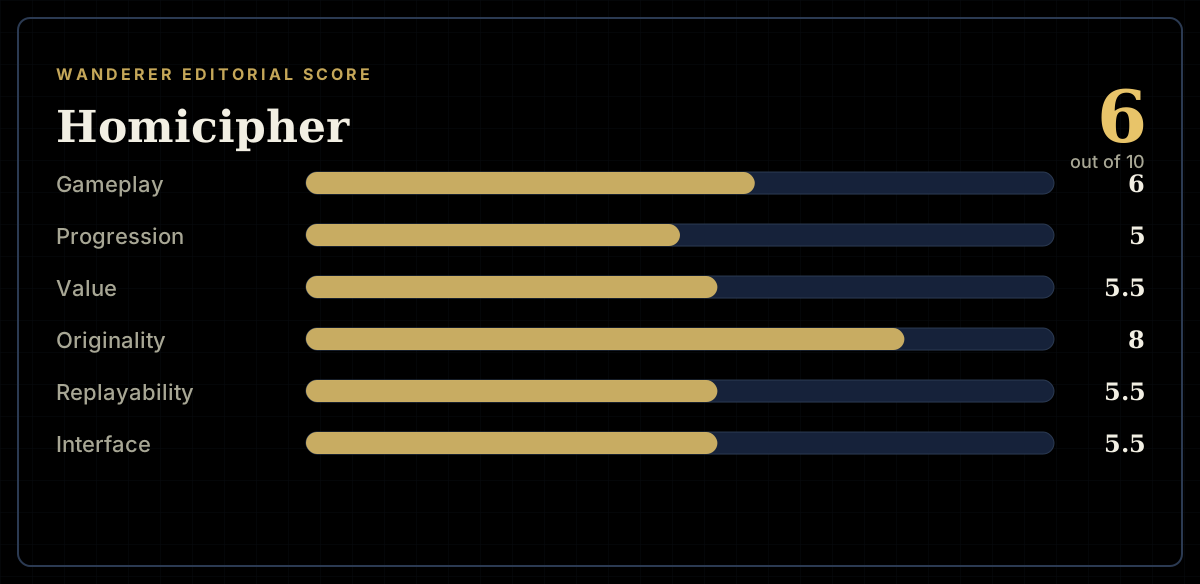
How the review scores each part of the gameWanderer Editorial -
The short versionWanderer Editorial