
Game review
Home Safety Hotline
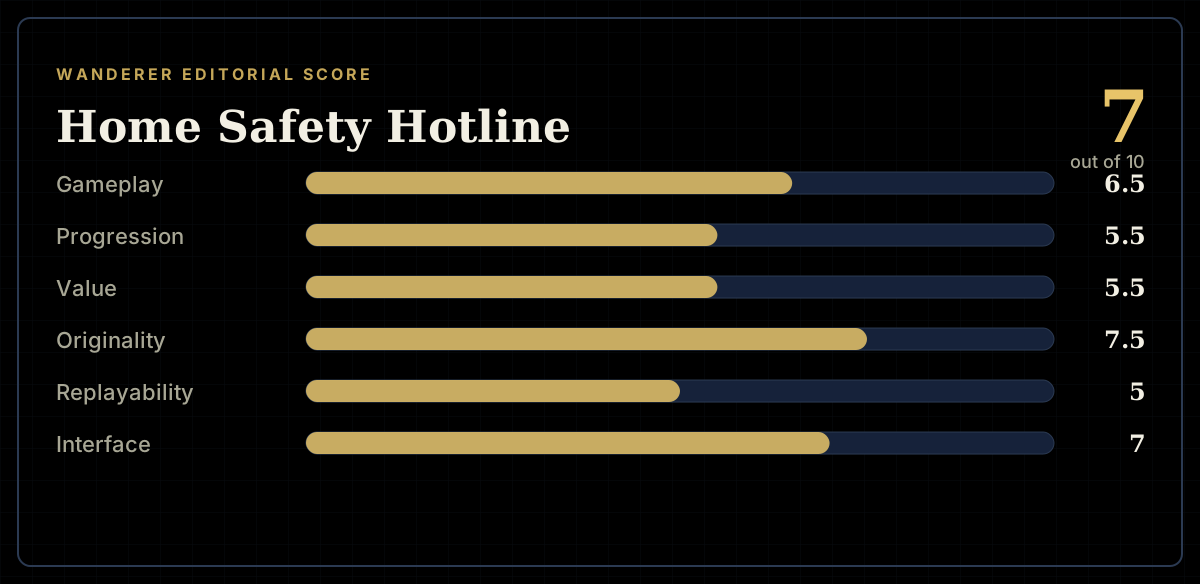
7 / 10
- Developer
- Night Signal Entertainment
- Publisher
- Night Signal Entertainment
- Released
- 16 January 2024
- Platforms
- Windows
- Genre
- Analog-horror telephone-operator simulator
- Monetisation
- One-time purchase, with one free content DLC and later paid Steam Trading Card support
- Players
- Single-player only
The short version
Home Safety Hotline puts you behind a 90s-style call centre desk, fielding panicked callers describing household problems that are, gradually and deliberately, far weirder than pest control should ever require. You cross-reference their descriptions against a growing catalogue of cryptids and hazards, dispense corporate-approved advice, and watch a genuinely well-written, darkly funny piece of world-building unfold call by call. Reviewers consistently praise the writing, the voice acting, and the tonal balance between mundane customer-service dread and real horror. The most consistent complaint, though, is about length and price together: a main campaign most reviewers finish in two to five hours, sold at a price some feel doesn't match that runtime, with limited reason to return once the story concludes. The developer has responded directly to that specific complaint with a free post-launch "Call Trainer" survival mode and a separate seasonal DLC, meaningfully extending what's on offer since several of the negative reviews quoted here were written.
Biggest strengths
- Writing and tone draw the most consistent, specific praise in the entire review sample, with reviewers repeatedly describing a genuinely effective balance between mundane customer-service dread and real horror
- Voice acting is singled out by multiple reviewers as unusually strong for an indie release of this scale, contributing directly to the atmosphere reviewers describe finding unexpectedly unsettling
- A dedicated "Phobia Toggles" accessibility option, letting players disable imagery tied to common phobia triggers, is a specific and thoughtful design choice worth noting directly
Biggest weaknesses
- The single most repeated complaint concerns value for money, with numerous reviewers independently stating the main campaign's two-to-five-hour length doesn't comfortably justify the asking price, several explicitly recommending buyers wait for a sale
- The main story is described by multiple reviewers as linear with little variation between playthroughs, meaning the core puzzle-matching loop offers limited incentive to replay once the narrative concludes, at least prior to the later Call Trainer addition
- Several reviewers describe the ending and overall narrative payoff as underwhelming relative to the intriguing world-building the game spends most of its runtime establishing
Who it's for: Fans of short, atmospheric, narrative-driven horror experiences who enjoy puzzle-like matching mechanics and appreciate sharp, deadpan writing. Less suited to players who weigh value purely by hours-per-dollar, since even with post-launch additions this remains a compact experience.
Our recommendation: A strong pick at a discount for horror and analog-horror fans specifically drawn to its concept and tone. At full price, weigh the short main campaign against the free Call Trainer mode added after launch, which meaningfully extends what you get for your money beyond the original release.
7 / 10
Home Safety Hotline's pitch is a small, perfectly formed piece of premise: you're a call-centre operator for a company that helps homeowners identify what's making that noise in the walls, and your job is to calmly, professionally match their panicked description against a corporate-approved catalogue of pests, hazards, and — increasingly, as the game goes on — things considerably worse than pests. It's a tight, well-executed idea from Nick Lives, the creator of NiGHT SIGNAL, and the review sample makes clear the tone lands almost exactly as intended. What it also makes clear, with real consistency, is that a specific number attached to that tone — its price relative to its length — has been the game's most persistent sticking point since launch.
Writing that earns its atmosphere
The praise in this sample isn't vague appreciation for "vibes" — it's specific about what makes the writing work. "Every day you dispassionately reveal that the world is far more horrifying than anyone could have guessed," one reviewer writes, capturing the game's central trick: dry, sanitized corporate language slowly giving way to real dread as the encyclopedia entries escalate. Voice acting draws similarly specific praise, with one reviewer describing genuine physical reactions to a game they were playing casually on a call with a friend: "I found the hairs on the back of my neck tingling." Another frames the entire concept succinctly: "the scariest thing about it is how close to a call centre job this is." That's a joke, but it's also a real compliment to how convincingly the game replicates the specific, low-grade dread of customer service work before layering supernatural horror on top of it.
The complaint that dominates the negative sample
Set against that praise, a remarkably consistent thread runs through the negative reviews: the game is short, and its price doesn't sit comfortably against that length for a meaningful share of buyers. "Almost $20 CAD for a 2 hour experience is kinda iffy," one reviewer writes, a sentiment echoed by numerous others citing runtimes between two and five hours and specifically recommending a sale rather than a full-price purchase. This isn't really a complaint about quality — most of the same reviewers explicitly praise the writing and atmosphere in the same breath — it's a complaint about a specific value calculation, repeated often enough across independent reviewers to treat as a real, structural concern rather than a handful of outliers.
A story some reviewers say doesn't fully pay off
A second, related complaint concerns narrative closure. "The lack of any real meaningful backstory as to what-all is going on... the 'good' ending feeling out of place," one reviewer writes, and several others separately describe the ending as underwhelming relative to the intriguing world-building built up over the course of the calls. This is a fair criticism to weigh against the writing praise above — the moment-to-moment writing can be sharp and effective while the overall narrative arc still leaves some players wanting more resolution than they get.
A developer that responded directly to the loudest complaint
What's genuinely notable here is how directly the developer addressed the length-and-replayability concern after launch. The partner-events feed confirms a "Call Trainer" survival-mode update arrived roughly seven weeks after the 16 January 2024 launch, letting players test their knowledge against randomly selected cases under time pressure once the main story is complete — precisely the kind of feature multiple early reviewers wished for. One reviewer's review reflects this directly: updated after the fact to note "the developer has added a 'survival mode' that unlocks after beating the game," acknowledging the addition changed their overall impression. A further free "Seasonal Worker" DLC arrived roughly eight months after launch, and the game has continued to receive attention since, including an announced film adaptation in April 2026 — a genuinely strong outcome for a small, single-developer passion project.
What the achievement data adds
Steam's own completion figures offer a useful independent angle on the length-versus-depth question. Day-by-day story milestones drop steadily from 94.5% to 46.4% for full completion, and a flawless run sits at just 13.3% — a meaningfully steep falloff for a game most reviewers describe finishing in well under five hours. That's consistent with a game whose puzzle-matching mechanic, while initially engaging, loses some of its grip on a real share of players well before the credits roll, even accounting for its short overall length.
A thoughtful accessibility touch, worth naming on its own
Separate from the tone and length discussion, this review wants to specifically credit a design choice easy to overlook: a dedicated "Phobia Toggles" option lets players disable in-game imagery tied to common phobia triggers, including arachnophobia, without disabling the game's broader horror content. That's a meaningfully more considered approach than a blanket content warning, letting players who are sensitive to specific imagery still engage fully with the game's tone and story rather than being forced to avoid it entirely or accept unwanted distress. It's a small feature in the context of the whole review, but a genuinely well-executed one, and the kind of detail that speaks well of a small team's care in a title otherwise defined by dread and dark comedy.
Final verdict
Home Safety Hotline is a sharply written, well-performed piece of analog horror that does a lot with a small, focused idea, and its most common criticism — that the price outran the original runtime — has been meaningfully addressed by a free post-launch survival mode that gives the concept somewhere to go after the story ends. Worth a strong recommendation for horror fans specifically drawn to its tone and premise, especially factoring in what's been added since launch; still worth waiting for a discount if raw hours-per-dollar is your primary buying criterion.
Pros and cons
Pros
- Writing and tone draw the most consistent, specific praise in the entire review sample, with reviewers repeatedly describing a genuinely effective balance between mundane customer-service dread and real horror
- Voice acting is singled out by multiple reviewers as unusually strong for an indie release of this scale, contributing directly to the atmosphere reviewers describe finding unexpectedly unsettling
- A dedicated "Phobia Toggles" accessibility option, letting players disable imagery tied to common phobia triggers, is a specific and thoughtful design choice worth noting directly
- The developer directly addressed the single most common post-launch complaint about replayability, adding a free "Call Trainer" survival mode roughly seven weeks after launch that lets players test their knowledge against randomly selected cases under time pressure
- A free seasonal DLC, "Seasonal Worker," was added around eight months after launch, and the game has continued receiving support and promotional attention, including Steam Trading Cards and a announced film adaptation, well into 2026
Cons
- The single most repeated complaint concerns value for money, with numerous reviewers independently stating the main campaign's two-to-five-hour length doesn't comfortably justify the asking price, several explicitly recommending buyers wait for a sale
- The main story is described by multiple reviewers as linear with little variation between playthroughs, meaning the core puzzle-matching loop offers limited incentive to replay once the narrative concludes, at least prior to the later Call Trainer addition
- Several reviewers describe the ending and overall narrative payoff as underwhelming relative to the intriguing world-building the game spends most of its runtime establishing
- At least one reviewer notes the difficulty curve flattens out after an initial ramp, with cases becoming a straightforward "match the two clues" exercise rather than sustaining tension through to the end
- Steam's own achievement data shows a fairly steep drop-off across the game's short length, with under half of players reaching the game-finished milestone and only 13.3% achieving a perfect run, suggesting a real share of buyers don't see the story through to completion despite its short runtime
Screenshots
-

Home Safety HotlineImage: Night Signal Entertainment via Steam -

Home Safety HotlineImage: Night Signal Entertainment via Steam -

Home Safety HotlineImage: Night Signal Entertainment via Steam -
How the review scores each part of the gameWanderer Editorial -
The short versionWanderer Editorial