
Game review
Still Wakes the Deep
7.5 / 10
- Developer
- The Chinese Room
- Publisher
- Secret Mode
- Released
- 18 June 2024
- Platforms
- Windows, PlayStation 5, Xbox Series X|S
- Genre
- Narrative Horror
- Monetisation
- One-time purchase, no in-game currency
- Players
- Single-player
The short version
Still Wakes the Deep strands electrician Caz McLearey on the Beira D, a North Sea oil rig in 1975, as a drilling accident unleashes something otherworldly while the platform itself progressively collapses into the sea. The Chinese Room's genre pedigree paid off with the industry at large: the game won three BAFTA Games Awards, including Performer in a Leading Role and Performer in a Supporting Role, from eight total nominations spanning Artistic Achievement, Audio Achievement, British Game and Narrative. Critics were solidly positive too, 74 to 84 across platform-specific Metacritic scores. Steam's own audience agrees the presentation is exceptional, Very Positive at 87.4% across more than 11,000 reviews — and just as consistently, across dozens of independent reviews, describes the moment-to-moment experience of actually playing it in almost identical terms: strictly linear, corridor-shaped progression with no puzzles, no combat and effectively no player agency, more a guided haunted-house ride than a game, wrapped around a four-to-six-hour runtime sold at a premium price.
Biggest strengths
- Voice acting is genuinely exceptional, backed up by industry recognition rather than just player enthusiasm — Alec Newman and Karen Dunbar each won BAFTA Performer awards for their roles
- The 1970s North Sea oil rig setting is a genuinely underused backdrop for horror, and its progressive, believable collapse across the story is consistently singled out as some of the year's best environmental design
- Atmosphere and tension are widely credited as effective throughout, with critics and players alike praising how convincingly the rig's disaster unfolds moment to moment
Biggest weaknesses
- A remarkably consistent complaint, appearing across dozens of independent detailed reviews, describes the game as strictly linear and "on-rails," with blocked doors and forced forward progression removing almost all player agency beyond walking and occasional quick-reaction chase sequences
- There are no puzzles, no combat, and essentially no problem-solving required of the player at any point, a specific and repeated description from reviewers who otherwise praise the narrative and presentation surrounding that lack of interactivity
- A typical playthrough runs four to six hours, and multiple reviewers explicitly recommend waiting for a sale given the NZ$49.99 asking price relative to that length
Who it's for: Players who prioritise atmosphere, performance and a tightly-told horror story above interactivity will find one of 2024's most accomplished pieces of horror craft, and the BAFTA recognition for its cast is genuinely well earned. Players who want meaningful choice, exploration or challenge from their horror games, or who specifically weigh price against playtime, should read the detailed value complaints below — the "beautiful but on-rails and short" pattern is remarkably consistent across independent reviews rather than a minority gripe.
Our recommendation: Recommended, but strongly at a discount rather than the full NZ$49.99 asking price. The atmosphere, setting and performances are genuinely award-worthy, and if you go in treating this as an interactive horror film rather than a game demanding your input, the four-to-six-hour length suits the format. If meaningful gameplay matters as much to you as the story it wraps, this isn't where you'll find it, however award-winning the voices telling that story are.
7.5 / 10
An award-winning cast on a genuinely underused stage
Still Wakes the Deep sends Caz McLearey, an electrician working off a troubled past, onto the Beira D oil rig in 1975, just as a drilling accident awakens something that starts tearing both the rig and its crew apart. The North Sea setting is doing real work here — horror rarely uses industrial, working-class British environments as its backdrop, and The Chinese Room leans into that specificity with genuine care, from the rig's period-accurate details to the Scottish and English accents populating its cast. That care paid off at the industry's own year-end reckoning: three BAFTA Games Awards from eight nominations, including wins for Alec Newman and Karen Dunbar's lead and supporting performances, alongside nominations spanning Artistic Achievement, Audio Achievement, British Game and Narrative. Critics backed that recognition up with solid, if platform-variable, scores — 74 on PS5, 76 on PC, 84 on Xbox — and Steam's own massive player base agrees emphatically on the presentation, Very Positive at 87.4% across more than 11,000 reviews.
What earns every bit of that praise
Environmental design is where the game is least disputed. The rig's collapse across the story isn't a single scripted set piece but a continuous, escalating process, and reviewers across the entire sentiment spectrum credit the attention to detail in how convincingly that disaster unfolds moment to moment — weather effects, structural damage, the specific texture of an industrial workplace falling apart around its terrified crew. Voice acting is the other pillar nobody disputes, and it's worth taking that praise seriously given it's now backed by two BAFTA Performer wins rather than just enthusiastic player reviews. Sound design and music round out a presentation package that's genuinely difficult to find fault with, regardless of how a given reviewer feels about anything else, and it's the kind of package that clearly resonated with BAFTA voters as much as it did with the ordinary players filling out its Steam review page.
The complaint that shows up almost everywhere
What's remarkable reading through Still Wakes the Deep's negative reviews is how narrowly and consistently they focus on one specific structural choice rather than scattering across unrelated grievances. Reviewer after reviewer, independently, describes the actual experience of playing the game using nearly identical language: strictly linear, "on-rails" progression where doors block off any path except the single intended one, no puzzles, no combat, and essentially nothing asked of the player beyond walking forward and occasionally reacting to a scripted chase sequence. One reviewer's blunt comparison lands the point about as precisely as it can be made: it plays like a theme park's Haunted House ride, carrying the player forward in a little car while jump scares fire on schedule, because that really is close to all there is to the moment-to-moment structure. Several reviewers explicitly contrast this with genuinely interactive horror, describing Still Wakes the Deep as functionally "a movie" rather than a game whatever narrative and technical polish surrounds that format.
Length compounds the frustration for many reviewers rather than standing as a separate issue. A typical playthrough runs four to six hours, and multiple detailed reviews explicitly recommend waiting for a discount given the game's NZ$49.99 launch price — not because the story or presentation are weak, but because the ratio of asking price to actual content and interactivity strikes a specific, repeated chord of disappointment. A smaller but notable complaint concerns the creature design specifically, with at least one detailed reviewer describing the otherworldly threat as closely derivative of the practical monster effects from John Carpenter's The Thing, a comparison worth knowing about if that kind of direct homage reads as unoriginal to you rather than a loving reference.
A promotional companion, not cut content
Worth clarifying one detail that occasionally gets tangled in player discussion: ahead of launch, Secret Mode released Oil Strike '75, a free retro-styled minigame collection framed as an in-universe "training exercise" for Beira D employees, developed separately by Sumo Digital Academy. It's a charming, low-stakes piece of marketing rather than content stripped from the main game, and later updates even routed a share of its optional charity-DLC revenue to Whale and Dolphin Conservation. It's easy to see how a player who discovers it only after finishing the main game might read its existence as evidence of missing content, but that's a mischaracterisation — Oil Strike '75 was always its own separate, complementary release rather than a piece of Still Wakes the Deep itself.
Verdict
Still Wakes the Deep earns its BAFTA recognition honestly on craft, atmosphere and performance — this is genuinely one of 2024's best-acted, best-designed horror experiences, and the North Sea oil rig setting deserves more company in a genre that too rarely looks past haunted houses and abandoned hospitals. What keeps it from an unqualified recommendation is a specific, remarkably consistent structural complaint from its own reviewers: there's very little game here beyond walking through a beautifully realised disaster, and at four to six hours for a premium asking price, a real and vocal share of its audience feels that ratio doesn't add up. Go in treating this as an interactive horror film with award-calibre performances, buy it on a sale rather than at launch price, and it delivers exactly what its reputation promises. Go in hoping the North Sea setting and the disaster unfolding around you will also ask something of you as a player, and the remarkably consistent minority making that exact complaint have a genuinely fair point.
Pros and cons
Pros
- Voice acting is genuinely exceptional, backed up by industry recognition rather than just player enthusiasm — Alec Newman and Karen Dunbar each won BAFTA Performer awards for their roles
- The 1970s North Sea oil rig setting is a genuinely underused backdrop for horror, and its progressive, believable collapse across the story is consistently singled out as some of the year's best environmental design
- Atmosphere and tension are widely credited as effective throughout, with critics and players alike praising how convincingly the rig's disaster unfolds moment to moment
- The game won three BAFTA Games Awards from eight nominations, a genuinely substantial haul reflecting broad industry recognition across performance, narrative and craft categories
- Sound design and music consistently draw specific praise across nearly the entire review spectrum, regardless of how a given reviewer feels about the gameplay
Cons
- A remarkably consistent complaint, appearing across dozens of independent detailed reviews, describes the game as strictly linear and "on-rails," with blocked doors and forced forward progression removing almost all player agency beyond walking and occasional quick-reaction chase sequences
- There are no puzzles, no combat, and essentially no problem-solving required of the player at any point, a specific and repeated description from reviewers who otherwise praise the narrative and presentation surrounding that lack of interactivity
- A typical playthrough runs four to six hours, and multiple reviewers explicitly recommend waiting for a sale given the NZ$49.99 asking price relative to that length
- At least one detailed reviewer describes the creature designs as closely derivative of the practical monster effects in John Carpenter's The Thing, a specific comparison worth knowing if that kind of homage bothers you
- Several reviewers describe the narrative as reasonably strong but stretched thin across its short runtime, arguing the story would have suited a shorter, tighter format or, alternatively, a genuinely more interactive one rather than sitting in between
Screenshots
-

Still Wakes the DeepImage: Secret Mode via Steam -

Still Wakes the DeepImage: Secret Mode via Steam -

Still Wakes the DeepImage: Secret Mode via Steam -
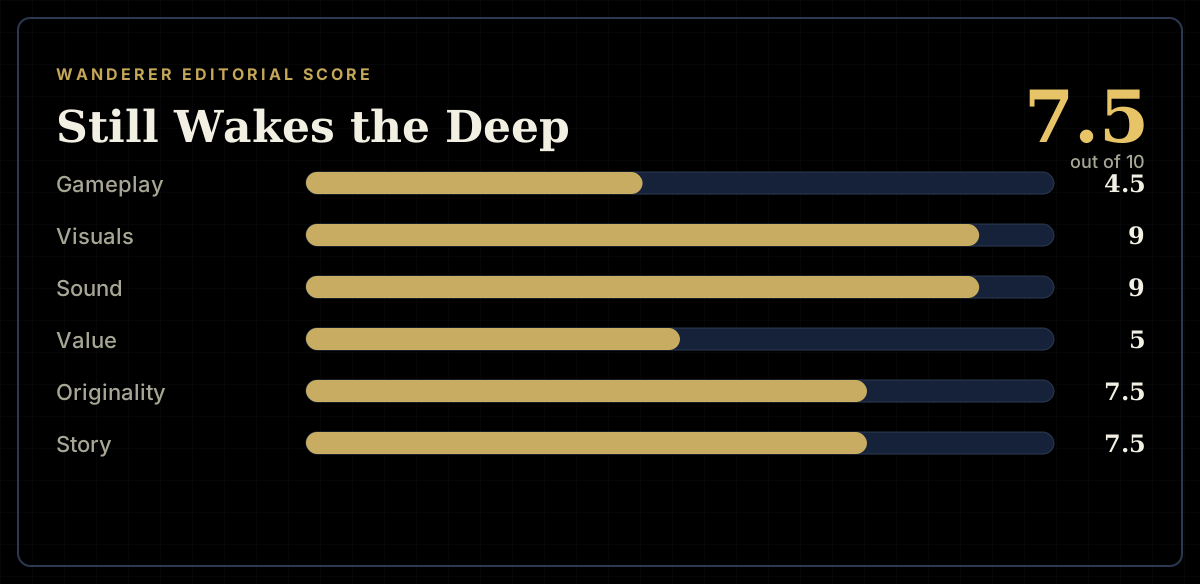
How the review scores each part of the gameWanderer Editorial -
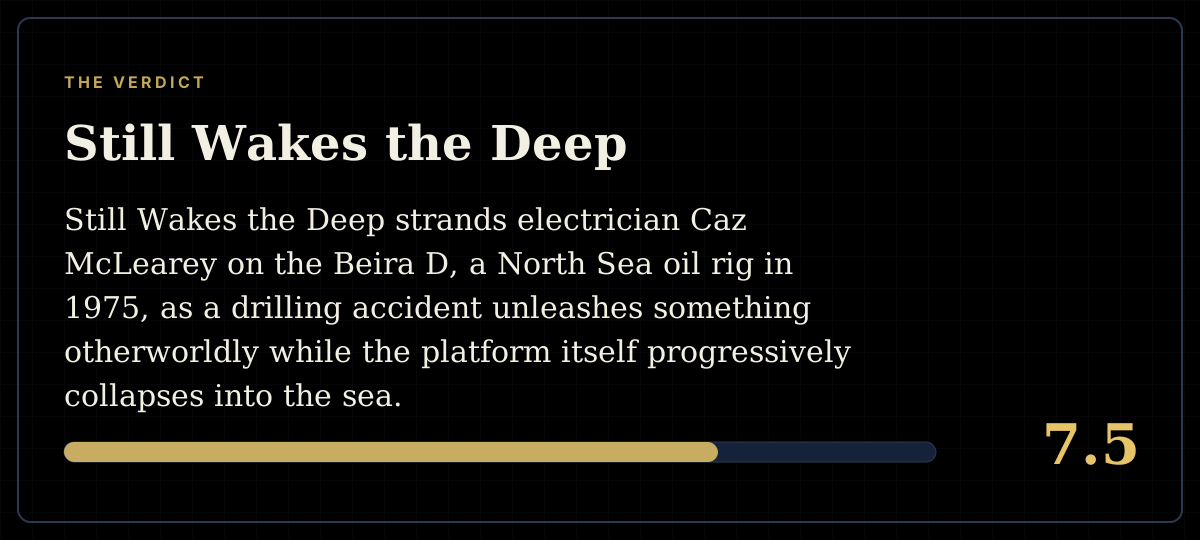
The short versionWanderer Editorial