
Game review
1000xRESIST
8.5 / 10
- Developer
- sunset visitor 斜陽過客
- Publisher
- Fellow Traveller
- Released
- 9 May 2024
- Platforms
- Windows, PlayStation 5, Xbox Series X|S, Nintendo Switch
- Genre
- Narrative Adventure
- Monetisation
- One-time purchase, no DLC or in-game currency
- Players
- Single-player
The short version
1000xRESIST casts the player as Watcher, one of many clones serving an isolated underground community devoted to a mysterious figure called ALLMOTHER, in a story that unfolds into a genre-blending meditation on generational trauma, diaspora identity and pandemic-era isolation. It's one of 2024's most decorated narrative games by any measure: a Peabody Award nomination, a shortlisting for the Independent Games Festival's Seumas McNally Grand Prize, wins and nominations across the DICE, GDC and New York Game Awards, and a 90 on OpenCritic with 100% of critics recommending it. Steam's own audience agrees almost as emphatically, Overwhelmingly Positive at 96% across more than 5,200 reviews. What that overwhelming consensus doesn't erase is a small but genuinely coherent minority of detailed reviews making a specific, shared argument: the game is, functionally, a walking simulator whose exploration sections are considerably larger and more aimless than the writing they're built to deliver actually needs, and for players whose engagement hinges on that writing landing for them personally, the gameplay wrapped around it becomes a real and specific frustration rather than a minor footnote.
Biggest strengths
- Critics were close to unanimous in their praise, with a 90 on OpenCritic, 100% of reviewers recommending it, and a genuinely rare Peabody Award nomination for a video game's storytelling
- The game's treatment of generational trauma, diaspora identity, authoritarianism and pandemic-era isolation is repeatedly credited by critics as thoughtful and specific rather than generically "prestige" in the way awards-bait narratives sometimes are
- Voice acting is consistently praised even by the game's detailed detractors, giving the fully-voiced English script real emotional weight
Biggest weaknesses
- A specific, recurring minority complaint describes the free-roam exploration sections as considerably larger than the content within them justifies, with players wandering labyrinthine areas for extended stretches simply to locate the one NPC or trigger that advances the story
- Multiple detailed reviews independently argue there are too few meaningful player choices that actually alter the plot, describing the experience as closer to a story you could watch than one you meaningfully play
- At least one detailed dissenting review argues the writing spreads itself across too many weighty themes to explore any single one with real depth, a direct counter-argument to the critical consensus praising its thematic specificity
Who it's for: Players who prioritise ambitious, literary storytelling above traditional game mechanics, and who are drawn to narrative experiments blending visual-novel structure with 3D exploration, are the clear intended audience, and the overwhelming critical and player consensus suggests it delivers for the vast majority of them. Players who need mechanical engagement or challenge to stay invested in a story, or whose taste in prose and pacing doesn't align with the game's specific literary voice, should read the detailed minority reviews below — their core complaint about oversized, purposeless exploration is real and specific rather than simple contrarianism.
Our recommendation: Strongly recommended for anyone drawn to ambitious, thematically dense narrative games, and the award recognition this year is not accidental. Players who bounce off walking-simulator pacing, or who found similarly acclaimed narrative games like Signalis or Disco Elysium overrated for their own tastes, should sample before committing, since this game's small dissenting minority makes almost exactly the same kind of argument those disagreements usually involve.
8.5 / 10
A Peabody nomination is not something video games get often
1000xRESIST opens on Watcher, a young clone devoted to serving ALLMOTHER in an isolated underground community sealed off from a world ravaged by an alien-linked plague. What begins as a story about faith and duty within that community unfolds, over its roughly ten-to-twelve-hour runtime, into something considerably more layered — a meditation on inherited trauma across generations, the specific experience of diaspora and immigrant identity, and the isolating weight of living through a pandemic, told through a genre-blending structure that shifts between 3D exploration and visual-novel-style narrative sequences. The scale of recognition this drew in 2024 is genuinely unusual for the medium: a nomination for the Peabody Award, an honour built for broadcasting and storytelling excellence that rarely touches games at all, sat alongside a shortlisting for the Independent Games Festival's prestigious Seumas McNally Grand Prize and recognition across the DICE, GDC and New York Game Awards. OpenCritic puts it at 90 from 30 critics with a full 100% recommending it, and Steam's own player base backs that up emphatically, Overwhelmingly Positive at 96% across more than 5,200 reviews.
What the acclaim is actually about
Critics weren't vague about what earned this level of praise. The specificity of the game's treatment of generational trauma and diaspora identity is repeatedly singled out as the difference between prestige-adjacent thematic ambition and the real thing — reviewers credit the writing with actually saying something concrete about those experiences rather than gesturing at Big Themes for their own sake. Voice acting draws consistent praise across nearly the entire review spectrum, including from the game's more critical voices, giving the fully English-voiced script genuine emotional texture. And the structural choice to blend 3D exploration with visual-novel-style storytelling, with a visual language that shifts meaningfully between the game's different narrative threads, is credited as a genuinely novel formal choice rather than a derivative mashup of existing reference points.
The specific case its dissenters make
Reading through the roughly 4% of reviews that don't recommend the game, what stands out isn't scattered disagreement — it's how consistently a small number of detailed reviewers land on the exact same structural complaint. 1000xRESIST is, mechanically, closer to a walking simulator than a game with systems, and several reviewers argue the free-roam exploration sections built around that structure are considerably larger than the content actually placed within them justifies — describing labyrinthine areas that ask players to wander for extended stretches simply to locate the one NPC or interaction that moves the story forward. One reviewer's blunt framing captures the specific frustration: the game added a map as a quality-of-life feature, which helps, but doesn't address the underlying question of why the spaces needed to be that large in the first place if their only real function is delivering the next piece of dialogue.
A related, equally specific complaint concerns player agency: multiple detailed reviews argue there are too few choices that meaningfully alter the plot, several describing what dialogue options exist as largely cosmetic rather than consequential. That's a coherent, falsifiable critique rather than vague dissatisfaction — these reviewers aren't objecting to a narrative-forward game existing, they're arguing this specific one doesn't do enough with the interactive half of its own hybrid structure to justify being played rather than watched. A smaller handful of reviews go further still, arguing the writing itself doesn't earn its reputation — one detailed review contends the story tries to address so many weighty themes simultaneously that none of them get the depth the critical consensus credits it with, a direct, specific counter-argument to the point critics praised most.
A pacing question worth flagging on its own terms
One more specific complaint deserves separate mention, since it's distinct from the exploration and agency arguments above: several reviewers, including some who otherwise enjoyed the game considerably, describe the back half continuing well past the point where its central mysteries already felt resolved. Rather than building toward one clear climax, the story keeps layering revelations and perspective shifts after several of its most emotionally resonant beats have already landed, and a few detailed reviews argue this dilutes the impact of the stronger material that came before it rather than deepening it further. It's a more measured critique than the exploration-design complaint — less "this shouldn't exist" and more "this could have ended somewhere tighter" — but it's specific enough, and repeated by enough independent reviewers, to be worth flagging for anyone whose patience for extended, layered narrative epilogues runs thinner than the format demands here.
Verdict
1000xRESIST earned its place among 2024's most decorated games through genuinely ambitious, specific storytelling that a Peabody nomination alone should tell you isn't a small achievement for the medium — critics and the overwhelming majority of its own massive player base agree the writing, themes and voice performances land with real weight. The dissenting minority isn't dismissible noise, though: their argument that the exploration sections are oversized relative to what they deliver, and that player choice doesn't meaningfully shape the plot, is specific, coherent, and worth taking seriously if mechanical engagement matters to how you personally experience a story-driven game. For most players, based on the numbers, it won't be an obstacle. For a real, if small, share of them, it's the exact and specific reason this acclaimed a game didn't land the way its considerable reputation had promised going in.
Pros and cons
Pros
- Critics were close to unanimous in their praise, with a 90 on OpenCritic, 100% of reviewers recommending it, and a genuinely rare Peabody Award nomination for a video game's storytelling
- The game's treatment of generational trauma, diaspora identity, authoritarianism and pandemic-era isolation is repeatedly credited by critics as thoughtful and specific rather than generically "prestige" in the way awards-bait narratives sometimes are
- Voice acting is consistently praised even by the game's detailed detractors, giving the fully-voiced English script real emotional weight
- The genre-blending structure — part 3D exploration, part visual novel, with a distinctive, shifting visual language across its different narrative threads — is credited by critics and the overwhelming majority of players as genuinely novel rather than derivative of any single reference point
- A shortlisting for the IGF's Seumas McNally Grand Prize and recognition at the DICE, GDC and New York Game Awards reflect sustained, cross-category industry recognition rather than a single outlet's enthusiasm
Cons
- A specific, recurring minority complaint describes the free-roam exploration sections as considerably larger than the content within them justifies, with players wandering labyrinthine areas for extended stretches simply to locate the one NPC or trigger that advances the story
- Multiple detailed reviews independently argue there are too few meaningful player choices that actually alter the plot, describing the experience as closer to a story you could watch than one you meaningfully play
- At least one detailed dissenting review argues the writing spreads itself across too many weighty themes to explore any single one with real depth, a direct counter-argument to the critical consensus praising its thematic specificity
- A handful of reviewers report genuine confusion at the scale of the game's acclaim relative to their own experience, specifically comparing it unfavourably to more mechanically substantial narrative games like Disco Elysium, 13 Sentinels and Outer Wilds
- Pacing is a specific complaint in the back half for some reviewers, who describe the story continuing well past the point where its central mysteries felt resolved, diluting the impact of its earlier, more tightly constructed sections
Screenshots
-

1000xRESISTImage: Fellow Traveller via Steam -

1000xRESISTImage: Fellow Traveller via Steam -

1000xRESISTImage: Fellow Traveller via Steam -
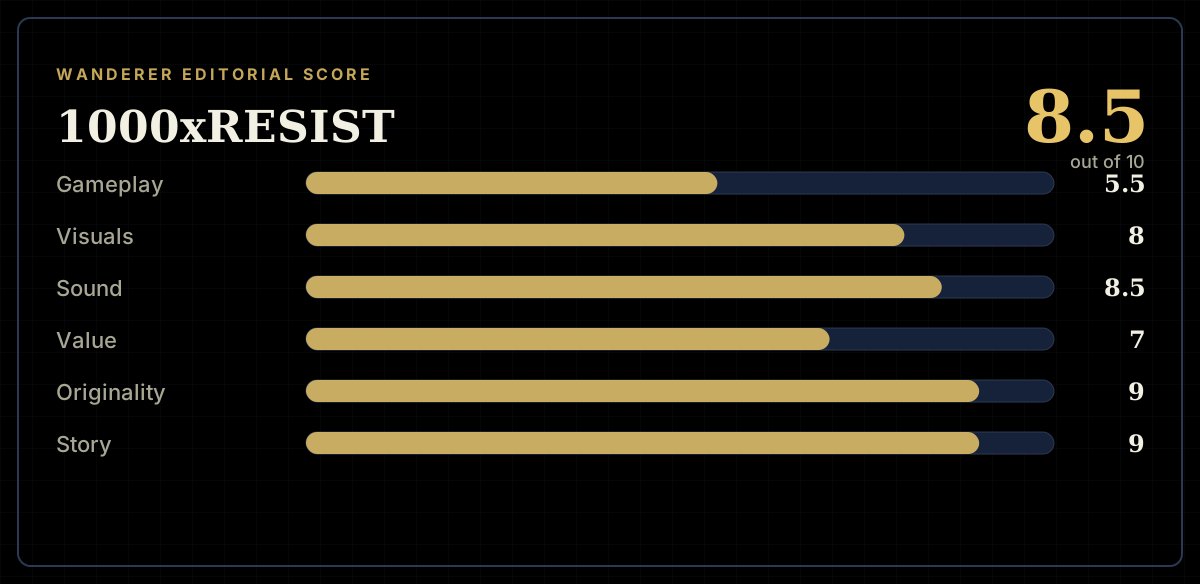
How the review scores each part of the gameWanderer Editorial -
The short versionWanderer Editorial