
Game review
Bastion
7.5 / 10
- Developer
- Supergiant Games
- Publisher
- Supergiant Games
- Released
- 16 August 2011
- Platforms
- Windows, macOS, Linux
- Genre
- Action RPG
- Monetisation
- Paid, one-time purchase. No in-app purchases or DLC beyond the base game.
- Players
- Single-player only.
The short version
Bastion's reputation rests on two genuinely singular achievements: hand-painted, watercolour-style environments that still look distinctive against everything released since, and a reactive narrator who comments on the player's actions in real time rather than delivering fixed cutscene dialogue. Both hold up completely; more than 28,000 reviews at Overwhelmingly Positive confirm it. What a consistent, coherent minority of reviews describe just as clearly is a combat loop that wears thin well before the story's short runtime ends, and a narrative structure that talks constantly about choice while rarely handing the player any that meaningfully change what happens.
Biggest strengths
- A hand-painted visual style that remains genuinely distinctive against nearly everything else in the genre, before or since.
- Logan Cunningham's reactive narration, commenting live on the player's actions rather than delivering static dialogue, is a still-influential piece of game design.
- A strong, memorable original soundtrack that multiple reviewers single out as the game's best-preserved element even when they're otherwise lukewarm.
Biggest weaknesses
- A consistent complaint across a decade of reviews: combat feels repetitive and doesn't evolve meaningfully as the game progresses, despite the weapon variety on offer.
- The narrative's framing around meaningful choice is undercut, per multiple reviewers, by a story that offers essentially two real decision points across its entire runtime.
- A small but specific and recent minority of reviews report reproducible crashes, including one October 2025 review citing repeated failures on a specific level.
Who it's for: Fans of atmospheric, narratively distinctive action games who value presentation and voice work as much as combat depth, and who don't mind a short, largely linear experience.
Our recommendation: An easy recommendation for the art and narration alone; go in with modest expectations for the moment-to-moment combat itself.
7.5 / 10
An art style and a narrator that still stand apart
Bastion's premise is simple and its execution remains genuinely unusual: the world has been shattered by a catastrophe called the Calamity, and the player, controlling a character known only as The Kid, rebuilds a floating sanctuary while a gravelly-voiced narrator comments on every action in real time. The store page's own framing is accurate rather than inflated — "an action role-playing experience that redefines storytelling in games, with a reactive narrator who marks your every move" — and the official screenshots back up the other half of the pitch just as clearly. One shows The Kid facing down a massive, chained, floating creature amid hand-painted watercolour foliage and glowing blue platforms, art that still looks distinctive well over a decade later against a genre that's mostly moved toward more generic realism or pixel art. Logan Cunningham's narration, delivered live and reactively rather than through fixed cutscenes, was a genuinely influential design idea at release and remains one of the most frequently cited reasons players remember the game fondly regardless of how they feel about anything else in it.
The gap between presentation and play
Set against that widely-agreed-upon strength is an equally consistent, if quieter, thread running through the review sample: the actual moment-to-moment combat and narrative choice don't fully deliver on what the presentation promises. "It has great art and some good ideas, sure. But the mechanics get old quickly," reads one review. Another, after finally finishing the game a decade after buying it, is more specific: "the gameplay is repetitive and I'm not particularly motivated to keep playing it. It's as though I should like this more than I actually do." A 2022 review zeroes in on the choice framing specifically: "You never make decisions, neither on where to go, nor on what to say. You are only 'a kid' whose story is narrated from the off as you play," pointing out that the game's entire structure hinges on essentially two real decision points across its whole runtime, despite constant narrative emphasis on consequence and agency. None of these reviewers deny the game's craft — several explicitly credit Supergiant's talent and go out of their way to say the soundtrack alone is worth experiencing — but they consistently separate admiring the game from actually enjoying playing it, which is a more specific and more useful critique than a simple thumbs down.
A small, recent technical footnote
Separate from the design debate, a small number of more recent reviews raise a straightforward technical complaint worth flagging on its own terms. An October 2025 review reports "seven crashes in just three hours of gameplay," specifically naming the Langston River level as "the worst offender" and consistently unstable. A January 2023 review independently describes "a repeated game-breaking crash" preventing progress. This isn't the dominant pattern in the review sample — the large majority of even critical reviews don't mention stability at all — but two independent, specific, dated reports naming the same kind of failure are worth noting rather than dismissing as one unlucky configuration, particularly for a fourteen-year-old game whose underlying engine and drivers have had over a decade to drift out of alignment with modern systems.
New Game Plus and the shrine system's honest attempt at variety
Bastion's own answer to the repetition complaint is worth examining on its own terms rather than assuming the game did nothing to address it. The store page specifically highlights a New Game Plus mode unlocked after finishing the main story, and within a single playthrough the game offers a shrine system that lets players deliberately increase difficulty in exchange for larger rewards — tools built explicitly to let a player who's mastered the base combat opt into something harder rather than simply repeating the same encounters at the same pace. That's a reasonable design answer to the exact complaint reviewers raise, and it's evidence Supergiant was aware combat depth alone might not sustain the full runtime. Whether it fully closes the gap is a matter the review sample splits on: some reviewers who otherwise criticise the repetition never mention the shrines at all, suggesting the system's existence doesn't automatically solve the perception problem for players who bounce off the core loop before discovering it.
A studio's foundation, not just a standalone game
It's also worth situating Bastion in the context of what it started rather than judging it purely in isolation. This was Supergiant Games' debut release, and the reactive-narration and hand-painted-art techniques it pioneered became the throughline for the studio's much larger later successes, Transistor and Hades — both of which appear elsewhere in this outlet's own genre-priority coverage and both of which reviewers frequently describe as refining ideas Bastion introduced first. Judged as a standalone action RPG competing against the genre's best combat systems, Bastion's repetition complaints land fairly. Judged as the specific, foundational work that established a studio's voice and then let that studio iterate its way to two more critically dominant releases, it earns a different kind of credit that a purely mechanical score doesn't fully capture, and that context is worth keeping in mind for players wondering whether a fourteen-year-old debut still deserves their time relative to the developer's later, more polished work.
Final verdict
Bastion earns its Overwhelmingly Positive standing honestly: the hand-painted art and reactive narration remain genuinely distinctive achievements that time hasn't dulled, and the soundtrack is close to universally praised even by the game's harsher critics. Where this review lands slightly below the aggregate score is in taking seriously a real, recurring pattern among a meaningful minority of players who found the combat repetitive and the promised narrative agency mostly illusory — legitimate criticisms from people who clearly wanted to love the game and didn't quite get there. That's still a very good foundation for a short, atmospheric action RPG, and the asking price rarely demands much of a gamble to find out which side of that gap you land on.
Pros and cons
Pros
- A hand-painted visual style that remains genuinely distinctive against nearly everything else in the genre, before or since.
- Logan Cunningham's reactive narration, commenting live on the player's actions rather than delivering static dialogue, is a still-influential piece of game design.
- A strong, memorable original soundtrack that multiple reviewers single out as the game's best-preserved element even when they're otherwise lukewarm.
- A large, varied arsenal of upgradeable weapons that rewards experimenting with different combat approaches.
Cons
- A consistent complaint across a decade of reviews: combat feels repetitive and doesn't evolve meaningfully as the game progresses, despite the weapon variety on offer.
- The narrative's framing around meaningful choice is undercut, per multiple reviewers, by a story that offers essentially two real decision points across its entire runtime.
- A small but specific and recent minority of reviews report reproducible crashes, including one October 2025 review citing repeated failures on a specific level.
- Several reviewers describe a game that's easy to admire on a technical and artistic level while finding it difficult to actually enjoy playing for its own sake.
Screenshots
-

BastionImage: Supergiant Games via Steam -

BastionImage: Supergiant Games via Steam -

BastionImage: Supergiant Games via Steam -
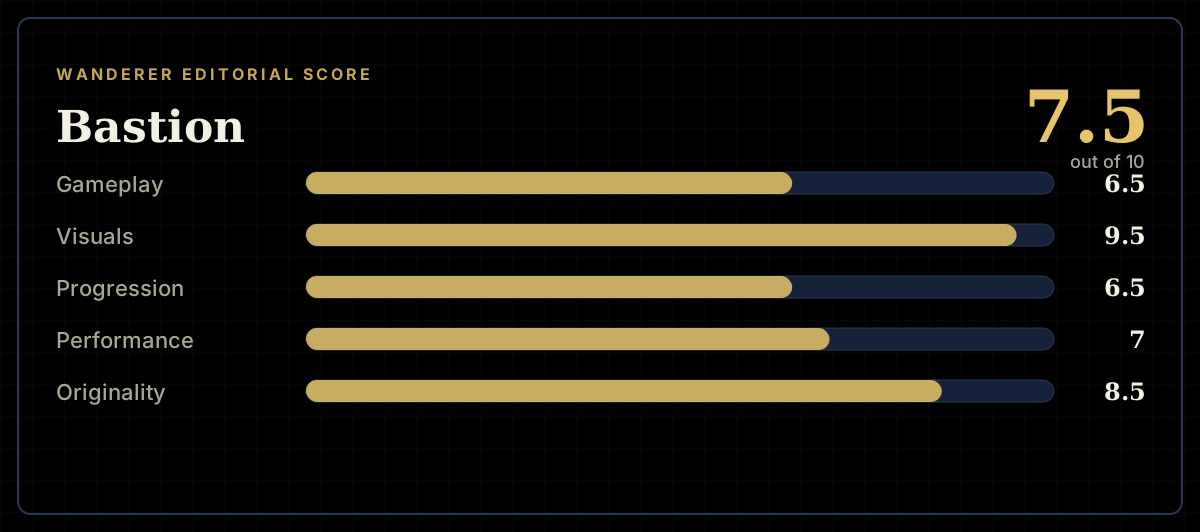
How the review scores each part of the gameWanderer Editorial -
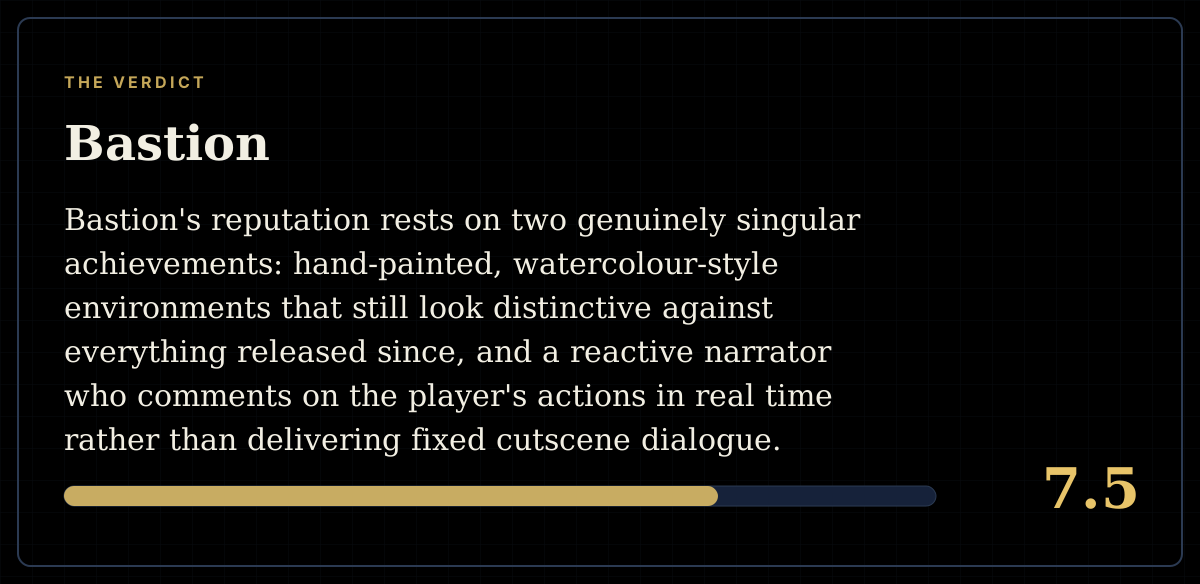
The short versionWanderer Editorial