
Game review
Ale & Tale Tavern
7 / 10
- Developer
- Scienart Games
- Publisher
- GrabTheGames, UpgradePoint
- Released
- 5 September 2024
- Platforms
- Windows
- Genre
- Open-world fantasy tavern-management sim with co-op
- Monetisation
- One-time purchase, all post-launch content and seasonal updates released free
- Players
- Co-op for up to 6 players, online
The short version
Ale & Tale Tavern hands you and up to five friends a run-down fantasy inn and asks you to bring it back to life — brewing ale, cooking for demanding guests, fishing and farming for ingredients, and heading out into a small open world for quests between shifts. Nearly 10,400 Steam reviews put it at 88% positive, and the developer has kept shipping free content updates at a genuinely remarkable pace for almost two years since launch. What holds it back from a stronger score is consistent, specific criticism from its own audience: combat and quest writing that most reviewers call weak at best, a launch that was widely reported as unbalanced for anyone playing solo, and a recurring, unresolved suspicion among a meaningful slice of reviewers that the game's dialogue and voice acting were produced with generative AI — a claim the store page's absence of an AI-content disclosure neither confirms nor denies.
Biggest strengths
- The tavern-management loop — brewing, cooking, serving increasingly demanding guests, and decorating the inn — is repeatedly singled out as the game's strongest and most enjoyable system, including by reviewers otherwise critical of the rest of the package
- Co-op for up to six players is treated as the definitive way to experience the game across the review sample, with players dividing labour between running the tavern and adventuring outside it
- The developer has sustained an exceptional post-launch support cadence — dozens of numbered patches and named content updates running almost continuously from the September 2024 launch through an August 2026 patch, including a full automation system, a UI overhaul, and multiple seasonal events, all released free
Biggest weaknesses
- The game is widely reported as poorly balanced for single-player, even after the Helpers update — several reviewers state directly that the core loop assumes three or four active participants and becomes an unmanageable chore alone
- Combat and quest design draw some of the most consistently negative language in the sample, described variously as "terrible," "slow," and "monotonous," standing in sharp contrast to the praise for the tavern-management half of the game
- A recurring, specific accusation — that the game's dialogue and voice acting were produced using generative AI — appears across multiple independent reviews citing the absence of voice-actor credits and unusual line delivery as their evidence; the store page carries no AI Generated Content Disclosure section addressing the question either way, and this review found no way to confirm or refute the claim directly
Who it's for: Groups of friends looking for a cozy, low-stakes co-op hangout game built around a shared task rather than combat or competition, especially those who enjoyed a co-op survival or crafting game's early years and want something similarly built to be played together rather than alone.
Our recommendation: A strong pick in a full group, especially at its discounted price, where the tavern-management loop genuinely shines. Considerably weaker as a solo experience — several reviewers specifically warn against buying it to play alone — and worth tempering expectations around combat, story writing, and how much content survives beyond the main questline.
7 / 10
Ale & Tale Tavern's pitch is simple enough to fit in one sentence on its own store page: you inherit a run-down fantasy inn, and you and up to five friends bring it back to life through cooking, brewing, farming, and the occasional monster fight in the small open world outside. Nearly 10,400 Steam reviews, sitting at 89% positive, say that pitch mostly works — and the developer's own patch history shows a level of sustained post-launch commitment that's rare even among successful indie releases. What that same review sample also documents, consistently and specifically, is where the game falls short of its own ambitions: a combat and quest layer most reviewers actively dislike, a single-player experience widely described as an afterthought, and a persistent, unresolved cloud of suspicion around how its dialogue and voice acting were actually made.
Running the inn is the best part, by consensus
Ask reviewers what they like about Ale & Tale Tavern and the answer converges fast: it's the tavern itself. Brewing ale, cooking dishes to match a growing menu, serving an increasingly demanding cast of patrons, and decorating the space are described across the sample as the game's most polished and satisfying loop, including by reviewers who go on to criticise almost everything else. One reviewer, otherwise harsh about the game's writing, calls the tavern sim portion "a lot of fun" and says it "feels like" the game the store page promises. Another compares the daily grind of serving customers to "the trauma of working in a restaurant" — meant, in context, as a backhanded compliment for how convincingly the pressure lands. This is the system the game is actually built around, and it's the one nearly everyone agrees the developer got right.
Built for a party, and it shows
The flip side of that strength is a structural dependency on other players. Reviewers repeatedly describe the game as balanced around three or four people splitting tasks — one running the kitchen, one serving tables, one out adventuring for ingredients and quest rewards — and struggling badly when that division of labour isn't available. "It seems like this game is balanced around having four people running around doing tasks," one reviewer writes, "because playing alone means you simply do not have time to engage with" everything the tavern demands. Another, blunter: "the game isn't single player friendly," citing a small, non-upgradable inventory and tools that break too quickly to keep pace without help. The developer clearly heard this complaint quickly — a "Helpers" update arrived on 19 October 2024, barely six weeks after launch, adding an owl companion the community affectionately named "Owlbert" who can serve or clean up in the player's place. Reviewers who play mostly solo credit this addition directly: one writes "I ADORE you added helpers for us who mostly play singleplayer, its so hard to manage a full tavern without help." That said, some later reviews still describe the automation as limited to serving and dishwashing rather than full task coverage, so the underlying tension between solo and co-op balance hasn't disappeared entirely — it's been meaningfully softened rather than solved outright.
Combat and quests are where the goodwill runs out
Set against the well-liked tavern loop, the game's action and questing systems draw some of the most consistently negative language in the entire sample. "The combat and quests are rough," one reviewer writes, going on to call fighting "slow" and unsatisfying. Another simply states there's "no challenge running a tavern and no penalty running a [bad] tavern," describing quests as running around a small open world doing "the most simple fighting and most simple things just for wasting time." A third reviewer who otherwise enjoyed the co-op tavern management calls the fetch-and-kill missions "so inconsequential there wasn't any real point in doing... anything really." This isn't a fringe complaint recorded only in the negative reviews — it shows up inside positive reviews too, from players who clearly like the game overall but single out combat and story content as the parts they'd cut or skip if they could.
A specific, unresolved question about AI
The most serious recurring accusation in the review sample concerns how the game's dialogue and voice acting were produced. Multiple, independent reviewers state they believe generative AI was used, citing specific circumstantial evidence: the absence of any voice-actor credits, line delivery several describe as "bizarre" or stylistically inconsistent with human performance, and writing one reviewer calls "nonsensical" and "unfunny" in a way that reads differently from ordinary bad writing. "Unfortunately, uses a lot of GenAI voicework and writing," one review states plainly, "and as of the posting of this review, the storepage does not have that warning written anywhere." This review checked that specific, checkable claim directly: as of 6 September 2026, the Steam store page carries no AI Generated Content Disclosure section of any kind. That absence doesn't confirm the accusation — Steam's disclosure requirement only applies to certain categories of AI-generated content, and plenty of games without disclosures use no AI content at all — but it also means there's no official statement from the developer settling the question either way. It's worth noting directly that this accusation isn't uncontested: at least one reviewer pushes back explicitly, calling the claims "frustrating to watch" and arguing people are "making claims with no proof." This review cannot resolve that dispute and reports both sides as presented rather than adjudicating a claim neither side has definitively proven.
Short on its own terms, by design or otherwise
A separate, more measurable complaint concerns length. Multiple reviewers report finishing the main questline in six to eleven hours — one pair specifically clocking in at 6 hours and another duo at 10.7, both well under a roughly 20-hour estimate they attribute to the developers. Beyond the main quests, several describe the remaining systems — expanding the tavern, adding animal-breeding areas, upgrading guest rooms — as largely cosmetic rather than mechanically meaningful, framing the post-story game as content with nowhere left to go rather than a genuine long tail. Steam's own achievement data offers a more nuanced picture: while the earliest achievements clear at 90%-plus, reaching 100 inn guests sits at just 2.2% completion and several late unlocks (painting every wall, opening every potion recipe) sit in the low single digits — evidence that a genuine long-form grind exists for players chasing full completion, even if the main story itself is short. Both things can be true at once: a quick critical path, and a much longer tail for players who stick around.
A developer who has, in fact, kept building
Whatever else is true about launch-week balance or contested writing credits, one claim this review can settle definitively with the public record: Ale & Tale Tavern has not been abandoned. The Steam partner-events feed shows a near-continuous stream of patches and named content updates running from the September 2024 launch through an August 2026 patch — well over eighty posts in total, including a full UI overhaul in March 2025, an Apiary update, a fishing-spots expansion, multiple seasonal events, and a "Major Update" as recently as May 2026 introducing a new dungeon mode. All of it has shipped free, with no paid DLC identified anywhere in the game's storefront listing. A March 2025 post celebrating "half a million taverns" created is a concrete, dated marker of the game's reach at that point in its life. Combined with the review sample's own numbers, this reads as a genuinely successful small-studio release that has kept reinvesting in itself well past its launch window, whatever specific criticisms its audience continues to raise.
Final verdict
Ale & Tale Tavern earns its Very Positive standing on the strength of one system executed well — running a fantasy tavern with friends — backed by a developer who has kept adding free content to that system for nearly two years running. What keeps it from scoring higher is everything built around that core loop: combat and questing most of its own reviewers actively dislike, a single-player experience that needed a dedicated patch to become merely playable rather than punishing, main content that a meaningful share of players clear in under half the advertised runtime, and a specific, unresolved suspicion about AI involvement in its writing and voice work that neither the store page nor this review can settle. Buy it for a group of friends looking for a low-stakes co-op hangout, at its regularly discounted price if you can wait for one, and go in expecting the tavern itself — not the adventure outside it — to be the reason you stay.
Pros and cons
Pros
- The tavern-management loop — brewing, cooking, serving increasingly demanding guests, and decorating the inn — is repeatedly singled out as the game's strongest and most enjoyable system, including by reviewers otherwise critical of the rest of the package
- Co-op for up to six players is treated as the definitive way to experience the game across the review sample, with players dividing labour between running the tavern and adventuring outside it
- The developer has sustained an exceptional post-launch support cadence — dozens of numbered patches and named content updates running almost continuously from the September 2024 launch through an August 2026 patch, including a full automation system, a UI overhaul, and multiple seasonal events, all released free
- At its regularly-discounted price, multiple reviewers explicitly call it good value for a co-op hangout session even while criticising its depth, citing the low buy-in cost for a group activity
- A "Helpers" automation update arrived roughly six weeks after launch specifically responding to complaints that the game was unplayable solo, adding an owl companion (nicknamed "Owlbert" by the community) that reviewers who play alone credit directly for making the game more approachable without a full party
Cons
- The game is widely reported as poorly balanced for single-player, even after the Helpers update — several reviewers state directly that the core loop assumes three or four active participants and becomes an unmanageable chore alone
- Combat and quest design draw some of the most consistently negative language in the sample, described variously as "terrible," "slow," and "monotonous," standing in sharp contrast to the praise for the tavern-management half of the game
- A recurring, specific accusation — that the game's dialogue and voice acting were produced using generative AI — appears across multiple independent reviews citing the absence of voice-actor credits and unusual line delivery as their evidence; the store page carries no AI Generated Content Disclosure section addressing the question either way, and this review found no way to confirm or refute the claim directly
- Multiple reviewers report finishing the game's main questline in six to eleven hours, well under the roughly 20 hours some say the developers advertised, and describe remaining systems — tavern expansion, animal breeding areas, room upgrades — as largely cosmetic once the main quests are done
- The game cannot be paused during single-player sessions, a specific, repeated frustration for reviewers needing to step away mid-session, forcing a save-and-exit-to-menu workaround instead
Screenshots
-

Ale & Tale TavernImage: GrabTheGames via Steam -

Ale & Tale TavernImage: GrabTheGames via Steam -

Ale & Tale TavernImage: GrabTheGames via Steam -
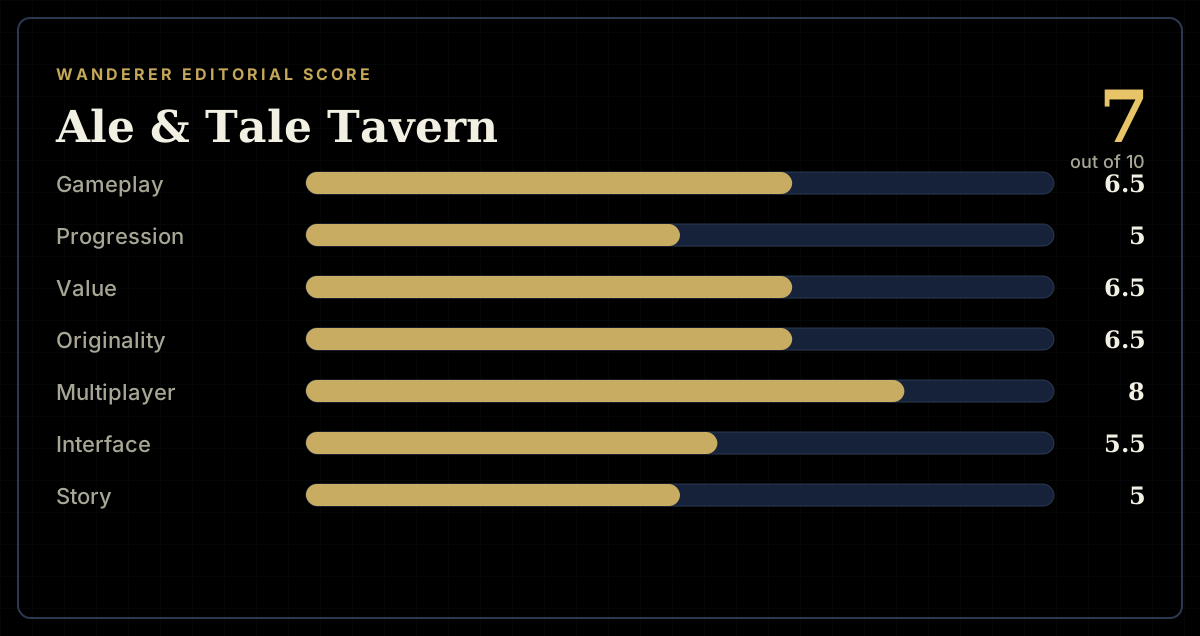
How the review scores each part of the gameWanderer Editorial -
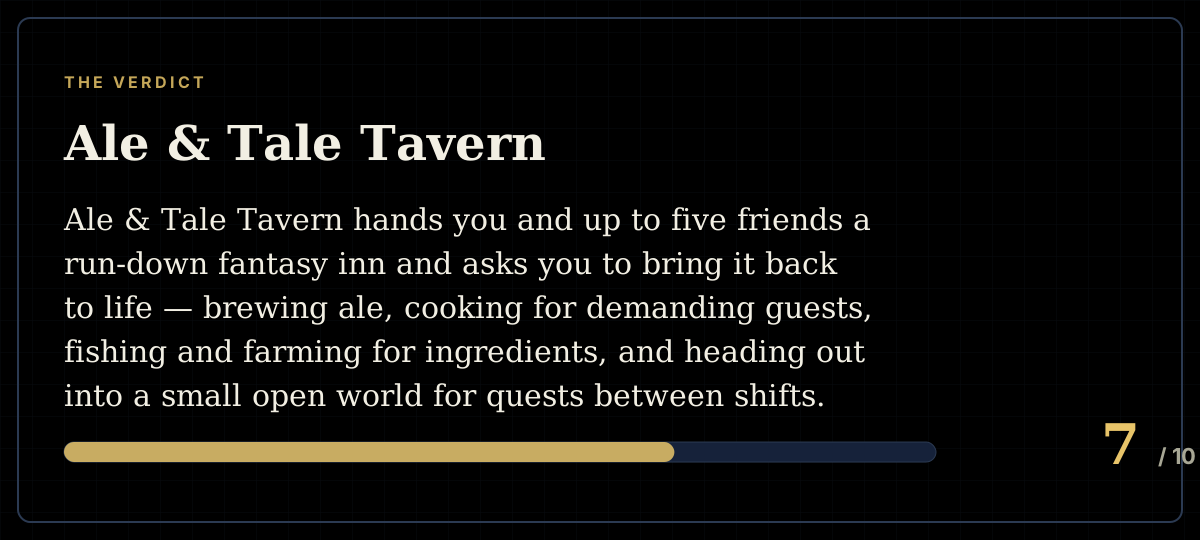
The short versionWanderer Editorial